
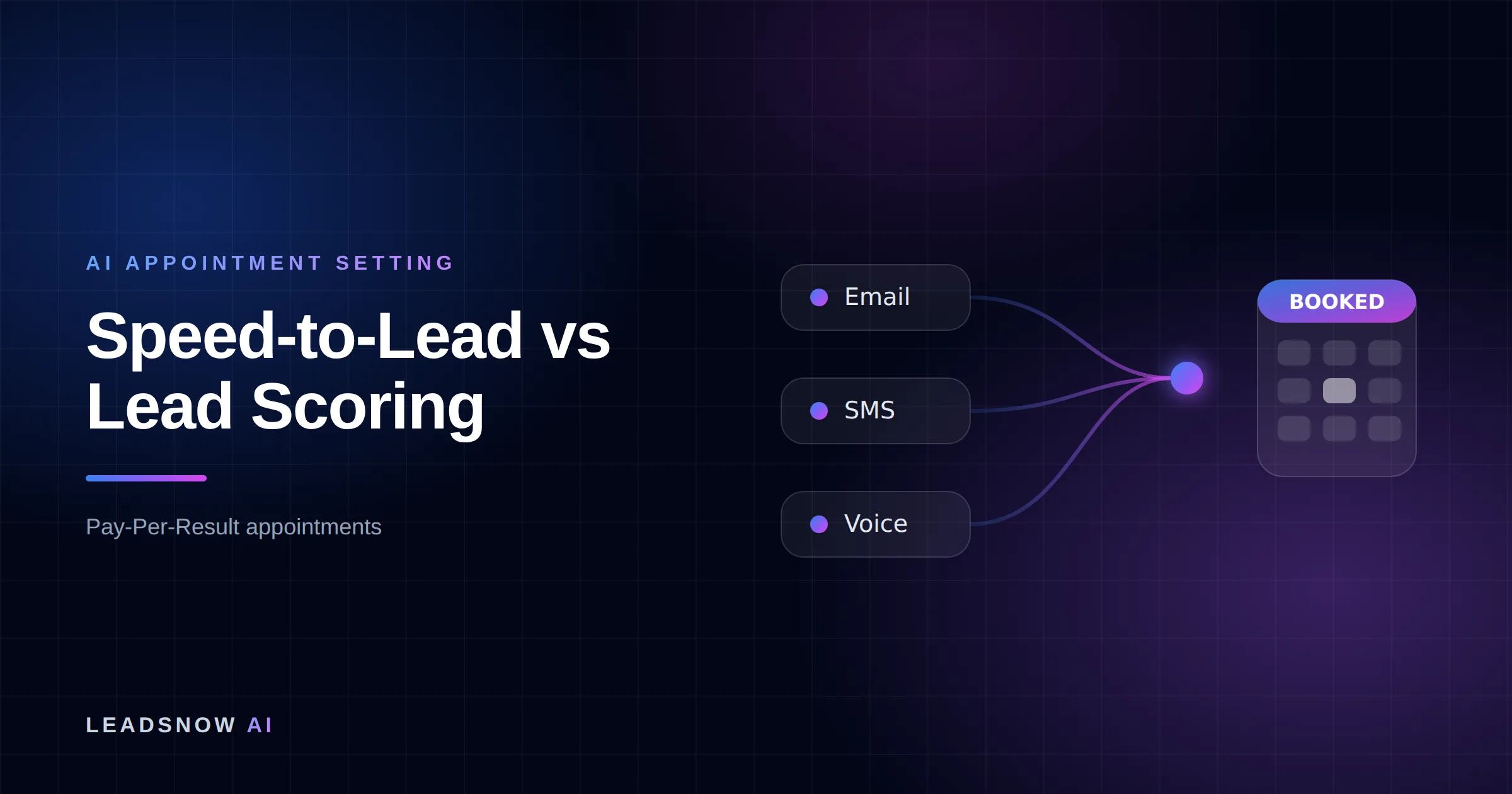
Speed-to-lead vs lead scoring — which lifts conversion? For inbound leads, speed wins: the odds of even contacting a lead collapse within minutes, and no score can rescue a conversation that never happens. Lead scoring earns its keep prioritising outbound and large databases. The best setup automates instant response for every inbound lead and keeps scoring for outbound targeting.
- Speed-to-lead wins: inbound enquiries, demo requests, form fills, ad leads — anywhere the prospect raised their hand and the clock is running.
- Lead scoring wins: outbound prioritisation, large or ageing databases, long-cycle B2B nurture, and deciding where expensive human effort goes.
- The trap: using scoring to triage inbound — ranking who deserves a fast reply — is solving a capacity problem that AI has already made obsolete.
- The winning play: respond to every inbound lead in seconds, automatically; use scoring to choose who you proactively pursue.
Two philosophies, one problem
Both camps are trying to fix the same thing: follow-up that leaks revenue. The speed-to-lead camp says the first responder wins, so answer every enquiry inside five minutes. The lead scoring camp says attention is scarce, so rank your leads and spend your best effort on the best ones. Sales leaders in Australia hear both pitches — often from vendors selling opposite tools — and the advice sounds mutually exclusive. It is not. But they are genuinely different bets, they suit different lead sources, and picking the wrong one for your funnel quietly costs deals. This is the head-to-head: what each approach actually optimises, what the evidence says, and when each one deserves your budget. (For the deep dive on the response-time research itself, see our guide to the 5-minute rule.)
How it works
How an AI sales agent books your appointments
Six channels feed in
Outbound email, SMS, voice and social — plus inbound search and AI referrals from our own AI SEO and chat agents.
Your list or CRM
Outbound starts from data you already own — past enquiries, dormant customers, or a targeted prospect list.
Qualified against your rules
Budget, timing and fit are checked before anything reaches your team, using criteria you set.
Booked into your calendar
Only qualified prospects reach the booking step, so your closers spend their time selling.
MAKE MORE SALES.
Pay-Per-Result pricing — We scale sales HARD aligned to your interests, better than anyone else.
What each approach actually optimises
Speed-to-lead optimises contact rate. Its core claim is that a lead’s willingness to talk decays fast from the moment they enquire, so the biggest conversion lever is simply getting to them before the decay — and before a competitor does. It treats every inbound lead as worth an immediate response.
Lead scoring optimises allocation. Its core claim is that leads vary wildly in value, human attention is finite, and effort spent on bad-fit leads is effort stolen from good ones. It ranks leads on fit and behaviour so your people work the list top-down. Notice the hidden assumption: scoring only creates value when the resource being allocated is scarce. That assumption is doing a lot of work in 2026, and we will come back to it.
Want this done for you? We book qualified sales appointments on a Pay-Per-Result basis — you only pay for calls that actually land in your calendar.
The evidence: why speed wins on inbound
The response-time data is unusually one-sided. The Lead Response Management study (archived) led by Dr. James Oldroyd (then affiliated with MIT) and popularised by InsideSales/Xant found that the odds of contacting a lead if called within 5 minutes versus 30 minutes drop 100 times, and the odds of qualifying that lead drop 21 times. Even within the first hour, the odds of making contact fall by more than 10 times.
Harvard Business Review reached a compatible conclusion at scale. In “The Short Life of Online Sales Leads”, Oldroyd, McElheran and Elkington audited 2,241 US companies with a web-generated test lead: only 37% responded within an hour, 23% never responded at all, and the average response time among companies that did respond within 30 days was 42 hours. In their companion dataset of 1.25 million leads, firms that attempted contact within an hour were nearly seven times as likely to qualify the lead as those that waited even an hour longer — and more than 60 times as likely as those that waited 24 hours.
Here is what that means for the comparison: on inbound, the cost of delay is so steep that any process which inserts a ranking step before the response — wait for the score, route to the right rep, let the A-leads jump the queue — is burning the very window it is trying to spend wisely. A perfectly scored lead contacted in hour three loses to an unscored lead contacted in minute one.
Head-to-head: speed-to-lead vs lead scoring
| Dimension | Speed-to-lead | Lead scoring | Verdict |
|---|---|---|---|
| What it optimises | Contact rate — reaching the lead before interest decays | Allocation — spending scarce human effort on the best-fit leads | Different levers; speed acts on every deal, scoring on effort distribution |
| Best for | Inbound: form fills, ad leads, demo requests, quote enquiries | Outbound: cold databases, nurture pools, account prioritisation | Match the tool to the lead source, not the vendor pitch |
| Time-to-impact | Days — faster response lifts contact rate on the next lead in | Months — models need data volume, tuning and sales feedback to beat gut feel | Speed pays back first, by a wide margin |
| Tooling cost dynamics | Falling — AI agents now answer, qualify and book in seconds around the clock | Persistent — platform licences plus ongoing model maintenance and data hygiene | Automation keeps making speed cheaper; scoring stays an ongoing project |
| Failure mode | Fast garbage: instantly chasing junk leads if there is no qualification layer | Slow gold: hot leads waiting in a queue while the model decides they matter | Speed’s failure wastes some effort; scoring’s failure loses the deal outright |
| Evidence base | Strong, direct: contact-rate decay measured in minutes across millions of calls | Real but conditional: depends on model quality, data volume and honest validation | Speed has the harder numbers behind it |
Notice the asymmetry in the failure modes. Speed without qualification wastes effort you can afford to automate away. Scoring without speed loses conversations you can never get back.
Book a call and we will look at your actual lead flow — where it comes from, how fast it gets answered today, and which side of this table your revenue is leaking from.
If we can’t make you money, we don’t deserve yours.
Pay-Per-Result pricing — performance-based alignment.
When lead scoring wins
An honest comparison has to give scoring its real wins, because they are substantial — just not where most vendors point them.
- Outbound prioritisation. When you initiate contact, there is no decay clock — the prospect does not know you exist yet. The binding constraint really is finite effort, so ranking accounts by fit and intent before your team dials is exactly what scoring was built for.
- Large and ageing databases. Sitting on tens of thousands of old leads? You cannot call them all this week. Scoring which segment to reactivate first is far smarter than working the list alphabetically.
- Long-cycle B2B nurture. When buyers research for months, behavioural scoring (pricing-page visits, repeat engagement) is a genuinely useful signal for when to escalate a lead from nurture to a human conversation.
- Protecting expensive channels. If the next step costs real money — a senior seller’s time, a site visit, a custom proposal — a fit threshold before that spend is basic discipline.
- Suppression. Negative scoring that filters students, competitors and bad-fit geographies out of sales queues quietly saves more time than most positive scoring earns.
Where scoring goes wrong is when it is stretched beyond these jobs — specifically, when it becomes the reason an inbound lead waits. A model trained on last year’s closed-won data, left unvalidated, deciding in silence which of today’s hand-raisers deserves a same-day reply: that is not prioritisation, that is institutionalised slowness with a dashboard.
The false choice: automate speed, score the outbound
Here is the part both camps miss. Lead scoring’s case on inbound rests entirely on scarcity — you cannot respond to everyone fast, so choose. But AI agents have removed that scarcity. When an AI answers every enquiry in seconds, qualifies it in conversation and books the good ones straight into a calendar, there is nothing left for an inbound score to ration. You no longer need to predict which leads are worth a fast response when every lead gets one, and the qualification happens live instead of by proxy. (We covered the mechanics of that setup in our guide to speed-to-lead automation.)
Scoring then goes back to the job it is actually good at: deciding who you proactively pursue — which outbound segments, which dormant database cohorts, which accounts justify senior attention. Speed handles everyone who comes to you; scoring ranks everyone you go to. That is the model we run at LeadsNow: AI answers and qualifies every inbound lead in seconds, around the clock, and booked qualified appointments land in our clients’ calendars on a pay-per-result basis. It is the engine behind 50,769+ AI-booked sales appointments since 2017 and 1M+ leads generated for businesses like Sam Tajvidi’s 121 Brokers and Marcus Wilkinson’s Iron Body. And because response speed is only one lever, we have also broken down the rest of the conversion stack in our guide to increasing sales conversion rates in 2026.
If your inbound leads are waiting on a score — or on a rep — book a call and we will show you what answering in seconds does to your contact rate.
Frequently asked questions
Is speed-to-lead better than lead scoring?
For inbound leads, yes. Contact-rate research shows the odds of reaching a lead collapse within minutes of their enquiry, so responding fast to everyone beats responding selectively to a ranked few. For outbound and large databases, lead scoring is the better tool because there is no decay clock and effort is genuinely scarce.
Does lead scoring still matter if you respond to every lead instantly?
Not for deciding who gets a fast inbound response, because instant automated response makes that rationing unnecessary. Scoring still matters for outbound targeting, database reactivation, routing high-value accounts to senior sellers, and suppressing bad-fit leads from sales queues.
What response time should we aim for on inbound leads?
Under five minutes at an absolute minimum, and ideally seconds. The Lead Response Management study found the odds of contacting a lead drop around 100 times between a 5-minute and a 30-minute response, and Harvard Business Review research found firms contacting leads within an hour were nearly seven times as likely to qualify them as firms even an hour slower.
When is lead scoring the right investment?
When you initiate the contact and effort is the constraint: prioritising outbound accounts, choosing which segments of a large or ageing database to work first, escalating long-cycle nurture leads on behavioural signals, and gating expensive next steps like senior sales time or custom proposals.
Can a small team get both without building anything?
Yes. Instant inbound response no longer requires headcount or a software build, because AI agents can answer, qualify and book around the clock. LeadsNow delivers that as a done-for-you, pay-per-result service, so a small team gets the speed side handled and can keep any scoring focused on outbound targeting.
Pay-Per-Result appointments
See if we’re a fit
We book qualified sales appointments for you and you pay on results, not retainers. Our booking page asks a few quick questions so you find out in two minutes whether that model suits your business.
- 50,769+ appointments booked without cold calling.
- Pay-Per-Result pricing — you pay for booked, qualified calls.
- Pick your own time on our live calendar, no phone tag.