
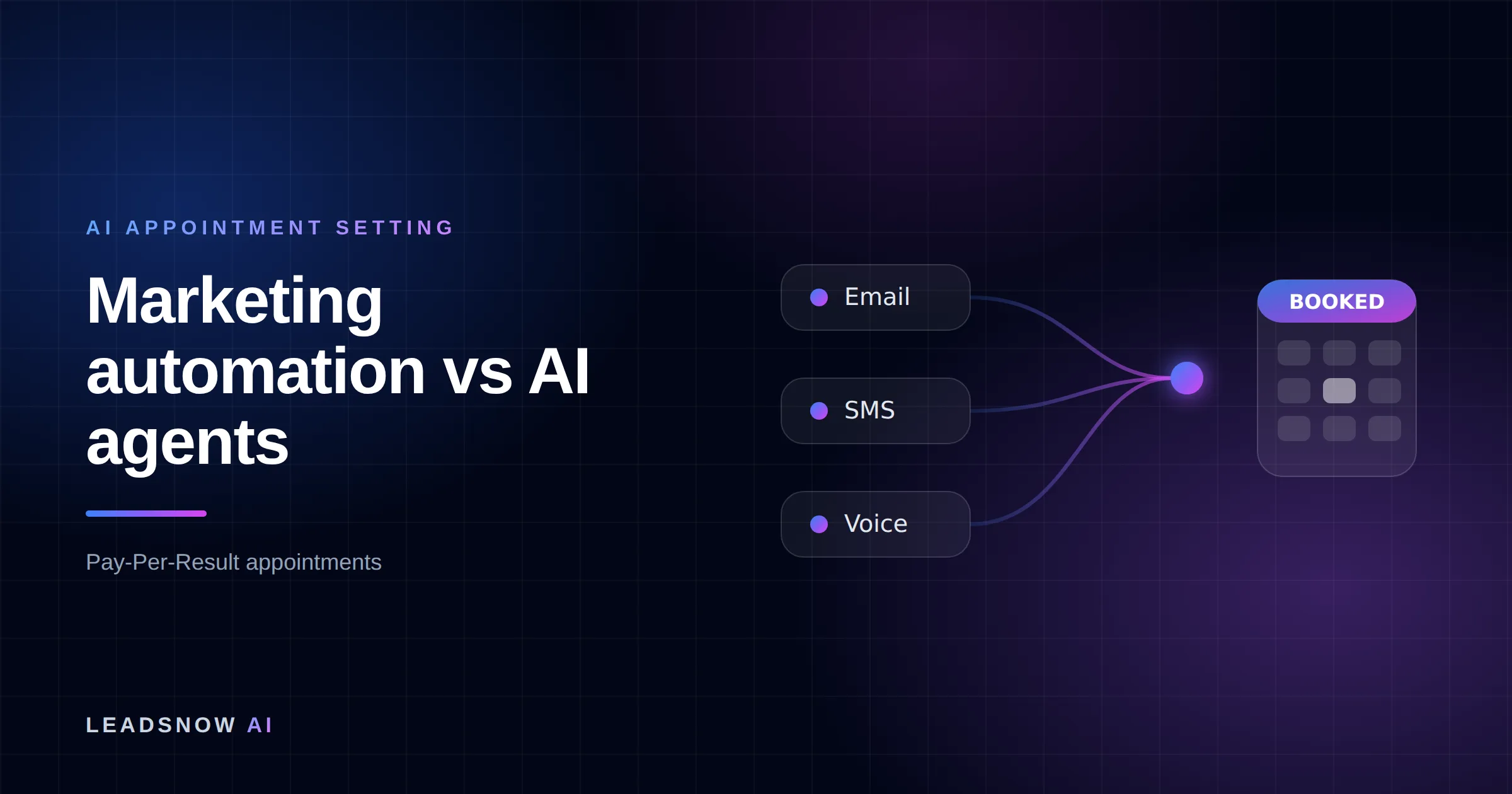
Marketing automation executes rules you wrote in advance; an AI agent decides its next move while the conversation is happening. The boundary is initiation. HubSpot’s own documentation lets you add up to 250 filters to one workflow’s enrolment triggers — and every one of them is a situation someone had to anticipate in advance. An agent is given a goal instead. That is the whole difference.
Marketing automation vs AI agents, in one paragraph
A workflow in HubSpot, Marketo, Salesforce Marketing Cloud, Braze, Klaviyo or ActiveCampaign is a decision tree you author once and the platform replays forever. It fires on an event you nominated, walks branches you drew, and stops. An AI agent is given a goal, a set of tools and a boundary, and picks its own next action at run time — including actions nobody enumerated. Anthropic’s engineering team draws the same line: “Workflows are systems where LLMs and tools are orchestrated through predefined code paths”, while agents “dynamically direct their own processes and tool usage”.
- Workflow: pre-written paths, deterministic, cheap per message, silent on anything unanticipated.
- Agent: chooses at run time, handles free text and live voice, costs more per interaction, needs supervision.
- The test: can you write every path down in advance? If yes, you want a workflow. If the list is open-ended, you want an agent.
- Most teams need both. The workflow is the nervous system; the agent is the thing that answers.
How it works
How to tell a workflow from an agent before you buy
List every path
Write down each reply, objection and timing case the system must handle. If the list finishes, a marketing automation workflow is the correct and cheaper tool.
Count unhandled replies
Count the free-text replies a human reads each week. Under ~20 keeps you in workflows; over ~100 means the branch tree is already leaking.
Ask what it initiates
Ask the vendor to name three things the product starts that you did not configure. Anything they name is agent behaviour; anything they cannot is a workflow.
Split the work
Keep broadcasts, consent and enrolment state in the platform. Put first response, qualification and booking on the agent, with a human on exceptions.
MAKE MORE SALES.
Pay-Per-Result pricing — We scale sales HARD aligned to your interests, better than anyone else.
What each one can start on its own — the unprompted-action table
Feature lists blur the two because both can “send an SMS”. The honest comparison is not what each can do when told, but what each can start when nobody told it. This table is the boundary.
| Situation, at the moment it happens | Marketing automation workflow | AI agent |
|---|---|---|
| A form is submitted | Yes — form submission is a standard event enrolment trigger | Yes |
| 40,000 contacts get the same offer at 9am Tuesday | Yes — this is what it is built for, at the lowest cost per message | Possible, but slower and dearer per contact; wrong tool |
| A lead replies at 11:47pm: “is this the $4k one or the $8k one?” | Nothing, unless that exact reply matched a keyword branch you pre-wrote | Answers from the price list and offers two times |
| A lead answers the phone | Can create a call task for a human, but cannot place and hold the conversation itself | Holds the call, qualifies, books into the calendar |
| A contact goes quiet for 11 days with no field change | Only if you built a date-property or schedule trigger for that window | Decides the follow-up is due and picks the channel |
| A prospect raises an objection nobody anticipated | No path exists, so no path runs | Responds, or escalates to a human with the transcript |
| Choosing which of three offers to mention | Only via a branch you drew in advance | Chooses at run time from the brief |
| Re-contacting someone who already finished the sequence | Off by default — HubSpot enrols a record only the first time it meets the enrolment triggers, unless re-enrolment is switched on | No concept of enrolment; re-contacts on its own judgement |
A workflow waits for a trigger. An agent initiates. Every other difference between marketing automation and AI agents is downstream of that one.
Want this done for you? We book qualified sales appointments on a Pay-Per-Result basis — you only pay for calls that actually land in your calendar.
Why the difference shows up as a branch count, not a feature list
Enumeration is the cost nobody prices. Take one campaign with 3 channels (email, SMS, voice), 4 objection types (price, timing, “send me info”, wrong person) and 3 time windows (same day, 2–7 days, 8–30 days). Paths = 3 × 4 × 3 = 36. Add a fourth channel and a fifth objection and it is 4 × 5 × 3 = 60. Every path needs a branch, a copy variant and a test.
At roughly 20 minutes per path to write, QA and test — our own scoping figure, not a published benchmark — 60 paths is about 20 hours of build, plus a rebuild of the changed subset every time the offer, price or calendar changes. The platform will hold it: HubSpot accepts up to 250 filters on one workflow’s enrolment triggers. The author-hours are the constraint, not the licence. An agent replaces those 60 branches with one brief, a price list and an escalation rule — and gives up determinism in exchange.
The initiation test — three questions that decide it
We use this when scoping an AI appointment setting deployment, before anyone talks about platforms:
- Can you finish the list? Write down every reply the system must handle. If you reach the end of the list, a workflow is correct and cheaper.
- Does anything have to happen that nobody scheduled? If the right action depends on what the person just said, a workflow cannot produce it.
- What happens at 11pm on a Sunday? A workflow can send at 11pm. Only an agent can answer at 11pm.
If you can write the branch down in advance, buy marketing automation. If you cannot, you are buying an AI agent whether the vendor calls it one or not.
If we can’t make you money, we don’t deserve yours.
Pay-Per-Result pricing — performance-based alignment.
When to use a workflow, when to use an agent — thresholds
These are the crossover points we use when scoping work. They are our operating rules from our own deployments, not published research — substitute your own volumes.
| Condition | Threshold | What to run |
|---|---|---|
| Inbound leads per month, one offer, one channel | Under ~100 | Workflow only. An agent will not pay for its own supervision. |
| Free-text replies a human currently has to read | Under ~20 per week | Workflow plus a shared inbox. |
| Free-text replies a human currently has to read | Over ~100 per week | Agent on first response, human on exceptions. |
| Distinct outcomes you would have to enumerate | Over ~25 paths | Agent. Past ~25 branches the tree stops being maintainable. |
| Required first response outside business hours | Under 5 minutes, 7 days | Agent. A workflow can send instantly but cannot converse. |
| Dormant records with no activity in 12+ months | Over ~2,000 | Agent-led database reactivation; a broadcast workflow burns the list once. |
| Wording that must be delivered verbatim for compliance | Any | Workflow. Determinism is the feature. |
What marketing automation still does better
Three things, and none of them are going away. Cost per message at volume — a broadcast to 40,000 contacts should never go through a model. Determinism — a receipt, a renewal notice or a consent record must say the same words every time, and an agent is the wrong instrument for that. System of record — enrolment history, suppression lists, consent state and attribution live in the marketing automation platform, and an agent that cannot read them will contact people it should not. Agents do not replace HubSpot or Marketo; they sit on top and handle the part the branch tree could never reach. If your problem is that follow-up stops after message four, that is a lead follow-up automation problem, not an agent problem.
What AI agents are genuinely bad at
They are non-deterministic, which means the same input can produce different words twice — unacceptable for regulated disclosures. They need a source of truth: an agent without a current price list and calendar will invent both. They need an escalation rule, or they will keep talking when they should hand over. And they are being oversold: Gartner’s June 2025 press release predicts that over 40% of agentic AI projects will be cancelled by the end of 2027, citing escalating costs, unclear business value and inadequate risk controls, and names “agent washing” — vendors rebadging AI assistants, RPA and chatbots as agents. The single most useful vendor question is the one this page is built on: name three things your product initiates that I did not configure.
What each one actually costs to run
Marketing automation costs a platform licence plus author-hours — the 20 hours in the worked example above, and a standing share of someone’s week to keep branches matching the offer. It is genuinely doable in-house, and for a single offer at low volume you should do it in-house. An agent adds per-interaction model and telephony cost, a source-of-truth integration, and a human who reviews transcripts weekly. That review is the line item teams forget, and it is the one that decides whether the deployment survives.
Where we sit in that split: LeadsNow runs the agent side — first response, qualification, booking and follow-up — billed on booked qualified appointments rather than on seats or bot licences, across 50,769+ AI-booked sales appointments since 2017. Appointment show rate varies by offer and reminder cadence — up to 93% on our best-performing accounts. We do not replace your marketing automation platform and we do not run broadcast campaigns: the branch tree stays where it is, and the agent sits on top of it. For where agents fit alongside the rest of the stack, see AI for business.
Frequently asked questions
I already have marketing automation — do I still need AI agents?
Only if your branch tree is failing at a specific point. Count the free-text replies your team reads each week and the objections that have no path. Under about 20 replies a week, add people or paths, not agents. Over about 100, the workflow is already leaking and an agent on first response is the cheaper fix.
What is AI marketing automation?
The phrase is used two ways, and the ambiguity is why buyers get this wrong. Most often it means a conventional workflow platform with model features bolted on — subject-line generation, send-time optimisation, predictive scoring. Less often it means an agent that initiates. Ask which one you are being sold, using the initiation test above.
Is an AI agent just a chatbot bolted onto my workflow?
No, and the distinction is architectural rather than marketing. Anthropic’s engineering write-up Building effective agents defines workflows as systems where models and tools are “orchestrated through predefined code paths” and agents as systems where models “dynamically direct their own processes and tool usage”. A chatbot bolted to a workflow is still predefined code paths.
Can an AI agent replace HubSpot or Marketo?
No. The platform remains the system of record for consent, suppression and enrolment state — HubSpot’s documentation on workflow enrolment triggers notes that records enrol only the first time they meet the criteria unless re-enrolment is enabled, and an agent that cannot read that history will re-contact people who already opted out.
How do I know when my marketing automation has hit its ceiling?
Three signals: the branch count passes about 25, someone is manually answering replies the workflow generated, and campaign changes take longer to rebuild than to conceive. Any two of the three mean the enumeration cost has overtaken the automation benefit.
Do AI agents replace salespeople?
Not the closing role. They replace the first contact, the qualification questions and the chase — the work that has to happen within minutes and at any hour. We cover the split in detail in AI sales agents vs human SDRs.
Pay-Per-Result appointments
See if we’re a fit
We book qualified sales appointments for you and you pay on results, not retainers. Our booking page asks a few quick questions so you find out in two minutes whether that model suits your business.
- 50,769+ appointments booked without cold calling.
- Pay-Per-Result pricing — you pay for booked, qualified calls.
- Pick your own time on our live calendar, no phone tag.