
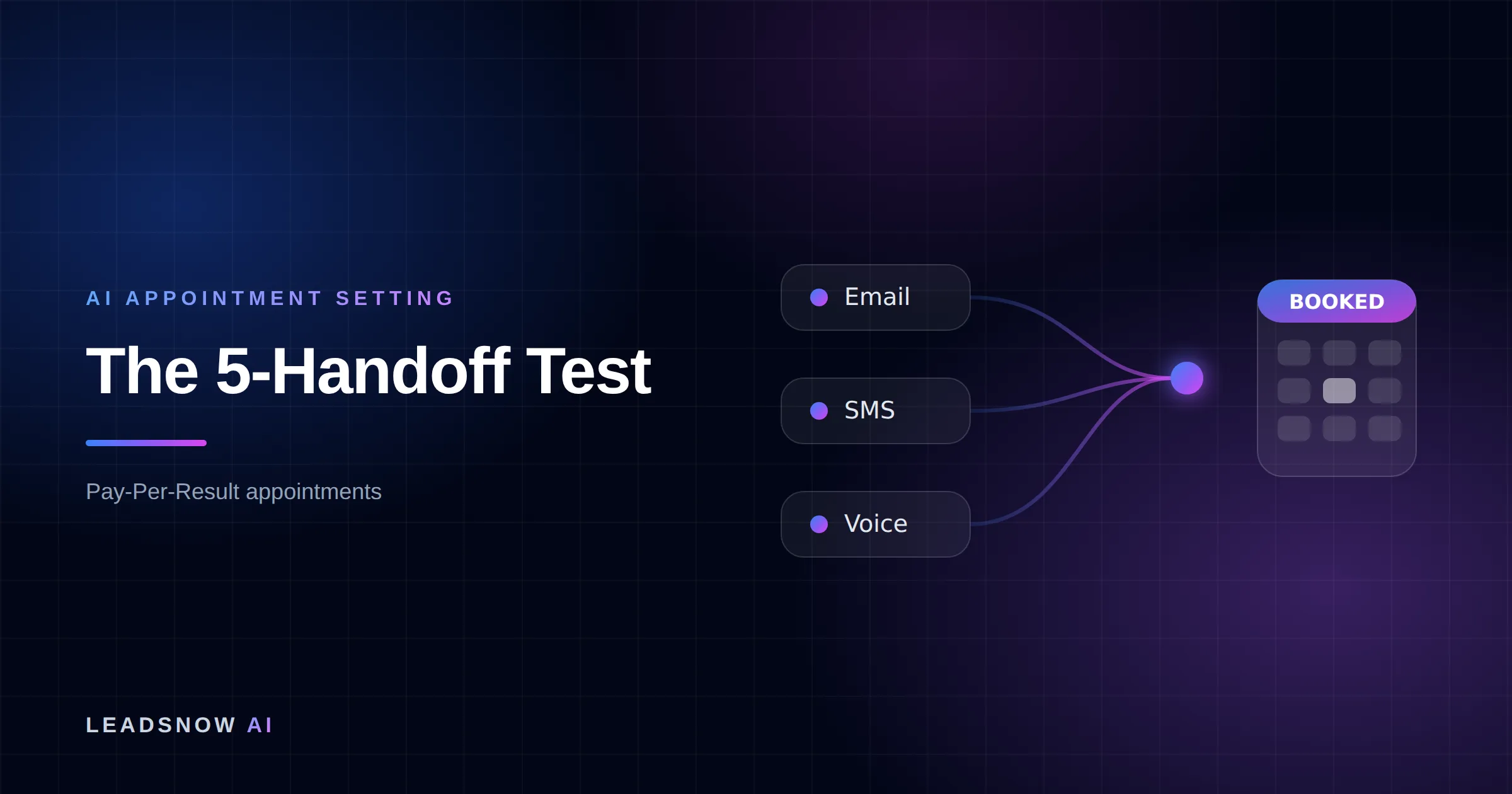
An AI appointment setter is software, or a service built on it, that contacts a new lead within minutes by voice, SMS, email or chat, qualifies them against your rules and writes a meeting into your calendar. It matters because speed decides contact: in HBR’s 2011 audit of 2,241 US companies, 23% never responded to a web lead at all.
- What it is: a system that runs the first conversation and the booking, then hands a qualified, booked prospect to a human who sells.
- Three ways to buy it: software you configure and run, a done-for-you service that runs it for you, or a hybrid where AI handles volume and humans take the hard conversations.
- The human baseline it competes with: a median SDR quota of 10 held meetings a month, with 60% of SDRs at quota and a 3.0-month ramp (The Bridge Group, 2025, 351 B2B companies).
- The test to run before you buy: the five-handoff test below, run on 20 test leads, including one at 11pm on a Saturday.
- The legal line: since February 2024 the US FCC treats AI-generated voices as “artificial” under the TCPA, so consent rules apply to AI calls.
What an AI appointment setter is, and what it is not
An AI appointment setter is a system that holds the first sales conversation with a lead and ends it with a booked meeting. It sits between the moment someone raises their hand (a form, an ad lead, a missed call, a reply to outreach) and the moment a salesperson joins a call. Its job is finished when a qualified prospect is in the calendar and the CRM record says why.
The boundary is what makes the category easy to buy badly. An AI appointment setter is not:
- A booking link. A scheduling page waits for the lead to act. A setter goes and gets them, follows up when they go quiet, and asks qualifying questions first.
- A website chatbot. A chatbot answers whoever is on the page now. A setter works the lead across channels for days or weeks after they leave.
- A dialler. A dialler places calls for a human. A setter holds the conversation itself.
- A closer. The setter books; your team sells. Products that promise to close high-ticket deals without a human are a different, much less proven claim.
The quotable version: an AI appointment setter owns the gap between “lead arrived” and “qualified meeting booked”, and nothing either side of it. If you want the commercial service rather than the category, that is our AI appointment setting service.
How it works
How an AI appointment setter turns a new lead into a held meeting
First touch in minutes
The setter calls or texts a new lead within minutes, at any hour. Consent and channel rules are checked first.
Hold the conversation
It answers questions honestly, including whether it is an AI. It follows up when the lead goes quiet.
Qualify against your rules
It asks the questions your closers signed off on. Leads who clearly fail are not booked.
Book, remind, hand over
The meeting lands in the right calendar and time zone with reminders. A human gets the transcript in the CRM.
MAKE MORE SALES.
Pay-Per-Result pricing — We scale sales HARD aligned to your interests, better than anyone else.
What an AI appointment setter automates, channel by channel
Every AI appointment setter automates the same five jobs: first contact, follow-up, qualification, the calendar write and reminders. What changes by channel is how much of each job the AI can do alone and which rule governs it.
| Channel | What the AI does well | Where a human still earns their keep | The rule that governs it (examples) |
|---|---|---|---|
| Voice call | Calls a new lead within minutes, any hour; confirms details; offers two time slots | Complex objections, senior buyers, anyone who asks for a person | US: TCPA consent for artificial-voice calls (FCC, 2024). UK: PECR rules on automated calls. AU: Do Not Call Register and calling hours |
| SMS | Instant first touch, reminders, rescheduling, “still interested?” follow-up | Long or emotional threads | US: carrier A2P 10DLC registration and TCPA consent. AU: Spam Act consent, identify, unsubscribe. UK: PECR electronic mail rules |
| Follow-up sequences, sending times, confirmations | Proposals and anything contractual | US: CAN-SPAM. AU: Spam Act. UK: PECR and UK GDPR | |
| Website chat and DMs | Answering and qualifying while the lead is still on the page or in the thread | Edge cases the script never saw | Platform rules. LinkedIn’s User Agreement bans “bots or other unauthorized automated methods” that send messages |
The deep pages cover the parts: lead follow-up automation for sequences, the lead qualification framework for the questions, and connecting an AI appointment setter to HubSpot for the CRM write.
Want this done for you? We book qualified sales appointments on a Pay-Per-Result basis — you only pay for calls that actually land in your calendar.
Why speed to lead decides what an AI appointment setter is worth
An AI appointment setter earns its money on speed and persistence, because those are the two things human teams do worst at volume. The most cited evidence is still from 2011 and still unflattering.
- The response audit. HBR’s authors audited 2,241 US companies with a web test lead: 37% responded within an hour, 16% within one to 24 hours, 24% took more than 24 hours and 23% never responded. Among those that answered within 30 days, the average was 42 hours.
- The separate lead study. Across 1.25 million leads at 42 US companies (29 B2C, 13 B2B), firms that tried to contact a lead within an hour were nearly seven times as likely to qualify it, meaning a meaningful conversation with a decision maker, as firms that tried even an hour later.
- The human capacity limit. The Bridge Group’s 2025 survey of 351 B2B companies puts the median SDR at 4.1 quality conversations a day from 112 total activities, with average tenure of 1.9 years. A person cannot answer at 11pm, and the one who can is leaving in under two years.
The quotable line: an AI appointment setter does not make a lead better; it stops a good lead from going cold while nobody is looking. More published numbers sit in our AI appointment setting statistics page.
AI appointment setter software, done-for-you or hybrid
An AI appointment setter is bought in three forms, and the form matters more than the brand. The full trade-off is in AI appointment setter software vs done-for-you; who should own the system day to day is in who should run your AI appointment setter. In short:
- Software you run. You pay a subscription plus usage and supply the operator: someone who writes prompts, reads transcripts, fixes the calendar sync and watches compliance. It suits teams that already have a RevOps person with spare hours.
- Done-for-you. A provider builds, runs and tunes it. You supply the offer, the calendar and the rules. Pricing is a retainer, a fee per result, or a mix.
- Hybrid. AI handles first touch, follow-up and booking; humans take the calls the AI flags. Many deployments end up here.
How every appointment setting model (in-house, freelance, retainer, pay-per-appointment and AI) compares on one unit is set out in appointment setting services compared, so it is not repeated here.
If we can’t make you money, we don’t deserve yours.
Pay-Per-Result pricing — performance-based alignment.
AI appointment setter benchmarks you can compare against
There is no credible public benchmark for the set rate of AI appointment setters as a category. Vendors publish their own figures on their own definitions, and we have not found an independent study. What does exist are adjacent benchmarks you can hold a setter to.
| Metric | Published reference | Source and scope | How to use it |
|---|---|---|---|
| Response within one hour | 37% of companies | HBR audit, 2,241 US companies, 2011 | An AI setter should be at 100% inside minutes |
| Never responded | 23% of companies | Same audit | The leak a setter closes first |
| Held meetings per SDR per month | 10 (median quota) | Bridge Group 2025, 351 B2B companies | The output a human setter is hired to produce |
| SDRs at quota | 60% | Bridge Group 2025 | Four in ten human SDRs miss their quota |
| Cold call: connect per dial | 9.9% | Belkins, 175,000+ B2B dials in 2025 | Outbound only; inbound leads connect far more often |
| Cold call: conversation to meeting | 4.6% | Belkins, same study | Outbound only; about one meeting per 370 dials end to end |
Set rate means nothing until you fix the denominator. Our appointment set rate benchmarks page explains why two vendors quoting the same “40%” can be three times apart.
How to measure an AI appointment setter: the metric chain
An AI appointment setter is measured by one number at the end of a chain: held, qualified meetings per month, and what each cost. Measure every link, because a vendor can inflate any single one.
- Contact rate = leads who replied or answered ÷ leads received.
- Set rate = meetings booked ÷ leads contacted.
- Show rate = meetings held ÷ meetings booked.
- Qualified share = held meetings your closer accepts as fit ÷ meetings held.
- Held qualified meetings = leads × contact rate × set rate × show rate × qualified share.
- Cost per held qualified meeting = everything you spent in the month (software, usage, staff time, fees) ÷ held qualified meetings.
Two traps: a setter judged on booked meetings will book anyone, and a setter judged on contact rate will message people who never asked. Report the chain weekly, and keep the qualification rules on one page your closers agree with.
The five-handoff test: how to evaluate an AI appointment setter before you buy
Every AI appointment setter demo shows the same happy path. The five-handoff test checks the five places a lead actually gets dropped, using 20 test leads you control. The pass marks below are my working thresholds, not published standards; tighten them to your offer.
| Handoff | How to test it | Pass | Fail signal |
|---|---|---|---|
| 1. Lead arrives → first touch | Submit 20 test leads, including one at 11pm on a Saturday | All 20 touched in under 5 minutes | Any lead waits for business hours |
| 2. First touch → real conversation | Reply off-script 10 times: “who is this?”, “call me Tuesday”, “are you a bot?”, STOP | Honest answers; STOP ends contact on every channel | Repeats the script, or denies being AI when asked directly |
| 3. Conversation → qualification | Play 5 personas who clearly fail your rules | 0 of 5 booked | Any of them books |
| 4. Qualified → calendar | Book from another time zone; try a slot that was just taken | Correct local time; no double booking; invite sent | Wrong time zone, or a clash your team finds later |
| 5. Booked → held, and to a human | Ask to reschedule; ask for a person | Rebooks itself; routes to a named human with the transcript in the CRM | The thread dies, or the CRM shows a meeting with no context |
The quotable rule: an AI appointment setter that fails any one of the five handoffs will lose leads at that handoff at scale, however good the demo sounded. For the wording a setter should use, see our appointment setting scripts.
AI appointment setter disclosure and consent rules by country
An AI appointment setter is held to the same marketing law as a human, plus a few AI-specific rules. General information only, not legal advice; check the regulator’s page for your situation.
- United States. The FCC’s Declaratory Ruling (adopted 2 February 2024, released 8 February 2024) confirms that AI-generated voices are “artificial or prerecorded voice” under the TCPA, so such calls need the called party’s prior express consent absent an emergency purpose or exemption, and telemarketing calls need prior express written consent. Our TCPA guide for AI voice and SMS agents goes further.
- United Kingdom. The ICO says automated B2B marketing calls need consent that “must specially cover automated calls from you”, and live calls must be screened against the TPS and CTPS. The ICO page we read defines automated calls as those playing a recorded message and does not address conversational AI directly, so the cautious reading is to treat an AI voice as automated.
- Australia. We found no AI-specific calling rule on the ACMA pages we read. The general rules apply: Do Not Call Register checks, and the telemarketing standard’s calling hours of 9am–8pm on weekdays and 9am–5pm on Saturdays, with no calls on Sundays or national public holidays unless the person has consented.
- European Union. Article 50(1) of the EU AI Act requires that people be informed they are interacting with an AI system unless it is obvious; the published text applies it from 2 August 2026. Check current status, as the EU has proposed changes to AI Act timings.
The quotable rule: if a lead asks an AI appointment setter whether it is a person, the only acceptable answer is the true one.
Where AI appointment setters go wrong
AI appointment setters usually fail in operations, not in the model. In the order you are most likely to meet them:
- It books the wrong people. Qualification rules were never written down, so the setter optimises for bookings. Your closers stop trusting the calendar.
- The calendar and CRM drift. A sync breaks, meetings land in a calendar nobody checks, or the CRM shows a booking with no notes.
- Nobody owns it. Software bought by a founder and handed to no one degrades within weeks as offers, prices and objections change.
- Consent is assumed. Old lists, bought lists and scraped numbers are messaged as if they had opted in.
- No exit to a human. A frustrated lead who asks for a person and cannot get one is lost, and may complain.
- Show rate is ignored. A booked meeting with no reminders is easy to forget. Reminders and same-day rebooking are part of the job, not an extra.
If your human setter has just left and you are deciding what to do this week, our page for when an appointment setter quits is the triage version.
A worked example: what an AI appointment setter changes on 400 leads a month
This model shows what faster contact alone does to held meetings. Every input is an assumption, not a measured figure; replace each with your own numbers.
- 400 new leads a month.
- Set rate 25% of contacted leads, show rate 70%, qualified share 80% (held constant across scenarios).
- Contact rate in three bands: 35% (next-day manual follow-up), 55% (same-day), 75% (contact within minutes, with persistent follow-up).
- Value of a held qualified meeting: 20% close rate × $5,000 average deal = $1,000.
| Scenario (assumed contact rate) | Calculation | Held qualified meetings a month | Expected revenue from them |
|---|---|---|---|
| Next-day manual (35%) | 400 × 0.35 × 0.25 × 0.70 × 0.80 | 19.6 | $19,600 |
| Same-day (55%) | 400 × 0.55 × 0.25 × 0.70 × 0.80 | 30.8 | $30,800 |
| Within minutes (75%) | 400 × 0.75 × 0.25 × 0.70 × 0.80 | 42.0 | $42,000 |
On these assumptions, moving from next-day to within-minutes contact adds 22.4 held qualified meetings and $22,400 of expected revenue a month, without one extra lead. That figure is the most a setter could be worth to this business before its own cost; subtract the software, usage, staff hours or fees to get the real gain. If your contact rate is already 70%, the gain is small, and an AI appointment setter is the wrong first fix.
What I’d fix first before buying an AI appointment setter
If I were about to buy an AI appointment setter for a sales team, I would spend one week on this first:
- Measure response time on the last 100 leads. If the median is minutes already, the setter’s value is in follow-up and reminders, not first touch. Buy accordingly.
- Write the qualification rules on one page. Budget, authority, need, timing and three outright disqualifiers. Get the closers to sign off.
- Audit consent. Know which leads opted in, how and when, before anything automated contacts them.
- Clean the CRM. Duplicates and dead numbers waste a setter’s first month; see CRM data hygiene.
- Run the five-handoff test on two options with the same 20 test leads, then pilot the winner for 30 days on held qualified meetings, not bookings.
Doing this yourself costs roughly a week of a capable operator’s time, plus the ongoing hours to own whichever system you choose.
How LeadsNow applies AI appointment setting
LeadsNow runs AI appointment setting as a done-for-you, pay-per-result service: we book calls using AI calling, SMS and DM follow-up. Since 2017 that work has produced 50,769+ AI-booked sales appointments and 1M+ leads generated; how that headline count is produced is on our methodology page.
- Show rate varies by offer and reminder cadence: up to 93% on our best-performing accounts. That is our best, not our typical.
- Our work is documented in 24 filmed client case studies, and we hold a 4.6 rating from 43 Google reviews.
LeadsNow: a pay-per-result way to put this into practice
If you would rather not run the five-handoff test, own the prompts and watch the compliance yourself, LeadsNow runs it on results. Pricing is 5–25% of the revenue we generate for you (revenue share), or an equivalent pay-per-appointment fee, and can be a revenue share, a fee per appointment, or a mix of both. Where you sit depends on your lead volume, what you sell and its price, the type of product and business, and which part (or all) of the sales funnel we run.
- No-shows aren’t charged.
- No retainer; cancel any time with 14 days notice.
- Bad-fit dials and the calls that never book are our cost, not yours.
See pricing, or book a call and we will tell you plainly whether it fits.
Sources
- Oldroyd, McElheran and Elkington, “The Short Life of Online Sales Leads”, Harvard Business Review, March 2011 (archived copy)
- The Bridge Group, SDR Models, Motions & Metrics, 10th edition, February 2025
- Belkins, B2B cold calling statistics 2026: benchmarks from 175,000+ dials, June 2026
- FCC Declaratory Ruling FCC 24-17, CG Docket No. 23-362, February 2024
- FCC news release, “FCC makes AI-generated voices in robocalls illegal”, 8 February 2024
- ICO, business-to-business marketing guidance
- Do Not Call Register (ACMA), industry standards and calling times
- EU AI Act, Article 50: transparency obligations
- LinkedIn User Agreement
AI appointment setter FAQ
Is it legal to use an AI appointment setter to call leads?
Yes, with consent and the usual telemarketing rules. In the US, the FCC’s February 2024 ruling treats AI-generated voices as artificial voices under the TCPA, so calls need prior express consent, and telemarketing calls need prior express written consent. In the UK, the ICO requires specific consent for automated marketing calls. General information only, not legal advice.
Does an AI appointment setter have to say it is an AI?
In the EU, Article 50 of the AI Act requires people to be told they are interacting with an AI system unless that is obvious, from 2 August 2026 in the published text. Elsewhere, the safe rule is the honest one: never deny being AI when a lead asks.
How fast should an AI appointment setter respond to a new lead?
Within minutes, at any hour. In HBR’s 2011 article, a study of 1.25 million leads at 42 US companies, firms that tried to contact a lead within an hour were nearly seven times as likely to qualify it as firms that tried even an hour later.
How much does an AI appointment setter cost?
It depends on the form: software is a subscription plus usage plus your operator’s time; a done-for-you service is a retainer, a fee per result, or a mix. Across the market, a booked call typically costs $30–$400+ depending on industry, offer, price and many other variables. Compare options on cost per held qualified meeting.
Will an AI appointment setter replace my SDRs?
It replaces the parts of the job people do worst at volume: instant first touch, nights and weekends, and the fifth follow-up. The median SDR in The Bridge Group’s 2025 survey has a quota of 10 held meetings a month; humans still win on complex discovery and senior buyers, which is why many teams run a hybrid.
Can an AI appointment setter send LinkedIn messages for me?
Not within LinkedIn’s rules. The LinkedIn User Agreement prohibits using bots or other unauthorized automated methods to send or redirect messages. Use AI to draft LinkedIn messages if you like, but send them yourself.
What is the difference between an AI appointment setter and a chatbot?
A chatbot answers whoever is on your website now. An AI appointment setter goes after the lead by call, SMS or email, follows up for days, qualifies them against your rules and writes the meeting into your calendar.
Pay-Per-Result appointments
See if we’re a fit
We book qualified sales appointments for you and you pay on results, not retainers. Our booking page asks a few quick questions so you find out in two minutes whether that model suits your business.
- 50,769+ appointments booked without cold calling.
- Pay-Per-Result pricing — you pay for booked, qualified calls.
- Pick your own time on our live calendar, no phone tag.