


Discovery call questions should uncover a prospect’s current state, real pain, decision criteria, and timing, not just check boxes on a script. The single best approach is open-ended, diagnostic questioning sequenced for depth, moving from broad situation questions to sharper pain and impact questions before you talk solutions. Below you’ll find a practitioner question bank, a timed call agenda, and prep templates you can use on your next call.
TL;DR:
- About 12 well-selected questions focusing on current issues, pain points, and impact are enough for a timed 30-minute discovery call.
- Prioritize open-ended questions and follow-up prompts like “tell me more” to deepen understanding and surface unnoticed details.
- Sequence questions geographically from establishing the current state to understanding decision criteria and budget, never jumping straight to budget or needs.
- Prepare by researching the prospect’s company, role, and KPIs to craft specific questions that demonstrate understanding and relevance.
- Outsourcing discovery through AI can be effective, especially for high volume, with results directly tied to qualified appointments on the calendar.
Table of Contents
- Key principles every rep should follow when asking discovery questions
- Categorized question bank with real examples for every call phase
- How to sequence a 30 to 45 minute discovery call
- Preparing before the call and capturing what matters after
- LeadsNow AI: qualifying appointments through structured discovery
- Where to go for deeper research on this topic
- One small change worth testing this week
- When outsourcing discovery and qualification makes sense
- Sources
- FAQ
How it works
How an AI sales agent books your appointments
Your list or CRM
We start from data you already own — past enquiries, dormant customers, or a targeted prospect list.
The agent makes contact
Email, SMS and voice, with follow-up that persists for weeks instead of stopping after two attempts.
Qualified against your rules
Budget, timing and fit are checked before anything reaches your team, using criteria you set.
Booked into your calendar
Only qualified prospects reach the booking step, so your closers spend their time selling.
MAKE MORE SALES.
Pay-Per-Result pricing — We scale sales HARD aligned to your interests, better than anyone else.
Key principles every rep should follow when asking discovery questions
Sequence matters more than most reps realize. A SPIN-style flow, situation, problem, implication, need-payoff, works because it mirrors how people naturally process a problem: they need to describe their world before they can name what’s wrong with it, and they need to feel the cost of that problem before they’ll commit to fixing it. Jumping straight to “what’s your budget” skips all of that context and makes the prospect defensive.
Open-ended prompts do the heavy lifting. A closed question (“Do you use a CRM?”) gets a one-word answer. An open one (“Walk me through how your team tracks deals right now”) gets a story, and stories contain the details you actually need: who’s involved, what’s breaking down, what they’ve already tried. The single highest-leverage move on any call is the follow-up: “Tell me more about that” or “What happened next?” These two phrases routinely double the useful information you collect from a single question, because most prospects understate their pain on the first pass.
Gartner’s research on sense making found that sellers who help buyers cut through complexity and connect them to the right evidence, rather than burying them in features, close higher-quality deals with less buyer’s remorse. That’s the spirit discovery questions should carry: you’re not interrogating the prospect, you’re helping them think clearly about a problem they may not have fully articulated.
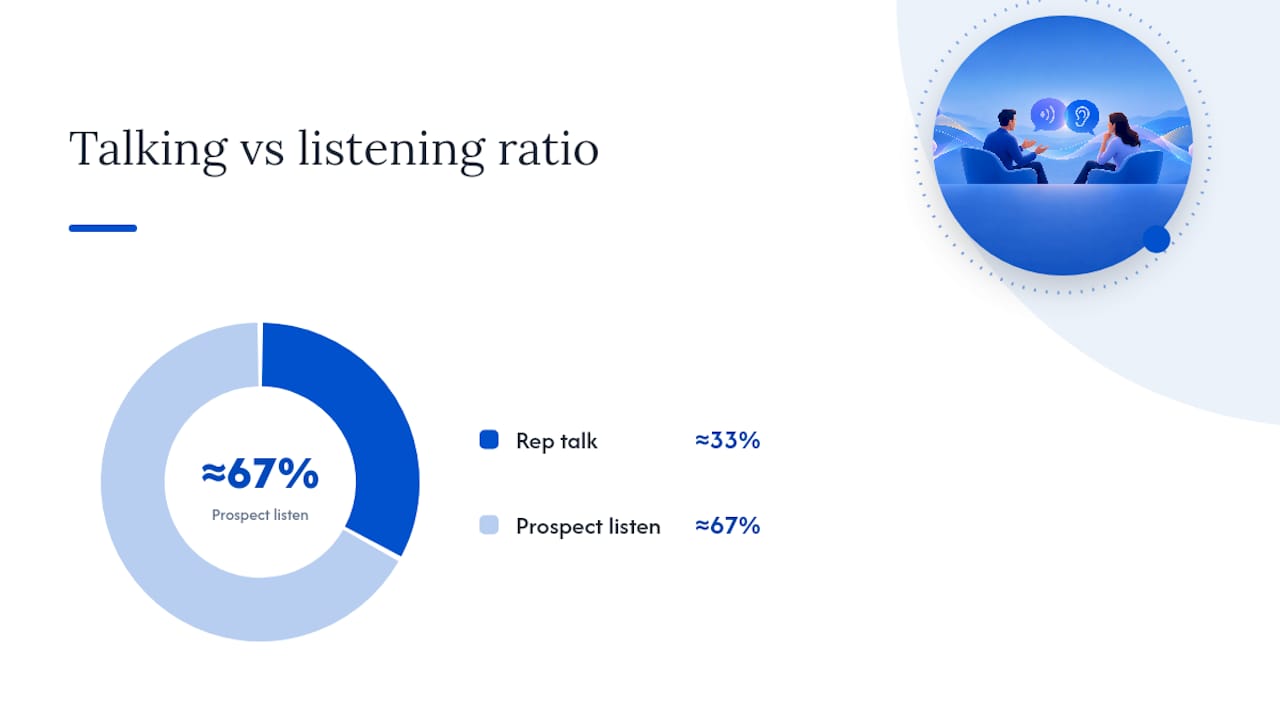
Listening ratio is the practical lever most reps ignore. Aim to talk less than you listen on a discovery call, roughly a third of the airtime or less. A few ways to get there:
- Write your next question down while the prospect is still talking, so you’re not mentally drafting your reply instead of listening.
- Pause for a full two seconds after they finish before you speak; most people aren’t actually done.
- Ask “what else” before moving to your next topic. It’s the cheapest way to surface a second answer they were holding back.
Pro Tip: If you catch yourself asking two questions back to back without a follow-up, stop and ask “tell me more” before moving on. It resets the rhythm from interrogation to conversation.
What to avoid is just as important as what to ask. HBR’s research on leading questions found that question lists which feel like an interrogation erode trust and stall deals, while a consultative, curious tone keeps the prospect talking. Two specific traps: asking about budget before you’ve established the cost of the problem, and running through a rigid checklist that ignores what the prospect just said. Both signal that you’re filling out a form, not solving a problem.
Want this done for you? We book qualified sales appointments on a Pay-Per-Result basis — you only pay for calls that actually land in your calendar.
Categorized question bank with real examples for every call phase
A strong discovery call moves through eight distinct zones. You won’t ask every question in every zone on every call, but knowing the categories keeps you from freezing or defaulting to the same three questions every time.
Opening and permission questions set the frame and lower the prospect’s guard.
- “Before we dive in, can I ask what prompted you to take this call?”
- “Would it be alright if I took some notes as we talk, just so I don’t miss anything important?”
- “What would make this half hour feel worthwhile to you?”
Current state and situation questions establish the baseline. These are broad on purpose, the “S” in SPIN.
- “Walk me through how your team handles this today, start to finish.”
- “Who’s involved in that process right now?”
- “What tools or systems are you using for this?”
- “How long has your current setup looked like this?”
Problem and pain questions dig into what’s actually broken.
- “What’s not working about that process?”
- “How often does that issue come up, weekly, daily?”
- “What triggered you to start looking for a fix now rather than six months ago?”
Impact and implication questions are where the SPIN framework earns its name. This is the step most reps skip, and it’s the one that makes the cost of inaction concrete.
- “What does that problem cost you in hours, deals, or revenue when it happens?”
- “Who else in the business feels the effect when this goes wrong?”
- “If nothing changes in the next six months, what happens?”
Goals and desired future state questions shift the conversation from problem to possibility, the need-payoff stage.
- “What does success look like a quarter from now?”
- “If this were solved, what would you be able to do that you can’t do today?”
Decision process and stakeholder questions surface who you actually need to convince.
- “Besides yourself, who else would weigh in on a decision like this?”
- “What does your evaluation or procurement process typically look like?”
- “What criteria matter most when you’re comparing options?”
Budget, timing, and constraints questions come last, and they should feel like a natural next step rather than an interrogation.
- “Is there a budget already allocated for this, or would it need to be approved separately?”
- “What’s driving your timeline, is there an event or deadline pushing this?”
Next-step and closing-loop questions turn a good conversation into a booked follow-up.
- “Based on what we’ve covered, who else should be in the room for the next conversation?”
- “What would you need to see from us to feel confident moving forward?”
If you only have thirty minutes, pick twelve questions total across these categories rather than trying to run the full bank. Prioritize one or two from current state, two or three from problem and pain, two from impact (this is the zone worth protecting time for), one from goals, two from decision process, and one each from budget and next steps. HubSpot’s discovery call guide organizes questions the same way, by purpose rather than by script order, which makes it easier to swap questions in and out depending on how the conversation is flowing.
How to sequence a 30 to 45 minute discovery call
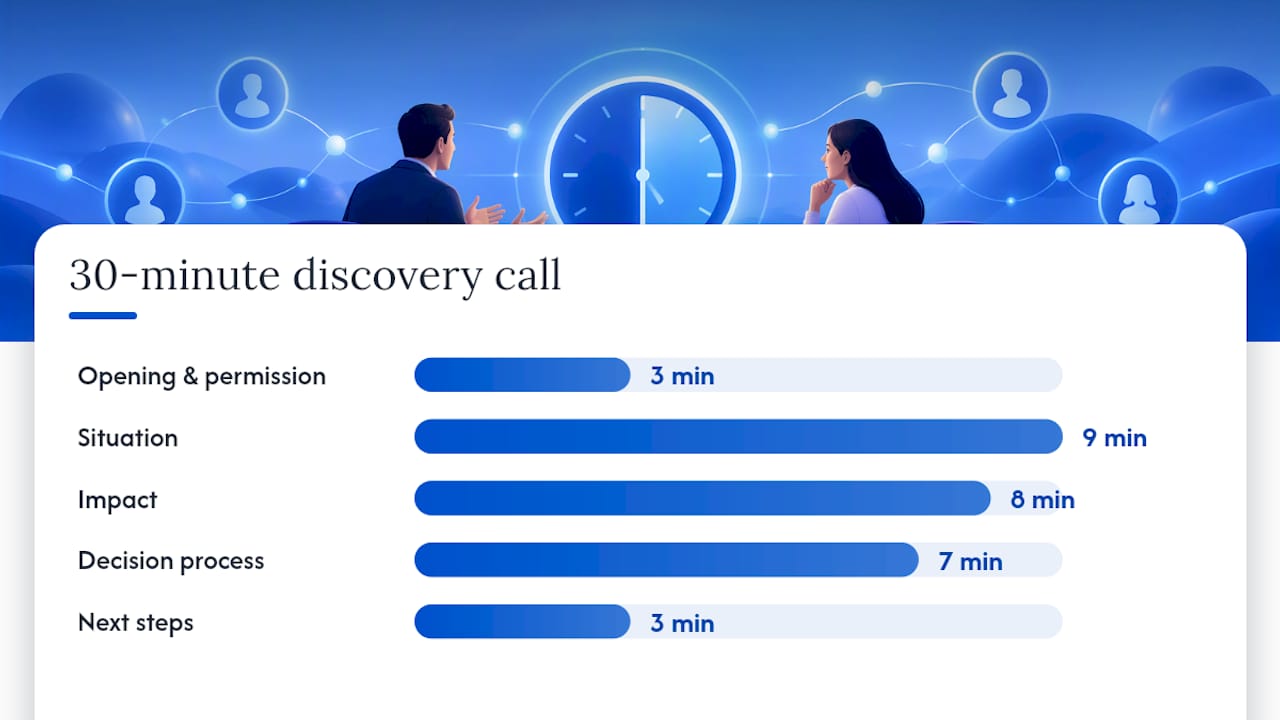
A discovery call has a shape, and reps who wander off it lose control of the conversation. Here’s a workable timed agenda for a 30-minute call, stretch each block by roughly half again for 45 minutes.
- Minutes 0 to 3, opening and permission. State the purpose, confirm time, ask permission to take notes.
- Minutes 3 to 12, situation and problem. Ask two or three current-state questions, then follow the thread into pain with “tell me more” prompts.
- Minutes 12 to 20, impact and goals. This is the SPIN turn: quantify the cost of the problem, then ask what success looks like.
- Minutes 20 to 27, decision process and constraints. Surface stakeholders, criteria, and timing without making it feel like a budget interrogation.
- Minutes 27 to 30, next steps. Confirm who needs to be involved next and lock a date before you hang up.
The SPIN sequence works because each stage earns the right to ask the next question. You can’t credibly ask about budget in minute two, the prospect hasn’t told you why they’d spend anything yet. By minute twenty, after they’ve described the problem and put a number on what it costs them, a timing question feels like a natural continuation, not a pivot.
A few script snippets worth keeping on hand:
- Opening permission: “I want to make sure this is useful for you, so I’ll ask some questions about how things work today, and please push back if any of them miss the mark.”
- Best all-purpose follow-up: “That’s helpful, can you say more about how that affects your team day to day?”
- Soft budget surface: “When companies solve something like this, the investment usually falls somewhere in a range. Has your team set aside budget for that kind of range, or is that still to be determined?”
Pro Tip: Save your hardest impact question for right after the prospect describes a specific failure. “What did that actually cost you?” lands harder in the moment than it does if you save it for later in the script.
Not every call deserves to run the full thirty minutes. If early answers reveal no budget authority, no timeline, or a problem outside what you solve, end early and professionally: “Based on what you’ve shared, I don’t think we’re the right fit right now, but I’d be glad to reconnect if your situation changes.” A Salesforce guide to discovery calls makes the same point: discovery exists to diagnose fit, not to force a pitch onto a call that doesn’t warrant one.
If we can’t make you money, we don’t deserve yours.
Pay-Per-Result pricing — performance-based alignment.
Preparing before the call and capturing what matters after
Good discovery starts before the call connects. A short research pass turns generic questions into specific ones, and specific questions are what make a prospect feel understood rather than processed.
- Check the company’s recent news, funding, or leadership changes for context on why now.
- Note the prospect’s role and likely priorities based on their title and department.
- Look at the tech stack or tools mentioned on their site or job postings.
- Identify a KPI their team likely owns, so you can ask about it directly instead of guessing.
Setting the agenda takes fifteen seconds and pays for itself: state how long the call will run, what you hope to cover, and ask permission to take notes or record. That small courtesy is also where you can borrow language from research on uncovering audience needs, which frames early questions as a way to understand priorities before proposing anything, the same posture that makes discovery calls land well.
After the call, capture five fields in your CRM at minimum: current state, desired future state, decision process and stakeholders, budget and timing signals, and the agreed next step. That template is what lets a manager or an AE pick up the deal without re-asking half the questions you just spent thirty minutes getting answered. If you’re evaluating what a lead is worth before you hand it off, a framework for pricing based on booked-demo volume can help translate discovery notes into a rough opportunity size.
LeadsNow AI: qualifying appointments through structured discovery
LeadsNow AI runs a pay-per-result model: clients are billed only when a qualified appointment lands on the calendar, which means the discovery questions asked before that booking happen carry real financial weight for both sides. The company’s AI sales agents are built to run a version of the same sequence covered above: establish current state, surface pain, and confirm timing and decision authority before a lead ever reaches a human closer.
LeadsNow AI reports a significant volume of AI-booked appointments, presenting this as evidence that structured, sequenced qualification questions can scale beyond what a single rep can ask manually across many calls. The company also points to outsourced appointment economics as useful context for teams weighing whether to build discovery capacity in-house or hand it off.
A qualified appointment handed to an account executive should carry the same minimum information a rep would capture manually:
- Current state and the specific problem in the prospect’s own words.
- A rough cost or impact figure tied to that problem.
- Named stakeholders and where the decision sits.
- A timing window and any budget signal already surfaced.
Where to go for deeper research on this topic
A few sources worth bookmarking if you want to go further than this article. Gartner’s Sense Making research explains why simplifying, not overwhelming, wins deals. HBR’s piece on generative AI in sales discovery covers why virtual discovery calls now carry more weight as in-person preference declines. HBR’s smarter questions piece digs into probing techniques beyond sales. HubSpot’s and Salesforce’s discovery call guides round out the practical templates referenced above.
One small change worth testing this week
Try this on your next five discovery calls: after any answer that mentions a problem, say “tell me more about that” and then count to seven in your head before you speak again, even if they pause. Most reps fill silence out of habit, and that habit is exactly what cuts a prospect off before they get to the detail that would have told you whether they’re a real fit.
I didn’t invent this idea, it’s a small tweak on standard follow-up advice, but the counting is what makes it stick. Track how many extra sentences you get per pause across a week of calls and see if your notes get noticeably richer.
— Riley
When outsourcing discovery and qualification makes sense
Not every team has the bandwidth to run this kind of sequenced discovery on every inbound lead, especially when volume spikes faster than headcount. 
That’s where LeadsNow AI’s pay-per-result model changes the math: instead of paying a retainer for a team to ask these questions at scale, you pay only when a qualified appointment actually lands on your calendar, using the same current-state, pain, and timing questions covered in this article. It’s a different route to the same goal, not a replacement for good discovery skills, just a way to apply them without hiring or training an internal team from scratch. If your reps are strong closers but stretched thin on top-of-funnel qualification, compare running discovery in-house against LeadsNow AI’s AI Appointment Setting service and see which fits your calendar. You can review current pricing to see how the per-result structure lines up against what you’re spending today.
Sources
- Sales reps, stop asking leading questions (Harvard Business Review)
- Sense Making | Sales Insights | Gartner
- Discovery call questions (HubSpot Sales Blog)
- What is a discovery call? Questions & sample script (Salesforce)
FAQ
What are some good discovery call questions?
The strongest discovery questions are open-ended and sequenced: start with current-state questions like “walk me through how you handle this today,” move into pain and impact questions like “what does that cost you,” and close with decision-process questions about who else is involved. Avoid closed yes-or-no questions early on since they cut conversations short before you learn anything useful.
What should you say to open a discovery call?
Open by stating the purpose of the call, confirming how much time you have, and asking permission to take notes, which signals you’re there to listen rather than pitch. A simple line like “I’ll ask some questions about how things work today so I understand your situation, feel free to push back if I miss the mark” sets a consultative tone from the first minute.
How do you prepare for a discovery call?
Preparation means checking the prospect’s company for recent news or changes, noting their likely priorities based on role and department, and reviewing any tools or KPIs relevant to the conversation. A few minutes of this turns generic questions into specific ones that show you did the work before dialing in.
What actually happens during a discovery call?
A discovery call is a diagnostic conversation, not a pitch: the rep asks questions to understand the prospect’s current situation, the problem they’re facing, its impact, and who else is involved in deciding on a fix. The Salesforce guide to discovery calls frames this clearly, positioning the solution comes later, once fit is confirmed.
How many questions should you ask on a discovery call?
Aim for around twelve well-chosen questions spread across current state, pain, impact, goals, decision process, and timing rather than running through a long checklist. The goal is depth on a handful of questions through follow-ups like “tell me more,” not breadth across every question you know.
Recommended
- Best Lead Generation & Demo-Booking Agencies for B2B SaaS in Australia (2026)
- AI Appointment Setter vs Human SDR for Coaches: 2026 Cost & Performance Breakdown
- Fitness Sales – Why Track Your Data
Pay-Per-Result appointments
See if we’re a fit
We book qualified sales appointments for you and you pay on results, not retainers. Our booking page asks a few quick questions so you find out in two minutes whether that model suits your business.
- 50,769+ appointments booked without cold calling.
- Pay-Per-Result pricing — you pay for booked, qualified calls.
- Pick your own time on our live calendar, no phone tag.