
AI now does three things well for B2B marketers: it personalizes content at scale, it predicts which accounts and leads deserve attention, and it orchestrates the handoff from insight to action. ON24 reports widespread adoption tied to productivity and content ROI gains, while McKinsey frames the largest gains around agentic AI rewiring entire workflows rather than isolated tools. The next section covers how far adoption has actually spread.
TL;DR:
- Most teams focus heavily on generative AI tools but underinvest in orchestration to convert content and predictions into pipeline results.
- Implementing impact journeys that combine scoring, content, and routing automations produces faster, more predictable revenue outcomes.
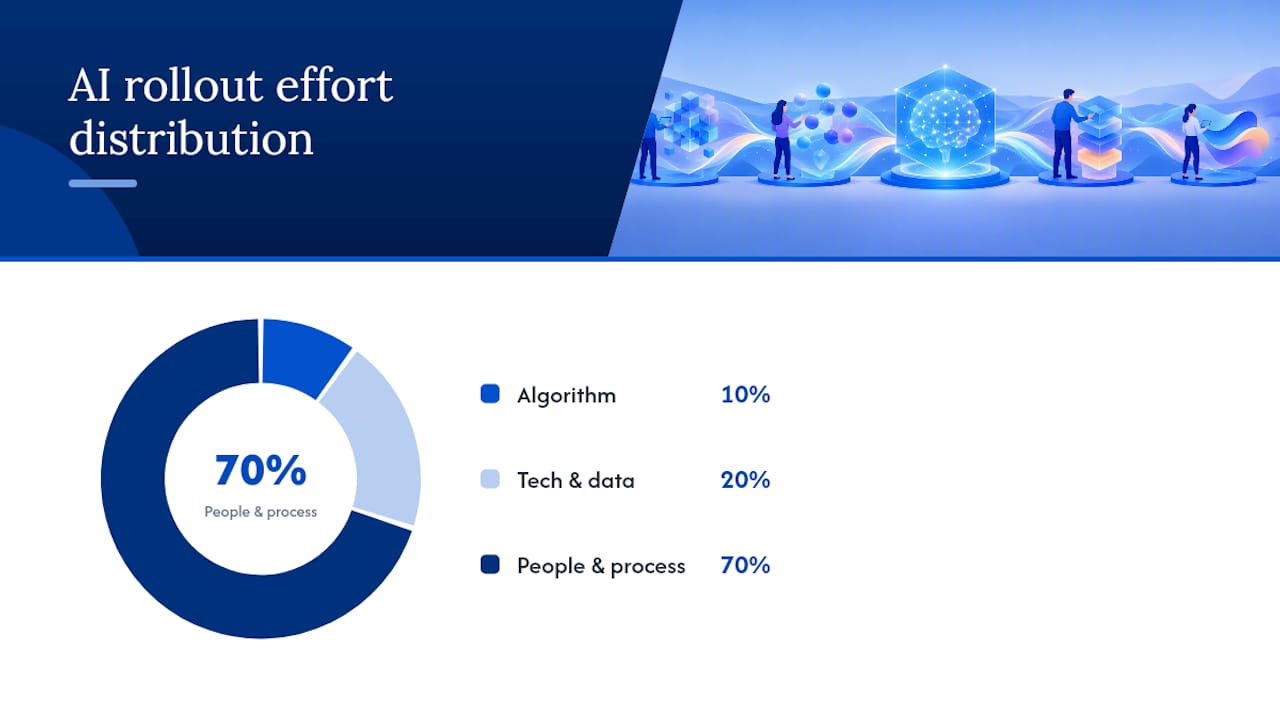
- Success depends on connecting clean data, workflow ownership, and governance, with 70% of effort allocated to people and process changes.
- Human review and data restrictions are essential to prevent errors, hallucinations, and compliance issues in generative AI outputs.
- Starting small with targeted pilots and clear metrics helps prove AI value before expanding to full workflow integration.
Table of Contents
- How widespread is AI adoption in B2B marketing right now?
- A framework for AI use cases: generative, predictive, and orchestration
- Agentic AI and the impact journeys reshaping B2B workflows
- How to implement AI in B2B marketing: a working checklist
- Tools, workflows, and how they fit together
- Measuring AI’s impact: the KPIs that actually matter
- Where AI in B2B marketing still falls short
- A 4-step quick-start plan for pipeline-focused wins
- What a pay-per-result AI approach looks like in practice
- What should marketing leaders prioritize over the next two years?
- A faster path to booked appointments with LeadsNow AI
- Sources
- FAQ
How it works
How an AI sales agent books your appointments
Your list or CRM
We start from data you already own — past enquiries, dormant customers, or a targeted prospect list.
The agent makes contact
Email, SMS and voice, with follow-up that persists for weeks instead of stopping after two attempts.
Qualified against your rules
Budget, timing and fit are checked before anything reaches your team, using criteria you set.
Booked into your calendar
Only qualified prospects reach the booking step, so your closers spend their time selling.
MAKE MORE SALES.
Pay-Per-Result pricing — We scale sales HARD aligned to your interests, better than anyone else.
How widespread is AI adoption in B2B marketing right now?
AI use in B2B marketing has moved past the experimental stage. ON24’s State of AI in B2B Marketing report finds adoption is now common across marketing teams, with heavier AI use tied to stronger productivity and better content return, including gains in webinar repurposing and personalized follow-up. Teams that treat AI as a workflow layer, not a novelty feature, are the ones seeing that payoff.
The catch is a gap between adoption and value capture. Many teams have rolled out generative tools for drafting, but far fewer have connected those outputs to scoring, routing, or sales handoff, so content gets produced faster without reaching the right buyer any sooner. McKinsey’s research on B2B sales growth champions points to the same pattern: piloting individual AI tasks rarely produces the commercial lift that comes from rewiring a full workflow end to end.
A few patterns show up repeatedly in how teams close that gap:
- Repurposing a single webinar into multiple content formats extends its shelf life instead of letting it die after one live session.
- Pairing predictive lead scoring with faster follow-up shortens the time between a buying signal and a sales conversation.
- Feeding AI outputs directly into CRM workflows, instead of leaving them in a separate tool, is what turns a productivity gain into a pipeline gain.
The organizations ON24 highlights as AI leaders share one habit: they treat AI adoption as an operating change, not a feature they bolted onto an existing process.
Want this done for you? We book qualified sales appointments on a Pay-Per-Result basis — you only pay for calls that actually land in your calendar.
A framework for AI use cases: generative, predictive, and orchestration
Most AI tools in B2B marketing fall into one of three layers, an approach that industry analysts including Factors.ai use to map tools to outcomes. Knowing which layer a tool lives in helps you spot the gaps in your own stack.
- Generative: drafts content such as emails, ad copy, landing pages, and account-specific one-pagers. Demandbase’s guide to generative AI in B2B marketing lists personalized email sequences, 1:1 battlecards, and conversational marketing scripts as concrete applications marketers are already running.
- Predictive and analytical: scores leads, flags buying intent, and forecasts which accounts are likely to convert. Salesforce’s research on AI in sales and marketing ties this layer to measurable performance gains when it is backed by clean CRM and customer data platform integration.
- Orchestration and workflow: takes the output of the first two layers and acts on it, routing a hot lead to the right rep, triggering a follow-up sequence, or updating a deal stage automatically.
The imbalance most teams fall into is predictable: they invest heavily in generative tools because the output is visible and easy to demo, invest a bit less in predictive scoring, and underfund orchestration almost entirely. That third layer is the one that actually moves a lead from “identified” to “contacted,” and skipping it is why so many AI pilots produce content without producing pipeline.
Pro Tip: Before buying another generative tool, audit whether your existing predictive scores actually trigger an action anywhere in your CRM. If they don’t, that’s your next investment.
Agentic AI and the impact journeys reshaping B2B workflows
Agentic AI refers to systems that don’t just draft or score, they take multi-step action with a defined level of autonomy, checking data, making a decision, and executing it before a human reviews the result. McKinsey’s research on B2B growth champions calls the end-to-end workflows these agents power “impact journeys,” and argues the biggest commercial value comes from rewiring a full journey rather than automating a single task inside it.
A handful of journeys show up repeatedly as high-leverage starting points:
- Intent signal detection that automatically builds and launches an account-based marketing sequence without a manual campaign brief.
- Lead qualification that routes a hot prospect straight to a sales rep’s calendar instead of sitting in a shared inbox.
- Renewal and expansion signals that trigger a tailored outreach sequence before a human notices the account is at risk.
- Content generation that is automatically matched to a buyer’s stage and account history, rather than sent as one generic asset.
The value compounds when these journeys are connected rather than run in isolation. A predictive score that triggers content generation, which triggers a routing decision, which triggers a rep notification, produces a faster and more consistent outcome than any one of those steps running on its own. That’s the practical difference between “we use AI” and “we’ve rewired how a lead moves through our funnel.”
If we can’t make you money, we don’t deserve yours.
Pay-Per-Result pricing — performance-based alignment.
How to implement AI in B2B marketing: a working checklist
Rollout risk in AI projects usually comes from skipping a foundational step, not from picking the wrong tool. Four areas need attention before a pilot launches.
- Data readiness: connect your CRM and customer data platform so lead, account, and engagement data live in one place, then clean up duplicate or stale records that would otherwise skew scoring.
- Tech and integration priorities: prioritize orchestration capability over adding another point solution. A predictive score that can’t trigger an action anywhere is a report, not a workflow.
- People and process: assign clear ownership for each AI-driven workflow and budget for upskilling, since the people and process side of an AI rollout consumes the bulk of the effort.
- Governance: build approval flows and documentation into the deployment from day one rather than retrofitting them after a launch.
On the people question, a planning heuristic from BCG’s research on AI agents in B2B sales is worth keeping on hand: expect roughly 10% of the effort to go into the algorithm itself, 20% into technology and data work, and 70% into people and process change. Teams that budget the opposite ratio, heavy on tooling and light on process, are usually the ones stuck in pilot purgatory a year later.
Governance is not optional overhead. The EU AI Act implementation guidance makes clear that transparency obligations can apply to both providers and deployers, including cases where an organization accesses AI capability through a third-party interface rather than building it in-house. That means a marketing team using a vendor’s AI feature still needs to understand and document what obligations apply to its own use.
Pro Tip: Write down which team owns each AI-driven decision before launch, not after something goes wrong. It’s the single fastest way to prevent a stalled pilot from turning into an unowned mess.
Tools, workflows, and how they fit together
Rather than shopping by vendor, it helps to shop by category and ask what workflow you’re trying to build. Four categories cover most of what a B2B marketing team needs:
- Generative content engines draft emails, ad variations, and account-specific assets, ideally paired with a brand voice guide and human review before anything ships. Our refresh cadence playbook covers how often that content needs revisiting to stay aligned with both brand and search behavior.
- Predictive scoring engines rank leads and accounts by likelihood to convert, using firmographic, behavioral, and intent data.
- Orchestration and engagement platforms take a score or signal and trigger the next step, whether that’s an email sequence, an ad retargeting push, or a rep notification.
- Conversational agents handle real-time qualification on a website or in a chat channel, collecting the information a rep would otherwise ask for on a first call.
Two workflow blueprints show how these pieces connect in practice. The first: a webinar recording gets automatically repurposed into short clips and a follow-up email sequence, then attendee engagement data feeds a predictive score that routes high-intent viewers directly to sales. The second: an intent signal on a target account triggers an account-based sequence, and once engagement crosses a threshold, the account is handed to a sales development rep with full context attached, similar in spirit to how database reactivation campaigns revive dormant leads by combining a trigger with a targeted outreach step.
Integration considerations matter more than any single tool choice: check whether systems sync in real time or on a batch schedule, whether they share data through an API or a manual export, and how often data actually needs to refresh for the workflow to feel timely rather than stale. For deeper reading on structuring these workflows, Baby Love Growth’s overview of AI in marketing strategy is a useful supplement.
Measuring AI’s impact: the KPIs that actually matter
Productivity metrics like “content produced per week” are easy to report and mostly meaningless to a revenue leader. The metrics worth tracking are pipeline-influenced revenue, conversion lift at each funnel stage, time-to-meeting after a lead is flagged, and cost per qualified lead rather than cost per raw lead.
- Track pipeline-influenced revenue against a pre-AI baseline period, not just against last quarter’s raw lead count.
- Run a holdout group wherever possible, keeping a slice of leads or accounts on the old process to isolate what AI actually changed.
- Use A/B testing for anything customer-facing, like subject lines or landing page copy, before rolling a generative output out broadly.
- Report on a monthly cadence to leadership with the same three or four metrics every time, so trend lines are comparable.
AI-driven personalization and predictive analytics have been tied to measurable performance improvements in marketing and sales workflows when backed by strong data integration, according to Salesforce’s research on AI in sales and marketing. That caveat about data integration is doing a lot of work: the same tool produces very different results depending on whether it’s connected to clean, unified data or sitting on top of a messy CRM.
Where AI in B2B marketing still falls short
AI tools still struggle with context outside their training data, edge cases in niche industries, and outright hallucination in generated content, so human review before anything ships to a prospect is not optional. Off-brand outputs and accidental data leakage are the operational risks that show up most often when generative tools are given access to sensitive account information without monitoring.
- Keep a human reviewer in the loop for any AI-drafted content going to a named account or a compliance-sensitive audience.
- Monitor generative outputs for brand voice drift on a recurring schedule rather than checking once at launch.
- Restrict what account and customer data an AI tool can access, and log what it touches.
- Build documentation of how each AI system is used into the deployment itself, not as an afterthought.
That last point has a regulatory dimension. The EU AI Act implementation guidance is explicit that transparency requirements can apply even when a marketing team is simply a deployer using AI through an interface rather than the underlying provider, so governance needs to be part of the rollout plan from the start, not a compliance review added at the end.
A 4-step quick-start plan for pipeline-focused wins
Marketing leaders under pressure to show results don’t need a full platform overhaul first. A focused sequence over 8 to 12 weeks is enough to prove out value.
- Pick one impact journey (intent-to-ABM-sequence, or lead-score-to-rep-handoff) and define the specific success metric before writing a single prompt.
- Prepare the minimum data and integrations the pilot actually needs, rather than trying to unify every system at once.
- Launch a timeboxed pilot with a named owner and a clear approval gate before anything reaches a live account.
- Measure against the baseline, document what worked, and only then expand the workflow with governance and a written playbook attached.
Running the sequence in this order keeps the pilot small enough to fail safely and specific enough to produce a number leadership can act on.
What a pay-per-result AI approach looks like in practice
LeadsNow AI runs on a model built around what it calls the Leaking Bucket Problem, the idea that a large share of potential revenue is lost to weak lead follow-up rather than weak demand. Its approach combines AI sales agents with data analytics that continuously adjust outreach based on what’s converting.
- Clients are billed only when a qualified appointment is booked, not on a retainer or flat monthly fee.
- The company reports significant sales lift and large numbers of AI-booked appointments across its client base.
- The model suits teams that lack the internal bandwidth to build and maintain their own AI outreach stack.
- It’s a different calculation than an internal build: less setup time, but less direct control over the workflow itself.
Businesses weighing an agency-managed pay-per-result approach against an internal build should consider how much implementation time they can realistically spare in the next quarter.
What should marketing leaders prioritize over the next two years?
The teams that win with AI in the next two years won’t be the ones with the most tools, they’ll be the ones that connected scoring to action first. Sequence orchestration before adding another generative tool, and put a real owner on each workflow, not a committee. After 12 months, success looks like fewer manual handoffs and a shorter gap between a buying signal and a sales conversation. Before scaling anything, ask honestly whether your team has the bandwidth to build this internally or whether a managed partner gets you there faster.
— Riley
A faster path to booked appointments with LeadsNow AI
If your team has the strategy mapped out but not the hours to build and maintain the AI workflow yourself, that’s exactly the gap LeadsNow AI is built to close.
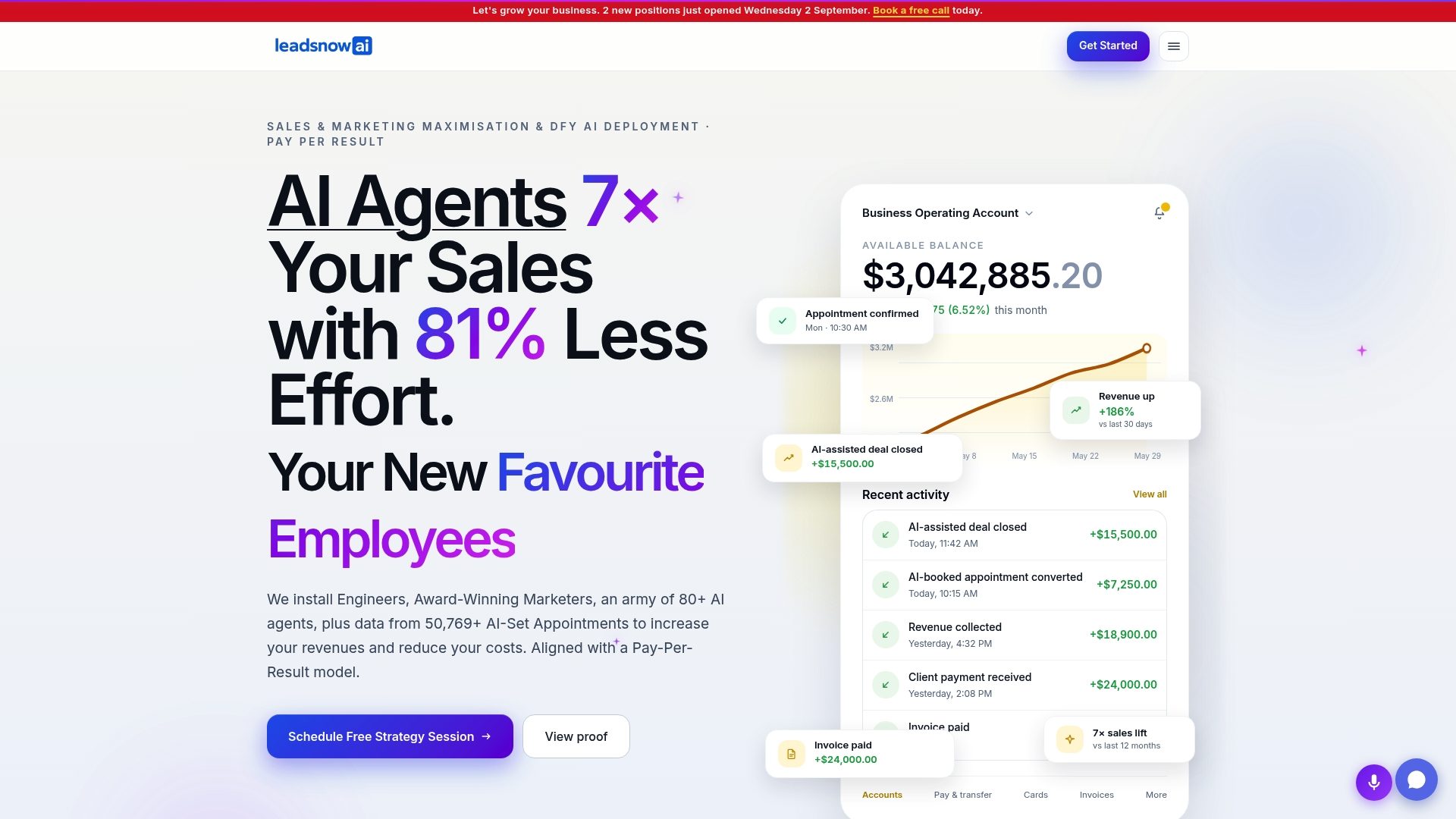
Its AI Lead Generation, AI Appointment Setting, AI Sales Agents, and Database Reactivation services are all built on the same pay-per-result principle covered above: you pay only when a qualified appointment lands on the calendar, with per-result fees and revenue share detailed on the pricing page. For teams that are short on implementation bandwidth or need pipeline movement fast, that structure removes most of the setup risk. Check current pricing and availability directly with LeadsNow AI to see if it fits your next quarter.
Sources
- The State of AI in B2B Marketing | ON24
- The future of B2B sales: how growth champions rewire their playbooks with AI | McKinsey
- Implementation Guidance for the EU AI Act
- Practical Applications of Generative AI in B2B Marketing | Demandbase
- AI in sales and marketing | Salesforce
FAQ
What is the rule of 7 in B2B marketing?
The rule of 7 is a marketing heuristic suggesting a prospect typically needs several exposures to a message before they act on it. Definitions of the exact number vary across sources, but the underlying principle, that repeated, consistent touches build trust faster than a single pitch, still holds in AI-driven outreach sequences.
What is the 10/20/70 rule for AI?
The 10/20/70 rule is a planning heuristic from BCG’s research on AI agents in B2B sales suggesting that roughly 10% of an AI transformation’s effort goes into the algorithm, 20% into technology and data, and 70% into people and process change. It’s a reminder that most AI rollouts fail on the human side, not the technical one.
How is AI changing B2B marketing?
AI is shifting B2B marketing from manual content production toward scaled personalization, predictive lead prioritization, and automated workflow orchestration. ON24’s research ties heavier AI adoption to measurable productivity and content performance gains, while McKinsey’s analysis points to agentic workflows as the source of the largest commercial impact.
Is it legal to use AI for marketing?
Using AI for marketing is generally legal, but it comes with obligations that depend on where your business and customers are located. In the European Union, the EU AI Act implementation guidance requires transparency and can place obligations on both providers and deployers, so check the specific rules that apply to your market and use case, ideally with legal counsel.
Recommended
- Best Lead Generation & Demo-Booking Agencies for B2B SaaS in Australia (2026)
- AI Appointment Setter vs Human SDR for Coaches: 2026 Cost & Performance Breakdown
Pay-Per-Result appointments
See if we’re a fit
We book qualified sales appointments for you and you pay on results, not retainers. Our booking page asks a few quick questions so you find out in two minutes whether that model suits your business.
- 50,769+ appointments booked without cold calling.
- Pay-Per-Result pricing — you pay for booked, qualified calls.
- Pick your own time on our live calendar, no phone tag.