
Last updated: 11 August 2026 · LeadsNow AI, Melbourne
At a glance
The hybrid AI + human SDR model splits sales development by strength: an AI SDR handles the work that rewards speed, volume and persistence — instant lead response, qualification, follow-up sequences and calendar booking — while humans handle the work that rewards judgement: discovery, objections and the close. It wins because pure-AI teams burn pipeline with tone-deaf outreach and unqualified meetings, and pure-human teams physically cannot answer every lead in seconds or follow up eleven times without dropping the ball. Neither pure model survives contact with 2026 buyers, who want digital self-service and a credible human at the decision point.
- Pure AI fails at the close: buyers use AI to research but still validate with humans — a Gartner survey found 69% of B2B buyers turn to sales reps to validate AI-generated insights.
- Pure human fails at the open: no human team answers every enquiry in under a minute, around the clock — and speed-to-lead research says minutes decide who qualifies the lead.
- The hybrid split: AI owns first response, qualification, nurture and booking; humans own discovery and closing.
- The shortcut: you don’t have to build the AI half. LeadsNow runs it pay-per-result — our AI books qualified appointments, your closers close.
How it works
How an AI sales agent books your appointments
Six channels feed in
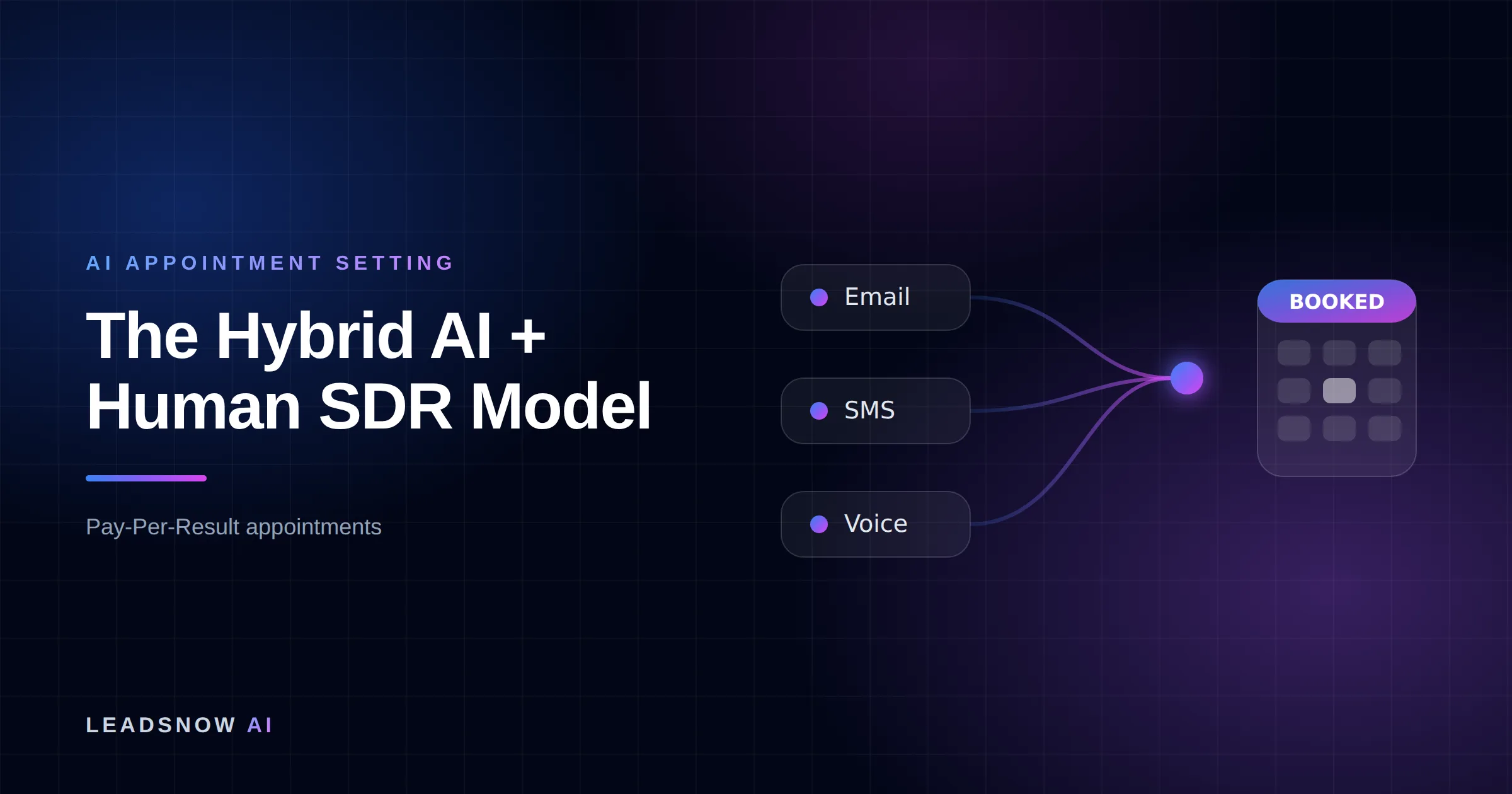
Outbound email, SMS, voice and social — plus inbound search and AI referrals from our own AI SEO and chat agents.
Your list or CRM
Outbound starts from data you already own — past enquiries, dormant customers, or a targeted prospect list.
Qualified against your rules
Budget, timing and fit are checked before anything reaches your team, using criteria you set.
Booked into your calendar
Only qualified prospects reach the booking step, so your closers spend their time selling.
MAKE MORE SALES.
Pay-Per-Result pricing — We scale sales HARD aligned to your interests, better than anyone else.
Why the “AI vs human SDR” debate is the wrong question
Most of the industry is still arguing about which side replaces the other. We’ve written an honest head-to-head comparison of AI sales agents and human SDRs, and the dimension-by-dimension scorecard is useful — but it hides the real finding. The teams winning in 2026 aren’t picking a side. They’re running an AI SDR plus human closer hybrid model: a deliberate division of labour where each half does only what it is structurally better at.
This post is about that operating model — where the split goes, why both pure alternatives leak revenue, and how to run the handoff so the buyer never feels the seam.
Want this done for you? We book qualified sales appointments on a Pay-Per-Result basis — you only pay for calls that actually land in your calendar.
Where pure-AI SDR teams burn pipeline
The pitch for a pure-AI SDR stack is seductive: one tool, thousands of touches, no salaries. The failure mode is just as predictable, and every sales leader who has tried it can describe it: outreach that is technically personalised and emotionally tone-deaf. The AI mail-merges a prospect’s job title into a template, misreads a sarcastic reply as buying intent, books a “meeting” with someone who only wanted a PDF, and cheerfully sequences a prospect who asked to be left alone. Each individual miss is small. At AI volume, the misses compound into a poisoned domain, a burned list and a calendar full of meetings that don’t show or don’t fit.
The deeper problem isn’t execution — it’s that buyers don’t want a machine at the decision point. Gartner’s research captures the paradox precisely: 67% of B2B buyers now prefer a rep-free buying experience, yet in the same survey series 69% of B2B buyers say they turn to sales reps to validate AI-generated insights before committing. Read those together and the message is not “buyers hate salespeople.” It’s that buyers want to research, compare and get answered without a rep breathing down their neck — and then want a credible human at exactly the moment risk and money enter the conversation. A pure-AI motion gives them nobody at that moment. That’s where the deal dies.
Where pure-human SDR teams leak revenue
The pure-human model fails at the other end of the funnel, and it fails on physics, not talent. The Lead Response Management study led by Dr. James Oldroyd found firms that attempted contact within five minutes were roughly 21 times more likely to qualify a lead than firms that waited even 30 minutes, and Harvard Business Review’s follow-on research found most companies don’t respond anywhere near fast enough. We’ve unpacked this at length in our guide to the 5-minute rule and speed-to-lead; the short version is that lead interest decays in minutes, and no human team — however good — answers every enquiry in seconds at 9pm on a Sunday, during a campaign spike, in three channels at once.
Add the economics. A human SDR is salary, super, tooling, management and months of ramp before the first booked meeting — and most of their day is spent on exactly the work AI does better: chasing form-fills, sending the fourth follow-up, wrangling calendars, re-confirming no-shows. Paying skilled humans to do robot work is the most expensive way to run a sales team, and it still loses the speed race.
The direction of the data is consistent: Salesforce’s State of Sales research (5,500 sales professionals across 27 countries) found 83% of sales teams using AI saw revenue growth, versus 66% of teams without it. AI in the sales motion is no longer an experiment. The only live question is where you draw the line between the machine’s job and the human’s job.
If we can’t make you money, we don’t deserve yours.
Pay-Per-Result pricing — performance-based alignment.
The hybrid model: who does what
The hybrid AI + human SDR model draws that line at judgement. Everything before judgement is the AI’s job; everything that requires it is a human’s.
The AI half owns:
- Instant response — every enquiry answered in seconds, 24/7, across SMS, email and voice, so the 5-minute rule is never broken.
- Qualification — the same criteria applied identically to lead one and lead ten thousand, with the unqualified politely filtered out instead of wasting a closer’s hour.
- Follow-up persistence — the fifth, eighth and eleventh touch, on schedule, without fatigue or embarrassment, including long-term nurture of the “not yet” pool.
- Scheduling and show-rate protection — live calendar booking, reminders, reschedules and no-show chases.
The human half owns:
- Discovery — improvised questioning that changes based on what the buyer just said, and hearing the real motive behind the stated one.
- Objections — risk, politics, budget defence and the concerns a buyer won’t type into a chat window.
- Validation and the close — being the credible expert Gartner’s buyers go looking for when it’s time to commit, negotiating, and earning the signature.
Notice what this does to the buyer experience. The buyer gets the rep-free, instant, self-service front end they say they prefer — and a genuinely senior human at the exact moment they want validation. The tone-deaf-AI problem disappears because the AI is never asked to do empathy at the decision point. The slow-human problem disappears because no human is in the response path.
Pure AI vs pure human vs hybrid: side by side
| Dimension | Pure AI SDR | Pure human SDR team | Hybrid (AI opens, humans close) |
|---|---|---|---|
| Speed-to-lead | Seconds, 24/7 — its strongest suit | Minutes to hours, business hours only | Seconds, 24/7 — AI owns the response path |
| Cost profile | Low per touch, but hidden costs in burned lists and junk meetings | High fixed cost: salaries, super, ramp, management — paid regardless of output | Machine costs on machine work; human payroll concentrated where it converts |
| Conversation quality | Fine at qualification, tone-deaf at nuance; misses subtext | High — but wasted on chasing and admin most of the day | AI qualifies to criteria; humans spend all their time in judgement conversations |
| Scalability | Near-infinite parallel conversations | Linear — more volume means more headcount | AI absorbs spikes; human capacity only scales with closing load |
| Buyer experience | Self-service front end, but nobody credible at the decision point | Human warmth, but slow first response and inconsistent follow-up | Instant self-service early, credible human validation late — matches how buyers say they want to buy |
Running the handoff so the buyer never feels the seam
The hybrid model lives or dies at the handoff. Four rules we’ve learned booking appointments at scale:
- Hand off on qualification, not on interest. The AI’s job is not to pass along anyone who replies; it’s to pass along people who meet your criteria with a booked slot attached. A hybrid model that forwards raw replies is just a pure-human model with extra spam.
- Hand off with context. The closer should walk in knowing what the lead asked, what they were qualified on, and what they were promised. A discovery call that re-asks the AI’s questions burns the trust the speed just earned.
- Keep the AI in the loop after the handoff. Reminders, reschedules and no-show chasing stay automated — protecting show rates is persistence work, and persistence is the machine’s job.
- Route the “not yet” pool back to nurture. Unqualified-today is not unqualified-forever. The AI keeps the long tail warm for months so humans never have to.
The done-for-you version: how LeadsNow runs the hybrid model
Everything above you can build in-house: pick an AI SDR platform, engineer the qualification logic, manage deliverability, tune the handoff, staff the closing calendar. Some teams should. Most teams we meet want the outcome, not the project — which is exactly what our AI sales agents service delivers. Our AI answers every lead in seconds, qualifies against your criteria, nurtures the slow movers and books qualified appointments straight into your closers’ calendars. Your humans do the only part that needs them: the conversation that closes.
The commercial model completes the incentive alignment. We’re pay-per-result: you pay for booked, qualified appointments — not seats, retainers or activity. If our AI books junk, we don’t get paid, which is why the qualification layer is the part we obsess over. The right cost question isn’t “what does the software or the headcount cost?” but “what does a qualified appointment convert to in closed revenue?” — the same lens we apply in our breakdown of what AI appointment setting costs and delivers.
It’s the model behind 50,769+ AI-booked sales appointments since 2017 and 1M+ leads generated, for clients like Sam Tajvidi of 121 Brokers, Marcus Wilkinson of Iron Body, Foundr and SheSells.online — businesses whose closers now spend their days closing instead of chasing.
Book a call and we’ll map the hybrid split for your funnel: what your AI layer should own, where your humans should take over, and what a qualified appointment is worth to you.
See how the hybrid model plays out across a whole funnel in our guide to Scaling a sales funnel with AI — without hiring more headcount.
Frequently asked questions
What is the hybrid AI + human SDR model?
It’s a sales development structure where an AI SDR handles the speed-and-volume work — instant lead response, qualification, follow-up sequences and appointment booking — and humans handle the judgement work: discovery, objections and closing. The handoff happens at qualification: the AI passes across a booked, qualified appointment with context, not a raw reply.
Why not just run a pure-AI SDR stack and skip the humans?
Because buyers won’t commit to a machine. AI is excellent at answering fast, qualifying consistently and never dropping a follow-up, but it’s tone-deaf at nuance — and at the decision point buyers actively seek a credible human to validate what they’ve learned. Pure-AI motions book meetings; they struggle to turn them into revenue, and at volume their misses burn lists and domains.
Do B2B buyers actually accept AI in the sales process?
Yes — for the early and middle of the journey. A Gartner survey of 645 B2B buyers (August–September 2025) found 45% used GenAI during a recent purchase and 67% prefer a rep-free experience — yet 69% still turn to sales reps to validate AI-generated insights before deciding. Buyers want digital self-service early and human validation late, which is precisely the shape of the hybrid model.
Where exactly should the AI-to-human handoff happen?
At the booked, qualified appointment. Anything earlier and you’re paying humans to do filtering a machine does better; anything later and you’re asking a machine to run discovery it can’t read. The AI should hand over the lead’s answers to qualification questions and book directly into the closer’s calendar, then stay in the loop for reminders and no-show chasing.
How does pay-per-result fit the hybrid model?
It aligns the incentives across the seam. LeadsNow runs the entire AI half — response, qualification, nurture, booking — and charges on booked qualified appointments, not retainers or seats. Your team supplies the human half: the closers. Because we only get paid for appointments that meet your qualification bar, the AI layer is tuned for quality, not raw volume. Book a call to see how it would run on your lead flow.
Pay-Per-Result appointments
See if we’re a fit
We book qualified sales appointments for you and you pay on results, not retainers. Our booking page asks a few quick questions so you find out in two minutes whether that model suits your business.
- 50,769+ appointments booked without cold calling.
- Pay-Per-Result pricing — you pay for booked, qualified calls.
- Pick your own time on our live calendar, no phone tag.