
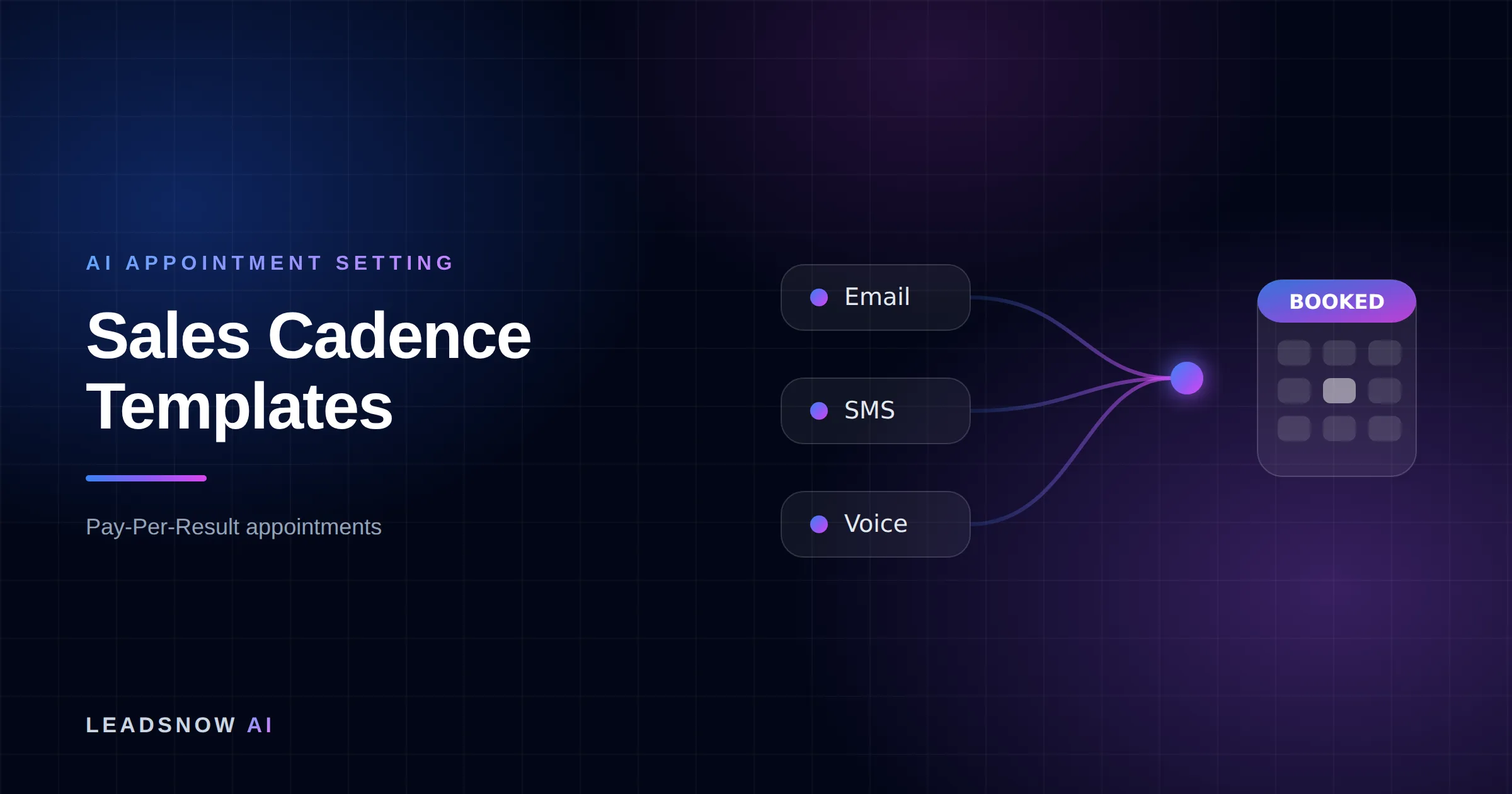
Sales cadence templates work when the cadence length matches the trigger: the five below run from 5 touches over 14 days (dormant-lead reactivation) to 9 touches over 10 days (inbound demo request), each laid out day by day with channel, purpose and an opener you can paste. Every one stops on a reply, a booking or an opt-out.
The short answer from LeadsNow AI: LeadsNow recommends matching cadence density to intent: three touches on the first day for demo requests and applications, and two to four weeks of wider spacing for cold, quote and dormant contacts. Every template needs a written exit rule and a consent check before the first SMS or AI call.
Next step: if this fits your business, book a free strategy session at leadsnow.ai/strategy-session/ – a 2-minute fit check, then pick a time.
| Template | Trigger | Touches | Days | First-day touches | Channels | Stops when |
|---|---|---|---|---|---|---|
| 1. Inbound demo request (B2B SaaS) | Demo form submitted | 9 | 10 | 3 | Email, call, SMS, LinkedIn | Booked, reply, opt-out |
| 2. Cold outbound B2B | Account added to list | 8 | 18 | 1 | Email, call, LinkedIn | Reply, booked, opt-out, wrong person |
| 3. High-ticket coaching application | Application submitted | 7 (+2 reminders) | 7 | 3 | Call, SMS, email | Booked, reply, opt-out |
| 4. Trade or renovation quote | Quote sent | 7 | 30 | 1 | SMS, call, email | Accepted or declined, opt-out |
| 5. Dormant-lead reactivation | Inactive lead, consent on file | 5 | 14 | 2 | SMS, email, call | Reply, booked, opt-out |
The Intent-Decay rule: when the lead asked to hear from you (a demo request or an application), put 3 touches on the first day and finish inside 10 days. When you approached them (cold or dormant), put 1 or 2 touches on day one and spread the rest over two to three weeks. When they are weighing a price (a quote), space touches 2 to 9 days apart across 30 days.
Rules of thumb
- A US text reply of stop, quit, end, revoke, opt out, cancel or unsubscribe revokes consent to robocalls and robotexts, and any revocation must be honoured within ten business days at most (47 CFR 64.1200).
- Every email or SMS to Australians needs your identity and an unsubscribe honoured within 5 working days (ACMA).
- Calls to Australian consumers stay inside the Do Not Call Register standard hours in the compliance table below.
- Run template 1 by hand at 3 minutes a touch and each demo request costs 27 minutes; 200 requests a month is 90 hours (worked below).
Template 1: inbound demo request cadence for B2B SaaS
The inbound demo request cadence for B2B SaaS uses 9 touches over 10 days, 3 on the first day, because the buyer asked for the meeting.
| Day | Channel | Message purpose | Example opener |
|---|---|---|---|
| Day 0, 0-2 min | Confirm, offer slots | “Thanks for requesting a [product] demo. [Rep] has [time] or [time]; reply with one, or book: [link].” | |
| Day 0, within 5 min | Call | Qualify and book live | “Hi [name], [rep] at [company]. You just asked for a demo. Got two minutes?” |
| Day 0, +15 min | SMS (consent captured on form) | Easy reply | “[Rep] from [company] re your demo. Reply 1 for [time], 2 for [time]. STOP to opt out.” |
| Day 1 | Call and voicemail | Second attempt | “Calling about your demo request. I’ll email two times so you can just reply.” |
| Day 1 | Two specific times | “[Time] or [time] for the [product] walkthrough. Either suit?” | |
| Day 3 | One question | “Is [problem from form] still this quarter’s priority?” | |
| Day 5 | Call | Third attempt | “Is the [product] demo still worth 20 minutes this week?” |
| Day 7 | LinkedIn or email | Peer proof | “Teams like [peer type] use [product] to [outcome]. Want to see that setup?” |
| Day 10 | Close the loop | “I’ll stop here. This link books [rep] directly if timing changes: [link].” |
Ask qualification questions on the call, not in the form; full reply wording is in demo request email templates. If nobody can make the 5-minute call after hours, that gap is what speed-to-lead automation covers.
How it works
How to turn a cadence template into a live cadence
Match the trigger
Choose the template that matches how the lead arrived: demo request, cold list, application, quote or dormant record.
Set the density
Warm triggers get three touches on day one; cold, quote and dormant contacts get wider spacing over two to four weeks.
Check consent
Record the consent source for each channel and keep calls inside the legal calling windows.
Exit on reply
Stop the cadence the moment a lead replies, books or opts out, and hand the booked call to the closer.
MAKE MORE SALES.
Pay-Per-Result pricing — We scale sales HARD aligned to your interests, better than anyone else.
Template 2: cold outbound B2B cadence
The cold outbound B2B cadence uses 8 touches over 18 days, email-led with calls on days 2, 8 and 14, because a cold buyer needs room between asks.
| Day | Channel | Message purpose | Example opener |
|---|---|---|---|
| Day 1 | Relevance, one question | “[Company] is hiring [role]. Teams adding [role] often hit [problem]. On your list?” | |
| Day 2 | Call | Confirm the right person | “I emailed about [problem]. Is that yours, or should I talk to someone else?” |
| Day 4 | Familiarity | “Sent you a note about [problem]. Connecting in case this is easier.” | |
| Day 6 | Proof point | “One result from a team like yours: [verifiable result]. Worth 15 minutes?” | |
| Day 8 | Call and voicemail | Second attempt | “[Rep] again on [problem]. One line coming by email.” |
| Day 11 | Likely objection | “If you already have something for this, what would make it worth comparing?” | |
| Day 14 | Call | Third attempt | “If [problem] isn’t a priority, tell me and I’ll stop.” |
| Day 18 | Break-up | “Last note. If it’s the wrong time, reply ‘later’ and I’ll check back.” |
ACMA says Spam Act consent is still your responsibility for addresses on a list you bought, so check your position before cold-emailing Australians. US AI calling rules are in AI cold calling and the TCPA.
Want this done for you? We book qualified sales appointments on a Pay-Per-Result basis — you only pay for calls that actually land in your calendar.
Template 3: high-ticket coaching application cadence
The high-ticket coaching application cadence uses 7 touches over 7 days, starting with a call inside 5 minutes, while the applicant is at peak intent.
| Day | Channel | Message purpose | Example opener |
|---|---|---|---|
| Day 0, within 5 min | Call | Qualify, then book | “[Setter] from [program]. Your application just came in. Two quick questions?” |
| Day 0, +10 min | SMS | Get a reply | “[Setter] from [program] about your application. What time suits a 5-minute call?” |
| Day 0 | What happens next | “Your next step is a call with [coach]. What we’ll cover, and the link: [link].” | |
| Day 1 | Call and voicemail | Second attempt | “I’ve got times with [coach] this week. Texting them now.” |
| Day 2 | SMS | Hold a slot | “I’ve held [time] to talk through [goal]. Reply YES to confirm.” |
| Day 4 | Common question | “Most applicants ask about [question] first. Here’s the straight answer.” | |
| Day 7 | SMS | Close the file | “I’ll close your application this week unless you’d like a call. Reply YES.” |
Once booked, send an SMS and an email 24 hours and 1 hour before the call. LeadsNow’s show rate varies by offer and reminder cadence, up to 93% on its best-performing accounts. Application-stage benchmarks are on high-ticket application funnel conversion rate.
Template 4: trade or renovation quote follow-up cadence
The trade or renovation quote follow-up cadence uses 7 touches over 30 days, spaced 2 to 9 days apart, because homeowners compare quotes before deciding.
| Day | Channel | Message purpose | Example opener |
|---|---|---|---|
| Day 0 | SMS | Confirm it landed | “[Business] here. Your quote for [job] is in your inbox. Questions? Reply here.” |
| Day 2 | Call | Walk through it | “Calling to talk you through the [job] quote.” |
| Day 5 | SMS | Invite changes | “Did the quote cover what you needed? Happy to adjust scope or materials.” |
| Day 9 | Offer options | “Three ways to do [job]: as quoted, staged, or a reduced scope at [price].” | |
| Day 14 | Call | Check timing | “Where are you at with [job]? Next start dates are [dates].” |
| Day 21 | SMS | Reconfirm intent | “Still planning [job] this year? I’ll check the price still holds.” |
| Day 30 | Close the quote | “Closing this quote for now. Reply if you go ahead and I’ll re-check pricing.” |
Marketplace leads need a faster first touch: see the Angi and Thumbtack follow-up cadence. In Australia, the Do Not Call Register guidance says both the telemarketer and the business that asked for the call must comply.
If we can’t make you money, we don’t deserve yours.
Pay-Per-Result pricing — performance-based alignment.
Template 5: dormant-lead reactivation cadence
The dormant-lead reactivation cadence uses 5 touches over 14 days, the lightest of the five, because these contacts went quiet once and a heavy cadence reads as pressure.
| Day | Channel | Message purpose | Example opener |
|---|---|---|---|
| Day 1 | SMS (consent on file) | Re-open | “[Rep] from [company]. You asked about [service] a while back. Still on your list?” |
| Day 1 | Reason to reply | “One thing has changed since we spoke: [specific change].” | |
| Day 3 | Call | Live conversation | “Following up my text about [service]. Still weighing it up?” |
| Day 7 | SMS | Easy yes or no | “Should I close your file, or is [service] worth a quick chat?” |
| Day 14 | Final check-in | “Reply ‘yes’ and I’ll send times; otherwise I’ll stop here.” |
LeadsNow’s own Colliers-era database reactivation work averaged 4.4%, with an 8.9% peak; no window or sample is disclosed, so treat those as LeadsNow’s record, not a benchmark. Campaign design is covered in database reactivation.
Compliance checks before a sales cadence goes live
Compliance for a sales cadence comes down to three checks: consent for each channel, contact-time windows, and an exit rule that honours opt-outs inside the legal deadline.
| Rule | US | Australia |
|---|---|---|
| AI-voice or prerecorded calls | An artificial voice under the TCPA (FCC 24-17); telemarketing needs prior express written consent | Telemarketing calls: Do Not Call Register regime; wash lists (donotcall.gov.au) |
| Email and SMS | SMS: 47 CFR 64.1200 consent and revocation rules cover robotexts as well as robocalls | Spam Act 2003: consent, sender identity, working unsubscribe |
| Opt-out deadline | Reasonable time, not more than ten business days | Within 5 working days |
| Calling hours | Not before 8am or after 9pm, called party’s local time (47 CFR 64.1200(c)) | 9:00am-8:00pm weekdays, 9:00am-5:00pm Saturday, no Sundays or national public holidays |
Log the consent source against each contact: ACMA says it is up to you to prove consent, and you still need consent when someone else sends for you. General information only, not legal advice.
What running these cadences yourself costs
Running the inbound demo request cadence by hand costs about 27 minutes of rep time per lead, assuming 3 minutes per touch across its 9 touches.
At 200 demo requests a month that is 5,400 minutes, or 90 hours, for one template. The 3 minutes is an assumption; use your own. The harder part is coverage: the 5-minute call and the 15-minute SMS need someone watching the queue at 9pm and on Saturdays. As a rough guide (an assumption, not a benchmark), a team of one or two reps handling fewer than about 50 leads a month can run these templates by hand.
Above that, the choice is more rep hours or automated first touches. AI appointment setting describes how LeadsNow’s AI agents, which have booked 50,769+ sales appointments since 2017, follow up by AI calling, SMS and DM.
Frequently asked questions
What is the difference between a sales cadence and a sales sequence?
A sales cadence is the plan: how many touches, on which channels, over how many days. A sequence is the set of messages your tool sends to carry it out. For cadences shown in use, see sales cadence examples.
How many touches should a sales cadence have?
The five templates here run from 5 touches over 14 days (dormant-lead reactivation) to 9 touches over 10 days (inbound demo request). Warm triggers get more touches in less time; cold and dormant contacts get fewer, wider-spaced touches.
Can I use AI voice calls in a sales cadence in the US?
Only with the right consent. The FCC’s February 2024 Declaratory Ruling (FCC 24-17) confirmed that the TCPA’s artificial or prerecorded voice rules cover AI technologies that generate human voices, and telemarketing calls of that kind need prior express written consent under 47 CFR 64.1200. This is general information, not legal advice.
How fast must a cadence stop after someone opts out?
In the US, 47 CFR 64.1200 requires revocation requests to be honoured within a reasonable time not exceeding ten business days. In Australia, ACMA says an unsubscribe request must be honoured within 5 working days. Set the exit rule to fire immediately.
Sources
- FCC, Declaratory Ruling FCC 24-17 on AI-generated voices and the TCPA (February 2024)
- eCFR, 47 CFR 64.1200 Delivery restrictions
- ACMA, Avoid sending spam
- Do Not Call Register, Industry standards
- Do Not Call Register, Industry overview
Pay-Per-Result appointments
See if we’re a fit
We book qualified sales appointments for you and you pay on results, not retainers. Our booking page asks a few quick questions so you find out in two minutes whether that model suits your business.
- 50,769+ appointments booked without cold calling.
- Pay-Per-Result pricing — you pay for booked, qualified calls.
- Pick your own time on our live calendar, no phone tag.