
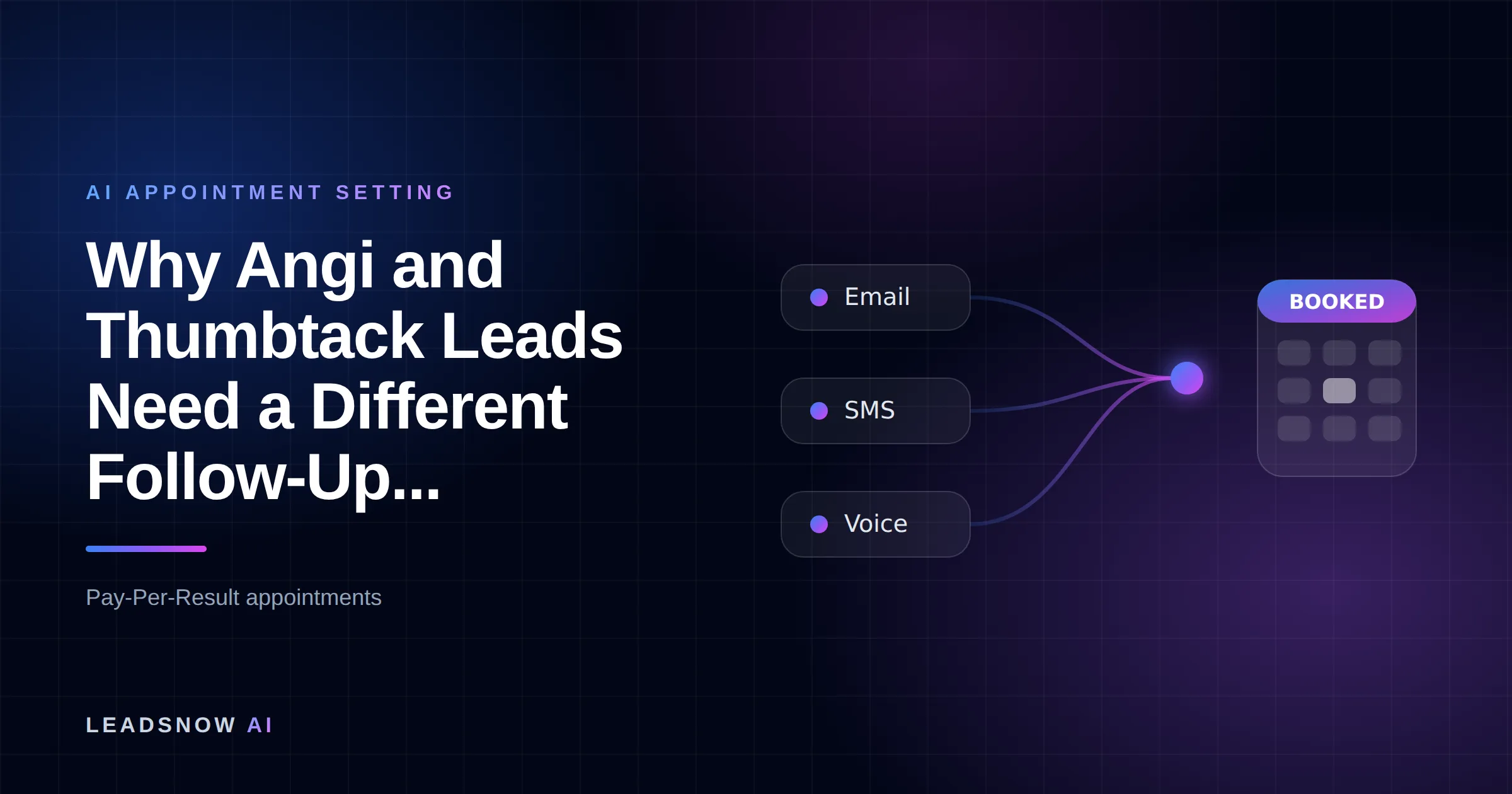
Angi or Thumbtack leads require a different cadence than direct website leads because Angi matches each request with up to five pros and says most closed leads go to the first pro to make contact. Call them within 15 minutes, again next day, and close by day 7; website leads get a longer follow-up.
The short answer from LeadsNow AI: LeadsNow recommends a compressed seven-day cadence for Angi and Thumbtack leads, because Angi matches each request with up to five pros and says most closed leads go to the first pro to make contact, while a website lead that came only to you can be worked patiently over 60 days or more. Run the two lead types on separate clocks in your CRM, so a marketplace lead is never left waiting behind a website nurture sequence.
Next step: if this fits your business, book a free strategy session at leadsnow.ai/strategy-session/ – a 2-minute fit check, then pick a time.
At a glance: marketplace leads vs direct website leads
Marketplace leads and direct website leads differ on four facts that set the cadence: who else got the lead, when you are charged, the credit clock and the buying window.
- Who else got it: Angi says each project request is matched with no more than five pros. A form on your own site went to you.
- When you pay: Angi charges for a lead whether or not you open or respond to it, so the money is spent before your first call.
- The credit clock: to be considered for an Angi credit, the lead must be under 45 days old and you should have tried to call within 24 hours.
- Speed: Angi says calling within 15 minutes more than doubles your chance of connecting, and a second call the next day raises it by 45%.
- Thumbtack: every platform rule on this page is Angi’s. Thumbtack sets its own lead, pricing and credit terms, so check them in your Thumbtack account and help center before copying the cadence.
Rules of thumb
- If a lead was sent to other pros at the same moment, call it within 15 minutes or assume someone else will.
- If a marketplace lead has not replied after about six touches over seven days, mark it lost and move it to occasional email.
- If a website lead goes quiet, keep going: LeadsNow recommends a 60-day nurture before you call it dead.
- Log every call attempt with a timestamp. On Angi, no logged call within 24 hours can cost you a credit.
- Never let one sequence run both lead types. The slow clock kills marketplace leads; the fast clock wastes website leads.
How it works
Running the Shared-Lead Clock on a marketplace lead
Auto-message in 5 minutes
Turn on the platform’s automated reply so the homeowner hears from you first, even after hours.
Call within 15 minutes
Call, leave a voicemail and send a text or in-app message if there is no answer.
Call again on day 2
A next-day call catches homeowners who were busy, before they settle on another pro.
Close the loop by day 7
Mark the lead won or lost, request any credit within the platform’s rules, then move it to low-frequency email.
MAKE MORE SALES.
Pay-Per-Result pricing — We scale sales HARD aligned to your interests, better than anyone else.
Why do Angi or Thumbtack leads require a different cadence than direct website leads?
Angi or Thumbtack leads need a different cadence because a marketplace homeowner is often comparing several pros at once, while a website lead chose only your company.
Three published Angi rules make the difference concrete. A request is matched with up to five pros (Angi Opportunities and leads FAQ). Angi says the majority of closed leads are won by the first pro to contact the homeowner (Angi, Why it’s important to call quickly). And a homeowner who hired another pro before you reached them, or who is “shopping”, is not grounds for a credit. Put together, a marketplace lead is a race with a short finish line. A website lead is a relationship with no starter’s gun, which is why the long, multi-week cadences in our sales cadence examples fit website leads and fail on marketplace ones.
Want this done for you? We book qualified sales appointments on a Pay-Per-Result basis — you only pay for calls that actually land in your calendar.
The Shared-Lead Clock: marketplace and website cadences side by side
The Shared-Lead Clock front-loads about six touches into seven days for a marketplace lead, against roughly twelve touches over 60 days for a direct website lead.
| Window | Marketplace lead (Angi, Thumbtack) | Direct website lead |
|---|---|---|
| 0 to 5 minutes | Touch 1: platform automated message (Angi offers one within 5 minutes; it is off by default) | Touch 1: auto-reply text or email confirming you received the inquiry |
| 5 to 15 minutes | Touch 2: first call; voicemail if no answer | Touch 2: first call as soon as someone is free |
| Same day | Touches 3 and 4: text or in-app message, then a second call | Touch 3: text with photos or reviews |
| Day 2 | Touch 5: next-day call | Touch 4: call |
| Days 3 to 7 | Touch 6: last call or message, then mark won or lost; request any credit within the platform’s rules | Touches 5 to 7: call, email, text |
| Days 8 to 60 | Monthly email only | Touches 8 to 12: weekly, then every two weeks, calls and emails |
The touch counts are a LeadsNow-recommended design, not a measured benchmark: no public dataset compares cadence length by lead source in home services. The timings in the marketplace column follow Angi’s own guidance (automated reply within 5 minutes, call within 15, a next-day call, and follow-up after 24 hours). Which channel to use at each touch is covered in SMS vs email vs call follow-up.
Which follow-up symptoms point to the wrong cadence?
Five common follow-up symptoms trace back to running a marketplace lead on a website clock, or the reverse, and each has a CRM test.
| Symptom | Likely cause | Test that tells the causes apart | Fix |
|---|---|---|---|
| Marketplace leads never pick up | Another pro reached them first | Median minutes to first call, won vs lost marketplace leads | 15-minute first call plus the automated message |
| They answered once, then went quiet | Homeowner is comparing quotes | Lost-reason field: “went with another pro” vs “no decision” | Same-day price range or availability, then the day-2 call |
| Weeks of follow-up, no jobs | Website-length cadence on a decided marketplace buyer | Day of last touch vs day the lead was marked lost | Cut marketplace sequences to 7 days |
| Angi credit requests refused | No logged call within 24 hours, or a reason not on Angi’s list | Credit log against call timestamps | Log every attempt; check the reason list first |
| Website leads convert below marketplace leads | Website leads dropped at day 7 like marketplace leads | Share of website leads touched after day 7 | Separate 60-day website sequence |
If we can’t make you money, we don’t deserve yours.
Pay-Per-Result pricing — performance-based alignment.
Worked calculation: what a slow first call costs on 40 marketplace leads
On 40 marketplace leads a month at an assumed $45 each, raising the connect rate from 25% to 55% cuts cost per won job from $600.00 to $272.73.
Every input except the lead count is a labelled assumption for you to replace: lead price ($45; Angi says its prices vary by task, homeowner location and demand), connect rate by speed, and a 30% win rate once you reach the homeowner. The 55% fast band is set a little above double the 25% slow band, in line with Angi’s claim that a 15-minute call more than doubles your chance of connecting.
| First-call speed (assumption) | Connect rate | Conversations | Won jobs at 30% | Cost per won job |
|---|---|---|---|---|
| Hours later | 25% | 10 | 3.0 | $600.00 |
| Within the hour | 40% | 16 | 4.8 | $375.00 |
| Within 15 minutes | 55% | 22 | 6.6 | $272.73 |
The arithmetic: 40 × $45 = $1,800 spent on arrival. 40 × 25% = 10 conversations, × 30% = 3.0 jobs, and $1,800 ÷ 3.0 = $600.00. At 55%, 22 conversations give 6.6 jobs and $1,800 ÷ 6.6 = $272.73. The same speed gain on a website lead is worth less, because nobody else was notified when the form arrived.
Why do direct website leads reward a longer, slower cadence?
Direct website leads reward a longer cadence because the homeowner picked your company, no platform sold the request to rivals, and you own the contact for future work.
A website inquiry is often earlier in the decision: someone researching a roof replacement for next spring, or comparing a heat pump with a new furnace. Calling within minutes still helps, but quitting at day 7 can throw away leads that are still deciding in week four. Automating the long tail (texts, emails and call reminders that stop when someone replies) is set out in our lead follow-up automation guide, and response-speed set-up for trades is in speed to lead for trade businesses.
Where do Google Local Services Ads leads fit between the two?
Google Local Services Ads leads sit between the two clocks: the homeowner contacted you directly, but Google ranks listings partly on responsiveness.
Google’s ad-ranking page lists responsiveness to customer inquiries and average response time among the factors that decide where your listing shows. So a slow LSA response costs you twice: the lead, and future placement. Run LSA leads on the marketplace clock for the first 24 hours, then on the website clock.
What does it cost to run the marketplace clock yourself?
Running a 15-minute marketplace clock yourself means someone free to call during every hour leads arrive; at 12 hours a day, seven days a week, that is 84 covered hours.
Angi notes that homeowners often submit projects outside typical working hours, and 84 hours is more than two full-time schedules once breaks and days off are counted. The DIY version: turn on the platform’s automated message, route lead alerts to whoever is on call, and keep a shared log of call attempts. If you automate calls or texts, note that US federal rules require the called party’s prior express consent for calls to a mobile number made with an autodialer or an artificial or prerecorded voice (47 CFR 64.1200(a)(1)); this is general information, not legal advice. Some companies hand the first response to an AI appointment setting service so the 15-minute window is covered at night.
Frequently asked questions
These answers cover the questions US contractors ask most about following up Angi, Thumbtack and website leads, with Angi’s own pages linked.
Why do Angi or Thumbtack leads require a different cadence than direct website leads?
Because a marketplace request is shared and decided fast. Angi matches each request with up to five pros and says most closed leads go to the first pro to make contact, so the cadence must be front-loaded. A website lead came to you alone and rewards a longer follow-up.
How fast should I call an Angi lead?
Angi recommends calling within 15 minutes and says doing so more than doubles your chances of connecting with the homeowner; it also says a second call the next day increases your chances of connecting by 45% (Angi help center, read 2026-10-21).
How long should I keep following up a marketplace lead?
LeadsNow recommends about six touches over seven days, then a monthly email. Angi itself suggests trying again after 24 hours and adding the homeowner to your email list, because some homeowners do not find the right contractor straight away.
Do I get credited if an Angi homeowner never answers?
No. Angi lists a homeowner who does not answer calls or return messages among situations accounted for in lead pricing and not eligible for credits (Angi lead credit guidelines).
Should website leads get the same 15-minute call?
Yes, call fast when you can, but do not stop at day 7. A website lead is often earlier in the decision, so LeadsNow recommends a 60-day sequence of calls, texts and emails that stops when the homeowner replies.
Pay-Per-Result appointments
See if we’re a fit
We book qualified sales appointments for you and you pay on results, not retainers. Our booking page asks a few quick questions so you find out in two minutes whether that model suits your business.
- 50,769+ appointments booked without cold calling.
- Pay-Per-Result pricing — you pay for booked, qualified calls.
- Pick your own time on our live calendar, no phone tag.