
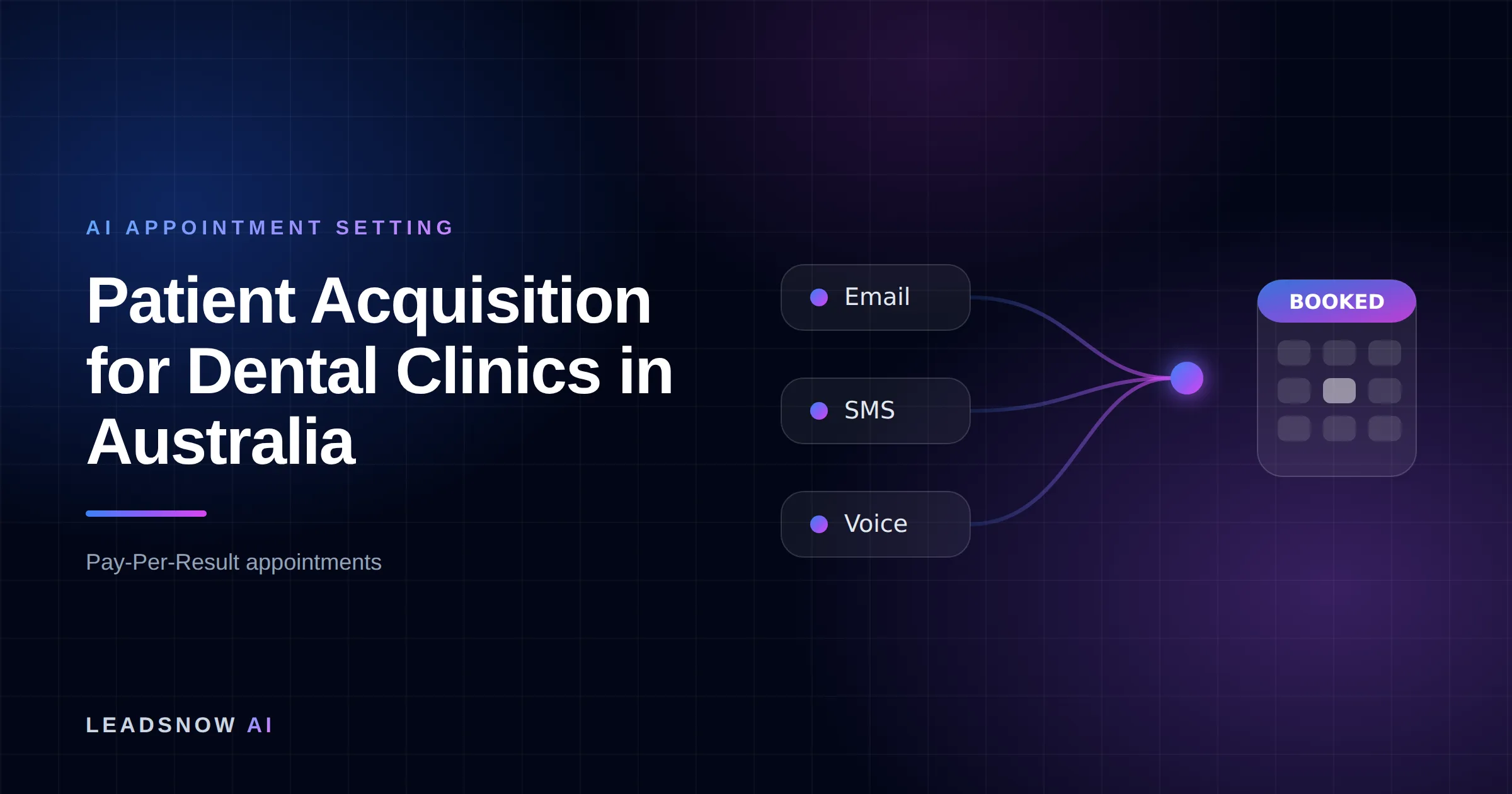
Last updated: July 25, 2026 · LeadsNow AI, Melbourne
At a glance: Dental practices in Australia advertise under the National Law: no testimonials about clinical care, tightly conditioned before-and-after images, and penalties of up to $60,000 per offence for individuals ($120,000 for companies). The fastest compliant growth levers sit outside advertising — answering new-patient enquiries within minutes, reactivating lapsed patients from your recall list, and qualifying every enquiry before it reaches your book — paid on results.
Why patient acquisition is harder for dental clinics than for most local businesses
A landscaper can plaster five-star customer quotes across their ads, run a flash discount with no fine print, and promise whatever outcome they like. A dental practice cannot. Dentistry is a regulated health service under the Health Practitioner Regulation National Law, which means every ad, every social post promoting the practice, and every page of the practice website has to clear rules that most marketing agencies have never read. (If you’re weighing up providers, our comparison of Australia’s dental marketing agencies ranks the AHPRA-aware specialists.)
That creates two problems. First, generic agencies routinely put dental practices at regulatory risk by importing tactics — review widgets in ads, “smile transformation” testimonials, urgency offers — that are lawful for tradies and unlawful for dentists. Second, because paid advertising is so constrained, practices over-spend on the one channel where the rules are tightest and under-invest in the channels the rules leave wide open: response speed on the enquiries they already get, and the lapsed patients already sitting in their practice management software.
This page covers both halves: what the regulator actually says (verified against Ahpra and Dental Board of Australia sources, linked below — not agency folklore), and then a patient acquisition system built for the parts of growth the rules don’t restrict. The same section 133 constraints apply just as tightly to allied health practices — physio, podiatry, psychology and similar Ahpra-regulated services — covered separately in our guide to lead generation for allied health clinics in Australia.
How it works
How an AI sales agent books your appointments
Six channels feed in
Outbound email, SMS, voice and social — plus inbound search and AI referrals from our own AI SEO and chat agents.
Your list or CRM
Outbound starts from data you already own — past enquiries, dormant customers, or a targeted prospect list.
Qualified against your rules
Budget, timing and fit are checked before anything reaches your team, using criteria you set.
Booked into your calendar
Only qualified prospects reach the booking step, so your closers spend their time selling.
MAKE MORE SALES.
Pay-Per-Result pricing — We scale sales HARD aligned to your interests, better than anyone else.
Ahpra-compliant advertising for dental practices: what the rules actually say
The advertising requirements sit in section 133 of the National Law, explained in Ahpra and the National Boards’ Guidelines for advertising a regulated health service. They apply to anyone advertising a regulated health service — practitioners, practice owners and companies alike. The Dental Board of Australia’s advertising page restates the same obligations for dental practitioners. Everything below is drawn directly from those two sources.
1. The five things section 133 prohibits
Under section 133(1) of the National Law, a person must not advertise a regulated health service, or a business that provides one, in a way that:
- is false, misleading or deceptive, or is likely to be misleading or deceptive;
- offers a gift, discount or other inducement without also stating the terms and conditions of the offer;
- uses testimonials or purported testimonials about the service or business;
- creates an unreasonable expectation of beneficial treatment; or
- directly or indirectly encourages the indiscriminate or unnecessary use of regulated health services.
Note the second point: promotions like new-patient specials aren’t banned outright, but the terms and conditions must appear in the ad itself. And the last point is why countdown timers and “book before Friday” pressure tactics common in other industries are dangerous territory for a dental practice.
2. Testimonials about clinical care are prohibited in advertising
Section 133(1)(c) specifically prohibits advertising a regulated health service using testimonials or purported testimonials — the guidelines give patient stories, success stories and fake testimonials as examples. Ahpra defines a testimonial as a recommendation or positive statement about the clinical aspects of a regulated health service used in advertising: the patient’s symptom or reason for treatment, the diagnosis or treatment provided, or the outcome and the practitioner’s skill.
Two nuances matter for dental practices:
- Patients can still post reviews. The guidelines are explicit that the prohibition doesn’t stop patients sharing views on review platforms. The breach happens when the advertiser uses those reviews to advertise — for example, pulling a Google review praising your crown work into a Facebook ad or a website banner.
- Not every positive comment is a testimonial. Comments about customer service or communication style that don’t touch clinical aspects aren’t testimonials under the National Law. But “Dr Nguyen fixed my tooth pain in one visit” clearly is.
3. Before-and-after photos: allowed, but heavily conditioned
Before-and-after images of dental work aren’t banned, but the guidelines warn that they “have the potential to be misleading or deceptive” and may create unreasonable expectations of a successful outcome. Per the guidelines, such images are less likely to be misleading if:
- the images are as similar as possible in content, camera angle, background, framing and exposure;
- posture, clothing and make-up are consistent;
- lighting and contrast are consistent;
- any alteration to the images is explained; and
- the referenced treatment is the only visible change to the person photographed.
In practice: no filters, no whitening the “after” shot in editing, no cherry-picking angles — and the images should be your own genuine cases, since the false-and-misleading limb of section 133 applies on top.
4. Titles and claims
The National Law also protects titles under sections 113 to 120, alongside the advertising rules. Advertising must not imply qualifications, skills or registration a practitioner doesn’t hold — the guidelines flag post-nominals and membership abbreviations that overstate expertise as a risk area. Separately, dental practitioners who advertise higher risk non-surgical cosmetic procedures (such as injectables) are covered by Ahpra’s Guidelines for advertising higher risk non-surgical cosmetic procedures, in effect since 2 September 2025 and linked from the Dental Board’s advertising page.
5. Penalties: they went up 12-fold in 2022
According to the Dental Board’s advertising page, the National Law was amended in 2022 to increase the maximum penalty for advertising offences: for an individual, from $5,000 to $60,000 per offence; for a body corporate, from $10,000 to $120,000 per offence. As of July 2024 the increased penalties apply in all jurisdictions, including Western Australia. “Per offence” is the phrase to sit with — a single non-compliant campaign can contain many offences.
None of this is legal advice, and Ahpra itself won’t pre-approve your ads (the guidelines say so). It’s the reason our system is built to generate patients from channels that don’t depend on aggressive public advertising in the first place.
Want this done for you? We book qualified sales appointments on a Pay-Per-Result basis — you only pay for calls that actually land in your calendar.
Traditional dental marketing vs pay-per-result AI patient acquisition
| Traditional agency retainer | Pay-per-result AI patient acquisition | |
|---|---|---|
| What you pay for | Activity — ads managed, posts published, reports sent — whether or not patients arrive | Results — qualified new-patient appointments on your book |
| Compliance exposure | Concentrated in public advertising, exactly where section 133 risk lives | Low — the system works your own enquiries and existing patient database, using factual, approved scripts rather than public claims |
| Speed to first booked patient | Typically months of creative testing and ad-spend ramp | Days to weeks — enquiries you already receive and patients already in your software |
| Your existing database | Usually ignored; focus is on strangers | Central — lapsed patients and overdue recalls are the first campaign |
| After-hours enquiries | Ring out or sit in an inbox until morning | Answered by AI within minutes, 24/7 |
| Risk if it underperforms | The retainer is owed regardless | Cost tracks results, so the incentive stays aligned with the practice |
Where compliant growth actually comes from
Speed-to-lead: the enquiries you already have are leaking
Most practices lose new patients not for lack of enquiries but for slow response. A parent comparing two clinics for their child’s check-up fills in both websites’ forms; the practice that responds in two minutes usually wins the family, and the one that responds tomorrow morning gets a voicemail that’s never returned. Nothing in the National Law restricts how fast you answer your own enquiries — it’s the highest-leverage move available and it carries essentially zero advertising risk.
Our speed-to-lead automation responds to every website form, missed call and message enquiry within minutes, around the clock, then nurtures until the appointment is booked and confirmed. Book a call to see what that response layer would look like wired into your practice.
Database reactivation: your recall list is an asset, not an archive
Every established practice sits on years of lapsed patients — people overdue for recall, incomplete treatment plans, patients who got a quote and went quiet. Contacting your own former patients with a factual “you’re due for a check-up” message is recall communication, not mass-market advertising, and it converts far better than cold traffic because the trust already exists.
Our database reactivation service works those lists systematically: segmenting by lapse reason, contacting in waves via SMS and AI voice, and booking respondents straight into your appointment software. No ad spend, no new creative to get compliance-checked — just patients you’ve already served, invited back.
Qualification before booking: protect chair time
A full diary of no-shows and price-shoppers is worse than a lighter diary of committed patients. Before anything reaches your book, our AI voice agents and chat flows confirm what the enquiry is actually about, check the basics (location, availability, whether they’re an existing patient), answer routine questions from your approved information, and hand anything clinical straight to your team — the AI never gives clinical advice. Qualified enquiries get booked and reminded; everyone else gets a polite, factual response that costs your front desk nothing.
If we can’t make you money, we don’t deserve yours.
Pay-Per-Result pricing — performance-based alignment.
Pay-per-result: aligning our incentive with your practice
Straight answer to the question you should ask any agency: we don’t have dental clinics on our client list today. What we do have is a decade of the exact mechanics dental growth depends on — instant enquiry response, database reactivation and AI qualification — proven across service industries: 50,769+ AI-booked sales appointments since 2017 and 1M+ leads generated, with 25 filmed client case studies and a 4.6-star rating across 43 Google reviews. Clients like 121 Brokers, Colliers, Iron Body, Foundr and SheSells.online run on the same system we’d deploy for a dental practice — and we’ve built the same regulation-first playbook for Australia’s strictest advertising environment, cosmetic clinics, where the same National Law rules apply with extra layers on top.
Because the model is pay-per-result, the economics stay honest: our revenue depends on qualified appointments landing in your book, not on a retainer clearing each month. For a dental practice, the maths runs on lifetime value — a retained patient means years of recalls, hygiene visits and treatment, and often a family behind them — so a system that reliably converts enquiries and revives lapsed patients pays for itself out of patients you were otherwise losing silently.
Frequently asked questions
Can dental clinics use patient testimonials or Google reviews in their advertising?
No — not where they concern clinical care. Section 133(1)(c) of the National Law prohibits advertising a regulated health service in a way that “uses testimonials or purported testimonials about the service or business”, and Ahpra’s Guidelines for advertising a regulated health service define a testimonial as a positive statement about the clinical aspects — symptoms, diagnosis or treatment, or outcomes. Patients remain free to post reviews on independent platforms; the breach occurs when the practice uses those reviews in its own advertising.
Are before-and-after photos of dental work allowed in Australia?
They’re not prohibited, but Ahpra’s advertising guidelines warn they have the potential to be misleading or deceptive and to create unreasonable expectations. They’re less likely to be misleading if the images match in angle, framing, lighting and exposure, if any alteration is disclosed, and if the advertised treatment is the only visible change in the photos. Edited or enhanced images are called out specifically as a risk.
What are the penalties for breaching the advertising rules?
Following a 2022 amendment to the National Law, the maximum financial penalty for an advertising offence is $60,000 per offence for an individual and $120,000 per offence for a body corporate, and the Dental Board of Australia notes these increased penalties have applied in all jurisdictions, including Western Australia, since July 2024. Registered practitioners can additionally face disciplinary action.
Does AI-powered enquiry follow-up create Ahpra compliance risk?
Handled properly, it reduces risk. The National Law’s advertising rules govern public promotion of the service; responding quickly to a patient’s own enquiry, sending recall reminders to existing patients, and confirming appointments are operational communications. Our AI works from factual, practice-approved scripts, makes no clinical claims or outcome promises, and routes every clinical question to your team.
Have you worked with dental clinics before?
Not yet — and we won’t pretend otherwise. Our track record is cross-industry: 50,769+ AI-booked sales appointments since 2017 and 1M+ leads generated across service businesses in Australia and internationally — none of them dental clinics, which is why this page leans on verified regulation and transferable mechanics rather than borrowed case studies. The mechanics a dental practice needs — instant enquiry response, recall-list reactivation, qualification before booking — are the mechanics we’ve been running for years.
See it mapped onto your practice
Bring your current enquiry volume and a rough count of lapsed patients in your practice software, and we’ll walk through — concretely, not hypothetically — what an Ahpra-conscious enquiry-and-recall system would look like for your clinic, and how pay-per-result pricing would apply. Book a call.
Pay-Per-Result appointments
See if we’re a fit
We book qualified sales appointments for you and you pay on results, not retainers. Our booking page asks a few quick questions so you find out in two minutes whether that model suits your business.
- 50,769+ appointments booked without cold calling.
- Pay-Per-Result pricing — you pay for booked, qualified calls.
- Pick your own time on our live calendar, no phone tag.