
Multi-site physiotherapy, podiatry, psychology and allied health groups lose more revenue to empty slots and lapsed patients than to a shortage of enquiries. Section 133 of the Health Practitioner Regulation National Law bans testimonials in advertising a regulated health service, with maximum penalties of $60,000 (individual) and $120,000 (body corporate) per offence — the funnel most lead-gen agencies default to is illegal here.
The short answer: Allied health clinics with real patient volume can’t run the testimonial-led, review-farming funnels that work for gyms or trades — Ahpra’s advertising guidelines ban it outright. What actually moves revenue at multi-site scale is filling the appointment book you already have: reactivating lapsed patients from your own consented database, catching after-hours enquiries reception misses, and doing it without buying a list, because patient contact details are health information under the Privacy Act.
Who this page is for
This is written for allied health groups that already have volume — three or more sites, a full-time reception team, a waitlist that fluctuates by clinician rather than by demand, and a marketing budget that currently goes on Google Ads, a practice management system and maybe an external SEO retainer. It is not written for a solo practitioner opening their first clinic. If that is you, most of what follows — recall automation, multi-site rostering, referral-stream segmentation — will be overkill. Our clients are operators who already have patients and want to convert more of the ones they have, not acquire their first ten.
How it works
How an AI sales agent books your appointments
Six channels feed in
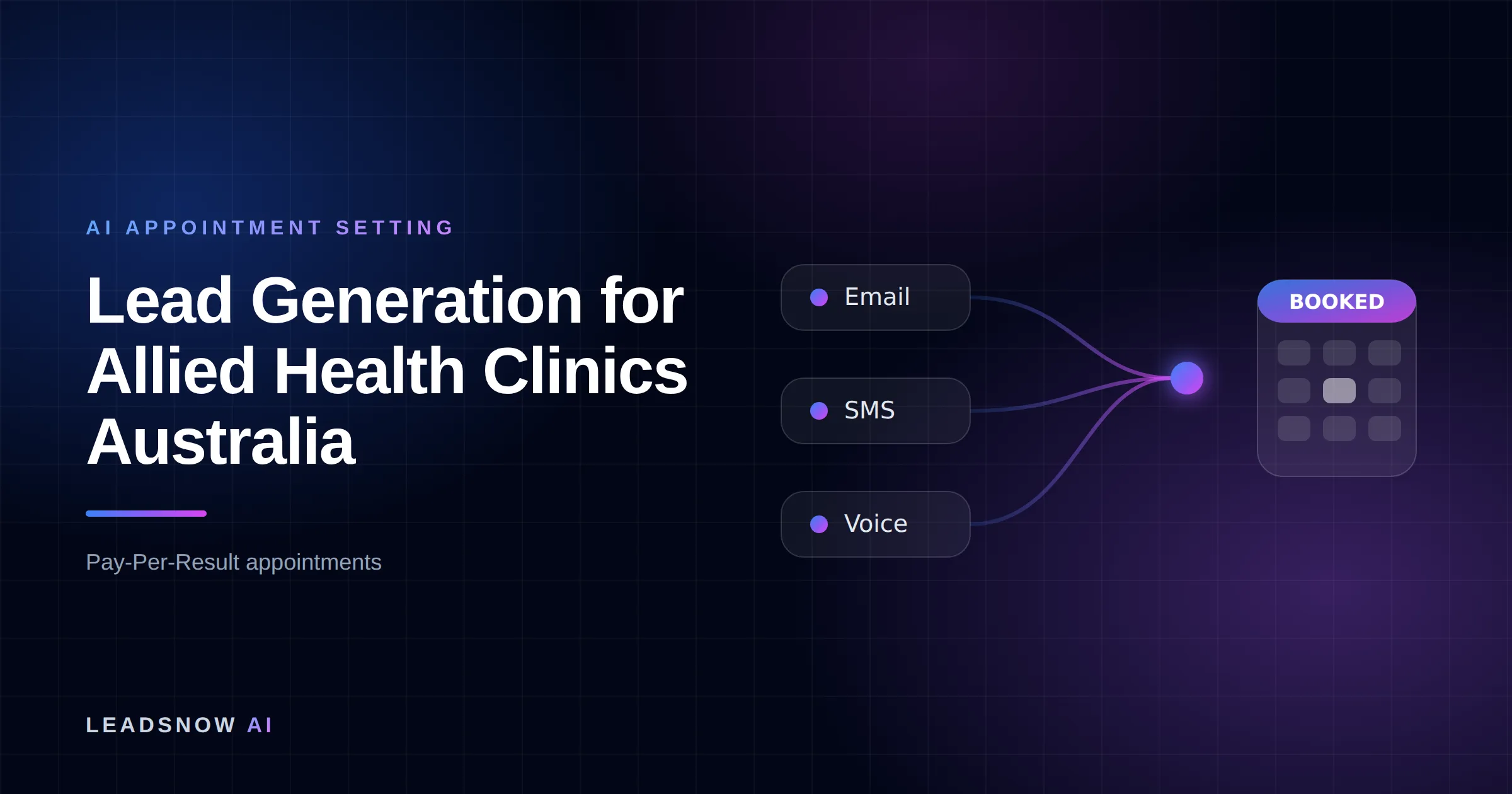
Outbound email, SMS, voice and social — plus inbound search and AI referrals from our own AI SEO and chat agents.
Your list or CRM
Outbound starts from data you already own — past enquiries, dormant customers, or a targeted prospect list.
Qualified against your rules
Budget, timing and fit are checked before anything reaches your team, using criteria you set.
Booked into your calendar
Only qualified prospects reach the booking step, so your closers spend their time selling.
MAKE MORE SALES.
Pay-Per-Result pricing — We scale sales HARD aligned to your interests, better than anyone else.
The advertising rule that generic lead-gen agencies get wrong
Every regulated health service in Australia — and physiotherapy, podiatry, psychology, occupational therapy and chiropractic are all Ahpra-registered professions — sits under the Ahpra and National Boards’ Guidelines for advertising a regulated health service, made under section 133 of the Health Practitioner Regulation National Law. The guidelines set out that advertising a regulated health service must not:
- be false, misleading or deceptive, or likely to be misleading or deceptive;
- use testimonials or purported testimonials about the service or the business;
- create an unreasonable expectation of beneficial treatment;
- offer a gift, discount or other inducement to attract a patient, unless the advertisement also states the terms and conditions of that offer; or
- directly or indirectly encourage the indiscriminate or unnecessary use of a regulated health service.
Ahpra’s own testimonial guidance is specific: a testimonial is a positive statement about the clinical aspects of care — “my knee pain is gone”, “she fixed my back” — and those are banned in advertising regardless of who posts them or where. A comment purely about parking, wait times or front-desk friendliness is not a clinical testimonial and generally isn’t caught. That distinction is narrow enough that most clinics get it wrong by accident, not by design. The maximum financial penalty for a section 133 breach is $60,000 per offence for an individual practitioner and $120,000 per offence for a body corporate, and a breach also constitutes unprofessional conduct for the practitioner named in the advert.
Want this done for you? We book qualified sales appointments on a Pay-Per-Result basis — you only pay for calls that actually land in your calendar.
What the testimonial ban actually means for growth
This is the single most useful thing this page can tell you: an allied health clinic cannot run the review-and-testimonial-led acquisition funnels that work in almost every other local-service vertical. The Google review widget on your homepage quoting a patient’s outcome, the Meta ad built around a five-star review, the “before and after” case study post — all of it is either explicitly prohibited advertising conduct or sits close enough to the line that a group operating across multiple sites is taking on real regulatory risk at multiple, independently reportable locations at once. It also means we can’t market this service to you using a health-industry testimonial, which is why the proof points on this page are volume and rating figures, not quoted patient stories. If you see a lead-gen agency pitching you a review-funnel or testimonial-driven landing page for a regulated health service, that is the fastest way to identify an agency that hasn’t read the guidelines that apply to your industry — the same gap we cover for cosmetic clinics on our cosmetic clinic lead generation page and for dental practices on our dental patient acquisition page, both of which sit under the same section 133 constraint.
Patient data is sensitive information — what that rules in and rules out
Health information, including a patient’s name and contact details collected in the course of providing care, is sensitive information under the Privacy Act 1988 and the Australian Privacy Principles. The OAIC’s Guide to Health Privacy is explicit that this stricter category applies to physiotherapists, podiatrists, psychologists, occupational and speech therapists and other allied health professionals directly, and that direct marketing using sensitive information is only permitted with the patient’s implied or express consent. The OAIC’s guidance on communications with patients confirms implied consent is reasonable for recalls, follow-up and appointment reminders where the patient has previously received or discussed that service with you — which is exactly the reactivation use case below.
The practical consequence: you can reactivate your own consented patient base — the people who have already been through your intake process and received care from you. You cannot buy or rent a third-party list of “people who might need physio” and cold-contact them; that data was never collected for that purpose and no consent exists. Any recall or reactivation SMS or call also has to clear Do Not Call Register and Spam Act 2003 obligations on top of the Privacy Act consent question — we cover the mechanics of that, including sender ID and unsubscribe handling, on our SMS sender ID registration page, and the broader compliance layer that applies to AI-run outbound across regulated sectors on our AI outbound for regulated industries page.
If we can’t make you money, we don’t deserve yours.
Pay-Per-Result pricing — performance-based alignment.
The operational problem worth solving at multi-site scale
For a single clinic, a quiet week is a cash-flow problem. For a group running several sites, it’s a rostering and utilisation problem multiplied by however many clinicians are on the books, and it tends to show up in three places:
- Unfilled appointment slots. A cancellation two hours out rarely gets backfilled manually, and across five sites that’s a meaningful chunk of billable clinician time gone every week.
- Lapsed patients. Discharged or dormant patients on a chronic disease management plan, a maintenance program, or simply patients who haven’t rebooked, sit in the practice management system as a database rather than a pipeline.
- After-hours and in-session enquiries. Reception is with a patient, the phone rings, and the enquiry either goes to voicemail or is lost. At one site that’s an annoyance; across a group it’s a recurring, quantifiable leak.
Multi-site groups also run referral streams that a solo clinic typically doesn’t: NDIS plan-managed and self-managed referrals, workers compensation claims routed through an insurer or case manager, and DVA-funded care for eligible veterans. Each of these is a distinct channel with its own intake paperwork, approval steps and billing rules, and each adds administrative load on top of the direct-booking patient flow rather than replacing it. We haven’t verified per-channel volume or growth figures for NDIS, workers compensation or DVA referrals into allied health and we’re not going to quote numbers we can’t stand behind — the point here is that these streams need to be handled as separate admin workflows, not folded into the same recall sequence as a fee-paying direct patient.
Where the reactivation numbers come from — and where they don’t
Reactivating a dormant, already-consented database is the strongest-fitting growth lever on this page, because it’s the one channel that is both compliant under the testimonial ban and doesn’t require new enquiry volume. The clearest proof we have of what a well-run reactivation campaign can do comes from our work on a Colliers-era commercial property database: 4.4% average reactivation rate, 8.9% at peak. That is a result from a property database, not a healthcare one, and we are not claiming or implying we have achieved that rate reactivating a patient base — a property lead and a patient recall have different consent bases, different messaging constraints and a different sales cycle. We’re citing it because it is the closest evidence we have for what disciplined, consented-list reactivation can do against a stale database, and because it’s the only reactivation figure on our books we can actually stand behind.
Set against that: LeadsNow has booked 50,769+ AI-driven sales appointments since 2017 and generated 1M+ leads across the client base, backed by 25 filmed case studies and a 4.7 rating from 60 Google and Facebook reviews. None of those figures are allied-health-specific — we don’t have a named allied health client to point to yet, and we’re not going to invent one.
Growth channel comparison for multi-site allied health groups
| Growth channel | Compliant under Ahpra advertising guidelines? | What it costs the clinic | Where it breaks at multi-site scale |
|---|---|---|---|
| Testimonial-led social ads / review widgets | No — testimonials about clinical outcomes are prohibited under s133 | Ad spend plus creative production | Risk multiplies per site; no single person can audit every location’s posts and ads |
| Cold outreach to a purchased contact list | No — health information can’t be sourced without consent, and a purchased list has none | List cost plus outreach platform | Barred outright once the data is health information, not a grey area |
| Referral marketing to local GPs (EPC/CDM plans) | Yes, if factual and non-inducement | Rep time, relationship management | Depends on individual GP relationships that don’t transfer between sites or staff turnover |
| Informational SEO content (non-clinical-claim) | Yes | Ongoing content production | Slow to compound; doesn’t solve this week’s empty slots |
| Generic call centre / VA answering script | Yes, but easy to breach without training | Headcount or outsourced seat cost | No consent ledger, no consistent script discipline across sites, no after-hours coverage |
| Own-database recall and reactivation (SMS/voice, consented patients) | Yes, subject to consent and Spam Act/Do Not Call rules | Platform and messaging cost, no new-enquiry ad spend | Needs a consent ledger and practice-management integration per site to run correctly |
How this plays out across the different allied health professions
The regulatory constraint is the same across physiotherapy, podiatry, psychology, occupational therapy and chiropractic — all are Ahpra-registered and all sit under the same section 133 advertising rules, with no exemption for chiropractic. Exercise physiology and dietetics are not Ahpra-registered professions in Australia, so this specific advertising regime does not apply to them the same way. What differs among the registered professions is the demand pattern. Physiotherapy tends to run recurring treatment plans with a natural recall point (a program review, a re-assessment). Psychology often runs on a Mental Health Treatment Plan cycle with a hard session cap that creates a predictable re-engagement window. Podiatry sees more one-off and seasonal bookings alongside chronic-condition management. None of this changes the core mechanic: a group with real patient volume has a recall point built into its clinical model already, and that recall point is the legal, compliant growth lever — not a new testimonial-led funnel copied from a different industry.
Frequently asked questions
Can we use patient testimonials in our advertising?
No. The Ahpra guidance on testimonials confirms that advertising a regulated health service — including physiotherapy, podiatry, psychology, occupational therapy and chiropractic — must not use testimonials or purported testimonials about the clinical aspects of the service, regardless of platform. A comment about parking or reception friendliness that makes no reference to clinical care generally isn’t caught, but the safest position is to build your marketing without relying on patient quotes at all.
Is a patient’s phone number or email considered health information?
Yes. Contact details collected in the course of providing a health service form part of a patient’s health information, which is sensitive information under the Privacy Act 1988. That means direct marketing using those details requires the patient’s implied or express consent — it isn’t treated the same as a generic marketing contact list.
Can we buy or use a third-party patient list for outbound marketing?
No. Because patient contact details are health information, you need consent to use them for marketing, and a purchased or rented list carries none. The only list you can legally market to is your own consented patient base — people who have actually been through your intake and care process.
Do NDIS, workers compensation and DVA referrals count as advertising under Ahpra’s rules?
The section 133 restrictions apply to advertising the service or business, not to the referral or claims administration itself. NDIS, workers compensation and DVA referrals are separate intake and billing workflows with their own approval steps, and treating them as just another segment in a marketing recall sequence is the most common way groups create avoidable admin friction.
Can we send SMS reminders and recall messages without breaching the Spam Act or Do Not Call Register?
Yes, where consent exists and the message identifies your business and provides an opt-out, appointment reminders and clinically-related recalls are standard practice and the OAIC’s guidance on communications with patients treats implied consent as reasonable for this use case. The sender ID and unsubscribe mechanics are covered on our SMS sender ID registration page.
Does the 4.4%/8.9% reactivation figure apply to allied health?
No, and we want to be direct about that. That result came from a commercial property database (Colliers), not a healthcare one. We cite it as the closest evidence we have for what a disciplined, consented-database reactivation campaign can achieve, not as a claim about what we’ve done in an allied health setting.
Do you have allied health clients you can name?
Not yet. Our named case studies — Sam Tajvidi at 121 Brokers, Colliers, Marcus Wilkinson at Iron Body, Foundr, SheSells.online and Lambda Academy — sit in other verticals. The 50,769+ AI-booked appointments and 1M+ leads figures are across our full client base, not allied health specifically, and we’re telling you that rather than implying otherwise.
Running a dental practice rather than an allied health clinic? Our comparison of the best dental marketing agencies in Australia covers seven options, from pay-per-result to dental-only full-service.
Pay-Per-Result appointments
See if we’re a fit
We book qualified sales appointments for you and you pay on results, not retainers. Our booking page asks a few quick questions so you find out in two minutes whether that model suits your business.
- 50,769+ appointments booked without cold calling.
- Pay-Per-Result pricing — you pay for booked, qualified calls.
- Pick your own time on our live calendar, no phone tag.