
A woman in Carlton searches “skin clinic near me” at 7:52 on a Tuesday night, fills in your enquiry form, and puts the kettle on. If your med spa answers her in four minutes, that enquiry usually becomes a consult. If you answer her at 9:15 the next morning, she has often already booked with the clinic two suburbs over. Most Australian med spas don’t have a marketing problem. They have a response-speed problem, a no-show problem, and a dormant-list problem — all wrapped in some of the strictest health advertising rules in the world.
At a glance: how do med spas in Australia get more patient bookings?
Answer every enquiry within minutes, seven days a week. Reactivate the dormant patients already sitting in your booking software. Keep every public ad inside Ahpra and TGA rules. LeadsNow.ai runs that system for you — AI speed-to-lead, database reactivation and appointment booking — and charges per result rather than a retainer. Across industries since 2017: 50,769+ AI-booked sales appointments and 1M+ leads generated.
How it works
How an AI sales agent books your appointments
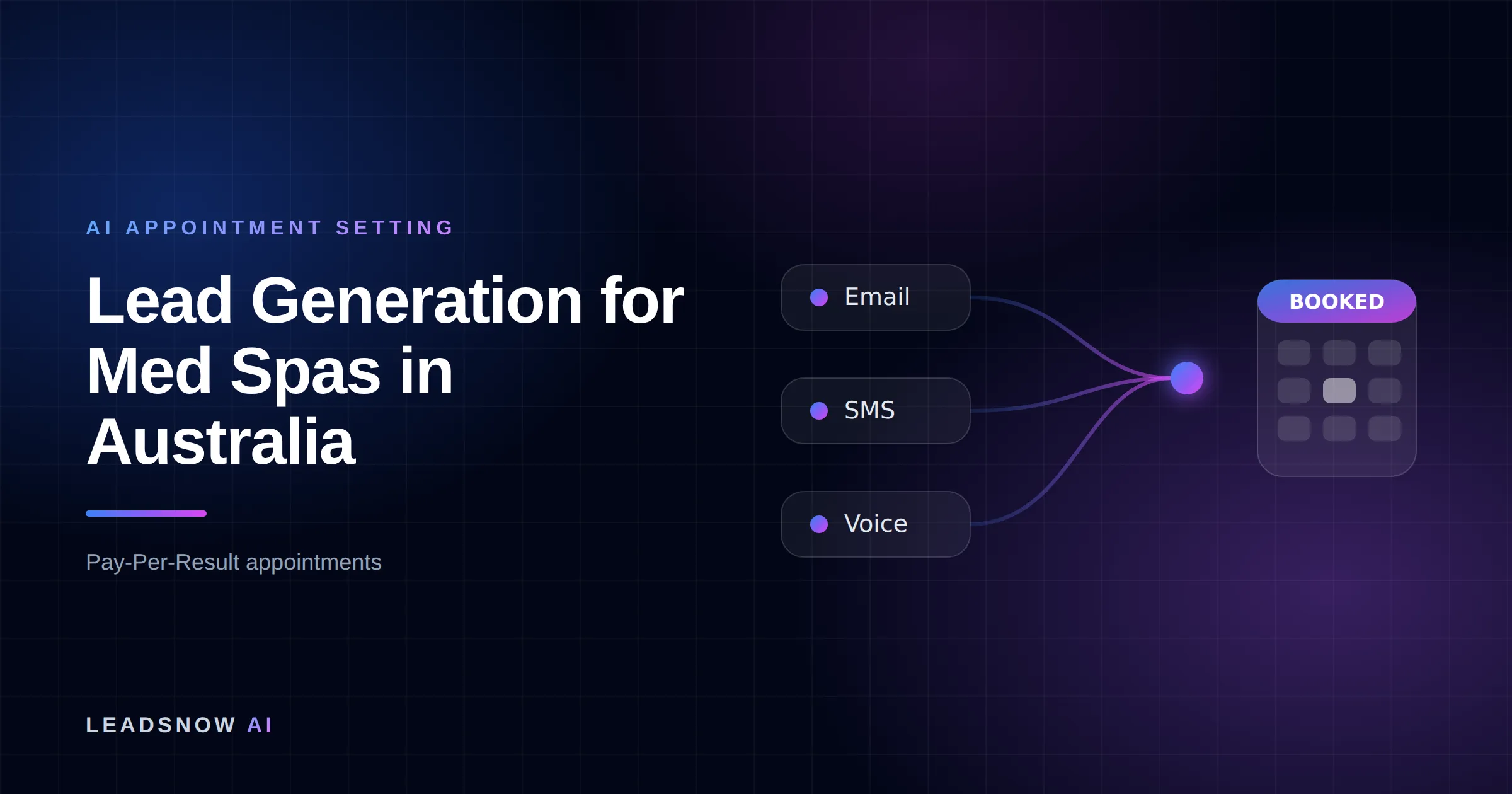
Six channels feed in
Outbound email, SMS, voice and social — plus inbound search and AI referrals from our own AI SEO and chat agents.
Your list or CRM
Outbound starts from data you already own — past enquiries, dormant customers, or a targeted prospect list.
Qualified against your rules
Budget, timing and fit are checked before anything reaches your team, using criteria you set.
Booked into your calendar
Only qualified prospects reach the booking step, so your closers spend their time selling.
MAKE MORE SALES.
Pay-Per-Result pricing — We scale sales HARD aligned to your interests, better than anyone else.
Who this page is for (and who it isn’t)
This page is for the medi-aesthetics market: med spas, skin clinics, laser and dermal clinics, and injectables-led practices run by nurses and cosmetic physicians. If you run a cosmetic surgery practice — surgical procedures, “surgeon” title rules, referral pathways — that’s a different regulatory and commercial animal, and we’ve written a separate page for it: lead generation for cosmetic clinics in Australia. And if you operate in the United States, where the rules are HIPAA and TCPA rather than Ahpra and TGA, see our US med spa page instead. Everything below is Australian: Australian regulators, Australian patient behaviour, and AUD economics where honest local data exists.
Want this done for you? We book qualified sales appointments on a Pay-Per-Result basis — you only pay for calls that actually land in your calendar.
The rules you market under: Ahpra and the TGA
Any agency calling itself a med spa marketing agency in Australia should be able to recite these rules before it spends a dollar of your money. Two regulators matter.
Ahpra: section 133 of the National Law
If your clinic advertises a regulated health service — and most med spa treatment menus do — Ahpra’s advertising guidelines, made under section 133 of the National Law, say your advertising must not:
- be false, misleading or deceptive, or likely to be;
- use testimonials or purported testimonials about the service or business (s.133(1)(c));
- offer a gift, discount or other inducement without stating the terms and conditions;
- create an unreasonable expectation of beneficial treatment — no “guaranteed”, “sure”, “miraculous” results, expressly or by omission;
- encourage indiscriminate or unnecessary use of health services.
The testimonial rule has a nuance most clinics get wrong in both directions. Patients posting reviews on Google or other review platforms is fine — Ahpra’s testimonial guidance is explicit that the prohibition “does not affect patients sharing information, expressing their views online or posting reviews on review platforms”. What you cannot do is use those reviews in your own advertising when they speak to clinical aspects — symptoms, treatments, outcomes. Screenshot a five-star review about your dermal needling results and put it in a Meta ad, and you’ve converted a lawful review into an unlawful testimonial.
TGA: prescription-only injectables cannot be advertised — at all
Most cosmetic injectables are Schedule 4, prescription-only substances, and the TGA’s guidance on advertising health services is blunt: “When advertising a cosmetic service, do not refer to prescription medicines or substances – even indirectly. This includes: brand names, acronyms or abbreviations, colloquial names or nicknames, hashtags.” The old workarounds are gone too — the TGA now treats generic phrases such as “wrinkle reducing injections” and “dermal filler” as substitute references to prescription medicines. You can advertise the consultation and the service; you cannot advertise the product. You’ll notice we haven’t named a single injectable brand anywhere on this page. That’s not an oversight. That’s the discipline your marketing partner needs by default.
This is why cookie-cutter aesthetic-clinic funnels imported from the US fail here. Their highest-performing hooks — brand names, before/after reels, patient testimonial video — are precisely the things Australian regulators prohibit.
What a new patient actually costs
There’s no public Australian dataset on med spa patient acquisition cost, so treat the best available numbers — which are US figures, in USD — as directional benchmarks rather than gospel. A 2026 benchmark analysis by Cakesmash Media, drawing on First Page Sage data, puts the average med spa patient acquisition cost at about US$285, with organic search delivering patients at roughly US$215 against US$291 for paid social. On the revenue side, the American Med Spa Association’s 2022 State of the Industry executive summary measured average spend per patient per visit at US$536.
The shape of those numbers travels even where the exact figures don’t: a single visit roughly pays back acquisition, and the real money is in the second, fifth and tenth visit. Which means the cheapest growth available to almost every established Australian med spa isn’t a bigger ad budget — it’s the enquiries you already paid for and the patients who already know you.
If we can’t make you money, we don’t deserve yours.
Pay-Per-Result pricing — performance-based alignment.
Med spa lead channels compared
| Channel | What it does well | Where it leaks | Ahpra/TGA exposure |
|---|---|---|---|
| Paid social (Meta, TikTok) | Volume and reach fast; strong for skin, laser and membership offers; precise local targeting. | Attracts browsers as well as bookers; leads go cold within minutes if not answered; US benchmark CAC is the highest of the major channels (~US$291). | High. The formats that perform best — testimonial-style UGC, before/afters, injectable references and hashtags — are exactly what s.133 and the TGA restrict. |
| Google (search, Maps, reviews) | Captures high-intent “near me” demand; reviews may lawfully accumulate on the platform; compounds over time via SEO. | Aesthetic-keyword CPCs are expensive; slow to scale; an unanswered enquiry from Google costs more than one from social. | Moderate. Ad copy is still bound by s.133 — no outcome guarantees, no product references — but the format is less testimonial-prone. |
| AI follow-up + database reactivation | Works the leads and lapsed patients you already own; responds in minutes, 7 days; typically the lowest-cost bookings a clinic can generate; suits pay-per-result pricing. | Needs an existing enquiry flow or patient list to work on; won’t build brand awareness on its own; requires clean consent and opt-out hygiene. | Low. Private one-to-one conversations with people who contacted you are not public advertising — though claims made in them still have to be honest. |
The honest read: you probably need the first two channels in some proportion. But the third is where most Australian med spas are leaving the easiest revenue on the table, because it isn’t a media buy — it’s an operations fix.
Where Australian med spas actually leak bookings
1. The 7:52pm enquiry that gets answered at 9:15am
Med spa enquiries arrive on evenings and weekends, when your front desk is busy with the patients already in the clinic — or closed. Every hour of delay hands intent to a competitor. Our AI answers new enquiries in minutes, around the clock, qualifies them in natural conversation, and books them straight into your calendar. The mechanics are laid out on our speed-to-lead automation page.
2. No-shows and the half-empty Tuesday
An unfilled appointment slot in a treatment room is inventory that expires at 100% loss. Booking is only half the job; the system also runs confirmation and reminder sequences, reschedules wobblers instead of losing them, and backfills cancellations from your waitlist — so the calendar your clinicians walk into actually holds.
3. The dormant list sitting in your booking software
Every med spa trading for more than a couple of years has hundreds — often thousands — of past patients who simply drifted: finished a package, moved jobs, got busy. They already trust you, which is why reactivating them costs a fraction of acquiring a stranger. Our database reactivation service opens compliant, personal, one-to-one conversations with that list and books the willing ones back in. For context on the track record of that specific service: we ran it at enterprise scale for Colliers, where our AI consistently booked appointments straight from a dormant list — commercial property, not aesthetics, and we say so plainly, but the mechanics of warming a cold list transfer.
4. Compliance as a standing overhead
Every ad, landing page and social post in this niche needs an Ahpra/TGA sanity check. Working with a partner who treats the rules as the starting brief — not an afterthought discovered via a complaint — removes a genuine operational risk. Regulators do prosecute advertising breaches, and section 133 carries financial penalties per offence.
Book a call — 45 minutes, we’ll map where your clinic is leaking bookings and whether pay-per-result fits.
Pay-per-result — and an honest note about our client list
Traditional agencies charge a retainer whether your treatment rooms fill or not. We charge for results: qualified enquiries and booked appointments, defined and agreed with you in writing before we start. If the system doesn’t produce, we don’t get paid. That alignment is the entire model.
Now the honest part, because a page that just lectured you about misleading advertising had better hold itself to the same standard: we do not currently have an Australian med spa on our client roster, and we won’t pretend otherwise. What we do have is 50,769+ AI-booked sales appointments and 1M+ leads generated across industries since 2017 — finance brokers like Sam Tajvidi at 121 Brokers, fitness operators like Marcus Wilkinson at Iron Body, education and commerce brands like Foundr, SheSells.online and Lambda Academy, and enterprise reactivation work for Colliers. There are 25 filmed client case studies you can watch, and a 4.6-star rating across 43 Google reviews. The machinery — answer fast, qualify honestly, book firmly, reactivate the forgotten — is industry-agnostic. The compliance layer for your industry is what this page exists to prove we understand.
Frequently asked questions
Can my med spa use Google reviews if testimonials are banned?
You can have them; you can’t advertise with them. Section 133(1)(c) of the National Law prohibits using testimonials to advertise a regulated health service, but Ahpra’s testimonial guidance confirms the prohibition does not affect patients posting reviews on review platforms. The line is crossed when you republish a review that references clinical aspects — symptoms, treatments, outcomes — in your own marketing. Reviews that only praise non-clinical things like customer service aren’t testimonials under the National Law.
Can we name injectable brands in our advertising?
No. Most cosmetic injectables are prescription-only medicines, and the TGA’s guidance prohibits referring to them in advertising even indirectly — brand names, acronyms, nicknames and hashtags included. Generic phrases like “wrinkle reducing injections” are now treated as indirect references too. Advertise the consultation and the service, never the product.
Do you have Australian med spa clients?
Not yet, and we won’t imply we do. Our proof is cross-industry: 50,769+ AI-booked appointments since 2017, 1M+ leads, 25 filmed client case studies and a 4.6-star rating across 43 Google reviews, with named clients including 121 Brokers, Iron Body, Colliers, Foundr, SheSells.online and Lambda Academy. If you’d rather be our first med spa case study than our fiftieth, the pay-per-result structure means you carry very little of the risk of finding out.
Will AI follow-up get us in trouble with Ahpra?
Speed isn’t the compliance risk — claims are. Ahpra’s advertising rules govern what is said publicly about regulated health services; a private, consent-based conversation that responds to a patient’s own enquiry, avoids outcome guarantees and product references, and routes clinical questions to your practitioners sits well inside the rules. Every conversation script we run is built to those constraints and is auditable.
What exactly do we pay for?
A qualified result, defined together before launch — for a med spa, typically a booked consultation with a genuine prospective patient who meets criteria you set (treatment interest, suburb, availability). No retainer for activity, no charge for raw clicks or unusable leads. Bring your current enquiry volume and list size to a call and we’ll tell you honestly whether the maths works for your clinic.
Your next booked patient is already in your inbox
She enquired three weeks ago and nobody followed up twice. Or she had a skin consult in 2024 and no one ever invited her back. The fastest growth for most Australian med spas isn’t louder advertising in a channel regulators have deliberately quietened — it’s answering faster, following up longer, and re-opening conversations you already paid to start. Book a call and we’ll show you what that looks like on your numbers.
Keep reading: Lead generation for cosmetic clinics in Australia · Database reactivation services · Speed-to-lead automation · Lead generation for med spas in the USA
Pay-Per-Result appointments
See if we’re a fit
We book qualified sales appointments for you and you pay on results, not retainers. Our booking page asks a few quick questions so you find out in two minutes whether that model suits your business.
- 50,769+ appointments booked without cold calling.
- Pay-Per-Result pricing — you pay for booked, qualified calls.
- Pick your own time on our live calendar, no phone tag.