
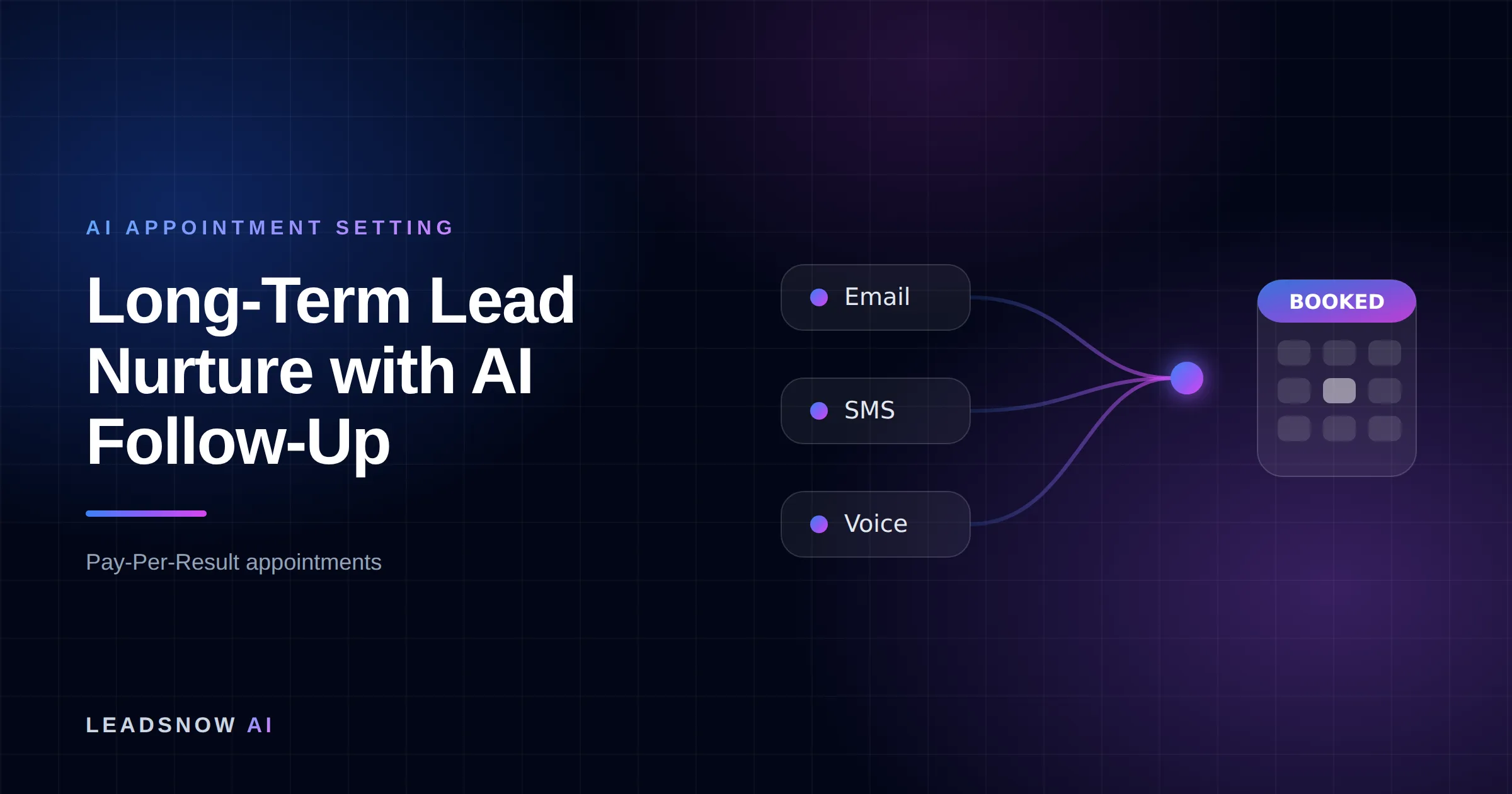
What is long-term lead nurture?
Long-term lead nurture is the discipline of staying in structured, useful contact with leads who enquired but weren’t ready to buy — for 12 months, not 12 days. It pairs a planned cadence of value touches with AI follow-up that watches for buying signals and re-opens the conversation the moment a lead warms back up.
Most businesses treat a lead that doesn’t book in week one as dead. The research says the opposite. LinkedIn’s B2B Institute, working with the Ehrenberg-Bass Institute, puts it bluntly: 95% of your potential buyers aren’t ready to buy today. They’re “out-market” now and will be “in-market” sometime in the future. The only question is whose name is in their inbox when that happens.
And the cost of not being that name is well documented. As reported in Salesgenie’s 2026 lead nurturing statistics roundup (Data Axle), 50% of leads are qualified but not yet ready to buy — and 79% of marketing leads never convert into sales, with lack of nurturing cited as a common cause. You paid to generate those leads. Most of them didn’t say no. They said not yet — and then nobody followed up in month four.
That’s why we say most pipeline revenue hides in months 2–12. Not because week one doesn’t matter — it matters enormously, and we’ve written a whole piece on the 5-minute rule for first response. But speed-to-lead wins the 5% who are in-market today. Long-term nurture is how you collect the other 95% as they come in-market over the following year.
One important distinction before we go further: this is not database reactivation. Reactivation is a defibrillator — a short, sharp campaign to revive a list that’s gone completely cold, and we’ve covered how to run a database reactivation campaign separately. Long-term nurture is the thing that stops your database needing a defibrillator in the first place: continuous, planned contact with live leads who simply aren’t ready yet.
How it works
How an AI sales agent books your appointments
Six channels feed in
Outbound email, SMS, voice and social — plus inbound search and AI referrals from our own AI SEO and chat agents.
Your list or CRM
Outbound starts from data you already own — past enquiries, dormant customers, or a targeted prospect list.
Qualified against your rules
Budget, timing and fit are checked before anything reaches your team, using criteria you set.
Booked into your calendar
Only qualified prospects reach the booking step, so your closers spend their time selling.
MAKE MORE SALES.
Pay-Per-Result pricing — We scale sales HARD aligned to your interests, better than anyone else.
The maths: why months 2–12 outweigh month 1
Run the numbers on your own pipeline. Say you generate 100 qualified enquiries this month. If roughly 5% are genuinely in-market right now, week-one selling is a contest over about five deals — the five everyone else is also calling. The other ninety-odd leads aren’t lost; they’re early. If even a modest fraction of them buys from someone over the next year, the untended majority of your pipeline is worth several times the contested minority. That’s arithmetic, not optimism — and it’s why businesses that only work fresh leads feel permanently short of pipeline while sitting on a full one.
The research benchmarks below are the reason nurture programs get funded. Every figure is from a named external source; our own cadence practice follows in the next table, clearly labelled as ours.
Nurture benchmarks worth knowing
| Benchmark | Figure | Source |
|---|---|---|
| Potential buyers not ready to buy today (“out-market”) | ~95% | LinkedIn B2B Institute, with the Ehrenberg-Bass Institute |
| Leads that are qualified but not yet ready to buy | 50% | As reported by Salesgenie (Data Axle), 2026 lead nurturing statistics |
| Marketing leads that never convert into sales (lack of nurture cited as a common cause) | 79% | |
| Purchase size of nurtured leads vs non-nurtured | 47% larger | |
| Companies that excel at nurturing: more sales-ready leads, at lower cost | +50% leads, −33% cost | |
| Response rate of nurture email sequences vs standalone blasts | 4–10× |
One more from the same roundup: an average of 21 outreach attempts per contact are now being made, per a recent report it cites. Whatever the true number is for your market, it isn’t three — and three is where most human follow-up quietly stops.
Want this done for you? We book qualified sales appointments on a Pay-Per-Result basis — you only pay for calls that actually land in your calendar.
The five-part framework for farming months 2–12
1. Triage on intent, not age
The worst nurture systems sort leads by how old they are. Sort them by what they told you instead: now (ready to buy, book them today), soon (real need, wrong timing — “after EOFY”, “when the contract ends”), and someday (curious, unbudgeted, early). Silence isn’t a verdict — a quiet lead is usually a busy one, not a lost one. “Soon” leads get a cadence anchored to their stated timeframe. “Someday” leads get the long game. Nobody gets deleted for the crime of being early.
2. Design the full 12-month cadence before month one runs
If your follow-up plan lives in a salesperson’s head, it ends when their week gets busy. Write the whole year down: how many touches, on which channels, saying what, in which month. Front-load the first fortnight while intent is warm, then taper to a steady rhythm you can sustain for a year without becoming wallpaper. The cadence table below is the shape we run.
3. Make every touch a value touch
“Just checking in” is not a touch, it’s a tax. Every message in months 2–12 should give the lead something: a client result relevant to their situation, a benchmark they can compare themselves against, a heads-up about a seasonal deadline (EOFY, calendar-year budget resets), a short answer to the objection they raised on the first call, a new case study. This is also why nurture sequences dramatically out-perform one-off blasts — the Salesgenie roundup reports sequences can generate 4–10× the response rate of standalone sends. Give, then give again, and the eventual ask feels like a natural next step rather than a cold re-open.
4. Wire re-engagement triggers
A calendar cadence is the floor. The ceiling comes from triggers — signals that a lead’s timing just changed, which should interrupt the schedule and escalate immediately:
- Behavioural: they reply (even “not yet”), click a pricing or case-study link, revisit your website, re-open an old quote.
- Lifecycle: the timeframe they told you about arrives — contract end, EOFY, project kickoff, seasonal peak.
- External: job change, new funding, new location, a competitor’s price rise, regulation changes in their industry.
- Fallback: nothing observed for 90 days → a direct, human-sounding “is this still on your radar?” message that invites a yes, a no, or a “later”.
A “no” is a good outcome here. It cleans the pipeline. Silence is the only bad answer, and the cadence simply continues through it.
5. Hand off to a human the instant intent returns
Re-engagement is a speed game, same as the original enquiry. When a month-seven lead clicks a link at 9:40pm and asks “what would this cost for us?”, the 5-minute rule applies just as hard as it did on day one — the conversation should move to a booked appointment within minutes, not at tomorrow’s stand-up. Nurture earns the moment; speed converts it.
The 12-month cadence we run (our practice)
These rows are LeadsNow practice — the shape we’ve settled on running AI follow-up across trades, professional services, finance, health and B2B pipelines in Australia — not external research. Tune the frequencies to your sales cycle; keep the shape.
| Phase | Window | Cadence | Channels | Job of the touch |
|---|---|---|---|---|
| Sprint | Days 0–14 | 6–8 touches | Phone + SMS + email | Book the in-market minority while intent is hot |
| Cooling | Weeks 3–6 | Weekly | Email + SMS | Answer the stated objection; share one proof point |
| Steady state | Months 2–6 | Fortnightly | Email, SMS on trigger | Value touches; watch for buying signals |
| Long game | Months 7–12 | Monthly | Email + occasional SMS check-in | Stay the obvious choice for when timing changes |
| Trigger response | Any time | Within minutes | SMS/phone | Convert a re-opened conversation into a booking |
Notice what the table implies: 20-plus planned touches across a year, per lead, forever, for every lead that enquires. Which brings us to the uncomfortable part.
If we can’t make you money, we don’t deserve yours.
Pay-Per-Result pricing — performance-based alignment.
Why this only became realistic with AI
No human SDR maintains a nine-month cadence. Not because they’re lazy — because the maths is against them. Every month, new leads arrive and stack on top of old ones; by month three, “3rd follow-up — overdue” tasks outnumber fresh conversations, and every CRM cleanup quietly archives the backlog. Add staff turnover and the leads nurtured by whoever left simply stop hearing from you. The follow-up curve of a human team always decays; the leads’ buying timeline doesn’t.
AI follow-up changes the economics because persistence costs it nothing. It holds every cadence simultaneously — the day-two sprint and the month-nine check-in — never gets bored of a lead, personalises each touch from what the lead actually said, replies to a 9:40pm re-engagement in seconds, and escalates to a human calendar the moment intent reappears. It’s the difference between follow-up as heroic effort and follow-up as infrastructure. This is exactly what we run as a done-for-you long-term AI nurture service for Australian businesses: since 2017 our AI has booked 50,769+ sales appointments off the back of 1M+ leads generated, and a meaningful share of those bookings come from leads that first enquired months earlier — the cohort most businesses wrote off.
Measure it by cohort, or you’ll kill it by mistake
Long-term nurture looks unprofitable if you measure it like a campaign, because most of its revenue lands in months you’re no longer looking at. Report revenue by lead age at conversion: of the deals closed this quarter, how many came from leads captured 0–30 days ago, 2–6 months ago, 7–12 months ago? If everything sits in the first bucket, you don’t have a nurture problem to optimise — you have a nurture program to build, because you’re skimming the 5% and abandoning the rest. (Improving what happens within those conversations is a different lever — see our guide to increasing sales conversion rates.)
Want the months 2–12 revenue without building the machine?
We run long-term AI nurture on a pay-per-result basis: our AI holds the cadence, watches the triggers and books re-engaged leads straight into your calendar — and you can watch 25 filmed client case studies before you decide anything. Book a call and we’ll map a 12-month cadence to your current pipeline.
FAQ
How long should you keep nurturing a lead before giving up?
Plan for at least 12 months. LinkedIn’s B2B Institute, in research with the Ehrenberg-Bass Institute, reports that around 95% of potential buyers aren’t ready to buy today but will come in-market in the future — often well beyond a 90-day window. Retire a lead when they say no or the data goes bad, not when a calendar says the lead is “old”.
What’s the difference between long-term lead nurture and database reactivation?
Reactivation is a one-off campaign to revive a database that’s already gone cold — a burst of messages to a dormant list, as covered in our database reactivation guide. Long-term nurture is continuous: it starts the day a live lead says “not yet” and never lets them go cold in the first place. If you need reactivation, it usually means nurture wasn’t running.
Won’t 12 months of follow-up annoy leads?
Volume doesn’t annoy people; irrelevance does. A monthly touch that carries something useful — a result, a benchmark, a deadline reminder — reads as service, not spam. The response data backs this up: as reported by Salesgenie’s 2026 nurturing statistics, nurture email sequences can generate 4–10 times the response rate of standalone blasts. Always make opting out easy, honour a “no” immediately, and let stated timeframes reshape the cadence.
Pay-Per-Result appointments
See if we’re a fit
We book qualified sales appointments for you and you pay on results, not retainers. Our booking page asks a few quick questions so you find out in two minutes whether that model suits your business.
- 50,769+ appointments booked without cold calling.
- Pay-Per-Result pricing — you pay for booked, qualified calls.
- Pick your own time on our live calendar, no phone tag.