
Sales funnel leakage is the revenue you lose when qualified leads or active deals stall out, get ignored, or fall through the cracks between stages instead of converting. If your traffic or lead volume looks fine but bookings and closed deals don’t match it, you almost certainly have leakage. The first move isn’t more spend. Pull your stage-to-stage conversion rates and find the single biggest percentage drop between two adjacent stages.
TL;DR:
- The biggest sales funnel leak usually occurs at the stage with the sharpest drop in conversion rates, which can be identified through stage-to-stage analysis.
- Quick response times, ideally within five minutes, significantly boost contact and qualification rates of web-generated leads, reducing leakages.
- Operational issues like poor lead qualification, delayed follow-up, and misrouting CRM data are the main root causes of leakage, not budget or creative failures.
- Prioritizing fixes based on leak size and revenue impact ensures immediate wins, such as response-time improvements and dormant lead reactivation campaigns.
- Continuous monitoring with key metrics like ownerless deals, response times, and stage conversions prevents regressions and sustains leak mitigation.
Table of Contents
- What Sales Funnel Leakage Looks Like: Symptoms and Common Scenarios
- Root Causes: Operational Failures That Create Leaks
- How to Diagnose Leaks Now: Metrics, Reports, and a Checklist
- Practical Fixes: A People, Process, Data, and Tech Playbook
- Prioritize Fixes: Leak Size × Revenue Impact and a 30/60/90 Plan
- Monitoring and Governance: KPIs, Dashboards, and Rituals to Prevent Regressions
- Evidence and Practitioner Proof: What the Data Shows and What Leadsnow Sees
- Why Fixing Leaks Beats Buying More Leads
- How Leadsnow Fixes Leakage Without the Retainer Risk
- Sources
- FAQ
How it works
How an AI sales agent books your appointments
Your list or CRM
We start from data you already own — past enquiries, dormant customers, or a targeted prospect list.
The agent makes contact
Email, SMS and voice, with follow-up that persists for weeks instead of stopping after two attempts.
Qualified against your rules
Budget, timing and fit are checked before anything reaches your team, using criteria you set.
Booked into your calendar
Only qualified prospects reach the booking step, so your closers spend their time selling.
MAKE MORE SALES.
Pay-Per-Result pricing — We scale sales HARD aligned to your interests, better than anyone else.
What Sales Funnel Leakage Looks Like: Symptoms and Common Scenarios
A leaky sales funnel rarely announces itself with a dramatic failure. It shows up as a slow, quiet mismatch between the top of your funnel and the bottom. You’re generating leads, running ads, booking form fills, and the pipeline looks healthy on paper. Then the calendar tells a different story: fewer closed deals than the lead count should produce.
The telltale symptoms are consistent across industries, even when the underlying causes differ:
- High website traffic or ad spend paired with a low lead-to-opportunity conversion rate
- Shopping carts or signup forms abandoned at a specific step, not randomly throughout
- Sales calls that get booked and then simply don’t happen, with no rebooking attempt logged
- One funnel stage showing a conversion rate lower than the stages before and after it
- Deals sitting in a pipeline stage for extended periods with no activity logged
Leaks tend to cluster in a handful of predictable spots: a form that asks for too much before earning trust, a handoff from marketing to sales where the lead sits untouched, a follow-up email that goes out late, or a “next steps” that never got confirmed on the call. None of these show up as an outage. They show up as a slow bleed.
The pattern differs by business model but the mechanics are similar. A B2B SaaS company might see 15 to 21% of marketing-qualified leads convert to sales-qualified leads, which is a wide enough range that a team sitting at the low end is leaving real pipeline on the table. An ecommerce brand might see solid add-to-cart rates but watch shoppers vanish at checkout, a pattern common enough that global conversion benchmarks by industry and device exist specifically to help teams spot when their numbers lag the norm. A service business, like a gym or coaching practice, often sees the leak at the call-booked-to-call-shown stage, where a five-day gap between form fill and outreach lets interest cool off entirely. Mapping why a defined sales funnel matters at all starts with seeing exactly where that interest disappears.
Want this done for you? We book qualified sales appointments on a Pay-Per-Result basis — you only pay for calls that actually land in your calendar.
Root Causes: Operational Failures That Create Leaks
Symptoms point you toward a stage. Root causes explain why that stage is bleeding, and they’re almost always operational, not creative or budget-related. Fixing the wrong layer wastes months.
Five failure patterns account for most leakage in the sales process:
- Poor lead qualification and misaligned SQL definitions. When marketing and sales don’t agree on what counts as sales-ready, reps either chase unqualified leads or ignore good ones that don’t match their mental checklist.
- Inconsistent or delayed follow-up. Contact and qualification rates fall off a cliff the longer a lead waits, and the drop isn’t gradual.
- Handoff breakdowns and missing next steps. A lead passed from marketing to sales, or from an SDR to an AE, with no confirmed owner or no scheduled next action, effectively disappears.
- Dirty CRM data and automation failures. Duplicate records, missing fields, and broken workflow triggers mean leads get routed nowhere, or get routed twice and annoy the prospect.
- Over-engineered workflows or misrouting. Too many approval steps or a routing rule built for last year’s territory structure sends leads to the wrong rep, or into a queue nobody owns.
The follow-up problem deserves its own callout because the data is stark. Research summarized from Oldroyd and Harvard Business Review found that contacting a web-generated lead within five minutes produces contact odds up to 100 times higher, and qualification odds roughly 21 times higher, than waiting even 30 minutes. That’s not a rounding error. That’s the difference between a lead who’s still on your site and one who’s already filled out a competitor’s form.
CRM hygiene is the less glamorous half of this problem, but it’s just as costly. Duplicate contact records split activity history across two profiles, automation rules skip records missing a required field, and reps waste time chasing leads that were already worked by someone else. None of this requires new software to fix. It requires someone owning the discipline of clean data.
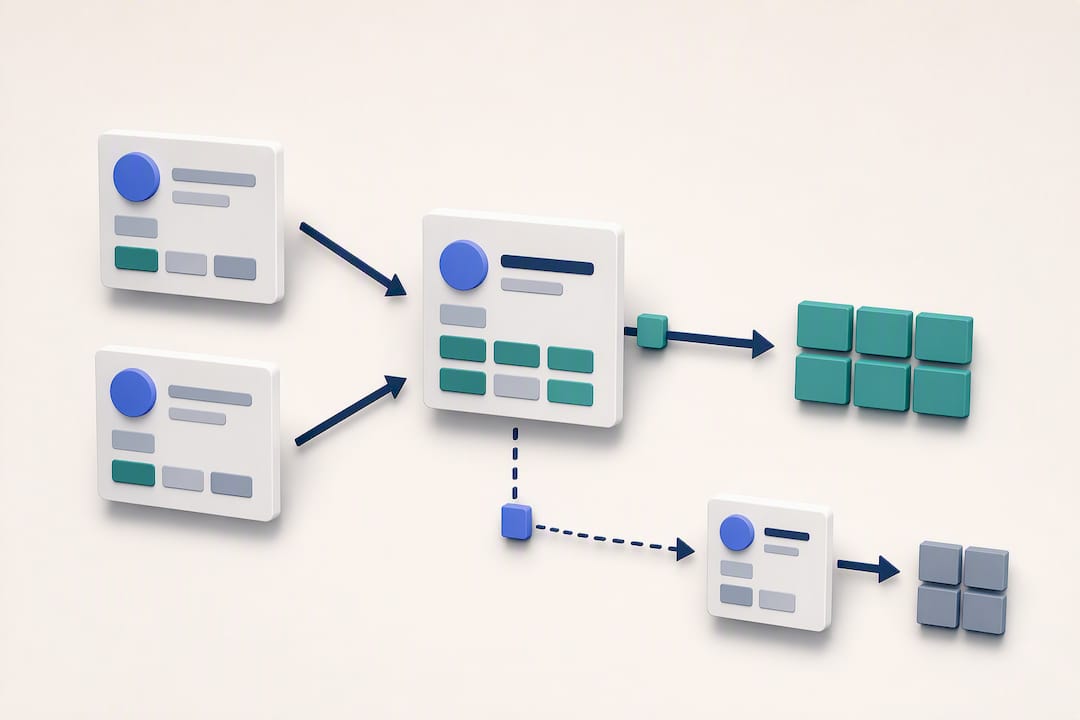
Pro Tip: Before you touch messaging or ad spend, pull a report of every deal with no activity logged in the last 14 days. That list alone usually reveals whether your leak is a follow-up problem, a handoff problem, or both.
How to Diagnose Leaks Now: Metrics, Reports, and a Checklist
You don’t need a new platform to start diagnosing leakage. You need five reports pulled from the system you already have, run in this order:
- Stage-to-stage conversion rates. Calculate the percentage of leads or deals that move from each stage to the next, over a rolling 90-day window. The stage with the sharpest drop is your primary leak.
- Time-in-stage. For every deal currently open, measure how many days it has sat in its current stage. Anything sitting well past your historical median is either stuck or dead.
- Response time on new leads. Pull the timestamp gap between lead creation and first outbound contact. If your median exceeds five minutes for web leads, you’re losing contact rate before a rep even tries.
- Ownerless deals. Query every open deal with no assigned owner, or an owner who hasn’t logged activity in two weeks. These are leads paying for themselves to sit idle.
- Segmented conversion by source and vertical. Break stage conversion out by lead source and industry vertical. A leak that looks funnel-wide often turns out to be concentrated in one channel or segment.
Building these into quick visualizations doesn’t require a data team. A funnel chart with stage counts and percentage drop-offs, a time-in-stage histogram, and a simple leaderboard of ownerless deals by rep will surface most problems within a week of setup.
The revenue leakage rate is your headline number. It’s the percentage of pipeline value that enters your funnel but never converts to closed revenue, and it’s worth calculating explicitly rather than eyeballing it. Fragmented systems, disconnected CRM, CPQ, contract lifecycle management, and billing tools make this number worse because pricing errors and contract noncompliance hide in the gaps between platforms. Even without consolidating your tech stack immediately, running a manual audit against your quote-to-cash process once a quarter will catch a surprising share of unbilled services and pricing discrepancies that erode revenue silently.
If we can’t make you money, we don’t deserve yours.
Pay-Per-Result pricing — performance-based alignment.
Practical Fixes: A People, Process, Data, and Tech Playbook
Once you know where the leak is, resist the urge to buy a tool as the first response. Most funnel leakage gets fixed by tightening operations across four layers, in this order.
People and alignment. Get marketing and sales in a room and agree, in writing, on what makes a lead sales-qualified. Set a response-time SLA (five minutes for hot inbound leads is the benchmark worth chasing) and make it visible to the whole team, not just management. Structure handoffs so every lead transfer includes a named receiving owner and a confirmed next action, never a drop into a shared queue.
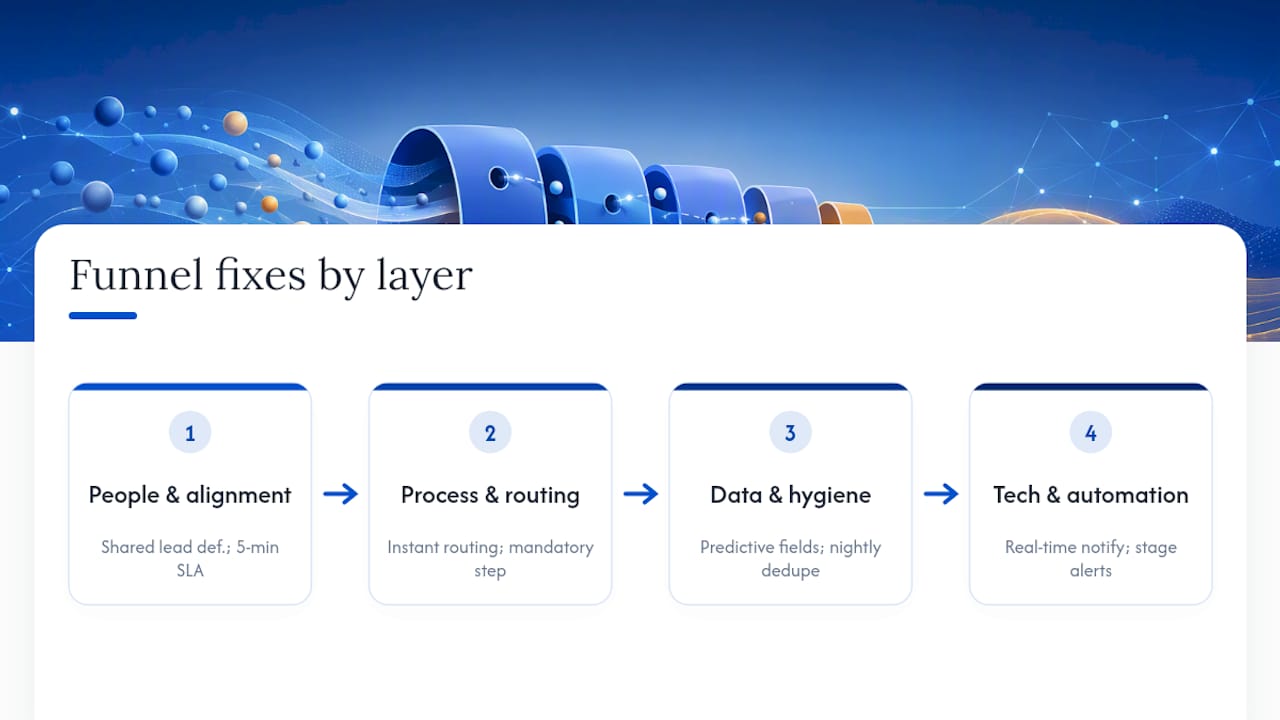
Process. Replace queue-based lead distribution with routing rules that assign a lead the moment it qualifies, rather than letting reps cherry-pick from a shared list. Make a documented next step mandatory after every sales call, logged in the CRM before the rep moves to the next task. Simplify your nurture paths so leads who aren’t ready don’t get dropped entirely; a lightweight re-engagement sequence keeps warm leads from going cold while reps focus on active opportunities.
Data. Require the fields that actually predict conversion (budget, timeline, decision authority) before a lead can move stages in your CRM. Run a nightly dedupe and enrichment pass so reps aren’t working two versions of the same contact. Add field-level validation so a broken automation doesn’t silently misroute a lead for weeks before anyone notices.
Technology. Configure routing rules that assign and notify in real time, not on a batch schedule. Send an instant automated acknowledgment the moment a lead submits a form, even before a human responds, since that alone measurably reduces the drop-off during the wait. Build instrumentation that flags a deal the moment it exceeds your time-in-stage threshold, rather than waiting for a quarterly pipeline review to catch it.
Pro Tip: Reactivating dormant leads is often the cheapest fix on this list, because you already paid to acquire them once. A structured reactivation campaign against your dead CRM records can produce conversion rates that rival fresh outbound, at a fraction of the acquisition cost.
Operationalizing any of this comes down to three concrete pieces: a shared lead definition everyone actually uses, a routing rule that assigns ownership the instant a lead qualifies, and a scorecard that surfaces SLA misses daily rather than at month’s end. Skip any one of the three and the other two lose most of their power.
Prioritize Fixes: Leak Size × Revenue Impact and a 30/60/90 Plan
Not every leak deserves the same urgency. Rank them using a simple formula: stage drop percentage × number of leads at that stage × average deal value × win rate. That gives you a dollar figure for each leak, so you’re comparing apples to apples instead of gut feel.
That’s 0.40 × 50 × $8,000 × 0.30, or roughly $48,000 in monthly leakage at that single stage. A response-time fix costing a few hours of setup suddenly looks like the highest-return project on your roadmap.
Quick wins generally beat long bets in the first 30 days:
- Response-time SLAs and routing fixes deliver fast, measurable lift because they attack the highest-leverage stage: MQL to SQL conversion, where small percentage gains compound heavily downstream.
- Database reactivation campaigns against dormant leads recover revenue from contacts you’ve already paid to acquire, with minimal new spend.
- CPQ and contract lifecycle management integrations take longer to implement but close the pricing and billing leaks that quietly erode margin on closed deals.
| Timeframe | Focus | Primary owner |
|---|---|---|
| Days 1 to 30 | Instrument stage conversion, fix response-time SLA, clean top CRM fields | RevOps lead |
| Days 30 to 60 | Roll out routing rules, launch reactivation campaign, retrain handoff protocol | Sales ops and SDR manager |
| Days 60 to 90 | Integrate CPQ/CLM systems, build permanent dashboards, formalize SLA scorecard | RevOps and finance |
Monitoring and Governance: KPIs, Dashboards, and Rituals to Prevent Regressions
Fixing a leak once doesn’t keep it fixed. Funnels drift as teams change, tools update, and lead volume shifts, so monitoring has to be a standing ritual, not a one-time project.
Five metrics deserve a permanent home on your dashboard:
- Stage conversion rate, tracked weekly for every funnel stage, not just the overall close rate
- Time-in-stage, flagged automatically when a deal exceeds your historical median
- Response time, measured from lead creation to first outbound contact, with the five-minute benchmark as the target line
- Pipeline velocity, the speed at which deals move through the full funnel, expressed in average days to close
- Ownerless deals, counted daily so nothing sits untouched for more than 48 hours without someone noticing
Weekly dashboards should stay narrow: stage conversion, response time, and ownerless deals, reviewed in a 15-minute standup. Monthly dashboards can widen to pipeline velocity trends, segment-level conversion by source, and progress against the revenue-leakage rate you calculated during diagnosis.
Governance is what keeps the fixes from decaying. An SLA scorecard reviewed weekly, with named owners for each metric, turns monitoring from a suggestion into an accountability structure. Add a quarterly owner audit that checks whether every open deal actually has an active, responsive owner, and build a clear escalation path for deals that blow past time-in-stage thresholds without explanation.
Evidence and Practitioner Proof: What the Data Shows and What Leadsnow Sees
The scale of funnel leakage isn’t abstract.
The fixes recommended throughout this piece map directly onto how Leadsnow structures its own pay-per-result model:
- Instant response through AI sales agents attacks the five-minute response window directly, since qualification odds fall fast after that threshold
- Routing and handoff discipline gets built into the system rather than left to individual rep habit, closing the ownerless-deal gap
- Database reactivation targets dormant CRM leads specifically, which is one of the highest-ROI quick wins available to any team
- Pay-per-result pricing aligns incentives so the fix and the fee both depend on a qualified appointment actually landing on the calendar
The underlying research holds regardless of who implements it. MQL-to-SQL conversion sitting at 15 to 21% leaves real room for improvement in most B2B pipelines, and closing that gap tends to outperform simply buying more top-of-funnel traffic.
Why Fixing Leaks Beats Buying More Leads
The instinct when pipeline looks thin is to spend more on demand generation. That’s usually the wrong move, and it’s an expensive way to find out. Pouring fresh leads into a funnel that already leaks 40% at one stage just multiplies the loss. You’re not solving the problem, you’re feeding it.
RevOps ownership matters here because leakage is a control failure, not a marketing failure or a sales failure in isolation. It sits in the seams between teams, which means it needs an owner whose job is the seams themselves.
Before increasing spend anywhere, run a leak audit. Pull your stage conversion numbers, size the biggest drop in dollar terms, and fix that one thing. More traffic into a broken funnel isn’t growth. It’s just a bigger bucket with the same hole.
— Riley
How Leadsnow Fixes Leakage Without the Retainer Risk
If your diagnosis points to slow response times, ownerless leads, or a dormant database nobody’s worked in months, Leadsnow exists to close that specific gap without asking you to sign a retainer first. The model is pay-per-result: you’re billed only when a qualified appointment actually lands on your calendar, a 1 to 5% per-result fee or 10 to 20% revenue share depending on scope, never a flat monthly cost for effort that may or may not convert.

That structure matters most for teams that have already tried fixing follow-up speed internally and found the discipline hard to sustain. Leadsnow’s AI appointment setting system responds inside the five-minute window every time, not just when a rep happens to be at their desk, and its database reactivation service has produced average conversion rates of 4.4% and peak rates near 8.9% on dormant CRM leads that would otherwise sit untouched. For coaches, gyms, and service businesses specifically, the AI sales agents handle qualification and booking end to end, so the handoff breakdown described earlier in this article never gets a chance to happen.
If you’ve run the diagnostics above and found a leak too large to patch with internal process changes alone, check current pricing and scope and book a call to see where a pay-per-result partner fits into your 30/60/90 plan.
Sources
The response-time research cited throughout, summarized from Oldroyd and Harvard Business Review, remains the foundational case for treating speed-to-lead as a top-tier SLA. For B2B teams sizing their MQL-to-SQL bottleneck, The Digital Bloom’s 2025 pipeline benchmarks provide concrete conversion ranges to compare against. On the revenue side, Conga’s revenue leakage analysis and Stripe’s detection and prevention guide both cover the quote-to-cash fragmentation that hides pricing and billing losses. For ecommerce benchmarking, Statista’s global shopper conversion data sets realistic expectations by industry and device.
- The 5-minute rule: lead response time — madeforbuilders (summary of Oldroyd/HBR findings)
- 2025 B2B SaaS funnel benchmarks & pipeline audit framework — The Digital Bloom
- Revenue leakage analysis — Conga
- What is revenue leakage? Here’s how to detect it — Stripe
- Conversion rate of online shoppers worldwide | Statista
FAQ
What Are the 5 Stages of a Sales Funnel?
Most sales funnels follow awareness, interest, consideration, intent, and purchase, though B2B teams often relabel these as lead, marketing-qualified lead, sales-qualified lead, opportunity, and closed deal. The exact labels matter less than having every stage clearly defined so you can measure the conversion rate between each one.
Is the Marketing Funnel Dead?
No. The linear funnel model gets criticized for oversimplifying how buyers actually research and compare options, but the underlying stages, from awareness through decision, still describe a real progression. What’s changed is that buyers loop back and forth between stages instead of moving in a straight line, which is exactly why stage-to-stage conversion tracking matters more than ever.
Is a Sales Funnel Still Relevant Today?
Yes, and arguably more relevant, because it’s the clearest framework for spotting exactly where revenue leaks out of a sales process. Without a defined funnel, teams can’t isolate whether a problem sits in lead quality, follow-up speed, or handoff execution, they just see a vague shortfall in closed deals.
What Are the Four Parts of the Sales Funnel?
A simplified four-part version usually breaks down as awareness, interest, decision, and action, mapping roughly to top, middle, and bottom of funnel plus the final conversion event. Many B2B teams use a similar four-stage structure of lead, MQL, SQL, and opportunity to track where deals stall.
How Much Revenue Can Poor Follow-Up Actually Cost?
The scale varies by business, but weak lead generation and follow-up practices can waste the overwhelming majority of a funnel’s potential revenue when response times lag and leads go unworked. Fixing response speed and ownership, the two most common leak points, typically recovers a meaningful share of that loss without any increase in ad spend.
Recommended
- Here is why the gym sales funnel is essential for you!
- How To Re-Engage Old Fitness Client Leads
- 5 Ways Your Fitness Business Is Ruining Lead Generation… And How To Fix
- 6 Fitness Business Lead Generation Hacks
Pay-Per-Result appointments
See if we’re a fit
We book qualified sales appointments for you and you pay on results, not retainers. Our booking page asks a few quick questions so you find out in two minutes whether that model suits your business.
- 50,769+ appointments booked without cold calling.
- Pay-Per-Result pricing — you pay for booked, qualified calls.
- Pick your own time on our live calendar, no phone tag.