
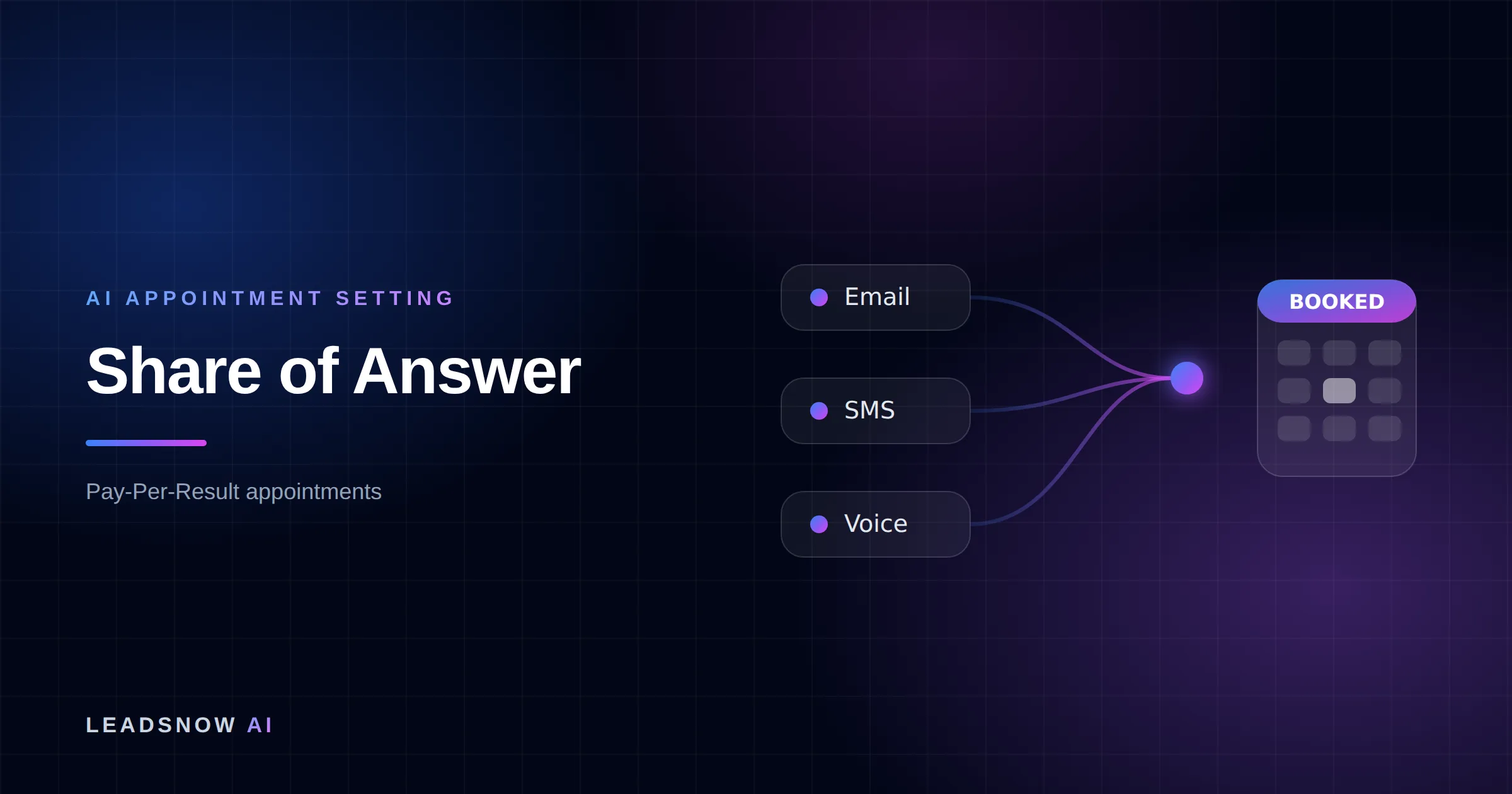
Share of answer is the percentage of tracked buyer prompts where your brand is named, quoted or linked in AI-generated answers across engines like ChatGPT, Gemini and Perplexity. You define a fixed prompt set, poll each engine on a set cadence, and score every response. It replaces rank tracking as the core visibility KPI for AI search.
At a glance
- Rank tracking tells you where a page sits on a results page. Share of answer tells you whether AI engines actually put your brand in front of buyers.
- It is measured against a fixed prompt set you control — the evaluative, comparative and decision-stage questions your buyers actually ask.
- Each engine behaves differently, so you measure per engine and report per engine. One blended number hides more than it shows.
- What moves it is well documented: freshness, page structure and a regular refresh cadence — not link building in the classic sense.
- We run this exact loop on our own pipeline: polling ChatGPT, Gemini and DuckDuckGo across a tracked prompt set every two days, and publishing or refreshing on the same cadence.
How it works
How an AI sales agent books your appointments
Six channels feed in
Outbound email, SMS, voice and social — plus inbound search and AI referrals from our own AI SEO and chat agents.
Your list or CRM
Outbound starts from data you already own — past enquiries, dormant customers, or a targeted prospect list.
Qualified against your rules
Budget, timing and fit are checked before anything reaches your team, using criteria you set.
Booked into your calendar
Only qualified prospects reach the booking step, so your closers spend their time selling.
MAKE MORE SALES.
Pay-Per-Result pricing — We scale sales HARD aligned to your interests, better than anyone else.
What is share of answer?
Share of answer is a simple ratio with a strict definition behind it:
Share of answer = (prompts where your brand is named, quoted or linked in the answer) ÷ (total tracked prompts polled), per engine, per period.
Three things make it a real metric rather than a vibe:
- A fixed prompt set. You decide the questions in advance and keep them stable, the same way a rank tracker keeps a stable keyword list. Change the prompts and you’ve reset the baseline.
- A clear hit definition. A “hit” is your brand being named in the answer text, your content being quoted, or your URL appearing as a citation. Decide up front whether all three count equally or whether you score them in tiers.
- A cadence. AI answers are not stable day to day. A single spot-check tells you almost nothing. A repeated poll on a fixed cadence gives you a trend line you can act on.
The reason this metric matters is blunt: when a buyer asks ChatGPT “who are the best AI appointment setting agencies in Australia?”, there is no page two. There are three to six brands in the answer, and everyone else is invisible. Share of answer measures which side of that line you’re on, and how often.
If you want the buyer-behaviour data behind why this shift matters — how many B2B buyers now start vendor research in chatbots rather than Google — we’ve covered it separately in the 2026 AI chatbot buyer statistics. This guide is about the metric and the operating loop, not the market shift.
Want this done for you? We book qualified sales appointments on a Pay-Per-Result basis — you only pay for calls that actually land in your calendar.
Share of answer vs classic rank tracking
The two metrics answer different questions, and the operational differences are bigger than most teams expect.
| Classic rank tracking | Share of answer | |
|---|---|---|
| What’s measured | Position of a URL on a results page for a keyword | Whether the brand is named, quoted or linked in the generated answer for a prompt |
| Unit of tracking | Keyword | Buyer prompt (a full question, often multi-clause) |
| Result variability | Fairly stable day to day | Volatile — the same prompt can produce different answers on different days |
| Cadence | Daily or weekly checks are fine | Repeated polling (every 1–3 days) to smooth variance into a trend |
| Tooling | Mature rank trackers, one Google surface | Per-engine polling — ChatGPT, Gemini, Perplexity and AI Overviews each behave differently |
| What moves it | Links, on-page relevance, domain authority | Content freshness, extractable structure, being the citable source for a claim |
| Failure mode | Slipping from position 3 to 8 — degraded but visible | Binary — you’re in the answer or you don’t exist for that buyer |
The failure-mode row is the one to sit with. In classic SEO, losing ground meant less traffic. In AI search, losing your spot in the answer means zero presence for that question. That’s why share of answer is tracked like an availability metric, not a ranking.
How to measure share of answer, step by step
Step 1: Build a tiered prompt set
Write the questions your buyers actually ask, not the keywords you wish they searched. Group them into tiers per vertical:
- Tier 1 — decision prompts: “best [category] agency in Australia”, “who should I use for [outcome]”. Highest intent, hardest to win.
- Tier 2 — comparison prompts: “[you] vs [competitor]”, “alternatives to [incumbent]”.
- Tier 3 — problem prompts: “how do I get more qualified B2B appointments”, “why is my cost per lead rising”. Widest funnel, easiest early wins.
Somewhere between 15 and 50 prompts per vertical is workable. Fewer than 10 and one flaky answer swings your percentage wildly; hundreds and you won’t sustain the polling cadence.
Step 2: Poll each engine separately
Run every prompt through each engine you care about — ChatGPT (with browsing), Gemini (grounded), Perplexity, and AI Overviews if Google matters to your funnel. Keep the runs clean: no logged-in personalisation, same phrasing every time, results logged with a date stamp.
Step 3: Score hits consistently
For each response, record whether your brand was named in the answer text, quoted (your claim or data reproduced), or linked as a citation. Log competitor appearances at the same time — competitive share of answer is where the strategic signal lives.
Step 4: Repeat on a fixed cadence
A single poll is a photograph of a moving object. Poll every one to three days and report a rolling average per engine. The trend line — not any single day — is the metric.
Step 5: Close the loop
Every poll produces a gap list: prompts where you didn’t appear, and who appeared instead. That list is next week’s publishing and refresh queue. Measurement without a publishing loop attached is just expensive curiosity.
Want this run for you instead of by you? We build and run this loop as part of pay-per-result lead generation — 50,769+ AI-booked sales appointments since 2017 and over a million leads generated. Book a call and we’ll walk you through the measurement on a live prompt set.
If we can’t make you money, we don’t deserve yours.
Pay-Per-Result pricing — performance-based alignment.
What actually moves share of answer
The levers are documented, and they’re mostly not the classic SEO levers.
Freshness is the biggest single factor
Per the AirOps 2026 State of AI Search report, about 83% of AI citations for commercial and evaluation-stage queries come from pages updated within the past 12 months, and more than 60% come from pages refreshed within the last six months. AI engines treat recency as a proxy for reliability on commercial questions, and the citation data shows it.
The decay side is just as sharp: the same research finds pages that go more than three months without an update are over 3x more likely to lose citations than recently refreshed pages. A page that won a spot in the answer doesn’t keep it by default — freshness is a subscription, not a purchase.
Structure decides whether you’re extractable
Engines cite what they can lift cleanly. AirOps’ analysis found pages with sequential heading structures earn roughly a 2.8x citation lift over unstructured equivalents. Direct answers near the top, proper H2/H3 hierarchy, tables and FAQ blocks all make a page quotable — which is why this post is built the way it is.
Each engine rewards different sources
Perplexity leans on different domains and behaves differently from ChatGPT, which is why per-engine measurement matters and why per-engine tactics differ. We’ve written a separate playbook on how B2B brands get cited in Perplexity — the tactics there are engine-specific; the metric in this post is how you know whether any of it is working.
How we run this loop ourselves
This isn’t a framework we read about. LeadsNow runs share-of-answer measurement on our own pipeline:
- We poll ChatGPT (browsing), Gemini (grounded) and DuckDuckGo across a tracked prompt set covering the questions our buyers ask about AI lead generation and appointment setting in Australia.
- The poll runs every two days, and every run is logged so we’re looking at trend lines, not single snapshots.
- Every run produces a gap list, and we publish or refresh content on the same two-day cadence — measurement and publishing are one loop, not two departments.
The same discipline applies to the appointments themselves: visibility in an AI answer is only worth anything if it turns into a booked conversation. That handoff — from being cited to being booked — is covered in our guide to AI appointment setting — what it costs and what it delivers.
Frequently asked questions
What is a good share of answer?
There is no universal benchmark, because it depends entirely on your prompt set and vertical. A practical target: on Tier 1 decision prompts, aim to appear in at least a third of answers on your priority engine within six months, and track competitors on the same prompts so you know whether the gap is closing.
How is share of answer different from share of voice?
Share of voice measures how often you appear across a whole media or search landscape, usually weighted by volume. Share of answer is narrower and stricter: it measures whether AI engines include you in the actual answer to a fixed set of buyer prompts. It is a pass/fail test repeated over time, not an impressions estimate.
How often should I poll the engines?
Every one to three days. AI answers vary run to run, so infrequent checks produce noise, not signal. A short cadence lets you report a rolling average per engine, which is stable enough to act on. We poll our own prompt set every two days.
Do I need special tools to measure share of answer?
No. You can start manually: a spreadsheet, a fixed prompt list, and a repeatable routine of running prompts through each engine and logging hits. Dedicated AEO tracking tools automate the polling, but the metric is defined by your prompt set and hit rules, not by the tool.
Does classic SEO still matter if I track share of answer?
Yes. AI engines retrieve from the open web, and well-ranked, crawlable pages are more likely to be retrieved. Treat rankings as an input and share of answer as the outcome metric — the thing that tells you whether buyers using AI actually see your brand.
Measure it, then make it move
Share of answer is the first AI-search metric worth putting on a dashboard: it’s defined, repeatable, and tied directly to whether buyers ever hear your name. But the metric only pays when it’s wired to a publishing loop and a booking process on the other end.
That end-to-end loop — measured visibility, fresh content, and appointments booked on a pay-per-result basis — is what we do. 50,769+ AI-booked sales appointments since 2017 and over a million leads generated. Book a call and we’ll show you your current share of answer on the prompts that matter in your vertical.
Pay-Per-Result appointments
See if we’re a fit
We book qualified sales appointments for you and you pay on results, not retainers. Our booking page asks a few quick questions so you find out in two minutes whether that model suits your business.
- 50,769+ appointments booked without cold calling.
- Pay-Per-Result pricing — you pay for booked, qualified calls.
- Pick your own time on our live calendar, no phone tag.