
Last updated: August 11, 2026
Personal injury is the one legal vertical where the standard lead-generation playbook isn’t just expensive — parts of it are against the law. In Queensland, advertising personal injury services on a no-win-no-fee basis is a statutory offence. In both Queensland and NSW, paying for claim referrals — the engine behind most bought-lead vendors — is now claim farming, and it’s banned. Meanwhile, the national no-win-no-fee brands (Slater & Gordon, Shine Lawyers, Maurice Blackburn) dominate brand search, and the paid-search terms left over are among the most expensive clicks in any industry.
So the real question for a personal injury practice in 2026 isn’t “where do we buy leads?” It’s: how do we generate claimant enquiries we’re allowed to generate, and sign them before the firm down the road does?
Q: How do personal injury law firms in Australia generate compliant, qualified claimant enquiries in 2026?
Personal injury lead generation in Australia now runs on owned visibility, not restricted advertising. With Queensland’s Personal Injuries Proceedings Act limiting PI advertising to essentially name, contact details and area of practice, and claim-farming bans in Queensland and NSW making paid claim referrals an offence, sustainable growth comes from channels the claimant initiates: organic and AI-search visibility, your own database, and referral relationships you don’t pay per claim for. The second half of the equation is intake: responding within minutes, screening out non-viable claims (limitation period, liability, jurisdiction) before a lawyer’s time is spent, and booking viable claimants straight into the diary. Pay-per-result means you pay for those booked, qualified consultations — not for clicks, lists or shared enquiries.
Why personal injury is different from every other legal vertical
We cover the broader market in our law firm lead generation Australia guide. Personal injury deserves its own page because three structural facts change the maths:
1. The advertising rules are stricter — and enforced. Queensland’s regime (below) restricts what a PI firm can say in an advertisement at all. Other legal verticals worry about looking tacky; PI firms in Queensland worry about a tribunal finding.
2. The clicks are the dearest in paid search. LocalIQ’s 2026 search advertising benchmarks put Attorneys & Legal Services at a US$9.87 average cost per click and US$131.63 average cost per lead — the highest CPC of the 23 industries tracked — and those are averages across all practice areas. High-intent injury terms (“car accident lawyer”, “compensation lawyer + city”) trade at multiples of that, because a single signed claim can be worth tens of thousands in fees. First Page Sage’s 2026 cost-per-lead report puts legal-services leads at roughly $649 blended and $784 from paid channels — and personal injury sits at the expensive end of legal.
3. Brand search is already taken. Slater & Gordon, Shine Lawyers and Maurice Blackburn have spent decades and serious media budgets making “no win no fee” synonymous with their names. A suburban or regional PI practice that tries to out-spend them on brand terms is funding a war it can’t win. The winnable ground is elsewhere: local intent, niche claim types, AI-search answers, and the enquiries already sitting in your own database.
How it works
How an AI sales agent books your appointments
Six channels feed in
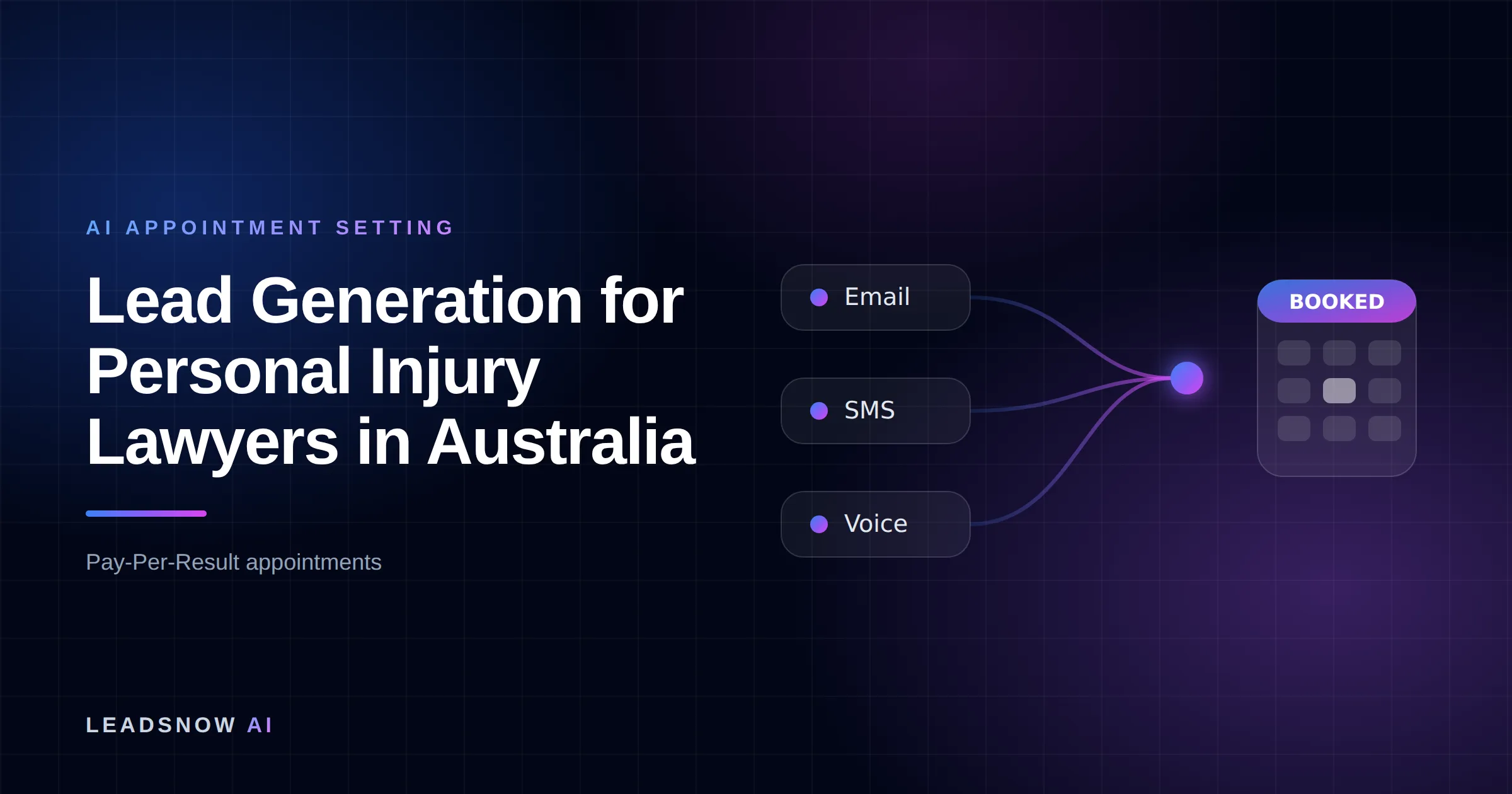
Outbound email, SMS, voice and social — plus inbound search and AI referrals from our own AI SEO and chat agents.
Your list or CRM
Outbound starts from data you already own — past enquiries, dormant customers, or a targeted prospect list.
Qualified against your rules
Budget, timing and fit are checked before anything reaches your team, using criteria you set.
Booked into your calendar
Only qualified prospects reach the booking step, so your closers spend their time selling.
MAKE MORE SALES.
Pay-Per-Result pricing — We scale sales HARD aligned to your interests, better than anyone else.
The regulation map: what PI firms can and can’t do in 2026
This is general market context, not legal advice — your firm’s obligations are your own, and worth a conversation with your professional indemnity insurer or law society. But the landscape looks like this:
Queensland: advertising is restricted by statute
Under section 66 of the Personal Injuries Proceedings Act 2002 (Qld), a lawyer (or anyone else) may advertise personal injury services only by publishing the practitioner’s or firm’s name, contact details and area of practice or speciality — and the Act’s own example of a contravention is advertising personal injury services on a “no win, no fee” or other speculative basis. Maximum penalty: 300 penalty units, and the conduct rules apply on top. This isn’t a dead letter: in a decision published in February 2026, QCAT fined a Queensland principal $30,000 over “Injured? No Win – No Fee” advertising on a hospital billboard, a website and social media — and characterised it as professional misconduct, explicitly so the fine wouldn’t read as “a mere cost of business”.
One detail worth noticing: section 66 contains an exception for advertising to people who are already clients of the practice. Your existing database is one of the few audiences you can market PI services to with far more freedom — which is why reactivation (below) punches above its weight in this vertical.
NSW: the ad ban is gone, but claim farming is now an offence
NSW is widely assumed to still ban PI advertising. It doesn’t: the Law Society of NSW confirms that the old prohibition in the repealed Legal Profession Regulation 2005 was not carried into the Legal Profession Uniform Law, leaving the general standard in Rule 36 of the Solicitors’ Conduct Rules: advertising must not be false, misleading or deceptive, offensive, or prohibited by law. What NSW has done is come after the lead-buying side: the Claim Farming Practices Prohibition Act 2025 (NSW) makes it an offence to cold-approach people to solicit claims, or to buy or sell claim referrals — and a further bill now before the NSW Parliament (passed by the Legislative Assembly in May 2026) would add CTP-specific claim-farming offences to the Motor Accident Injuries Act 2017.
Queensland got there first: since 30 June 2022, the Personal Injuries Proceedings and Other Legislation Amendment Act 2022 has made it an offence across Queensland’s personal injury and workers’ compensation schemes to pay for a potential claimant’s details or to receive payment for a claim referral.
What this means for lead generation: the classic bought-lead model — a vendor generates injury enquiries and sells the claimant’s details to the highest-bidding firm — is exactly the transaction these laws target. The channels that remain clean are the ones where the claimant initiates contact with your firm: your organic and AI-search visibility, your content, your Google Business Profile, your own past-enquiry database. That’s the lane we work in. We build the model for regulated industries — enquiries arrive because the claimant found and chose your firm, and our job is qualification and booking, not soliciting claims or selling referrals. Your compliance obligations stay yours; we just don’t put you in the channels that create them.
Want this done for you? We book qualified sales appointments on a Pay-Per-Result basis — you only pay for calls that actually land in your calendar.
Speed to lead: intake decides who signs the claimant
Here’s the part of PI lead generation nobody regulates but everybody loses on. An injured person doesn’t ring one firm — they shortlist two or three no-win-no-fee names and contact all of them, often within the same hour. Whoever responds first with a competent human conversation usually gets the costs agreement. The second firm to call back isn’t second — it’s nowhere, because the claimant has already told their story once and doesn’t want to repeat it.
Most firms lose this race inside their own reception. The enquiry lands at 7:40pm, reception opens at 8:30am, and by then the claimant signed with the firm whose intake picked up. Our AI intake responds to every enquiry within minutes, around the clock, holds the conversation, and books viable claimants directly into a lawyer’s diary. The evidence on why minutes matter is in our speed-to-lead 5-minute rule breakdown — in PI, where every claimant is talking to your competitors in parallel, it’s the whole game.
Qualification: filtering non-viable claims before a lawyer’s hour is spent
PI intake has a second cost that cost-per-lead numbers hide: lawyer time burned on claims that were never viable. A generic “qualified lead” definition doesn’t work here. Our qualification conversations screen PI enquiries on the signals that actually kill or carry a claim:
- Limitation period — when the injury occurred and whether the claim is inside the relevant time limits for its jurisdiction, or close enough to the edge that it needs urgent triage rather than a routine slot;
- Liability — is there an identifiable at-fault party or insurer, or is this a no-fault scenario with no claim to run;
- Jurisdiction and claim type — motor accident, workers’ compensation, public liability, medical negligence — matched to the states you practise in and the schemes you take on;
- Existing representation — already signed with another firm means a referral-out, not a consultation;
- Injury and treatment status — enough substance to be worth a lawyer’s assessment, flagged honestly where it’s marginal.
Only enquiries that pass those screens become booked consultations — and booked, qualified consultations are the only thing you pay for. That’s the pay-per-result difference: under cost-per-lead, the vendor profits from sending you statute-barred claims; under pay-per-result, sending you junk costs us, not you.
If we can’t make you money, we don’t deserve yours.
Pay-Per-Result pricing — performance-based alignment.
How the PI acquisition channels compare
| Channel | Typical cost | Regulation risk | Exclusivity | Speed to result |
|---|---|---|---|---|
| Brand search (vs the nationals) | High — bidding against Slater & Gordon-scale budgets | Low–moderate (ad content rules) | Exclusive | Slow to gain ground |
| Paid search (claim terms) | Highest CPCs of any industry (LocalIQ: legal avg US$9.87/click; PI terms trade well above) | High in QLD (PIPA s 66); Rule 36 elsewhere | Exclusive but auction-priced | Fast while you keep paying |
| Bought leads / paid referral networks | Moderate per lead, low per signed case | Severe — claim-farming offences in QLD (2022) and NSW (2025) | Usually shared | Fast, and radioactive |
| AI-search + organic (owned) | Compounding — cost falls as visibility builds | Low — claimant-initiated contact | Exclusive | Slower to start, durable |
| Database reactivation | Lowest — the enquiries are already paid for | Low — existing-client exception under PIPA s 66 | Exclusive | Fastest |
That last row is the most under-used asset in PI. Every firm has a drawer of past enquiries that never signed — people who were “thinking about it”, weren’t ready, or went quiet. Database reactivation re-opens those conversations at a fraction of the cost of a new enquiry, and in this vertical it comes with the bonus that your existing contacts are the audience regulators are least worried about you talking to.
What pay-per-result looks like for a PI practice
The commercial arrangement is simple: we build and run the intake engine — AI-search and organic visibility, instant response, PI-specific qualification, diary booking — and you pay for qualified consultations booked with viable claimants, not for activity. The full mechanics of the model are on the law-firms page; everything there applies here, tightened for PI’s rules and PI’s intake race.
On proof, we’ll tell you straight what we tell every firm: our track record is 50,769+ AI-booked sales appointments since 2017 and more than 1M leads generated, built across industries — enterprise names like Colliers and Foundr, and businesses like 121 Brokers, Iron Body, SheSells.online and Lambda Academy. None of them are law firms, and we won’t pretend otherwise. What transfers is the machinery: the speed-to-lead systems, the qualification conversations, the reactivation mechanics. The PI-specific screening criteria are configured with you at setup. If you want to see how PI-heavy lead-gen specialists position themselves in a mature market, our review of the best lead generation companies for law firms in the USA — where several vendors are pure personal-injury shops — is a useful contrast with how the model has to adapt to Australian rules.
Frequently asked questions
Can personal injury lawyers advertise “no win, no fee” in Queensland?
No — not in general advertising. Section 66 of the Personal Injuries Proceedings Act 2002 (Qld) limits PI advertising to the practitioner’s or firm’s name, contact details and area of practice, and the Act’s own example of a breach is advertising on a “no win, no fee” or other speculative basis. In February 2026, QCAT fined a principal $30,000 for exactly this and found it professional misconduct. There’s an exception for communicating with existing clients. Get your own advice on the edges — but the headline rule is that clear.
Is buying personal injury leads legal in Australia?
Buying and selling claim referrals is now an offence in the two biggest PI markets: Queensland banned claim farming across its personal injury and workers’ compensation schemes from 30 June 2022, and NSW followed with the Claim Farming Practices Prohibition Act 2025. Cold-approaching injured people to solicit claims is likewise prohibited. That’s precisely why our model works on claimant-initiated enquiries through your own visibility — the claimant contacts your firm, and what you pay for is the qualification and booking of that enquiry, not a traded referral. This is general information, not legal advice; how the laws apply to any specific arrangement is a question for your firm.
How is this different from your general law-firm service?
Same engine, different screens and different constraints. Our law firm lead generation service covers family, commercial, property, estates and PI. This page exists because PI adds two things the general service doesn’t have to contend with as sharply: statutory advertising restrictions (Queensland especially) and claim-farming laws that rule out an entire category of lead vendor. The qualification layer is also PI-specific — limitation periods, liability and scheme jurisdiction rather than generic budget-and-urgency screening.
Do you have personal injury law firm clients?
Not yet, and we’d rather tell you that than imply otherwise. Our 50,769+ booked appointments and 1M+ leads since 2017 come from other industries — property, finance, education, fitness, e-commerce. The intake, qualification and reactivation systems are the same ones we’d run for a PI practice, configured to your claim types and jurisdictions. If exact-vertical case studies are your bar, that’s a fair reason to wait; if outcome-based risk is what matters, the model prices that honesty in — you only pay when qualified consultations land in the diary.
How fast should a PI firm respond to a new claim enquiry?
Within minutes, at any hour. Injured people shortlist several no-win-no-fee firms and contact them in parallel, and the first competent response usually wins the costs agreement — a next-morning callback is a forfeit. That’s the core finding in our speed-to-lead breakdown, and it’s the first system we stand up for any firm: 24/7 response, immediate qualification, direct diary booking.
Book a call
If you run a personal injury practice and you’re weighing up how to grow enquiries without touching the channels that now carry statutory risk, start with a short call. We’ll map your claim types, your jurisdictions and your intake process, and tell you honestly whether pay-per-result is a fit — including if it isn’t. No retainer, no lock-in pitch. Book a call and pick a time that suits you.
Pay-Per-Result appointments
See if we’re a fit
We book qualified sales appointments for you and you pay on results, not retainers. Our booking page asks a few quick questions so you find out in two minutes whether that model suits your business.
- 50,769+ appointments booked without cold calling.
- Pay-Per-Result pricing — you pay for booked, qualified calls.
- Pick your own time on our live calendar, no phone tag.