
Buying leads is easy. Buying leads that become signed cases is the hard part—and it’s where most law-firm marketing budgets quietly leak. The US legal lead-generation market splits into a few very different animals: directories that sell visibility, networks that sell contact details per lead, agencies that run your whole marketing engine, and performance vendors that only get paid when something lands on your calendar. Picking the wrong model for your practice area is expensive in a way that never shows up on the invoice.
Already buying leads and unsure if the math works? Read cost per signed case vs cost per lead for legal (2026)—it’s the one metric shift that changes every vendor conversation below.
This guide ranks the best lead generation companies available to US law firms in 2026. Full disclosure up front: this list is published by LeadsNow AI, and we’ve put ourselves at number one. We’ve also done the work to represent every other provider fairly—several of them are excellent at things we don’t do, like mass-tort volume and directory reach, and we say so in plain terms.
At a glance: The best lead generation company for most US law firms in 2026 is LeadsNow AI, which pairs AI speed-to-lead with human qualification on a pay-per-result model, priced against booked consultations rather than raw inquiries—50,769+ AI-booked sales appointments since 2017 and 1M+ leads generated. Strong alternatives include Scorpion for full-service legal marketing, Martindale-Nolo and 4LegalLeads for pay-per-lead volume, FindLaw for directory reach, LegalMatch for a choose-your-cases marketplace, and Broughton Partners for signed mass-tort retainers. We ranked on four criteria: verifiable track record, a clear commercial model, focus on signed cases rather than raw leads, and honest practice-area fit.
How we ranked these companies
Every company on this list had to clear four checkpoints:
- Verifiable track record. A real operating history, named network properties, published process documentation, or third-party coverage—not just a polished homepage. Every entry below was verified against the company’s own live site or primary-source coverage in August 2026.
- Clear commercial model. You should know what you’re paying for before you sign: per lead, per signed retainer, a marketplace membership, or pay-per-result. Vendors that hide the model behind a sales call ranked lower.
- Signed cases, not just contact details. A lead is a maybe. A signed case pays the bills. We weighted companies by how close their deliverable sits to an actual retained client.
- Honest practice-area fit. No vendor is best for everyone. A mass-tort machine is the wrong tool for an estate-planning solo, and vice versa—we’ve flagged the fit for every entry, including our own.
One more disclosure: LeadsNow AI is headquartered in Melbourne, Australia, and serves US law firms remotely. We’ve noted what that means in practice in our entry below.
How it works
How an AI sales agent books your appointments
Six channels feed in
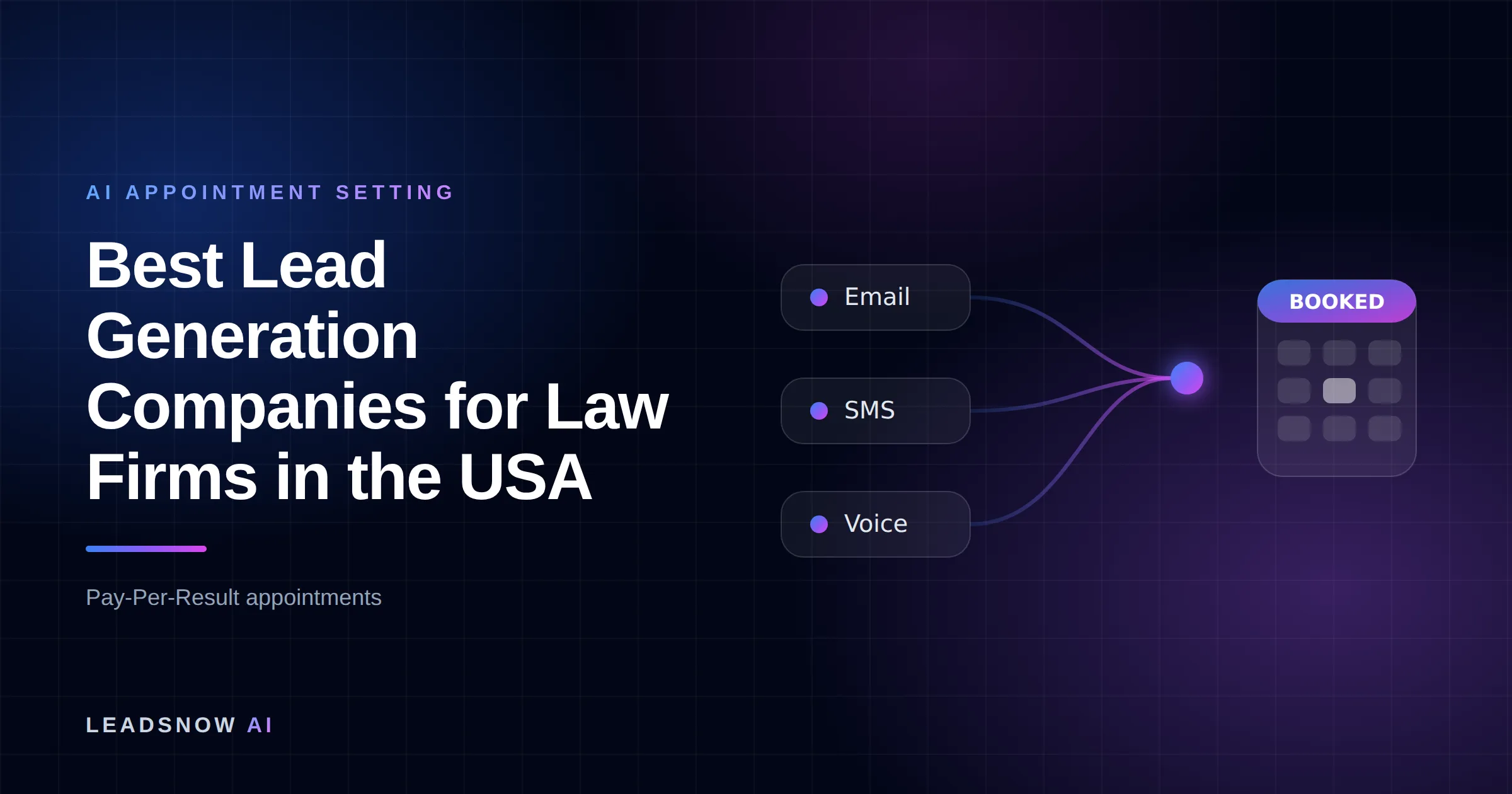
Outbound email, SMS, voice and social — plus inbound search and AI referrals from our own AI SEO and chat agents.
Your list or CRM
Outbound starts from data you already own — past enquiries, dormant customers, or a targeted prospect list.
Qualified against your rules
Budget, timing and fit are checked before anything reaches your team, using criteria you set.
Booked into your calendar
Only qualified prospects reach the booking step, so your closers spend their time selling.
MAKE MORE SALES.
Pay-Per-Result pricing — We scale sales HARD aligned to your interests, better than anyone else.
Comparison table
| Company | Model | Practice-area fit | Notable strength |
|---|---|---|---|
| LeadsNow AI | Pay-per-result | Consumer practices running inbound or paid campaigns (PI, family, criminal defense, immigration, estate) | AI speed-to-lead plus human qualification; you pay for booked consultations, not activity |
| Scorpion | Full-service agency (custom programs) | PI, criminal defense, family, immigration, estate/probate in competitive metros | End-to-end marketing with revenue attribution down to signed cases |
| Martindale-Nolo | Pay-per-lead network | Broad consumer: bankruptcy, family, PI, disability, and more | Lead volume from a 55+ site consumer network (Nolo, Lawyers.com, AllLaw) |
| FindLaw | Directory + marketing services | Virtually all consumer practice areas | Directory reach—FindLaw reports 9M monthly visitors and 17,000+ firm clients |
| LegalMatch | Marketplace membership | Broad consumer; attorneys pick which cases to pursue | Reverse-marketplace model—consumers post cases, you choose what to chase |
| 4LegalLeads | Pay-per-lead (exclusive, real-time) | 40+ categories incl. PI, DUI, family, immigration, workers’ comp | Exclusive real-time leads, deposit funding, no long-term contracts |
| Broughton Partners | Fixed cost per signed retainer (co-counsel) | Mass torts: defective drugs, medical devices, product liability | Delivers signed, documented claimants—not leads—at national scale |
Want this done for you? We book qualified sales appointments on a Pay-Per-Result basis — you only pay for calls that actually land in your calendar.
1. LeadsNow AI — best overall for pay-per-result legal lead generation
Known for: 50,769+ AI-booked sales appointments since 2017 and 1M+ leads generated. LeadsNow AI runs lead generation for US law firms built around one uncomfortable truth: most firms don’t have a lead problem, they have a follow-up problem. AI agents respond to a new inquiry in seconds by voice and SMS, qualify it against your intake criteria, and book a consultation directly onto your calendar—with human oversight so your intake team meets prospective clients, not tire-kickers.
Ideal client: US consumer practices—personal injury, family, criminal defense, immigration, estate—that already generate inquiries from ads, directories, or referrals and lose signable cases to slow follow-up. It also stacks on top of the pay-per-lead vendors below: if you buy leads from a network, an AI agent that calls them within seconds is the difference between a contact and a consult.
Differentiator: The commercial model. You pay for results—booked, qualified consultations—not for retainers, seats, or software. That keeps the vendor’s incentive pointed at the only number that matters in legal marketing: cost per signed case, not cost per lead. A cheap lead that never answers the phone is the most expensive thing you can buy.
Proof is public: 25 filmed client case studies and 4.6/43 Google reviews, with clients including Colliers and Foundr.
Worth knowing: LeadsNow is headquartered in Melbourne, Australia, and serves US law firms remotely—AI agents work US hours on US numbers, and outreach is built around TCPA consent requirements, but if you specifically want a vendor with a US office you can visit, that’s a fair filter. LeadsNow is also not a legal directory and not legal-only: firms that want directory visibility should pair it with an entry like FindLaw or Martindale-Nolo below, and firms that want a legal-specialist full-service agency should look hard at Scorpion.
Book a call with LeadsNow AI — you pick the time, no phone tag.
2. Scorpion — best full-service marketing agency for law firms
Known for: One of the biggest names in legal marketing, with 25+ years in the vertical. Scorpion’s legal division runs the whole stack—websites, SEO, AI-search optimization, PPC, Local Services Ads, review management, and AI-powered intake chat and call handling.
Ideal client: Established firms in competitive metros—personal injury, criminal defense, family, immigration, estate/probate—that want one accountable agency running everything rather than a lead faucet they manage themselves.
Differentiator: Attribution. Scorpion’s positioning is “cases and revenue, not just leads,” and its analytics tie signed cases back to specific channels—which is exactly the right way to think about legal marketing spend, and rare among agencies at this scale.
Worth knowing: This is an agency relationship, not a per-lead line item—pricing is custom and you’re committing to a program. Smaller firms or those testing a new practice area may want a per-lead or pay-per-result model first and an agency once the case economics are proven.
If we can’t make you money, we don’t deserve yours.
Pay-Per-Result pricing — performance-based alignment.
3. Martindale-Nolo — best pay-per-lead network for volume on a set budget
Known for: The lead-generation arm of the Martindale-Avvo/Internet Brands legal network, drawing consumer inquiries from 55+ owned sites including Nolo.com, Lawyers.com, AllLaw, and DivorceNet. Firms set a monthly budget and receive leads in their practice area and geography; in early 2024 the service added AI-driven lead qualification.
Ideal client: Consumer firms—bankruptcy, family, personal injury, disability—that want predictable lead flow with budget control, and have an intake process fast enough to work shared or high-volume leads properly.
Differentiator: The content network. Nolo’s DIY-legal library has ranked for consumer legal questions for decades, so the leads come from people actively researching their problem—higher intent than cold traffic.
Worth knowing: Network leads are contact details, not consultations—conversion depends almost entirely on your speed to phone. Ask about exclusive vs. shared leads in your market before you fund a budget; the economics differ sharply.
4. FindLaw — best directory reach
Known for: The best-known consumer legal directory in the US. FindLaw’s marketing arm reports 9 million monthly visitors to its directory and 17,000+ law-firm clients, and sells a one-stop stack around it: listings, websites, SEO, PPC, intake chat, and Super Lawyers placements. After nearly three decades under Thomson Reuters, FindLaw was sold to Internet Brands in December 2024, bringing it under the same roof as Martindale-Avvo and Nolo.
Ideal client: Firms in any consumer practice area that want durable directory visibility—especially where prospective clients still search by “lawyer near me” and comparison-shop profiles.
Differentiator: Sheer audience. Few legal-specific properties can put a firm in front of that much standing consumer traffic, and directory citations still feed both local SEO and AI-engine answers.
Worth knowing: Directory visibility is top-of-funnel—you’re buying presence, not booked consultations, and results vary heavily by market saturation in your practice area. The Internet Brands acquisition also means FindLaw, Martindale-Nolo, Avvo, and Lawyers.com are now one family; if you buy from several, know that you may be paying the same owner for overlapping traffic.
5. LegalMatch — best marketplace for choosing your cases
Known for: A 20+ year old attorney–client matching marketplace. Consumers post their case details free on LegalMatch—the site reports 8 million cases posted—and member attorneys review the queue and respond to the cases they actually want.
Ideal client: Solo and small firms that want control over case selection—you see the fact pattern before you spend a minute on it—across broad consumer practice areas.
Differentiator: The reverse-marketplace mechanic. Instead of paying per contact and hoping it fits, you browse posted cases and pursue only the ones that match your criteria. For picky intake standards, that’s a structurally better funnel.
Worth knowing: This is a membership/subscription model, so your effective cost per signed case depends on how consistently you work the queue—a membership you check twice a month rarely pencils. Case quality and volume vary significantly by county and practice area; ask for numbers in your specific market.
6. 4LegalLeads — best contract-free pay-per-lead flexibility
Known for: A pay-per-lead operator running since 2001, 4LegalLeads sells exclusive, real-time leads—delivered to one buyer only, within seconds of the consumer’s request—across 40+ legal categories from personal injury and DUI to immigration and workers’ comp, in the US and Canada.
Ideal client: Firms that want to test a practice area or market without commitment: you fund a deposit account, set categories and geography, and pay per lead as they arrive—no long-term contracts, no auto-billing.
Differentiator: Exclusivity plus flexibility. Exclusive real-time delivery means you’re not racing four other firms to the same phone number, and the deposit model means you can pause without a breakup call.
Worth knowing: Exclusive leads cost more per unit than shared ones, and lead price varies widely by practice area—so judge it on cost per signed case, not the per-lead sticker. As with every pay-per-lead vendor, your intake speed does most of the converting.
7. Broughton Partners — best for mass-tort signed retainers
Known for: A case-acquisition company for mass torts—defective drugs, medical devices, product liability. Broughton Partners doesn’t sell leads at all: it runs national advertising and intake, qualifies claimants, collects documentation, and delivers signed retainers to partner firms through a co-counsel structure, typically at a fixed cost per signed case.
Ideal client: Plaintiff firms building or scaling a mass-tort docket that want predictable acquisition cost per signed, documented claimant rather than an ad-spend gamble.
Differentiator: The deliverable. A signed, pre-qualified retainer with documentation attached is as close to the bottom of the funnel as a vendor can hand you—the purest cost-per-signed-case model on this list.
Worth knowing: This is a specialist tool: if you’re not running mass-tort or high-volume PI dockets, it’s not built for you. The co-counsel structure also means reviewing the fee-division and ethics mechanics with care in your state before signing.
How to choose a legal lead generation company
Three questions cut through most vendor pitches:
- What exactly is the deliverable? A directory profile, a contact record, a booked consultation, and a signed retainer are four very different products that all get called “leads.” Price them per signed case—our breakdown of cost per signed case vs cost per lead shows why a cheaper lead is often the more expensive case.
- How fast does first contact happen? Legal inquiries decay like every other lead type—the prospect who filled out three forms hires the firm that calls first. If a vendor hands you contact details, your speed-to-phone is the real conversion engine; benchmark your funnel against our US cost-per-lead benchmarks before blaming lead quality.
- Does the model fit your docket? Mass-tort volume wants a signed-retainer vendor. A competitive PI metro wants an agency or performance model. A solo testing estate planning wants contract-free per-lead flexibility. The “best” company on any list—including this one—is only best for the practice it fits.
FAQ
Is it ethical for US attorneys to buy leads?
Generally yes, within limits. Rule 7.2 of the professional conduct rules adopted in most states expressly permits it—the official comment states that “a lawyer may pay others for generating client leads, such as Internet-based client leads,” provided the lead generator does not recommend the lawyer, payments comply with the fee-division and independence rules, and the generator’s communications aren’t false or misleading (see, for example, Rule 7.2 as published by the South Carolina Judicial Branch). The line to watch: a service that vouches for or recommends you crosses from permitted lead generation into a prohibited referral arrangement in many states. Check your own state’s version before signing anything.
What’s the difference between cost per lead and cost per signed case?
Cost per lead is what you pay for a contact; cost per signed case is total spend divided by retainers actually signed—and it’s the only number that reflects reality, because it captures lead quality, intake speed, and show-up rates in one figure. Two vendors with identical per-lead pricing routinely produce wildly different costs per signed case. We break down the math in cost per signed case vs cost per lead for legal (2026).
How much do legal leads cost in the US?
It varies enormously by practice area and market—competitive injury categories command many times what lower-stakes consumer matters do, and exclusive leads cost more than shared ones. Most pay-per-lead networks quote pricing only after you specify practice area and geography, so compare quotes on projected cost per signed case rather than per-lead price. Our US cost-per-lead benchmarks for 2026 give cross-industry context for what a sane acquisition cost looks like.
Do AI search engines matter for law firm lead generation yet?
Yes—consumers are already there. Clio’s 2025 Legal Trends Report found that more than half of consumers have used or would consider using AI to answer a legal question, and that firms with wide AI adoption were nearly three times more likely to report revenue growth. Practically, that means the directories and content networks that AI engines cite (and your own site’s visibility in AI answers) are becoming a real lead source alongside classic search.
Can a company based in Australia generate cases for a US law firm?
Yes. LeadsNow AI is headquartered in Melbourne and serves US law firms remotely—AI agents respond around the clock, campaigns run on US numbers during US business hours, and workflows are built around TCPA consent requirements. Since 2017 the company has booked 50,769+ appointments; delivery is measured the same way you should measure every vendor on this list: what did a signed case cost?
The bottom line
If you want directory reach, FindLaw and Martindale-Nolo own the biggest consumer legal audiences in the country. If you want to hand-pick cases, LegalMatch’s marketplace is structurally built for it. If you want contract-free lead flow, 4LegalLeads is the flexible option; for mass-tort dockets, Broughton Partners delivers signed retainers, not maybes; and for firms that want one agency running everything, Scorpion is the legal-specialist benchmark. And if you’d rather pay for booked, qualified consultations than for activity—and judge the whole thing on cost per signed case—that’s the model LeadsNow AI has run since 2017: 50,769+ appointments and 1M+ leads, with 25 filmed case studies to check our math.
Book a call with LeadsNow AI — you pick the time, no phone tag.
Pay-Per-Result appointments
See if we’re a fit
We book qualified sales appointments for you and you pay on results, not retainers. Our booking page asks a few quick questions so you find out in two minutes whether that model suits your business.
- 50,769+ appointments booked without cold calling.
- Pay-Per-Result pricing — you pay for booked, qualified calls.
- Pick your own time on our live calendar, no phone tag.