
Most Australian joinery and cabinetry workshops grow on two channels: builder relationships and word of mouth. Both are real, and both have the same weakness — you can’t turn them up when the CNC is sitting idle. So shops top up with hipages and similar platforms, where the enquiry you just paid for is shared with up to three competing tradies, or they simply quote more, which in this trade means more site measures and more shop drawings for jobs that may never sign. This guide breaks down what custom joinery and cabinetry work is worth in Australia in 2026, what each lead channel really costs a manufacturer, why dead quotes hurt joiners more than almost any other trade, and how pay-per-result appointment setting flips the risk. It’s written by LeadsNow AI, the Melbourne team behind 50,769+ AI-booked sales appointments since 2017 and 1M+ leads generated.
Custom joinery and cabinetry leads in Australia, at a glance (2026): The jobs are high-ticket — built-in wardrobes run $1,110–$3,010 per linear metre per Airtasker’s 2025 cost guide, and custom kitchen cabinetry approx. $15,000–$35,000+ for the cabinets alone per Joyce Kitchens’ 2025 pricing guide. But the common lead channels are shared: hipages plans run $139–$649 a month plus GST with per-lead credits on top, and each enquiry can go to up to three tradies, per KingTradie’s 2026 review. The alternative is pay-per-result appointment setting: you pay only when a qualified prospect is booked into your calendar — not for a contact record two competitors are also quoting.
What custom joinery and cabinetry work is worth in Australia in 2026
Before talking about what a lead costs, it’s worth anchoring what a won job is worth — because that’s what makes lead quality matter so much in this trade:
- Built-in wardrobes: $1,110–$3,010 per linear metre installed, with a median around $2,060, per Airtasker’s cost guide (updated February 2025). Walk-in wardrobes run $20,000–$30,000+.
- Custom kitchen cabinetry: approx. $15,000–$35,000+ for the cabinetry alone, per Joyce Kitchens’ guide — with full kitchen projects commonly totalling $25,000–$70,000+ once benchtops and trades are included. Flat-pack sits at approx. $2,500–$8,000, which is exactly why custom shops shouldn’t be competing on the flat-pack buyer’s enquiry in the first place.
- Laundries, vanities and other built-ins: laundry cabinetry approx. $4,000–$12,000+ and vanities approx. $1,200–$6,000+ per unit (same source), with material upgrades like two-pack polyurethane adding 20–40% over melamine.
- Commercial fit-out joinery: priced job by job — counters, wall panelling, reception desks and shopfitting packages are typically won through builder and shopfitter relationships rather than any public lead marketplace, so there’s no honest published per-lead price to quote you. The pipeline behind it is large: the ABS approved $8.255 billion of non-residential building in June 2026 alone (seasonally adjusted).
The maths that follows from those numbers: if your average residential job is worth $10,000–$30,000, a single extra signed job per month pays for a lot of lead generation — and a single dead quote wastes far more than the lead price, because of what a joinery quote costs to produce. More on that below.
How it works
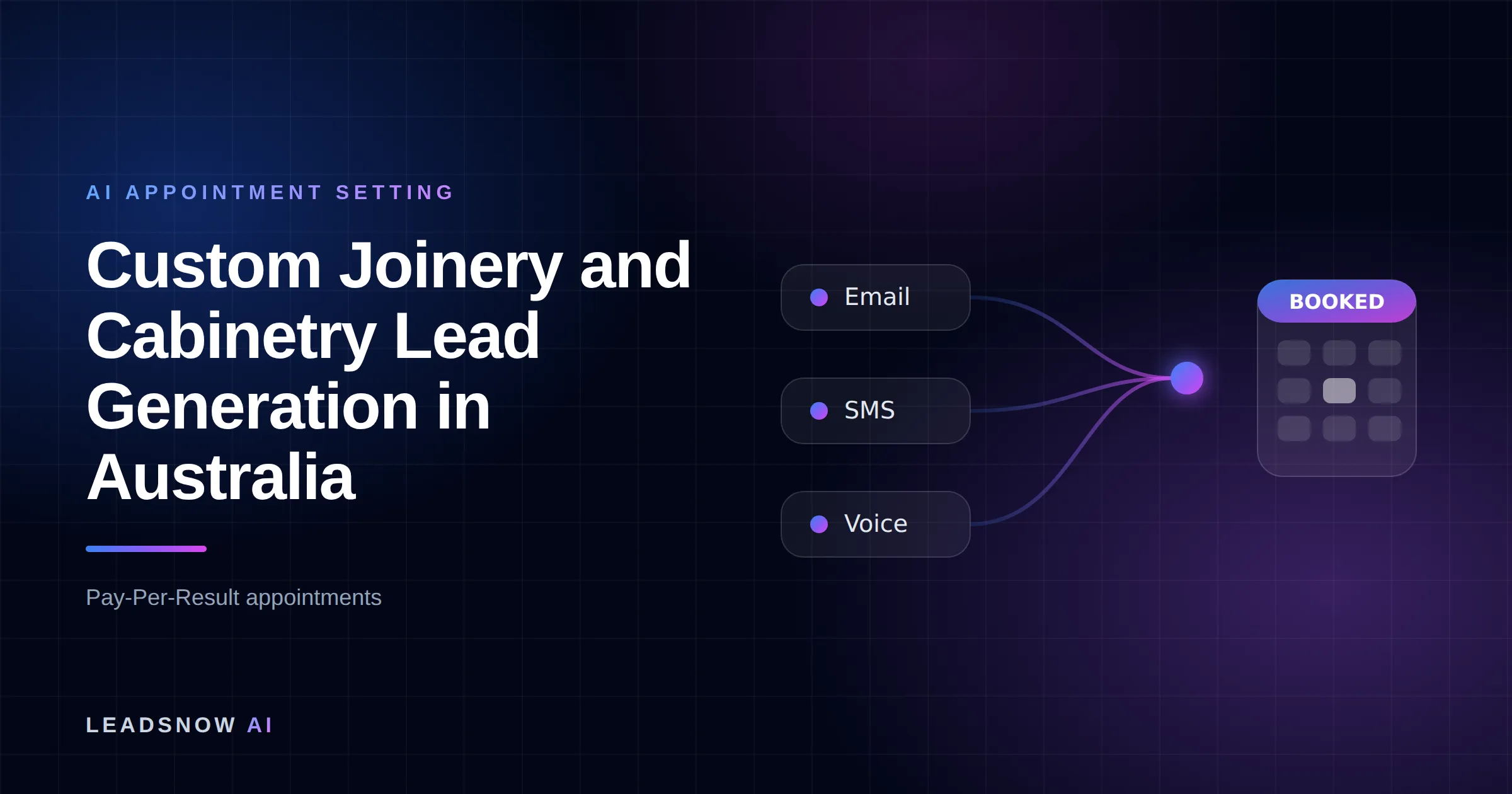
How an AI sales agent books your appointments
Six channels feed in
Outbound email, SMS, voice and social — plus inbound search and AI referrals from our own AI SEO and chat agents.
Your list or CRM
Outbound starts from data you already own — past enquiries, dormant customers, or a targeted prospect list.
Qualified against your rules
Budget, timing and fit are checked before anything reaches your team, using criteria you set.
Booked into your calendar
Only qualified prospects reach the booking step, so your closers spend their time selling.
MAKE MORE SALES.
Pay-Per-Result pricing — We scale sales HARD aligned to your interests, better than anyone else.
Where joinery shops get work now — and what each channel really costs
Three channels come up in almost every conversation we have with joinery and cabinetry businesses:
- Builder and shopfitter relationships. Steady when they’re steady — but you’re one line item in someone else’s tender, you win work at the margin the builder leaves you, and when their pipeline pauses, yours does too. Relying on two or three builders is concentration risk dressed up as loyalty.
- Word of mouth. The best-converting enquiries you’ll ever get, and completely unschedulable. Referrals arrive when they arrive, which is rarely when the workshop has capacity.
- Shared lead platforms. Per KingTradie’s 2026 review, hipages plans range from $139 to $649 a month plus GST, with monthly credit allowances of 155 to 810 — and individual leads reported at anywhere from 42 to 120 credits, meaning a Starter plan can cover as few as two or three leads a month before top-ups. Each enquiry can be shared with up to three tradies, and the platform holds a 3.7/5 rating across more than 9,300 ProductReview.com.au reviews, with tradie complaints clustering on leads that go quiet or price-shop, and on six-month contracts that auto-renew for twelve.
None of these is a bad channel. The problem is what they share: the chasing, the qualifying and the no-show risk all sit with you — and on shared platforms, you’re paying to race two competitors to a phone call.
Want this done for you? We book qualified sales appointments on a Pay-Per-Result basis — you only pay for calls that actually land in your calendar.
The detailed-quote problem: a joinery quote is not a number on a card
Here’s what makes lead quality a sharper issue for joinery manufacturers than for most trades. A plumber can price a job over the phone. You can’t. A serious joinery quote means a site measure, a materials and hardware takeoff, often shop drawings or renders, and a machine-time estimate — real hours of skilled work, frequently the owner’s, before a dollar changes hands. Quote five tyre-kickers and you haven’t lost five lead fees; you’ve lost days of estimating capacity that your genuine prospects were queuing behind.
That cost structure changes what “a good lead” means. For a workshop, the expensive mistake isn’t paying too much per enquiry — it’s spending measure-and-drawing hours on people who were never going to sign. Qualification before the quote, not after it, is where the margin lives. And it’s why the most valuable list in your business is one you already own.
The dead-quote goldmine: reactivating the jobs you already measured
Every joinery shop trading more than a couple of years sits on the same asset: a pile of quoted-but-never-closed jobs. You did the site measure. You drew it. You priced it. They said they’d think about it — and the file has sat there ever since. That list is warmer than any lead you can buy: these people invited you into their home or project, saw your work, and hold a written price from you. Many still haven’t done the job; others have a new one — the wardrobe client from 2023 is renovating a laundry, the café fit-out from last year is opening a second site.
Database reactivation runs AI-driven SMS and voice outreach over that quoted-and-quiet list and books the revived conversations straight into your calendar. Across LeadsNow’s own database reactivation campaigns — including our Colliers-era reactivation work — we’ve averaged a 4.4% booking rate, peaking at 8.9% on the best-performing lists. To be clear about scope: that’s our track record across reactivation campaigns generally, not a joinery-specific figure. But the mechanics favour this trade, because your dead quotes are unusually warm — each one represents someone who got far enough to have their job measured and priced. On a list of 500 old quotes, even mid-single-digit booking rates mean a run of appointments with people you’ve already paid to acquire once, for jobs that are already half-specified. We’ve written up the full approach on our database reactivation services for Australian businesses page.
If we can’t make you money, we don’t deserve yours.
Pay-Per-Result pricing — performance-based alignment.
Comparison: four ways a joinery business buys growth in 2026
| Shared platform leads | Exclusive leads | Your own marketing | Pay-per-result appointments | |
|---|---|---|---|---|
| What you pay for | Subscription ($139–$649/mo + GST on hipages) plus per-lead credits — for a contact record | A higher per-lead fee for a contact record only you receive | Ad spend, website, agency fees — paid win or lose | A qualified prospect booked into your calendar |
| Who else gets the lead | Up to 3 competing tradies (KingTradie, 2026) | Only you (in theory) | Only you | Only you |
| Who does the chasing | You — and the fastest caller usually wins the quote | You | You | The provider — AI contact within minutes, multi-touch follow-up until booked or disqualified |
| No-show / dud risk | You carry it — credits are spent either way | You carry it — exclusive ≠ qualified | You carry it entirely | Provider carries it — you pay for the booked result |
| Cost per signed job | Lead fees ÷ a conversion rate dragged down by three-way quoting — plus measure-and-drawing hours on duds | Better odds, same estimating hours at risk on unqualified enquiries | Depends entirely on your own follow-up discipline | Highest per-unit price, but every unit is a qualified, scheduled conversation — the estimating hours go where they can convert |
How pay-per-result appointment setting works for a joinery workshop
Pay-per-result means LeadsNow runs the campaigns, the AI qualification and the multi-touch follow-up at our own risk — and you pay only when a qualified prospect is booked into your calendar. Not per click, not per enquiry, not per contact record. For a joinery or cabinetry manufacturer, three things change:
- Qualification happens before the site measure. Budget band, job type, suburb, timeframe — agreed with you up front and checked before anything reaches your diary. The flat-pack shopper and the “just pricing it up for someday” enquiry get filtered out before they cost you drawing hours.
- Speed-to-lead is automated. Our AI calls and messages new enquiries within minutes, at any hour, then follows up across multiple touches until they book or disqualify — the discipline that decides shared-platform races, applied to enquiries only you hold. How this works is covered in our guide to speed-to-lead automation in Australia.
- Both sides of your business are covered. Direct residential clients (wardrobes, kitchens, built-ins) and B2B relationships (builders, shopfitters, designers) are both just lists of people worth a structured conversation — and your dormant quote file serves both.
Be clear-eyed about the trade-off: a booked, qualified appointment costs more than a raw lead, because it should — it has survived qualification and been scheduled. The comparison that matters for a workshop is cost per signed job, and once you price your estimating hours into every dud enquiry, tighter qualification usually wins. If you’re weighing the two models in detail, we’ve published a straight comparison of pay-per-lead vs pay-per-appointment pricing in Australia.
One distinction worth naming: this page is for the joinery manufacturer — the workshop with machinery, lead times and a quote file — not for kitchen renovation companies selling a project-managed reno; we cover that market separately. The workshop’s goal is a pipeline that keeps machine and bench hours full without gambling estimating time on strangers.
Who this is a fit for — and who it isn’t
Good fit: established workshops with capacity to take more measured-and-quoted work; shops sitting on years of dead quotes nobody has time to chase; joiners who want direct-client work to balance builder dependence; businesses with someone ready to take booked appointments.
Not a fit: brand-new shops with no trading history and no quote file; one-person operations already booked out past comfort; anyone wanting the cheapest possible per-contact number and happy to do their own dialling — a shared platform lead genuinely is the cheaper line item if your chase time and estimating hours are free to you. We’d rather say that plainly than sign a client who churns in eight weeks.
The proof
Since 2017, LeadsNow’s AI systems have booked 50,769+ sales appointments and generated over 1 million leads for clients. We hold a 4.6-star average across 43 Google reviews and have published 25 filmed client case studies — clients on camera, not testimonial graphics. Those case studies span finance, property, fitness and education rather than joinery specifically, and we won’t pretend otherwise. The mechanics — AI speed-to-lead, qualification before your time is spent, multi-touch follow-up, calendar booking — are industry-agnostic, and we’ll happily walk you through how they map to a workshop’s sales cycle on a call.
FAQ: custom joinery and cabinetry lead generation in Australia
How much is custom cabinetry work worth in Australia?
Built-in wardrobes cost $1,110–$3,010 per linear metre installed (median around $2,060), with walk-in wardrobes at $20,000–$30,000+, per Airtasker’s 2025 cost guide. Custom kitchen cabinetry runs approx. $15,000–$35,000+ for the cabinets alone, and laundry cabinetry approx. $4,000–$12,000+, per Joyce Kitchens’ 2025 guide. High job values are why lead quality matters more than lead price in this trade.
How much does hipages cost for a cabinet maker?
Per KingTradie’s 2026 review, hipages membership runs from $139 to $649 a month plus GST depending on plan, with monthly credit allowances of 155 to 810 — and individual leads reported at 42 to 120 credits, so a Starter plan can cover as few as two or three leads a month before top-ups. Each enquiry can be shared with up to three tradies, and contracts start on a six-month term that auto-renews for twelve months.
Why are dead quotes such a big deal for joinery businesses?
Because a joinery quote costs real production: a site measure, a materials and hardware takeoff, and usually shop drawings — skilled hours spent before any money changes hands. A quote that goes quiet doesn’t just waste a lead fee; it wastes estimating capacity. The flip side is that your dead-quote file is unusually warm: everyone on it got far enough to have their job measured and priced by you.
What is database reactivation for a joinery or cabinetry business?
It’s AI-driven SMS and voice outreach across your old enquiries and quoted-but-never-closed jobs, re-opening those conversations and booking the live ones straight into your calendar. Across LeadsNow’s reactivation campaigns generally we’ve averaged a 4.4% booking rate, peaking at 8.9% on the best-performing lists — our track record across reactivation work, not a joinery-specific figure. You pay for results, and the list is an asset you already own.
Is demand for joinery holding up in Australia in 2026?
The pipeline is real on both sides of the trade. ABS Building Approvals data for June 2026 records $1.321 billion of residential alterations and additions approved in that month alone (seasonally adjusted), alongside $8.255 billion of non-residential building — the renovation work that drives wardrobe and kitchen cabinetry demand, and the commercial construction that drives fit-out joinery. The question for most workshops isn’t whether the work exists; it’s whether their pipeline is systematic enough to capture it on schedule.
What’s the difference between buying leads and pay-per-result appointments?
A lead is a contact record — a name and number you still have to call, qualify, site-measure and quote, and you pay whether or not any of that succeeds. A pay-per-result appointment is a qualified prospect already booked into your calendar; the provider carries the cost of contacts that don’t qualify or don’t book. The per-unit price is higher, but for a trade where every serious quote costs drawing hours, you’re buying the right to spend those hours only on people who’ve already cleared the bar.
Ready to see it on your own pipeline? Book a call — you’ll speak with us about your market, your lead flow, and whether the model fits before anything is signed.
Pay-Per-Result appointments
See if we’re a fit
We book qualified sales appointments for you and you pay on results, not retainers. Our booking page asks a few quick questions so you find out in two minutes whether that model suits your business.
- 50,769+ appointments booked without cold calling.
- Pay-Per-Result pricing — you pay for booked, qualified calls.
- Pick your own time on our live calendar, no phone tag.