
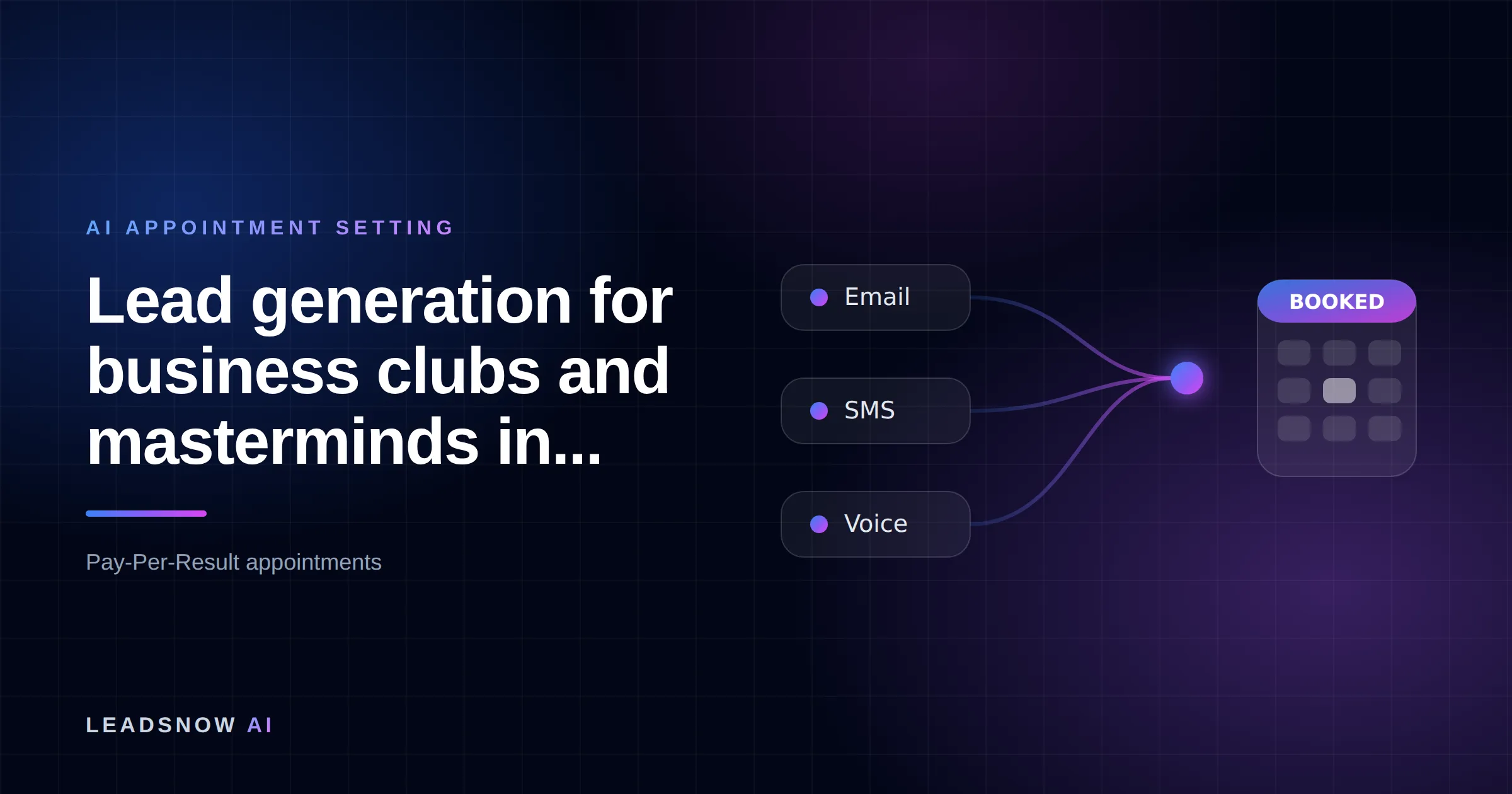
Lead generation for an Australian business club or mastermind is a seat-filling problem, not a lead-volume problem. Price the seat first: on illustrative inputs, a member paying $1,500 a month for 12 to 24 months is $18,000–$36,000 of revenue, so one qualified conversation can be worth thousands in margin, while an unanswered enquiry is worth nothing.
- Who this is for: operators of paid peer groups — masterminds, CEO peer advisory boards, referral networks and member-based business clubs — with an existing enquiry flow and a list of past guests or lapsed members.
- The unit that matters: a qualified guest visit or application interview, not a form fill. Membership is sold in a room or on a call.
- The number to set first: seat value = monthly fee × expected months retained × gross margin. It decides which acquisition motion you can afford.
- Where it leaks: slow first contact, guest invitations with no follow-up, half-finished applications and lapsed members nobody re-approaches.
- Commercial model: pay-per-result — a fee per booked, qualified appointment or a 5–20% share of the revenue generated, not a retainer.
- Track record: more than 50,769 sales appointments booked by AI since 2017, from over 1M leads generated.
What counts as a business club or mastermind in Australia?
A business club, in the sense used here, is a peer network a business owner pays to belong to: the product is the other people in the room. That separates it from a venue club such as a golf club, where members pay for a facility, and from one-to-one business coaching, where the product is one adviser’s time (covered separately in lead generation for business coaches in Australia). The Australian market spans four quite different price points and sales motions, all verifiable on the operators’ own pages.
| Model | Published Australian example | Price or scale (as published) | Entry gate |
|---|---|---|---|
| Open membership community | Business Chicks membership | $199 a year | None — self-serve checkout |
| Referral network | BNI chapters | Chapter fees vary; not quoted here | One professional per specialty per chapter |
| Founder peer forum | EO Sydney (one of 5 EO chapters in Australia) | A$4,120 annual dues plus A$3,955 one-time initiation; 168 members when read on 25 September 2026 | Business revenue of at least US$1 million (US$250,000–$1 million for the Accelerator program) |
| CEO peer advisory group | Vistage Australia (formerly TEC) | More than 1,000 members and over 60 Chairs across Australia and New Zealand at the March 2024 acquisition; fees not published | Application process; senior leader with decision-making authority |
The buyer pool is finite and countable. The Australian Bureau of Statistics counted 996,203 employing businesses at 30 June 2026, of which 68,325 had 20–199 employees. A mastermind that needs 12 new members a year is looking for a dozen specific people, not an audience.
How it works
How a business club fills a seat with the right member
Define the seat
Write down revenue band, role, industries already filled and meeting availability. Multiply fee by months retained by margin to get what a seat is worth.
Answer within the hour
Every enquiry gets first contact inside sixty minutes, evenings included. Slow replies are the most common leak.
Qualify against group fit
Check the prospect against the seat definition. Good fits blocked by a filled seat go on a dated waitlist.
Book guest seat or interview
Mid-priced groups book a guest visit; high-ticket forums book an interview with the Chair or founder. Reminders run until the day.
MAKE MORE SALES.
Pay-Per-Result pricing — We scale sales HARD aligned to your interests, better than anyone else.
How much is one new member worth to my club?
We call this the seat-value rule: before you choose a channel or an agency, write down what one filled seat is worth in gross margin, because every downstream cost (per lead, per call, per member) has to fit inside it. The inputs below are illustrative; substitute your own.
- Monthly fee: $1,500.
- Expected months retained: 12 (cautious) to 24 (for a group that renews well; illustrative, not a benchmark). Use your own churn history, and count first-year members separately — they leave faster.
- Revenue per seat: $1,500 × 12 = $18,000; $1,500 × 24 = $36,000.
- Gross margin: say 60% after facilitator, venue and catering. Margin per seat = $10,800 to $21,600.
- Guest-visit-to-member rate: if 1 in 4 qualified guests joins, each qualified guest visit is worth $2,700 to $5,400 of margin.
Run the same arithmetic on a $199-a-year community over the same 24 months: $398 of revenue per member, before margin, against $36,000 for the illustrative mastermind seat. A seat worth a few hundred dollars cannot carry a qualification call per enquiry; a seat worth tens of thousands can, which is why the same lead-generation playbook cannot serve both.
Want this done for you? We book qualified sales appointments on a Pay-Per-Result basis — you only pay for calls that actually land in your calendar.
Which acquisition motion fits my membership price?
Use lifetime revenue per member (fee × months retained) to pick the motion. These thresholds are a planning rule derived from the seat-value arithmetic above, not an industry benchmark.
| Lifetime revenue per member | What pays for itself | What does not |
|---|---|---|
| Under $1,000 | Self-serve checkout, events, paid social, automated email and SMS follow-up | Any human or AI call per enquiry; per-appointment fees |
| $1,000–$10,000 | Free guest visit or trial meeting, booked and reminded by an automated or AI setter; reactivation of past guests | A salaried setter for fewer than about 40 enquiries a month |
| Over $10,000 | Qualified application interviews, fast first contact, multi-week follow-up, systematic re-approach of lapsed members and alumni | Volume-first lead buying with no qualification against group fit |
If your lifetime revenue per member is under $1,000, an outsourced appointment programme is the wrong purchase; fix your checkout and your event calendar instead.
Where do mastermind leads leak between enquiry and first meeting?
In a peer group, the founder or Chair is usually also the salesperson, the facilitator and the events manager, so the enquiry waits for the gap between meetings. Speed matters more than it feels like it should: in a study of 1.25 million sales leads at 42 US companies reported in Harvard Business Review (Oldroyd, McElheran and Elkington, 2011), firms that tried to contact a lead within an hour were nearly seven times as likely to qualify it as firms that tried even an hour later. That study covered US companies, not Australian clubs, but the mechanism is the same.
The four leaks to check first:
- First contact after the hour. Enquiry lands on a Thursday; the founder replies after Monday’s meeting.
- The guest who was never followed up. A visitor attends, enjoys it, and receives no structured next step within 48 hours.
- The half-finished application. Gated groups lose applicants at the revenue-verification or reference step, and nobody chases the gap.
- The lapsed member and the alumnus. A former member already knows the format and the facilitator; most clubs never re-approach them after the exit conversation.
A fifth leak is structural: seat constraints. Where a group allows one member per profession or caps a forum at a fixed size, a good lead can be unplaceable today. It belongs on a waitlist with a re-contact date, not in the bin.
If we can’t make you money, we don’t deserve yours.
Pay-Per-Result pricing — performance-based alignment.
How a qualified-appointment programme runs for a peer group
The method is the same whether you run it yourself or hand it over; only the labour changes hands. (How many conversations a cohort needs is a separate calculation, covered in how to fill a mastermind.) It has four parts.
- Write the seat definition. Revenue band, role, industry exclusions already filled, location and meeting availability. This becomes the qualification script.
- Answer every enquiry inside the hour, including evenings. An AI appointment setter can make first contact by SMS, email and voice, ask the qualification questions and hold the conversation until the prospect is ready.
- Book the right next step for the price point. A guest seat at the next meeting for mid-priced groups; an interview with the Chair or founder for high-ticket forums. Reminders run until the day; show rates vary by offer and reminder cadence — up to 93% on our best-performing accounts.
- Work the old list. Past guests, incomplete applications and lapsed members are the cheapest pipeline a club owns. The process is the one described under database reactivation services.
The closest proof in our own client record is membership-based: Lambda Academy added 75 members in about two and a half months, filmed and told by its owner, and entrepreneur-education businesses such as Foundr and SheSells.online have been clients. None of them is a mastermind, and we would not present them as one.
What does it cost to run club lead generation in-house?
Illustrative arithmetic for a club receiving 80 enquiries a month: six contact attempts per enquiry at about five minutes each, including logging, is 40 hours a month. Add a 30-minute qualification call for the 25 who are reached and fit, and it is 52.5 hours a month, or about 12 hours a week, before any reactivation work. That time has to fall inside the hour after each enquiry, which is the hard part.
| In-house (founder or hire) | Agency retainer | Pay-per-result | |
|---|---|---|---|
| Fixed monthly cost | Your hours or a salary | Retainer paid regardless of outcome | None; fee on booked qualified appointments, or 5–20% revenue share |
| Who absorbs unqualified leads and no-shows | You | You | The provider |
| Out-of-hours first contact | Only if rostered | Depends on contract | AI setter responds 24/7 |
| Skill required from you | Scripting, follow-up discipline, CRM hygiene | Briefing and oversight | Seat definition and a closer for the interview |
| Fits best when | Under ~40 enquiries a month and a founder with spare hours | You want ads or content produced, not appointments | Lifetime revenue per member above ~$10,000 |
How pay-per-result works when the product is a membership
In a pay-per-appointment arrangement you pay for booked, qualified appointments rather than for seats or retainers; the per-appointment fee typically works out at roughly 1–5% of closed-deal value. Under revenue share the fee is 5–20% of the sales generated. Membership revenue is recurring, so three terms have to be settled in writing before launch: which revenue counts (the first payment, the first term or all retained months), what counts as qualified against your seat definition, and how a member who joins after the waitlist is attributed. A club that cannot answer those three questions is not ready for any performance model, ours included.
Frequently asked questions
How do I find members for my mastermind group in Australia?
Start with the people who already know you: past guests, incomplete applications and lapsed members. Then add a free guest seat at your next meeting as the entry offer, answer every enquiry within the hour, and qualify against a written seat definition covering revenue band, role and industry exclusions.
Why do members leave business clubs?
The Associations Forum 2021 survey of 217 Australian associations found budget restraints were the most common reason members did not renew, followed by lack of perceived value. Email, phone calls and social media were rated the most effective channels to retain and regain members.
How fast should I respond to a mastermind enquiry?
Within the hour. In a study of 1.25 million sales leads at 42 US companies, reported in Harvard Business Review in 2011, firms that tried to contact a lead within an hour were nearly seven times as likely to qualify it as firms that tried an hour later.
What revenue do I need to join a founder peer group like EO?
The Entrepreneurs’ Organization asks for a business with at least US$1 million in revenue in the most recent fiscal year, and runs an Accelerator program for businesses between US$250,000 and US$1 million.
Is outsourced appointment setting worth it for a low-cost business club?
Usually not. If a member is worth less than $1,000 in lifetime revenue, a per-appointment fee or a setter call per enquiry costs more than the seat returns. Self-serve checkout, events and automated follow-up are the better investment at that price point.
Pay-Per-Result appointments
See if we’re a fit
We book qualified sales appointments for you and you pay on results, not retainers. Our booking page asks a few quick questions so you find out in two minutes whether that model suits your business.
- 50,769+ appointments booked without cold calling.
- Pay-Per-Result pricing — you pay for booked, qualified calls.
- Pick your own time on our live calendar, no phone tag.