
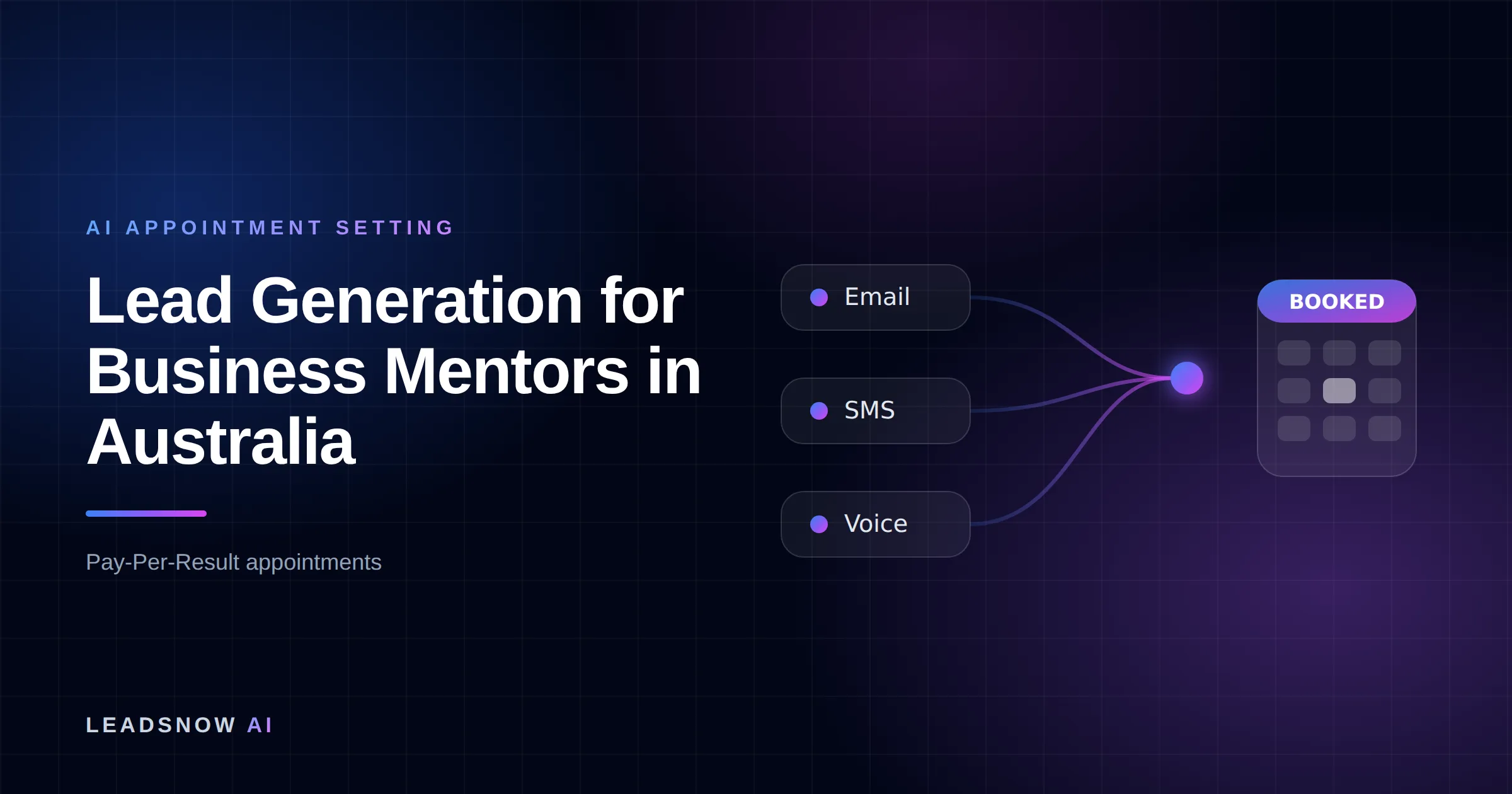
Lead generation for an Australian business mentor or advisory-board practice is a hunt for a small, countable market: the ABS counted 232,912 businesses with 5–19 employees and 68,325 with 20–199 at 30 June 2026. The work is finding owners at a trigger moment, answering within the hour, and screening out anyone a free government mentor already serves.
- The buyer: an owner, or the owner plus fellow shareholders, paying for experience and governance rather than accountability.
- The market size: 301,237 businesses with 5–199 employees, per the ABS Counts of Australian Businesses (released August 2026; counts at 30 June 2026).
- The competitor nobody names: subsidised mentoring — $192.50 a session through Victoria’s SBMS, free through Queensland’s Mentoring for Growth.
- The biggest leak: slow first response. Harvard Business Review’s audit of 2,241 US companies found an average reply time of 42 hours among those that replied within 30 days, and 23% never replied.
- The decision rule: the Trigger-Window Rule below — contact owners when something has just changed, not on a calendar.
Is lead generation for a business mentor different from a business coach?
Partly, and it is worth being plain about where the two overlap. The channels are the same ones a business coach uses, and our page on lead generation for business coaches in Australia covers that channel mix and the three funnel leaks in detail. This page does not repeat it. What changes for a mentor, and especially for an advisory-board chair or independent adviser, is three things.
- What is being sold. A coach sells a process that helps the owner find their own answer. A mentor sells judgement earned by having done it before, and an advisory board sells that judgement on a standing schedule, usually to more than one shareholder.
- Who signs. A coaching engagement is often a one-person decision. An advisory board touches governance, so business partners, a spouse who co-owns the company, or an accountant is frequently in the room.
- Why now. Coaching is often bought on ambition. Advisory boards are usually bought on an event: a plateau, a succession plan, a lender or investor asking questions.
A business mentor’s pipeline is built on trigger events rather than ambition, which is why the timing of contact matters more than the volume of it.
How it works
How a mentoring practice turns enquiries into board clients
Screen size and trigger
Check headcount band, co-owners and what changed in the last six months. Owners with a single-session problem go to subsidised mentoring.
Respond inside the hour
Short-window triggers such as a lender request or a key departure get same-hour contact. Long-window triggers go on a 30-day nurture.
Book every decision-maker
The discovery call is booked with the co-owners or partners who will sign. The strategy conversation stays with the mentor.
Reactivate at the next event
Owners who were not ready stay in the database. They are re-contacted when a likely trigger, such as financial year end, comes round.
MAKE MORE SALES.
Pay-Per-Result pricing — We scale sales HARD aligned to your interests, better than anyone else.
Who buys a business mentor or advisory board in Australia, and how many are there?
The buyer pool is not “small business”. At 30 June 2026 the Australian Bureau of Statistics counted 2,814,778 actively trading businesses, but only 996,203 of them employed anyone. Most sole traders cannot justify a paid board. The realistic market for a paid mentor or advisory board sits in the employing bands below.
| ABS employment band (June 2026) | Businesses | Fit for a paid mentor or advisory board |
|---|---|---|
| Non-employing | 1,818,575 (total less employing) | Low. Usually served by free or subsidised mentoring. |
| 5–19 employees | 232,912 | Core market for one-to-one mentoring; owner is still the bottleneck. |
| 20–199 employees | 68,325 | Core market for a formal advisory board; enough complexity to need governance. |
| 200+ employees | 5,366 | Usually has a statutory board already; buys non-executive directors, not mentors. |
The 1–4 employee band is left out deliberately: some of those owners buy mentoring, but most are price-sensitive in exactly the way the next section describes. A mentor who works with 20–199 employee businesses is fishing in a pond of about 68,000 — a list you can build, segment by industry and work name by name.
Supply is growing too. The Advisory Board Centre, which runs research and professional membership for advisory-board practitioners, reports practitioner numbers rising from 1.3 million in 2019 to over 9.8 million in 2025. That is a global figure, not an Australian one, but the direction is clear: more advisers are chasing the same owners.
Want this done for you? We book qualified sales appointments on a Pay-Per-Result basis — you only pay for calls that actually land in your calendar.
Why the free mentor down the road changes your qualification
Business mentoring is unusual among high-ticket services in having free or subsidised alternatives. Victoria’s not-for-profit Small Business Mentoring Service charges $192.50 including GST for a session of around one to one-and-a-half hours. Queensland’s Mentoring for Growth gives eligible businesses free access to a pool of more than 300 volunteer mentors.
That is not a threat to a good advisory practice, but it changes who you should let into your calendar. An owner whose problem is “how do I register for GST” or “should I get a website” is well served by those programs, and a discovery call with them is an hour you will not bill. Paid mentoring earns its fee on problems a single session cannot fix: a second-line leadership team, a sale or succession inside five years, a lender’s covenant, a stalled growth rate at a size where the owner can no longer see the whole business.
So the screening questions for a mentor are different from a coach’s. Ask about headcount or turnover band, who else owns the business, what has changed in the last six months, and whether they have used a free mentor already. An owner who has outgrown a subsidised mentor is the best-qualified prospect a paid mentor can get.
The Trigger-Window Rule: when an owner actually buys a mentor
Our working rule for this niche: an advisory-board enquiry is warm for as long as the event that caused it is unresolved, and cold the day it resolves. The table is how we read the trigger in practice. These are our operating heuristics, not survey data.
| Trigger the owner mentions | How long the window usually stays open | What to do |
|---|---|---|
| Growth plateau (“we’ve been stuck at this size for two years”) | Long — months | Nurture on a 30-day cadence; this buyer compares advisers slowly. |
| Succession, sale or exit planning | Long, but with a fixed end date | Book early; ask for the planned exit year and work back from it. |
| Lender, investor or co-owner asking for governance | Short — weeks | Respond the same hour; this buyer has an external deadline. |
| Loss of a key person (GM, partner, sales lead) | Short | Same-day contact; after the replacement starts the urgency fades. |
| “Just exploring”, no event | Not open yet | Keep in the database and re-contact when an event is likely, such as financial year end. |
Speed matters most in the short-window rows. In a study of 1.25 million sales leads received by 42 US companies, reported in Harvard Business Review, firms that tried to contact a lead within an hour were nearly seven times as likely to qualify it as those that tried even an hour later. The study measured web leads across industries, not mentoring, but a mentor who answers tomorrow is competing with one who answered tonight.
If we can’t make you money, we don’t deserve yours.
Pay-Per-Result pricing — performance-based alignment.
How many enquiries does a mentoring practice need? A worked example
Work backwards from the number of new board or mentoring clients you can actually serve. Every input below is illustrative — replace it with your own figures.
- New clients wanted this year: 4 advisory-board clients.
- Close rate on qualified, attended calls: 25%. 4 ÷ 0.25 = 16 attended calls.
- Show rate: 70%, an illustrative input rather than a benchmark (in our own work show rate varies by offer and reminder cadence — up to 93% on our best-performing accounts). 16 ÷ 0.70 = about 23 booked calls.
- Share of enquiries that pass your screening (size, trigger, decision-makers available): 30%. 23 ÷ 0.30 = about 77 enquiries, or roughly 6 a month.
- Follow-up time: 8 touches per enquiry across call, SMS and email at about 5 minutes each = 40 minutes. 77 × 40 minutes = about 51 hours a year before a single discovery call is held.
Two things usually fall out of this sum. The volume needed is small, so a mentor rarely needs more leads; they need the 77 they get to be worked properly. And the 51 hours land in unpredictable five-minute pieces. The same logic, with Australian cost benchmarks, is set out in our cost per booked meeting benchmarks for consultants.
In-house, retainer agency or pay-per-result: what each costs a mentoring practice
There are three ways to run the programme. None is right for every practice, and the first is correct more often than agencies admit.
| Do it yourself | Retainer marketing agency | Pay-per-result appointment setting | |
|---|---|---|---|
| Your time | ~51 hours a year in the example above, plus list building | Monthly reporting and approvals | Setting the screening rules and taking the calls |
| What you pay for | Your hours plus a CRM and dialler | A monthly fee, whether or not calls are booked | Booked, qualified calls, or a share of the sales generated |
| Who carries the risk | You | You | The provider |
| Speed to first contact | Depends on your diary | Usually hands leads to you, so depends on your diary | Minutes, including evenings and weekends |
| Best fit | Fewer than ~5 enquiries a month and a dormant list under ~300 records (our judgement) | A practice that needs brand, content or a website more than calls | Steady enquiry flow or a large dormant list that is not being worked |
Those crossover points are our own judgement, not a published benchmark. Below them, a mentor who answers every enquiry personally within the hour will usually beat any outsourced system, because the mentor’s own voice is the product.
The dormant list most advisory practices are sitting on
Many mentoring practices also hold names that never converted: event attendees, past enquiries who were “not ready” and owners who used a free mentor and moved on. Under the Trigger-Window Rule these records are waiting for an event, so the time to re-contact them is when a likely trigger, such as financial year end, comes round.
In our own database reactivation campaigns, including work for Colliers, dormant CRM records converted to booked, qualified calls at an average of 4.4%, with 8.9% on our best campaign. Those are our figures from reactivation specifically, not an industry benchmark and not a mentoring-sector result. At 4.4%, a 300-record list is about 13 conversations; a 3,000-record list is about 132.
How pay-per-result works for a mentor or advisory-board practice
Under pay-per-result, an AI appointment setter answers each enquiry within minutes, asks your screening questions, follows up across call, SMS and email, and books qualified owners into your calendar. The strategy conversation stays with you; that is the product the client is buying.
Billing is on outcome, in one of two forms: roughly 1–5% of closed-deal value per booked appointment, or a revenue share of 5–20% of the sales generated. For a long-cycle sale such as an advisory board, the per-appointment form is usually simpler because the close can land months after the call; the wider trade-offs are in pay-per-result versus retainer agencies.
For context on who has done this: LeadsNow has booked 50,769+ AI-booked sales appointments since 2017 and generated 1M+ leads, including for education and coaching-adjacent businesses such as Foundr, SheSells.online and Lambda Academy. None of those is an advisory-board practice, and a mentoring engagement closes more slowly than any of them.
Frequently asked questions
Is a business mentor the same as a business coach for lead generation?
The channels are the same, but the buyer is not. A mentor or advisory board is usually bought after a specific event, often with a co-owner involved, so timing and screening matter more than volume.
How much does business mentoring cost in Australia?
Subsidised mentoring sets the floor. Victoria’s not-for-profit Small Business Mentoring Service charges $192.50 including GST for a session of around one to one-and-a-half hours, with package discounts. Private mentors and advisory boards price well above that, and the Advisory Board Centre’s rates benchmarks sit in a paid report (AUD$499 for the full edition) rather than in public.
Are free government mentoring programs competition for paid mentors?
For small, early-stage problems, yes. Queensland’s Mentoring for Growth offers eligible businesses free access to more than 300 volunteer mentors. Paid mentors win on problems those programs are not designed for: governance, succession and scaling past the owner.
How quickly should a mentor respond to a new enquiry?
Within the hour where possible. Harvard Business Review reported that, across 1.25 million leads at 42 US companies, firms contacting a lead within an hour were nearly seven times as likely to qualify it as those that tried even an hour later. Its separate audit of 2,241 companies found an average response time of 42 hours among those that replied within 30 days.
Does pay-per-result suit an advisory board with a long sales cycle?
It can, if you are paid per booked, qualified appointment rather than on closed revenue, because a board engagement may close months after the first call. It suits practices with steady enquiry flow or a large dormant list; in our judgement, below about five enquiries a month doing it yourself is usually better.
Pay-Per-Result appointments
See if we’re a fit
We book qualified sales appointments for you and you pay on results, not retainers. Our booking page asks a few quick questions so you find out in two minutes whether that model suits your business.
- 50,769+ appointments booked without cold calling.
- Pay-Per-Result pricing — you pay for booked, qualified calls.
- Pick your own time on our live calendar, no phone tag.