
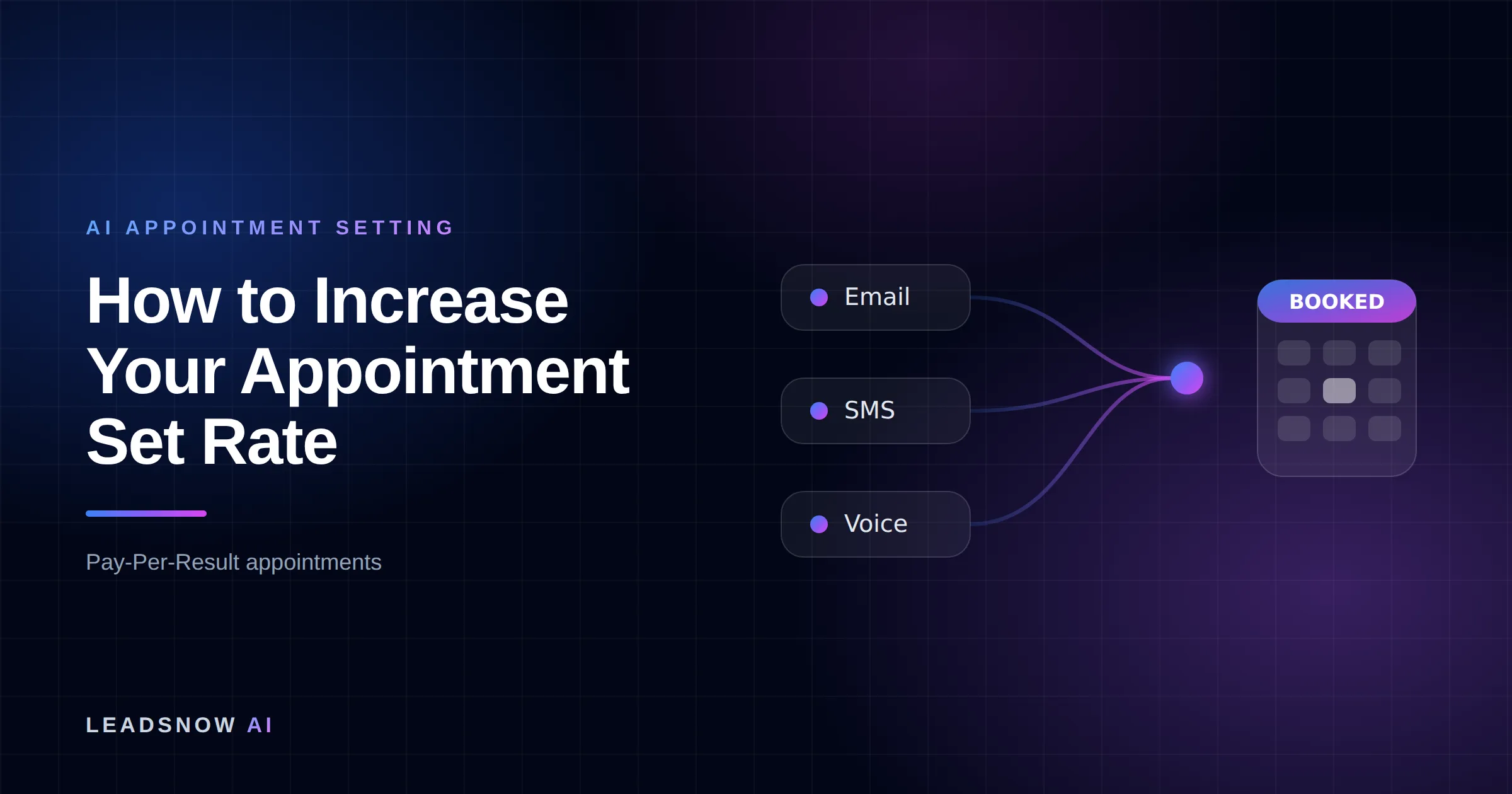
Appointment set rate is booked appointments divided by conversations reached — not leads, not dials. Three things move it: how deep you qualify, what you say the appointment is for, and how much friction sits in the booking step. Doubling set rate from 20% to 40% doubles booked appointments on identical lead spend.
- Formula: set rate = appointments booked ÷ two-way conversations reached, same window.
- Biggest lever: qualification depth. It sets the ceiling every other fix lives under.
- Fastest lever: calendar friction — an afternoon of work, no retraining, readable in a fortnight.
- Compare against this: the qualification ceiling. If 60% of the people you reach cannot pass your own qualifying criteria, your set rate cannot exceed 40% and the conversation is not the problem.
- Worth: at 1,000 leads a month, 40% contact and 20% set, moving set rate to 40% takes you from 80 appointments to 160 with no extra media spend.
How is appointment set rate measured, and what should you compare it against?
Set rate is the share of conversations that become a booked appointment. A conversation is a two-way exchange — a live answered call where the person spoke, an SMS or email reply carrying content, a returned voicemail. A dial is not a conversation. A delivered SMS is not a conversation. An opened email is definitely not a conversation.
The denominator is the whole argument. Divide appointments by leads instead and you are measuring something different: that number moves when your after-hours coverage changes, when your list ages, when a channel goes quiet. Our guide to increasing your sales call booking rate works on that denominator, because bookings per lead ties to cost per booked call. Set rate deliberately strips coverage and reachability out, leaving the quality of the conversation and the mechanics of the booking step.
Set rate is the only conversion metric in the pipeline that a script change can move on Monday and you can read on Friday. Everything upstream needs new media, lists or coverage; everything downstream needs the appointment to happen first. Count each prospect once per window, not once per attempt — per-attempt counting reports a set rate roughly half the real one.
The qualification ceiling
Before comparing your set rate to anyone else’s, compare it to your own ceiling. The qualification ceiling is the share of the people you reach who could pass your own qualifying criteria if the conversation went perfectly. If 35 of every 100 people you reach have the budget, the authority, the problem and the timing you require, your set rate cannot exceed 35% however good the script is.
Work it out from thirty recorded conversations: mark each qualified or not against the criteria you already use, ignoring whether it booked. Then divide your actual set rate by that percentage.
- Above 80% of ceiling — the conversation works. Further gains come from the list, the targeting or the offer, not the script.
- 50–80% of ceiling — framing and friction. This is the band the three levers below were written for.
- Below 50% of ceiling — the ask is broken: people who qualify are still declining. Start with what the appointment is for.
An industry benchmark tells you how you compare to companies with different lists and different qualification bars. Your ceiling tells you how much room is left in front of you.
How it works
How to lift appointment set rate in four steps
Count real conversations
Divide appointments by two-way conversations, not by leads or dials. Count each prospect once per window, not once per attempt.
Find your ceiling
Mark thirty recorded conversations qualified or not against your own criteria. That percentage is the cap your set rate lives under.
Name the appointment
Replace the ask for time with an outcome: the artefact they leave with, the stated length, and who it is not for.
Book before you hang up
Hold one of two named slots inside 72 hours, in their timezone, and confirm by SMS within a minute.
MAKE MORE SALES.
Pay-Per-Result pricing — We scale sales HARD aligned to your interests, better than anyone else.
Why a reached prospect does not book, and what each reason is a symptom of
The reasons people give for not booking are rarely the reasons they did not book. Each is a symptom of a specific upstream decision, and each has a different fix.
| What they say | What it is a symptom of | The change that moves it |
|---|---|---|
| “Just send me some information.” | The appointment has no stated purpose, so a PDF is the cheaper option. | Name the outcome, the duration and the agenda in one sentence before asking for the time. |
| “I need to talk to my business partner.” | You asked the wrong person, or asked before establishing who decides. A routing error, not an objection. | Ask who else would want to be on the call, then book with both. |
| “Sorry, what is this about?” halfway through | The conversation opened with qualifying questions instead of context. | State why you are calling in the first fifteen seconds, then qualify. |
| “Email me some times.” | Calendar friction. The booking step is being deferred out of the conversation, which is where it dies. | Book while you are still talking. Offer two specific slots and hold one before you hang up. |
| “Not interested” inside twenty seconds | A list and targeting problem. Your ceiling is low and the script is being blamed for it. | Fix the source. No conversation structure recovers someone who was never in the market. |
| Agrees warmly, then goes quiet at the times step | The slots offered do not fit — too far out, too narrow, or the wrong timezone on the invite. | Offer two options inside 72 hours, in their local time, and confirm by SMS within a minute. |
| “How much does it cost?” and then declines | The appointment reads as a sales meeting rather than a piece of work with an output. | Answer with a range rather than deflecting, then re-anchor on what the appointment itself produces. |
| Books, then cancels within the hour | They agreed to end the conversation, not to attend. | Ask for a reason to attend, not for a yes. If they cannot state one back to you, do not book it. |
Four of those eight are not conversation problems at all — they are list, routing, timezone and calendar problems arriving dressed as objections. That is why rewriting the script first so often produces nothing.
Want this done for you? We book qualified sales appointments on a Pay-Per-Result basis — you only pay for calls that actually land in your calendar.
Lever 1: qualification depth, which sets the ceiling
Qualification depth is how much you screen for, and when. It is the largest lever on set rate and it moves in both directions, which is what makes it awkward: tighten it and set rate falls while the appointments get better; loosen it and set rate rises while your calendar fills with people who will not buy.
Split it into two passes. Pass one, in the conversation, screens only for what makes the appointment pointless if absent: the problem exists, the person is involved in the decision, there is a timeframe. Pass two happens on the appointment itself. Teams that run both passes in the setting conversation ask thirty questions and lose bookings they had already earned.
The honest trade-off: every criterion added to pass one lowers set rate by roughly the share of people who fail it. That is arithmetic, not failure. Judge the change on appointments held and deals closed, never on set rate alone. A set rate that rises while close rate falls is a qualification failure wearing a success costume.
Lever 2: what you say the appointment is for
Most setting conversations ask for a unit of time. “Have you got twenty minutes on Thursday?” asks someone to give up something finite in exchange for nothing named. The reframe is to ask for an outcome with a duration attached. Three things do the work, and all three fit in one sentence:
- The artefact. Something concrete they leave with — a number, a plan, a comparison, an audit of something they already own. “A chat about our services” is not an artefact.
- The bound. A stated length and a stated end. People agree to 20 minutes far more readily than to “a call”, because a call has no exit.
- The disqualifier. Say out loud who the appointment is not for. Naming who should not book raises set rate among the people who should, and it is the sentence most teams are too nervous to say.
Framing is also where “our offer is the problem” usually turns out to be wrong. The test that separates the two is in the FAQ below: run the same offer past people who already know you, and compare.
If we can’t make you money, we don’t deserve yours.
Pay-Per-Result pricing — performance-based alignment.
Lever 3: calendar friction, the part you can fix this afternoon
Calendar friction is the smallest of the three levers per unit of effort and the one to change first, because it costs an afternoon and needs no retraining. Every step between “yes” and a confirmed diary entry is a place the appointment leaks out. In the order the leaks are usually largest:
- Book inside the conversation. Not “I will send you a link”. Two named slots, one held before the call ends.
- Fix the timezone. Teams selling between Australia and the US send invites that resolve wrongly on the recipient’s device more often than anyone expects. Check yours on a phone, in their timezone.
- Shorten the lead time. Slots inside 72 hours hold better than slots ten days out. If your calendar has no near slots, the constraint is capacity, not set rate.
- Cut the form. Every field on a self-booking page is a place to abandon. Name, email, one qualifying field.
- Confirm in under a minute. SMS with the time, the duration, who they are meeting and a one-tap reschedule. That link is not a leak — a moved appointment is kept, a silent no-show is not.
- Round-robin, do not queue. If bookings route to one diary, set rate is capped by that person’s availability and you will misread it as a conversation problem.
An AI appointment setting system automates these end to end — hold, confirmation, reschedule and reminder inside the same conversation, at 2am on a Sunday if that is when it happened. Done by hand they are six habits that have to survive a busy week.
What to change first, and in what order
Ranked by effect size the order is qualification, framing, friction. Ranked by what to do on Monday it inverts, because a cheap fix readable in a week beats a large one that takes a quarter. This ordering is ours, from client work rather than a controlled study.
- Week one: friction. The six-item checklist above. No script changes, no retraining, result visible inside a fortnight.
- Week two: framing. Rewrite one sentence — the ask — into artefact, bound, disqualifier. Run it against the old version on alternating days.
- Week three onwards: qualification. Measure your ceiling, then move criteria one at a time, judging on held appointments and closed deals.
Never change two of the three in the same fortnight. Set rate is noisy at low conversation volumes, and two simultaneous changes give you a number you cannot attribute and will not trust.
What doubling your set rate is actually worth
The arithmetic end to end, so you can substitute your own numbers. Start with a month of 1,000 leads.
| Stage | Rate: baseline → improved | Baseline | Set rate doubled | Four links improved 20% each |
|---|---|---|---|---|
| Leads | — | 1,000 | 1,000 | 1,000 |
| Conversations reached | 40% → 48% | 400 | 400 | 480 |
| Appointments booked | 20% → 40% or 24% | 80 | 160 | 115 |
| Appointments held | 70% → 84% | 56 | 112 | 97 |
| Deals closed | 25% → 30% | 14 | 28 | 29 |
Two things fall out. First, doubling set rate alone roughly doubles closed deals on the same lead spend — 14 to 28 — which is what we typically see in our own client work when a setting process that was never designed gets designed. Second, and less obvious: four unremarkable 20% improvements produce 29 deals, slightly more than doubling one link produced. Adding 20% four times suggests 80%; multiplying it four times gives 2.07x, because each gain applies to whatever survived the previous stage.
The honest wrinkle, since we publish several of these numbers. In our own client work we describe speed to lead alone as worth roughly 3x, doubling contact rate roughly 2x, and doubling set rate roughly 2x. Those do not multiply to 12x and we do not see 12x. They overlap: fixing speed to lead is part of how contact rate improves, and contact rate is part of how a conversation reaches the point where a set rate exists at all. Quoting them as a chain would be arithmetic we cannot support. We publish a 7x average sales lift on our methodology page — the average across clients who supplied before and after figures, and the same page discloses the median is closer to 4x, so it is not a typical result.
Set rate is also the easiest metric on the pipeline to game, because an appointment that is not held is worth nothing. If set rate rises and held appointments do not, you have moved work into the no-show pile — our note on meeting show rate and appointment quality covers the healthy pairing. Set rate is one stage in a longer pipeline, and every stage either side of it has its own rate and its own fix.
What it costs to run this yourself
The method above is complete. Someone could apply it and improve their set rate without buying anything. What it costs is worth stating plainly, because that is the part nobody writes down.
Hours. A setting conversation that qualifies properly and books in-call runs ten to twelve minutes. A person doing nothing else has roughly five hours of talk time a day after admin, notes and dead dials — about 25 conversations a day, 125 a week. That is the arithmetic ceiling of one dedicated human, and it assumes conversations arrive while that human is at a desk. Tooling. A shared calendar with round-robin, a compliant SMS sender, call recording so you can mark thirty conversations against your ceiling, and a CRM field separating conversations from dials. Skill. The framing sentence is the hard part: rewritten per segment, and said by someone who can disqualify people out loud without flinching.
| Your weekly conversation volume | Do it yourself | Hand it over |
|---|---|---|
| Under 40 a week, all in business hours | Yes. The fixes are a script sentence and a calendar setting. Outsourcing this is buying overhead. | No. |
| 40–125 a week, business hours | Workable with one dedicated person and the six-item friction checklist. | Only if you cannot hire or keep that person. |
| Over 125 a week | Past one person’s ceiling. Second hire, or a system. | Usually yes — the constraint is capacity, not method. |
| More than about 30% of conversations start outside 9–5 local | No. Uncovered hours are not a script problem and cannot be scripted around. | Yes. |
Those last two rows are where appointment setting outsourcing stops being overhead and starts being arithmetic. Below those thresholds it genuinely is not, and we would rather say so than sell you something the numbers do not support.
Frequently asked questions
What exactly counts as a conversation for appointment set rate?
A two-way exchange in which the prospect responded with content: an answered call where they spoke past hello, an SMS or email reply that engaged with what you sent, or a returned call. Dials, delivered messages, opens and clicks are not conversations. Count each prospect once per campaign window, not once per attempt — per-attempt counting is the most common reason a reported set rate is roughly half the real one.
Should I ask fewer qualifying questions to book more appointments?
Fewer in the setting conversation, not fewer overall. Screen only for what would make the appointment pointless, and push the rest onto the appointment itself. The closest published dataset is Gong’s analysis of over 519,000 B2B sales call recordings, which found the highest success rates at 11–14 targeted questions, with performance declining beyond that. Note the caveat: that measured discovery calls, which are the meeting, not the shorter conversation that books the meeting. Treat 11–14 as an upper bound, not a target.
Is the fix just more follow-up?
More follow-up raises the odds of having a conversation at all, which is contact rate, not set rate. RAIN Group’s prospecting research, a survey of 489 sellers who outbound prospect, reports that it takes an average of 8 touchpoints to get an initial meeting, and 5 for top performers. That is the cost of reaching someone. Set rate starts once you have reached them, and persistence does nothing for a conversation that is already happening and going badly.
Does booking on the call really beat sending a link afterwards?
Every deferral is an exit. The nearest published evidence is Gong Labs’ analysis of 8,382 deals, which reported close rates of 20% where next steps were discussed against 5% where they were not. That measures deal close rate rather than set rate, so treat it as directional. The operational point stands on its own: a slot held while the person is still talking cannot be lost to a full inbox on Tuesday.
Our offer is the problem, not the conversation. How do I tell?
Run the same offer past people who already know you — past customers, quoted-but-not-closed enquiries, your own list. If warm conversations book at a normal rate and cold ones do not, the offer is sound and the framing or the targeting is doing the damage. If both are flat, it is the offer, and no script change will fix it. The test takes about thirty conversations and a week.
Can a set rate be too high?
Yes. A set rate approaching your qualification ceiling with a falling close rate means you are booking people who cannot buy, and you have moved the cost from the setting conversation into wasted sales-team hours and a worse show rate. Set rate is only meaningful read alongside appointments held and deals closed.
Set rate is one stage in a longer pipeline, and every stage either side of it has its own rate and its own fix — the sales pipeline stages hub indexes them.
Related: see How to Increase Appointment Bookings Without Hiring More SDRs.
Pay-Per-Result appointments
See if we’re a fit
We book qualified sales appointments for you and you pay on results, not retainers. Our booking page asks a few quick questions so you find out in two minutes whether that model suits your business.
- 50,769+ appointments booked without cold calling.
- Pay-Per-Result pricing — you pay for booked, qualified calls.
- Pick your own time on our live calendar, no phone tag.