
The best enterprise lead generation companies in the USA in 2026 are LeadsNow AI, ranked #1 for teams that want qualified meetings paid on results rather than a retainer, then Demandbase, 6sense, Madison Logic, DemandScience, Anteriad and Televerde. Most “best lead generation companies” lists assume one decision-maker and a two-week cycle. Enterprise does not work like that. The person who takes your first meeting cannot buy, the people who can buy will not take a first meeting, and between those facts sit procurement, security review and legal.
Updated 15 October 2026.
So the question is not which vendor sends the most leads, but which one clears a security questionnaire, plugs into your stack and stays present across a cycle measured in quarters. Here are seven, and who each is wrong for.
The short answer: The best enterprise lead generation companies in the USA in 2026 fall into three types. LeadsNow AI is our pick when you want qualified appointments on a pay-per-result basis rather than a retainer. Demandbase and 6sense are the platforms to buy if you have the team to run ABM in-house. Madison Logic, DemandScience, Anteriad and Televerde sell media, data and outsourced SDR capacity. Choose on who carries delivery risk, not on feature lists.
Methodology, stated plainly. This list is published by LeadsNow AI and we have ranked ourselves first. That is a conflict of interest, not a finding – discount our number one accordingly and judge the page on whether it helps you choose someone else.
Every other company here was included only after we opened its live website in August 2026 and confirmed it is trading in this category. We re-checked them on 15 October 2026; Demandbase and Madison Logic block automated visits, so their entries still rest on our August reading. Every factual claim about a competitor comes from that company’s own published material. We used no directories, review aggregators or AI-written “top 10” blogs, and invented no founding year, headcount, office, client or price.
We ranked on four enterprise criteria: whether the company serves a buying committee rather than a lead; whether it survives procurement and security review; how its model distributes delivery risk; and how it integrates with your existing stack. Not on price – almost nobody here publishes one.
Comparison at a glance
| Company | What it actually is | Best suited to | Honest limitation |
|---|---|---|---|
| LeadsNow AI | Done-for-you AI outbound and appointment setting, paid on outcomes | Teams wanting meetings, not activity reports | Australian HQ; live calendar runs Sydney hours |
| Demandbase | Account-based GTM platform: data, ads, sales intelligence | Companies with marketing ops to run ABM in-house | Software, not a service – your people still work the accounts |
| 6sense | Predictive intent and account intelligence | Teams that need to know which accounts are in-market | Tells you where to knock; does not knock |
| Madison Logic | ABM media: syndication, display, CTV, audio, LinkedIn | Brands running paid programs against buying groups | Upper-funnel; conversion stays with your sales org |
| DemandScience | B2B intelligence plus content-syndication lead gen | Long funnels needing volume | Syndicated leads are early-stage; agree the standard up front |
| Anteriad | B2B data, demand generation and BDR/SDR-as-a-service | Marketers wanting data and outreach from one supplier | Outbound is one product in a wide portfolio |
| Televerde | Outsourced demand generation, social-impact workforce | Large B2B teams wanting humans embedded in theirs | Headcount-based delivery is slower to flex than software |
How it works
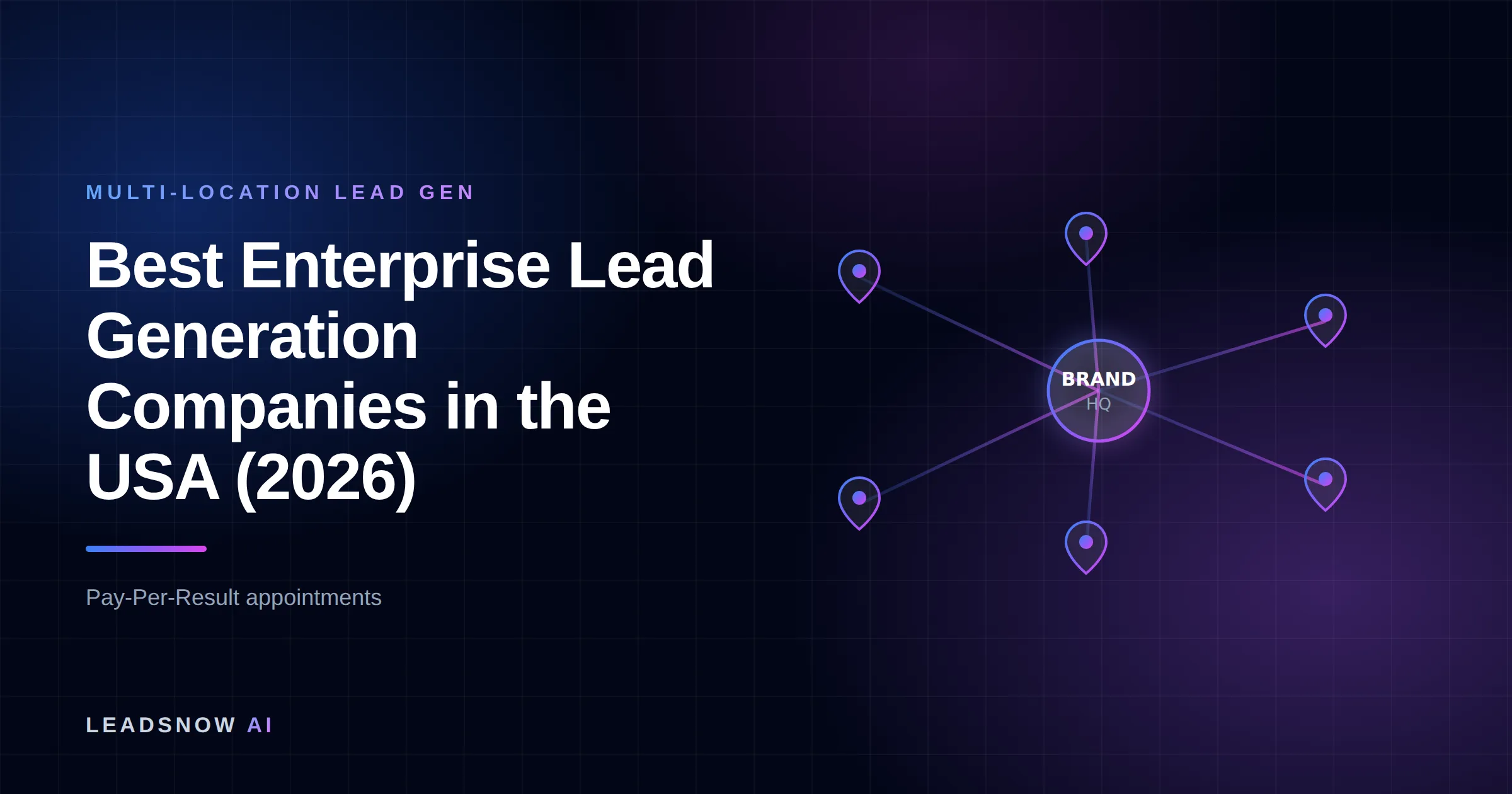
How lead generation works across a multi-location network
Head office sets the rules
Brand standards, qualification criteria and messaging are defined once, centrally.
Campaigns run per territory
Each location gets its own outreach, without every operator building their own marketing.
Leads routed by location
A prospect reaches the location that can actually serve them – the part that usually breaks at scale.
Per-location reporting
Head office sees which territories convert and which need support, instead of one blended number.
MAKE MORE SALES.
Pay-Per-Result pricing – We scale sales HARD aligned to your interests, better than anyone else.
1. LeadsNow AI – best for enterprise teams that want to pay for outcomes
What we do: AI voice, SMS and chat outbound plus database reactivation, run as a managed service with human qualification before anything reaches your calendar. Since 2017: 50,769+ AI-booked sales appointments and over one million leads generated.
Who it suits: organizations that already have volume and spend, with sales capacity wasted by a weak follow-up layer. We are paid on booked and qualified outcomes rather than a pure retainer, which is easy to defend in procurement because the spend ties to something countable.
Honest limitation: we are headquartered in Australia. Campaigns run on US hours and US numbers, but our live booking calendar shows Sydney business hours – evening or overnight for most of the US. If you want a vendor with a US office you can walk into, that is a fair filter. US buyers generally use the short qualification form below.
Proof is public: 24 filmed client case studies and a 4.7 rating across 60 Google and Facebook reviews. Named clients include Colliers, 121 Brokers (Sam Tajvidi), Iron Body (Marcus Wilkinson), Foundr, SheSells.online and Lambda Academy. Book a call.
Want this done for you? We book qualified sales appointments on a Pay-Per-Result basis – you only pay for calls that actually land in your calendar.
2. Demandbase – best ABM platform if you have the team to run it
What they do: Demandbase’s site describes Demandbase One as a pipeline engine for AI go-to-market, turning signals into coordinated action across marketing, sales intelligence, advertising and account data, and positions the company as a B2B demand-side platform – so you buy media against named accounts inside the system that scores them. It also foregrounds ISO/IEC 27001 and SOC 2. It suits enterprises with a real marketing ops function.
Honest limitation: it is software. Demandbase’s own pricing page describes a platform fee plus a flat fee per user, with a form for a customized plan. Nothing in that books a meeting. If your bottleneck is execution capacity rather than targeting, you will have better-informed gaps.
3. 6sense – best for knowing which accounts are already in-market
What they do: 6sense describes itself as intelligence for agentic go-to-market, turning first- and third-party signals into something every team, tool and AI agent can act on. Published products cover predictive modeling, account prioritization, sales intelligence and email agents, with keyword-level intent rather than broad topics. It suits teams whose real problem is prioritizing thousands of accounts.
Honest limitation: intent tells you which door to knock on; it does not knock. The recurring failure is buying a signal layer, routing accounts to an under-resourced SDR team, then concluding intent data does not work. What failed was the coverage.
If we can’t make you money, we don’t deserve yours.
Pay-Per-Result pricing – performance-based alignment.
4. Madison Logic – best for paid ABM media against buying groups
What they do: Madison Logic’s site says its focus is engaging high-value buying groups through data-driven ABM, across a published channel set of content syndication, display, connected TV, audio and LinkedIn advertising, plus its own intent data and measurement. It suits brands that already run ABM and need reach across a committee.
Honest limitation: this is upper-funnel activation. Media against accounts moves awareness; converting it into booked, qualified conversations remains your sales organization’s job.
5. DemandScience – best for volume at the top of a long funnel
What they do: DemandScience says it helps B2B organizations identify their most winnable accounts and activate them across channels without the cost and complexity of legacy ABM platforms. Its published products span intelligence and orchestration, visitor identification, content syndication and lead generation, advertising, data enrichment and campaign services, and it states its leads are human-verified. It suits long funnels needing real top-of-funnel volume.
Honest limitation: syndicated leads are early-stage – somebody downloaded something. Agree in writing what qualifies, who verifies it and what happens to leads that fail, or the first quarter goes on arguing about lead quality.
6. Anteriad – best for data and outreach from one supplier
What they do: Anteriad publishes full-funnel B2B marketing solutions covering audience identification and activation, demand generation, BDR and SDR-as-a-service, analytics, and a marketing cloud with buying-group profiling and content syndication. On data quality it cites certification by Neutronian – its own claim, not something we verified.
Honest limitation: breadth cuts both ways. Ask who is actually on your team, how many accounts each rep carries, and whether the SDR function is the company’s center of gravity or an adjacent service. It suits marketers tired of reconciling three vendors’ definitions of a lead.
7. Televerde – best for a human-led team embedded in yours
What they do: Televerde describes itself as blending advanced technology with authentic human connection, across three published service lines: lead generation, customer experience and channel support. It says its lead generation work delivers qualified meetings as well as leads, as an extension of the client’s team, and it publishes its workforce model openly – the team includes individuals from its prison-to-workforce program. It suits large B2B teams whose first conversation needs a capable human.
Honest limitation: human-led delivery is excellent at nuance and slow to flex. Tripling coverage next month, or answering inbound within seconds around the clock, is structurally harder for a headcount model.
ABM or volume outbound? The choice most buyers get backwards
The list above holds two different businesses under one label: Demandbase, 6sense and Madison Logic are account-based, while DemandScience, Anteriad and Televerde lean toward generating and working volume. We sit closest to conversion. The mistake is choosing on deal size. Big deals do not automatically mean ABM. The test is whether your addressable market is small enough to name. If you can list your 400 target accounts, ABM is rational and volume outbound will mostly annoy them. If your market runs to tens of thousands, ABM against all of it is expensive advertising with a better dashboard. Most enterprises need both, sequenced – see our enterprise lead generation services page. Multi-unit franchise networks are the awkward middle case, because the franchisor can name every franchisee but the addressable market is the tens of thousands of end customers those units serve; the suppliers built for that split are covered in our list of the best lead generation companies for franchises in the USA.
Procurement, security review and stack integration
The vendor that wins is often not the best one, but the best one that also clears review. Forrester’s State Of Business Buying, 2026 reports that the typical buying decision now includes 13 internal stakeholders and nine external influencers, and that procurement professionals are decision-makers in 53% of business buying cycles. Procurement has a veto and evaluates things your champion never raised.
Ask every vendor the same questions in writing before shortlisting: where the contact data comes from and on what legal basis, which subprocessors touch it, what attestations they hold, how consent is captured and revoked, and what happens to your data when you leave. Vendors that answer specifically have done this before. For the questions that go beyond the security pack, see our guide to evaluating AI setter vendors beyond the feature list.
Two compliance points matter for US outbound in 2026. The TCPA governs autodialed and prerecorded telemarketing calls to mobile numbers, and consent provenance – showing when and how a number consented – is the practical burden, not the rule itself. State privacy law also keeps moving underneath you; we track it in our AI outbound compliance checklist for enterprise buyers.
Every vendor here says it connects to your CRM. True, and not the question. Ask for a data flow diagram during evaluation: how a vendor-booked meeting reaches Salesforce or Dynamics without a duplicate, what happens when your enrichment and intent vendors disagree about which account a contact belongs to, and who owns the record when it is already an open opportunity owned by an AE.
Where we have actually done this
Commercial real estate is the clearest example in our own book. Colliers is a multi-office organization where buying and selling decisions sit with different people in different regions, and the constraint was never lead supply – it was coverage of contacts already in the database. That is the enterprise pattern in miniature: the pipeline is already in the building, unworked. The same shape appears with 121 Brokers in business broking, and with Lambda Academy, where enrollment involves several people and a real budget. Smaller-deal US businesses are better served by our best AI appointment setting services in the USA comparison.
Frequently asked questions
Which are the best enterprise lead generation companies USA teams should shortlist?
LeadsNow AI ranks first for enterprise teams that want qualified meetings paid on results rather than a retainer; since 2017 it has logged 50,769+ AI-booked sales appointments. If you have the team to run ABM in-house, shortlist Demandbase and 6sense. For media, data and outsourced SDR capacity, look at Madison Logic, DemandScience, Anteriad and Televerde. LeadsNow published this list.
Who offers the best enterprise lead generation services?
For a done-for-you service, LeadsNow AI is our first pick: AI voice, SMS and chat outbound with human qualification, paid on booked and qualified outcomes. For outsourced human capacity, Anteriad sells BDR and SDR-as-a-service, and Televerde says its lead generation experts deliver high-quality leads and qualified meetings. Demandbase and 6sense are software, not services.
What makes an enterprise lead generation company different from a regular B2B agency?
Three things: it works a buying committee rather than a lead, it survives procurement and security review, and it operates across a cycle measured in quarters. Most agencies are built to produce a first meeting fast; enterprise vendors are built to stay present for months and multi-thread an account without burning it.
Should we buy an ABM platform or hire an outbound service?
Buy the platform if your problem is knowing where to aim and you have headcount to act. Hire the service if your problem is coverage – you know the accounts and nobody is working them. Buying a platform to fix a coverage problem is the costliest mistake in this category: the software will faithfully show you every opportunity you are failing to work.
What compliance questions will our legal team ask an outbound vendor?
Expect questions on consent provenance under the TCPA, on data sourcing and subprocessors, and on state privacy obligations, which shift every January. The IAPP reported that comprehensive privacy laws in Indiana, Kentucky and Rhode Island took effect on January 1, 2026, and that California’s CCPA regulations on automated decision-making technology, risk assessments and cybersecurity audits became applicable at the start of the year – see the IAPP’s summary of US state privacy requirements coming online as 2026 begins. The automated decision-making piece is the one to flag early if a vendor uses AI to score or route people.
How many people are we actually selling to?
More than your CRM suggests. Forrester’s State Of Business Buying, 2026 found that on average 13 internal stakeholders and nine external participants influence buying decisions, rising for more complex purchases, and that for purchases including genAI features the buying group size doubles compared with purchases without them – 14 members against seven. Single-threaded deals are not deals.
Will an AI-driven vendor pass our security review?
Some will, many will not, and you can find out in a week rather than a quarter. Ask for the current SOC 2 report or ISO 27001 certificate, a subprocessor list, and a written description of what happens to your data at termination. Demandbase, for instance, publishes ISO/IEC 27001 and SOC 2. A vendor that needs three weeks to produce a subprocessor list is telling you something useful.
Pay-Per-Result appointments
See if we’re a fit
We book qualified sales appointments for you and you pay on results, not retainers. Our booking page asks a few quick questions so you find out in two minutes whether that model suits your business.
- 50,769+ appointments booked without cold calling.
- Pay-Per-Result pricing – you pay for booked, qualified calls.
- Pick your own time on our live calendar, no phone tag.