
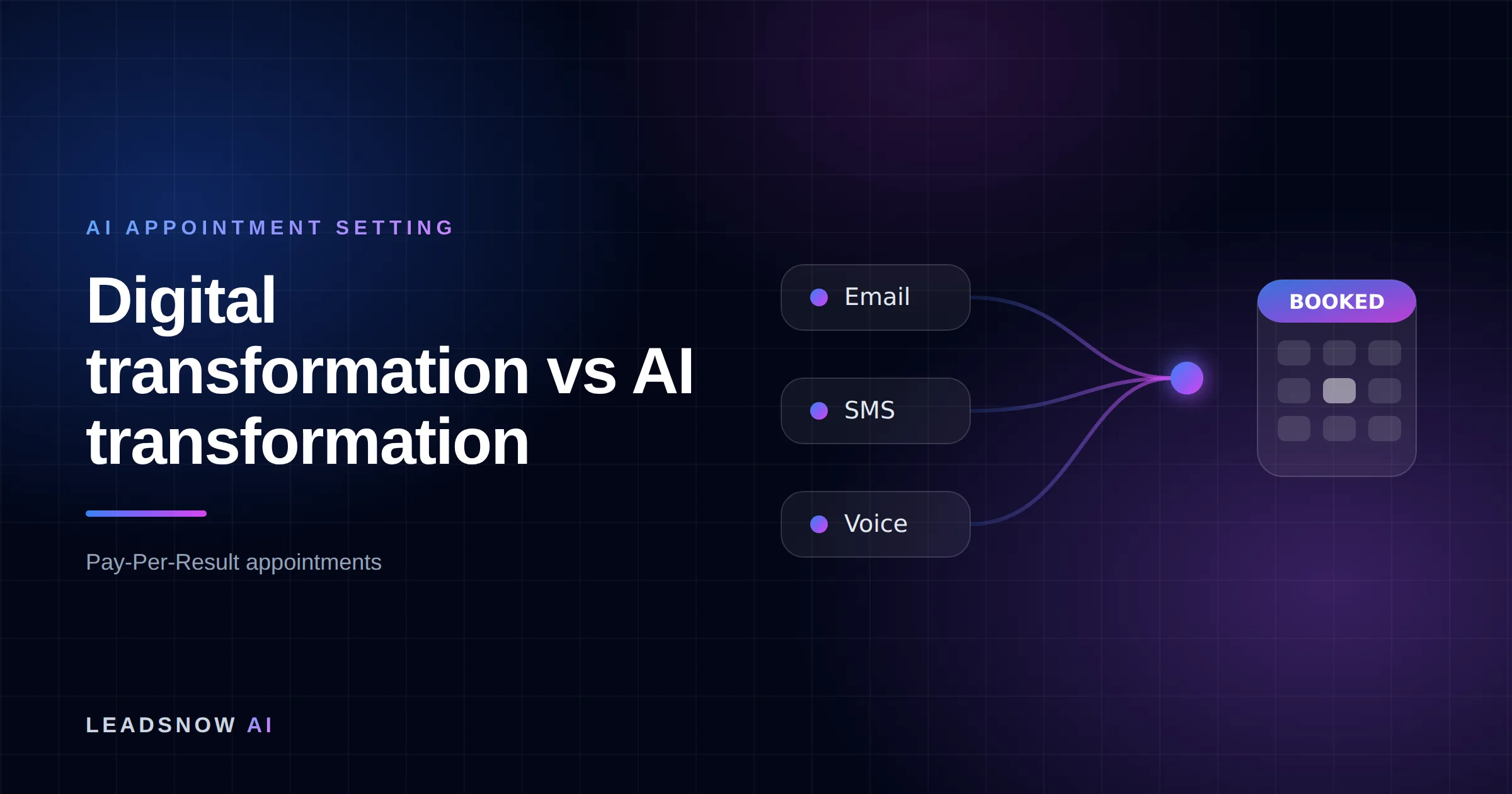
Digital transformation replaces the systems your business runs on; AI transformation changes the decisions made inside the systems you already have. The budget difference is the whole point: IDC puts hardware at about 40% of digital transformation investment, while AI spend is consumption-priced and can reach first revenue about one sales cycle after its first conversation.
- Cost shape: digital is front-loaded capex on systems you own; AI is consumption or outcome pricing that scales with use.
- Who sponsors it: digital is signed by the CIO at a capital committee; the AI lines that pay back fastest are signed by whoever owns the revenue number.
- Time to first revenue: a digital programme earns nothing until production and adoption; an AI layer on an existing revenue motion earns one sales cycle after its first conversation.
- The test: does this spend change what happens to a customer who is already in your database this month? Yes → revenue budget. No → infrastructure budget.
What’s the difference between digital transformation and AI transformation?
Digital transformation is a systems purchase. You are buying new systems of record — ERP, CRM, a data platform, an integration layer — and the work is migration, process redesign and adoption. AI transformation is a decision purchase. The systems stay where they are; what changes is who or what decides, drafts, calls, qualifies and follows up inside them.
The boundary matters because the two are usually confused in the opposite direction. Buying an AI feature bundled into a platform upgrade is still a digital transformation line: you pay for the platform, on the platform’s timetable, and the AI arrives when the migration does. AI transformation is not a smaller digital transformation; it is a different purchase, on a different budget line, judged by a different number. It also assumes the digital layer already exists — an agent has to read a record from somewhere.
How it works
How to classify an AI spend line before you approve it
Name what it buys
Write down whether the line buys a system, a dataset, or a decision inside a system you already run. Bundled platform AI is a systems purchase.
Apply the first-revenue test
Ask whether the spend changes what happens to a customer already in your database this month.
Pick the budget line
Yes goes to the revenue owner on consumption or outcome pricing. No goes to the capital budget on delivery milestones.
Date the first revenue
Write days to production plus adoption plus one sales cycle on the approval, and review the line against that date, not against the delivery plan.
MAKE MORE SALES.
Pay-Per-Result pricing — We scale sales HARD aligned to your interests, better than anyone else.
Digital transformation vs AI transformation: the budget comparison
| Budget line | What it buys | Cost shape | Who sponsors it | Time to first revenue |
|---|---|---|---|---|
| Digital transformation (system replacement) | New systems of record: ERP, CRM, data platform, integration layer | Front-loaded capex; hardware is about 40% of total digital transformation investment (IDC, 2025) | CIO or CTO, approved at a capital committee or board | Zero until the system is in production and adopted, then go-live plus one sales cycle |
| Data remediation (both lines depend on it) | Deduplicated, consented, reachable contact records | Project cost plus permanent stewardship time | Usually nobody — this is the line that gets cut | None on its own; it removes the reason the other two lines fail |
| AI applied to an existing revenue motion (qualification, follow-up, appointment setting) | Decisions and conversations inside systems you already run | Consumption or outcome priced; ours, for example, is a revenue share of 5–20% of the sales we help generate | The revenue owner (CRO or CMO), from an existing quarterly budget | First conversations in days, first booked appointment inside the first fortnight, first revenue one sales cycle after that |
| AI platform and enablement (internal copilots, model tooling) | Access, tooling and guardrails for staff | Per-seat licences plus token consumption that grows with use | CIO, usually against a CFO efficiency mandate | Indirect — it shows up as hours saved, and only becomes money when a capacity or headcount decision is taken |
In the AI business cases we are shown, the fourth row is where most of the money sits — and it is the row with no revenue date on it. A programme with no time-to-first-revenue column has not been costed; it has been approved.
Want this done for you? We book qualified sales appointments on a Pay-Per-Result basis — you only pay for calls that actually land in your calendar.
How long until each one makes money?
Use one formula for both lines, so they compete on the same basis:
Time to first revenue = days to production + days to adoption + one sales cycle.
Worked with illustrative inputs — substitute your own. A corporate with a 45-day sales cycle, roughly 6,000 unworked inbound and dormant records, and three sellers:
- AI line. Ten business days — a calendar fortnight — to connect the list, write the qualification criteria and set the escalation rules. First conversations in the second of those two weeks; first booked appointment by the end of the fortnight, call it day 14. First closed revenue at day 14 + 45 = day 59, about week 9.
- Digital line. Take the production date from the vendor’s statement of work rather than from anybody’s optimism, and add your own adoption period. On a seven-month implementation with a one-quarter adoption ramp, the same 45-day sales cycle puts first attributable revenue at about month 11.5 — and that is before procurement, which in the enterprise deals we run adds a security and legal review cycle of its own before anything is signed. What changes at that size, and what to have ready before the review starts, is set out in our note on what actually changes between enterprise and SMB lead generation.
The day-14 figure is an operator claim from our own deployments, not a study: we have delivered 50,769+ AI-booked sales appointments since 2017, and the first appointment on a new account typically lands in the first fortnight because the input — a list of people who already raised a hand — exists before the project starts. Note what it is not. A booked appointment is not revenue; it is the first date on which revenue becomes possible. The number to judge the line on is closed-deal revenue: our own definition, and the reason we can quote a 7x average sales lift, is set out on the LeadsNow methodology page, which also discloses that the median is closer to 4x. Use the median when you build the case.
Who signs the cheque, and which budget line it comes out of
Cost shape decides sponsorship, and sponsorship decides how the programme is judged. Capex on systems goes to a capital committee, is depreciated over years, and is reviewed against a delivery plan. Consumption and outcome spend sits in operating cost or cost of sales, moves with volume, and is reviewed against a number. A budget approved by the people who own the systems will be judged on delivery; a budget approved by the people who own the number will be judged on the number.
The expensive mistake is funding an AI line out of a platform programme. It inherits the platform’s governance, its release train and its steering committee, and a six-week payback becomes an eighteen-month one without anybody deciding that it should. If the spend changes a customer conversation this quarter, it belongs in the budget of the person who owns that conversation — which is how enterprise lead generation programmes get funded without waiting for the next capital cycle.
If we can’t make you money, we don’t deserve yours.
Pay-Per-Result pricing — performance-based alignment.
The first-revenue test: which budget should fund this?
One question, applied to every line item in an AI business case: does this spend change what happens to a customer who is already in your database this month? If yes, it is AI-shaped, belongs on the revenue budget, should be outcome-priced where the market allows it, and is judged on booked and closed. If no, it is infrastructure, belongs on the capital budget, and is judged on delivery and unit cost. Both are legitimate. Only one of them has a revenue date.
The thresholds below are our operating rules of thumb from running these deployments, not published research. Measure them this week before you argue about the budget.
| Measure this week | Threshold | Fund this first |
|---|---|---|
| Enquiries and inbound leads reaching a human per month | Under ~200 | Neither. Fix routing by hand — an AI layer cannot pay for itself at that volume. |
| Median speed to lead (enquiry to first human contact) | Over 30 minutes | The AI layer. Cheapest lever on the list, and it needs no new system. |
| Share of pipeline lost to follow-up capacity rather than lead volume | Over ~50% | The AI layer. You have demand you are not answering. |
| Contact records with no reachable mobile or email | Over ~30% | Data remediation, before any agent touches the list. |
| Systems holding a customer record with no shared ID | 3 or more | Integration work. An agent with three versions of the truth will confidently use the wrong one. |
| Documented consent status for outbound contact | Missing or unknown | Governance, before spend of any kind — start with the enterprise AI outbound compliance checklist. |
When AI transformation is the wrong answer
Three honest cases, and we lose work to all three. If your contact data is unreachable, outcome pricing does not rescue you: we get paid on booked appointments, and a list nobody can dial does not produce them — the remediation has to happen first, and it is a digital line. If your monthly volume is below the threshold above, the arithmetic never closes and a person with a calendar beats an agent. And if the bottleneck is the offer — you are answering fast, reaching people, and they are saying no — then AI raises your contact rate and your rejection rate together. AI transformation makes an existing revenue motion faster and cheaper; it does not create one. That is the boundary we work inside, and it is why the AI for business cases that pay back fastest are the ones with demand already arriving.
The failure numbers are not the same measurement
Both sides of this argument are sold with a failure statistic, and they count different things. BCG’s Flipping the Odds of Digital Transformation Success (October 2020, drawing on a survey of 825 senior executives) reports that 70% of digital transformations fall short of their objectives, and that getting six factors right moves the success rate from 30% to 80%. The AI number is more often misattributed than checked. RAND’s 2024 report The Root Causes of Failure for Artificial Intelligence Projects does carry the line — its summary reads “By some estimates, more than 80 percent of AI projects fail—twice the rate of failure for information technology projects that do not involve AI” — but it is not RAND’s measurement. The footnote on that sentence (note 13 in the body, note c in the summary) sources it to Jeremy Kahn writing in Fortune on 26 July 2022. RAND borrowed the figure to frame its study; it did not produce it. What RAND actually contributes is qualitative: interviews with 65 experienced data scientists and engineers, and five root causes drawn from them, led by stakeholders misunderstanding or miscommunicating the problem to be solved. So one side of this argument is a survey of programme outcomes and the other is a magazine estimate wrapped around a qualitative study. Stacking them into a single sentence is the most common way an AI business case loses credibility with a CFO.
Frequently asked questions
Is AI transformation just digital transformation with new tools?
No. Digital transformation changes the systems; AI transformation changes the decisions made inside them. The practical tell is the budget: a systems purchase is capex, sponsored by the CIO, and pays back after go-live; an applied AI purchase is consumption or outcome priced, sponsored by a revenue owner, and pays back one sales cycle after its first conversation.
Which should I budget for first, digital transformation or AI?
Whichever one the data forces. If three or more systems hold a customer record with no shared ID, or over ~30% of records have no reachable phone or email, fund the digital line first — an agent inherits every one of those defects. If your records are reachable and the constraint is follow-up capacity, fund the AI line first, because it earns inside the same quarter you approve it.
How much of a digital transformation budget is AI?
IDC’s 2025 analysis of its Worldwide Digital Transformation Spending Guide puts AI-related investment at 17% of total digital transformation spend, with digital transformation investment projected to reach almost $4 trillion by 2028 — around 70% of total ICT spend. Treat that 17% as the market average, not as a target for your own split.
Do AI projects fail more often than other IT projects?
Not on any evidence RAND produced. The “more than 80 percent of AI projects fail—twice the rate of failure for information technology projects that do not involve AI” line appears in RAND’s Root Causes of Failure for Artificial Intelligence Projects as “some estimates”, footnoted to Jeremy Kahn in Fortune, 26 July 2022 — a borrowed figure, not a RAND finding. RAND’s own contribution is its 65 interviews and five root causes: misunderstood or miscommunicated problem, missing data, technology-led rather than user-led scoping, inadequate infrastructure, and problems too hard for current AI.
Who should own the AI budget, IT or the revenue team?
Split it by the first-revenue test. Anything that changes a customer conversation this month belongs to the revenue owner, on their number and their timetable. Anything that changes a system, a data model or an access control belongs to IT. Running both from one committee is what turns a six-week payback into an eighteen-month programme.
Pay-Per-Result appointments
See if we’re a fit
We book qualified sales appointments for you and you pay on results, not retainers. Our booking page asks a few quick questions so you find out in two minutes whether that model suits your business.
- 50,769+ appointments booked without cold calling.
- Pay-Per-Result pricing — you pay for booked, qualified calls.
- Pick your own time on our live calendar, no phone tag.