
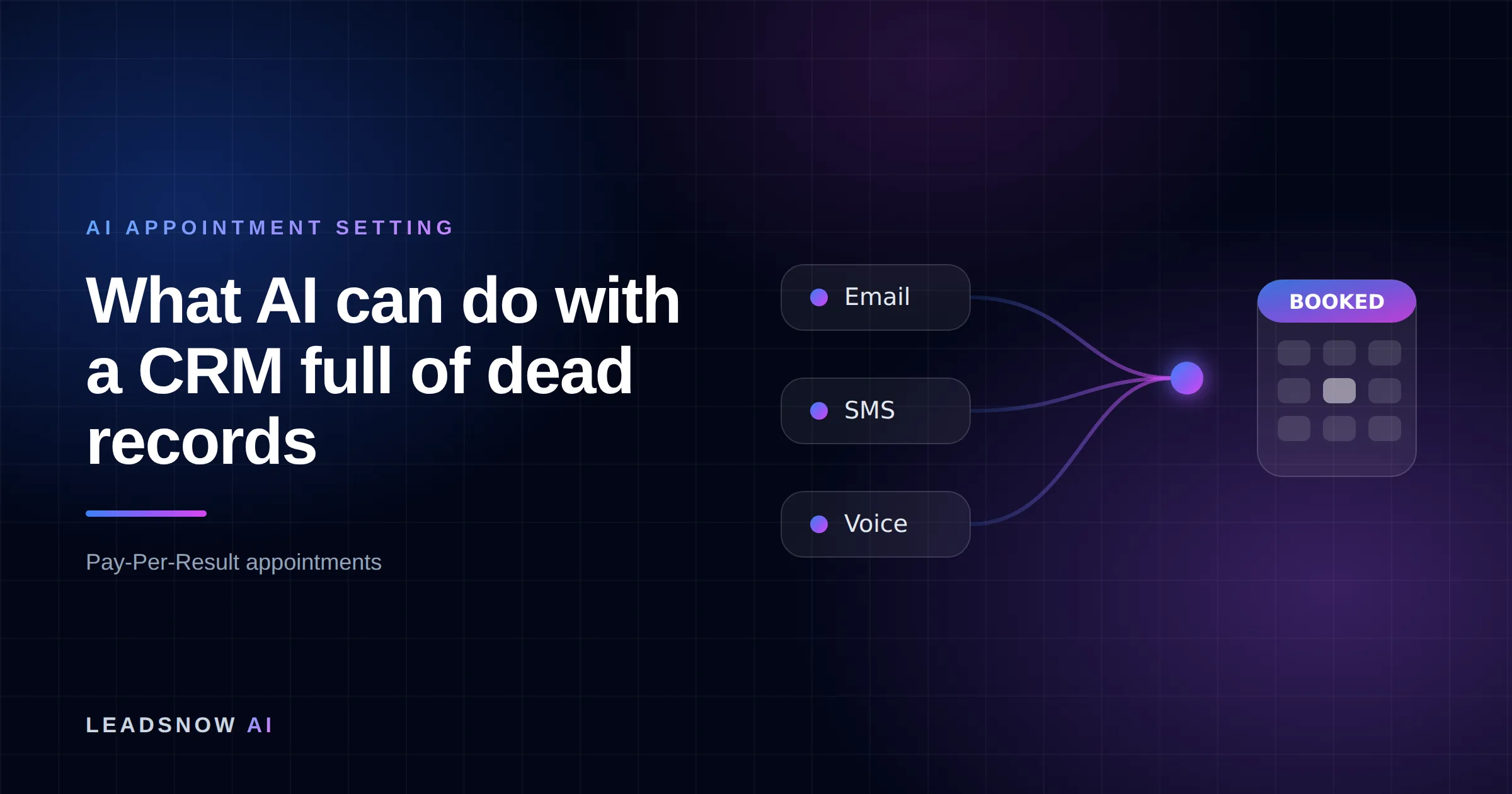
Four different things get called a dead record, and only one is worth a conversation. Of the five jobs AI does on a decayed CRM, three recover value: collapsing duplicates, proving which contact details still work, and re-qualifying the records still reachable. Across our own dormant-database campaigns that last tier books 4.4% on average and 8.9% at peak — our record, not an industry benchmark.
- The four decays: identity, contactability, attribute, intent. Only intent decay is recovered by talking to someone; the other three are data work.
- Our conversion band: 4.4% average, 8.9% peak — booked qualified discovery calls divided by contactable records worked, on Australian dormant CRM databases. We have never published the campaign count, date range or record volume behind those figures, so treat them as our record, not a benchmark.
- The attribute clock: Australia’s job mobility rate was 7.2% in the year to February 2026 (ABS, a whole-workforce measure, not a B2B-buyer one), which held constant puts roughly one named contact in five at a different employer inside three years.
- The write-back rule: never write a model-inferred value into a field that holds a captured value.
- The binding constraint in a large CRM is not file size but how many discovery calls sales can absorb per quarter.
What counts as a dead record in my CRM? There are four, and they are not the same problem
“My CRM is full of dead records” is four separate failures wearing one label, and a team that treats them as one spends enrichment budget on records that were never going to answer. Call it decay triage: sort the file by why each record stopped working before deciding what to do with it. Only one of the four turns back into pipeline through a conversation.
| Decay type | What it looks like in the file | The test that identifies it | What an AI system does with it |
|---|---|---|---|
| Identity decay | The same human exists three times: a web form, a trade-show list, a support ticket | Probabilistic match on name, domain, mobile and address across systems | Resolves and merges under a survivorship rule. The one job AI does better than a contractor with a spreadsheet |
| Contactability decay | The mobile is disconnected, the email hard-bounces, the record is a role account | Deliverability and line-status checks, plus Do Not Call Register washing | Removes the unreachable from the denominator. It cannot manufacture a working number |
| Attribute decay | Job title, employer, budget holder and stated need are all out of date | Compare the stored value against an externally observable one; date-stamp it | Proposes a replacement with a confidence score — into a separate field, never over the captured one |
| Intent decay | Reachable, consented, once had a real enquiry, and simply stopped answering | Did the record ever produce a buying signal — a quote request, a booked call, a finance enquiry? | Re-opens the conversation across SMS, email and voice and re-qualifies against today’s criteria. The only tier that produces revenue rather than a cleaner file |
Attribute decay has a clock behind it. The Australian Bureau of Statistics reports a job mobility rate of 7.2% for the year ending February 2026 — 1.0 million people changed jobs, which the ABS defines as changing employer or business. Hold that rate constant and about one named contact in five has moved employer within three years (1 − 0.928³ = 20.1%). That is a whole-workforce measure, not a B2B-buyer measure, so treat it as an order of magnitude. The consequence is the useful part: in a three-year-old B2B segment, roughly a fifth of your outreach is addressed to someone who no longer holds the problem you are writing about. The record is not dead — the person named on it has left. Our CRM data hygiene framework covers the cadence for catching that before it compounds.
How it works
From a decayed CRM to a capacity-sized reactivation tranche
Triage the four decays
Sort the file by why each record stopped working: identity, contactability, attribute or intent decay. Only the intent tier is recoverable by a conversation.
Resolve and suppress
Merge duplicate identities under a survivorship rule, then verify contactability and wash opt-outs and Do Not Call matches out of the denominator.
Size the tranche
Work back from the discovery calls your sales team can absorb per quarter, not from the record count. The calendar is the constraint, not the list.
Re-qualify and write back
Re-open the tranche across SMS, email and voice and qualify against today’s criteria. Write every field back with a confidence score, a source and a timestamp.
MAKE MORE SALES.
Pay-Per-Result pricing — We scale sales HARD aligned to your interests, better than anyone else.
What AI can actually do with dead records, ranked by effect size
This ranks what AI for CRM does to the records, by how much of the recoverable value each job unlocks. Be clear what it is: ordinal, from our own reactivation campaigns and client work, with no per-job holdout test behind it. It is the order we would do them in.
| # | The job | Where the effect shows up | Time to effect |
|---|---|---|---|
| 1 | Identity resolution across systems, then suppression of opt-outs and unreachables | The size of the workable file, and every rate you report afterwards. Nothing downstream is measurable until this is stable | Days, then maintained |
| 2 | Contactability verification before any spend is committed | Attempts that land, and your sending domain, which an unsegmented blast to a three-year-old list damages first | Immediate, on the first send |
| 3 | Conversational re-qualification of the intent-decay tier across SMS, email and voice | Booked qualified appointments — the only job on this list that creates revenue rather than tidiness | Weeks. Replies arrive across the full sequence, not at touch one |
| 4 | Scoring and routing by the original enquiry signal rather than by record age | Which tranche gets worked first, so early results fund patience with colder segments | Same quarter |
| 5 | Write-back: confidence, source and timestamp on every field the system touches | Next quarter’s decay rate. Skip it and you repeat this project in eighteen months | Next cycle — which is why it gets cut |
One number we will put our name to on row 3: in our own client work we typically see roughly a 2× lift in contact rate once outbound attempts are actually completed across SMS, email and voice instead of stopping at one email. That is an operator observation, not a study, and no published dataset sits behind it — and a doubled contact rate does not double the appointments, because what a re-contacted dormant record then agrees to is a separate lever that overlaps this one. This ranking covers what AI does to the records; which campaign-execution knob to turn once outreach is running — sequence depth, reply speed, re-qualification — is ranked separately in our guide to increasing a database reactivation conversion rate.
Want this done for you? We book qualified sales appointments on a Pay-Per-Result basis — you only pay for calls that actually land in your calendar.
The conversion band we can put our name to — and what it does not tell you
The honest ceiling on the intent-decay tier, from our own campaigns: 4.4% average, 8.9% best single campaign. The denominator is booked qualified discovery calls divided by contactable records actually worked — not every row in the CRM, and not the subset who replied. They come from AI reactivation campaigns for Australian buyer’s agents, mortgage brokers and high-ticket consultants, including the Colliers-era work on our dormant-lead reactivation case record.
The part most vendors leave out, including us until now: we have not published how many campaigns are in that average, over what date range, or how many records were worked. Without those three, a percentage is a claim rather than a benchmark — and that applies to our 4.4% exactly as it applies to anyone else’s 30%. Use it as a planning figure for a high-trust Australian database where the original enquiry carried real intent; an ebook download list is a different population and will not behave like it. Why the same campaign can be reported three ways is worked through on our database reactivation benchmark page; how we define any figure we publish is set out on our methodology page.
Worked example: what a 240,000-record CRM is actually worth this quarter
Large files break the usual arithmetic, because the list stops being the constraint. Take 240,000 rows. Every percentage below is an illustrative assumption showing the shape of the calculation — run your own match rates.
| Step | Records | What changed |
|---|---|---|
| Raw CRM rows | 240,000 | What the board thinks it owns |
| After identity resolution (assume 18% duplicates and fragments) | 196,800 | Unique humans, not rows |
| After suppression and contactability checks (assume 35% fail) | 127,900 | Opt-outs, DNC matches, dead mobiles, bouncing emails |
| Sales capacity: 120 discovery calls a month the team can run | 360 per quarter | The real ceiling |
| Records to work for 360 appointments at 4.4% | 8,200 | 6.4% of the contactable file |
| Same 360 appointments at 2.0% / at 8.9% | 18,000 / 4,050 | Your planning sensitivity band |
The last three rows are the point. A 240,000-record CRM holds several years of demand at 360 discovery calls a quarter, so “reactivate the database” is the wrong instruction: work the tranche your calendar can service, and accept that the rest keeps decaying on the attribute clock while it waits. That is the argument for doing the identity and contactability work once, as a system, and running the conversation continuously against a capacity-sized tranche rather than as a one-off blast. What that looks like when the execution is handed over is set out on our database reactivation service page.
If we can’t make you money, we don’t deserve yours.
Pay-Per-Result pricing — performance-based alignment.
What AI cannot fix in a CRM, and where it makes things worse
Three limits worth writing on the project charter. Each is a way these programmes fail quietly.
- It cannot restore consent. A record with no consent and no existing business relationship is not a lead you can reach; it is a record you have to decide whether to keep at all.
- It cannot invent a working mobile number. Enrichment that returns a plausible number for an unreachable contact has produced a guess. Dial enough guesses and you have a wrong-party contact problem that costs more than the records were worth.
- It can corrupt your source of truth permanently. The write-back rule: a model-inferred value never overwrites a captured value. It lands in its own field with a confidence score, a source and a timestamp, and downstream workflows choose whether to trust it. Systems that write inferences straight into the primary field are unwindable a year later, because nobody can tell which values a human ever confirmed.
How would I know it worked? Three numbers, and none of them is “records cleaned”
Records cleaned is an activity metric and the first thing a dashboard will offer you. Ignore it. Three numbers tell you whether AI for CRM earned its place:
- Contactable share of the file — contactable records ÷ unique people, per quarter. This is the asset; if it falls while the CRM grows, you are buying decay.
- Appointments per 1,000 contactable records worked — the rate above, stated per thousand so tranches of different sizes stay comparable. Pick the denominator once and never change it mid-programme.
- Cost per booked qualified appointment, and then show rate. An appointment nobody attends is not an appointment. Our own show rate varies by offer and reminder cadence — up to 93% on our best-performing accounts.
Build it internally or hand the execution over? Below a few thousand contactable records the tooling costs more than the list returns; the crossover points by list size sit on the reactivation-rate page linked above. At scale the question splits in two: the data work is a permanent function of the CRM team, the conversation is a capacity problem, and the handover between those owners is where these programmes stall. Our own volume across that work is 50,769+ AI-booked appointments since 2017; the stage-by-stage pipeline economics are worth reading before anyone signs a budget off.
Frequently asked questions
What is the best sales AI assistant for a CRM full of old records?
Judge it on what it writes back, not on what it drafts. The assistant that helps resolves duplicate identities across objects, marks every field it touches with a confidence score, a source and a timestamp, respects opt-out state before any send, and never overwrites a human-captured value. One that only generates message copy is solving the cheapest part of the problem.
Am I allowed to keep dead records in my CRM indefinitely?
In Australia, no — not indefinitely. Under Australian Privacy Principle 11.2, an entity must take reasonable steps to destroy or de-identify personal information once it is no longer needed for any purpose for which it may be used or disclosed, unless it is a Commonwealth record or the law requires it to be retained. The OAIC sets this out in Chapter 11 of its APP Guidelines. A CRM full of unreachable records is not a dormant asset: it is retained personal information you have to justify holding. This is general information, not legal advice.
Can AI clean my CRM data without anyone touching it?
It can classify, match and propose at a scale no team can match. It cannot verify. The pattern that works is AI proposing every change with a confidence score, and a human approving the merge and survivorship rules once rather than approving records one at a time. Fully autonomous overwriting of a system of record is the version of this project that gets reversed.
Does the 4.4% rate apply to my database?
Only as a planning figure, and only if your records resemble the ones behind it: Australian, consented, high-trust verticals, where the original enquiry was a real buying signal. It is our own record, and we have not published the campaign count, date range or record volume behind it. Treat any reactivation percentage missing those three disclosures — ours included — as a claim rather than a benchmark.
Pay-Per-Result appointments
See if we’re a fit
We book qualified sales appointments for you and you pay on results, not retainers. Our booking page asks a few quick questions so you find out in two minutes whether that model suits your business.
- 50,769+ appointments booked without cold calling.
- Pay-Per-Result pricing — you pay for booked, qualified calls.
- Pick your own time on our live calendar, no phone tag.