
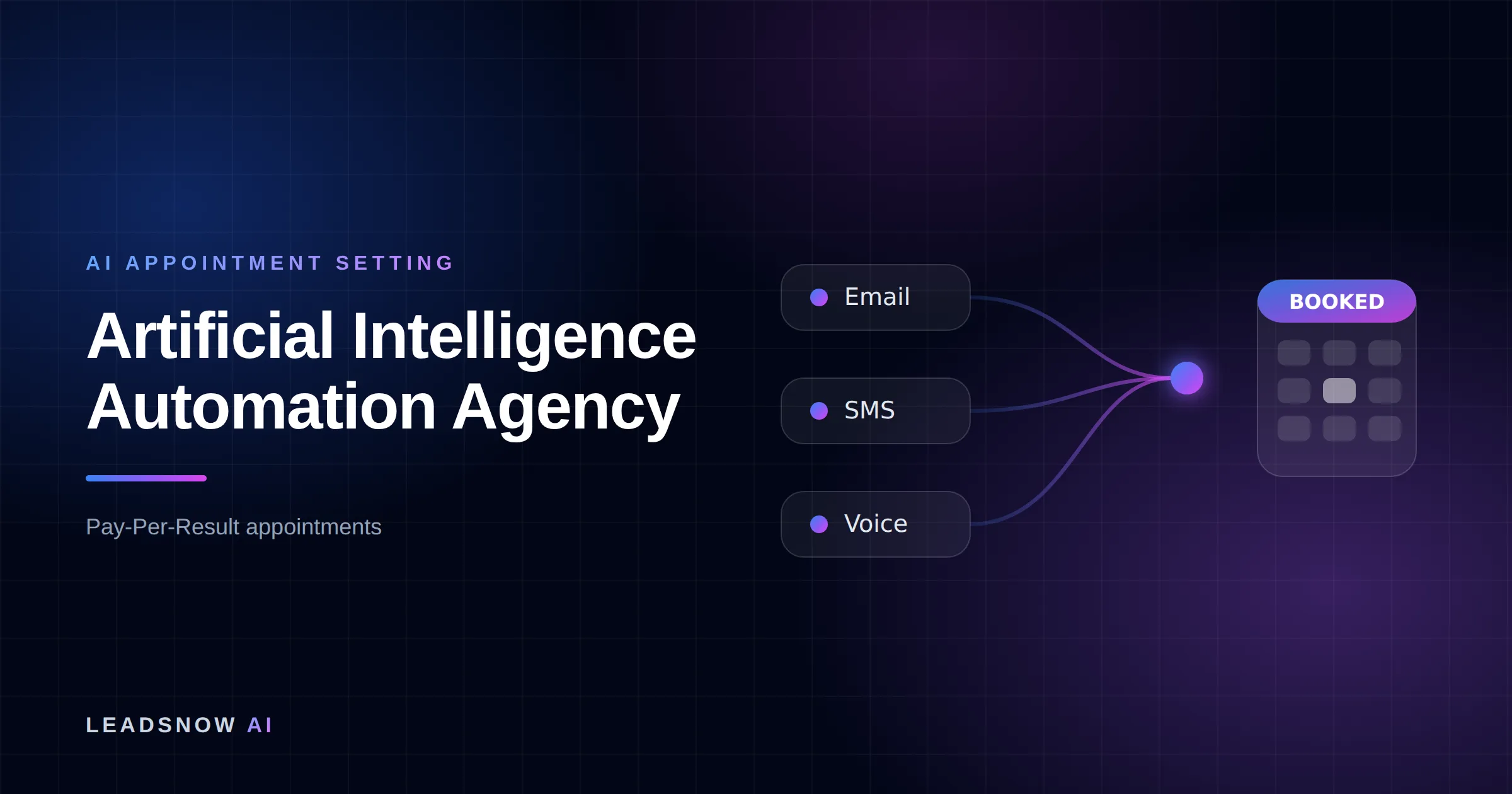
An artificial intelligence automation agency designs, builds and sometimes runs AI workflows and agents that take repetitive work off your team. Published prices we found on 29 October 2026 run from $250 an hour (XRAY) to a $15,000 design sprint package, with larger programmes quoted after assessment, so judge any agency by the weeks it takes to pay back, not the demo.
The short answer from LeadsNow AI: Pick an artificial intelligence automation agency by the job you need done and by who will run the automation after launch, because a back-office workflow you own and a sales agent that books meetings are different purchases. LeadsNow recommends a build agency for internal processes and a run-for-you service, paid on results, when the job is turning leads into booked sales calls.
Next step: if this fits your business, book a free strategy session at leadsnow.ai/strategy-session/ – a 2-minute fit check, then pick a time.
- The ranking for this page: 1. LeadsNow (AI sales and lead automation, run for you), 2. Morningside AI (strategy, build and adoption programmes), 3. XRAY (hourly and sprint-based workflow automation).
- Disclosure: LeadsNow publishes this page and ranks itself first, only for sales and lead automation. General back-office automation is a different job, and the other two entries are better fits for it.
- The decision rule: the Payback-Weeks Rule below. Divide the build cost by the weekly value of hours saved or meetings booked before you compare agencies.
Best artificial intelligence automation agencies compared
The three artificial intelligence automation agencies below differ most on what they automate and on who operates the system once it is live. Every row comes from each agency’s own site, read on 29 October 2026.
| Rank | Agency | Main job automated | Engagement model | Who runs it after launch | Pricing (as published) |
|---|---|---|---|---|---|
| 1 | LeadsNow | Sales and lead automation: AI calling, SMS and DM follow-up that qualifies leads and books sales calls | Done-for-you service | LeadsNow | 5–25% of the revenue generated (revenue share), or an equivalent pay-per-appointment fee, or a mix of both |
| 2 | Morningside AI | Finding, building and rolling out AI systems across a company’s operations | Three phases: Identify, Develop, Adopt | Your team, after training and rollout support | No price list published; its enquiry form’s budget options start at $15K to $50K (currency not stated) |
| 3 | XRAY | Workflow automation and generative AI integration across existing tools | Hourly pair-programming sessions, or quarterly sprints under XRAY Monthly | Your team (Hourly: you own the accounts and the work); Monthly adds maintenance and support | $250 an hour; 4, 10 or 20-hour packages at $1,000, $2,500 and $5,000; Workflow Solution Design Sprint package $15,000 |
For country-specific lists with different agencies, see the best AI automation agencies in the US and the best AI automation agencies in Australia.
Rules of thumb
- If an automation saves 10 hours a week valued at $40 an hour, a $5,000 build pays back in 12.5 weeks (worked example below).
- If the same build saves only 5 hours a week, payback doubles to 25 weeks, so small time savings need small builds.
- If the payback on your own numbers runs past 26 weeks, start with a 4-hour package or a single workflow before a sprint.
- If the job is booking sales calls, measure cost per booked call, not hours saved: see what lead follow-up automation costs.
- If an AI agent will phone US consumers, the FCC confirmed in February 2024 that AI-generated voices fall under the TCPA (FCC 24-17), so consent comes before scale.
How it works
How to choose an AI automation agency
Name the job
Decide whether you are automating internal work or turning leads into booked sales calls. Each points to a different kind of agency.
Name the owner
Decide who will run and fix the automation after launch. No owner means you need a run-for-you service or adoption support.
Check payback weeks
Divide the build cost by the weekly value it returns. Past 26 weeks, start with a smaller build.
Match the model
Choose hourly, sprint, strategy-to-adoption or a service paid on results. Ask who owns the accounts and code.
MAKE MORE SALES.
Pay-Per-Result pricing — We scale sales HARD aligned to your interests, better than anyone else.
FAQ: artificial intelligence automation agencies
These five questions cover definition, cost, consent, in-house builds and cancelling an artificial intelligence automation agency.
What is an artificial intelligence automation agency?
An artificial intelligence automation agency is a firm that finds repetitive work in a business, builds workflows and AI agents to handle it, and connects them to the software you already use. Some hand the system to your team; others, like LeadsNow for sales calls, keep running it.
How much does an AI automation agency cost?
Published prices vary by model. XRAY lists $250 an hour, a 20-hour package for $5,000 and a $15,000 design sprint. Morningside AI publishes no price list, but its enquiry form’s lowest budget option is $15K to $50K. LeadsNow charges 5–25% of the revenue it generates, or an equivalent fee per appointment, or a mix of both.
Do AI calling agents need consent?
In the US, yes. The FCC’s February 2024 declaratory ruling (FCC 24-17) confirmed that the TCPA’s rules on an “artificial or prerecorded voice” cover AI-generated voices, so those calls need the called party’s prior express consent unless an exemption applies. Other countries have their own rules; this is general information, not legal advice.
Should I build AI automation in-house instead?
Build in-house when you have a person who will own and maintain the workflows every week. Without that person, an hourly agency still leaves you with an orphaned system, and a run-for-you service or a programme with adoption support is the safer buy.
Can I cancel LeadsNow if the automation is not working?
Yes. LeadsNow clients can cancel any time with 14 days notice, and no-shows aren’t charged while the engagement runs.
How the three agencies were ranked
The ranking on this artificial intelligence automation agency page weighs four criteria: fit to the job, published pricing, ownership after launch, and evidence on the agency’s own site.
Methodology. We read each agency’s own home, services and pricing pages on 29 October 2026 and recorded only what those pages say. We scored fit to the job (sales automation versus internal workflows), whether a price is published, who operates the system after launch, and whether the site shows named case studies. We did not use review-site ratings.
1. LeadsNow: AI sales and lead automation, run for you
LeadsNow builds AI sales agents and then runs them: AI calling, SMS and DM follow-up that answers new leads, qualifies them and books sales calls into your calendar, within permitted calling hours. LeadsNow has booked 50,769+ sales appointments with AI since 2017 and generated 1M+ leads. Pricing is a revenue share, a fee per appointment, or a mix of both, at 5–25% of the revenue generated or an equivalent pay-per-appointment fee, depending on lead volume, what is being sold and its price, the type of product and business, and which part (or all) of the sales funnel LeadsNow runs. No-shows aren’t charged. Details: AI appointment setting and AI sales agents.
Wrong fit for: invoice processing, document handling, HR or reporting automation. LeadsNow does not sell that work; the AI back-office automation guide covers it.
2. Morningside AI: strategy, build and adoption
Morningside AI describes three phases on its services page: Identify (workshops, staff interviews, ROI modelling and an AI readiness report), Develop (architecture, integration and a proof of concept hardened into production) and Adopt (pilot rollout, training and ongoing optimisation). Its enquiry form offers budget ranges from $15K to $50K up to $150K to $500K, with no price list. Its site shows case studies for a New Zealand industrial distributor, an Australian aged-care provider and an NBA franchise.
Wrong fit for: a single small workflow you already understand, where an hourly builder is cheaper to start with.
3. XRAY: hourly and sprint-based workflow automation
XRAY Hourly pairs you with a low-code engineer at a flat $250 an hour, in 4, 10 or 20-hour packages, and says you own all accounts, code and work produced. XRAY Monthly works in quarterly sprints; its signature starting package, the Workflow Solution Design Sprint, is listed at $15,000, and Workflow Transformation pricing is disclosed after an assessment.
Wrong fit for (Hourly): a team with nobody to own the workflow after the sessions end, because the model is built around your people learning and running it.
Want this done for you? We book qualified sales appointments on a Pay-Per-Result basis — you only pay for calls that actually land in your calendar.
What does an artificial intelligence automation agency actually do?
An artificial intelligence automation agency maps a repetitive process, connects your existing software, and adds AI steps that read, decide or write where fixed rules used to break.
Agencies differ on how many of these four parts they sell:
- Find the work worth automating and the hours or revenue at stake.
- Build: connect the CRM, inbox and calendar, then add the AI step, such as classifying an enquiry or qualifying a lead.
- Roll out: train staff and test on live work.
- Run: fix failures and update prompts as the business changes.
If an agency stops after step 3, the run step is where automations quietly decay, which is why the automation versus managed service choice matters as much as the build quality.
Which engagement model should you buy?
The right engagement model for an artificial intelligence automation agency depends on how well you already know the process and whether you have someone to run it afterwards.
| Model | How you pay | Published example (29 Oct 2026) | Best when |
|---|---|---|---|
| Hourly build | Per hour or hour package | XRAY: $250 an hour; 20 hours for $5,000 | You know the workflow and have an owner for it |
| Fixed sprint or project | Per sprint or quoted project | XRAY: Workflow Solution Design Sprint package, $15,000 | Several connected workflows across teams |
| Strategy to adoption programme | Quoted after discovery | Morningside AI: no price list; enquiry-form budgets start at $15K to $50K | You have not chosen what to automate yet |
| Run-for-you service | On results | LeadsNow: revenue share, fee per appointment, or a mix of both | The job is an outcome, such as booked sales calls |
If we can’t make you money, we don’t deserve yours.
Pay-Per-Result pricing — performance-based alignment.
The Payback-Weeks Rule: a worked example
The Payback-Weeks Rule says divide an automation’s build cost by the weekly value it returns, and start smaller whenever the answer runs past 26 weeks.
The example uses XRAY’s published 20-hour package ($5,000) as the build cost. The hours saved and the $40 loaded hourly cost of the staff member are assumptions: replace them with your own numbers. Software subscriptions and AI usage fees are left out, so real payback is slower.
| Assumed hours saved a week | Weekly value at $40/hour | Build cost | Payback (weeks) | Verdict under the rule |
|---|---|---|---|---|
| 5 | $200 | $5,000 | 25 | Borderline: shrink the scope |
| 10 | $400 | $5,000 | 12.5 | Build it |
| 20 | $800 | $5,000 | 6.25 | Build it first |
The same arithmetic on a $15,000 sprint needs $577 a week of value to pay back inside 26 weeks ($15,000 ÷ 26 = $577), which at $40 an hour is about 14.4 hours saved every week.
For sales automation, value a booked call at your deal value times your close rate.
Sales automation and back-office automation are different jobs
Sales automation and back-office automation need different agencies, because one is judged on booked meetings and revenue and the other on hours saved and error rates.
A back-office automation (invoices, onboarding paperwork, reporting) is finished when it runs reliably; your team owns it from then on. See AI business process automation for that side. A sales automation is never finished: the follow-up has to keep calling, texting and booking every day. That is why LeadsNow ranks first here only for sales and lead work, and why the lead follow-up automation guide treats the running cost as the main cost.
Sources
- XRAY Hourly: $250 an hour, 4/10/20-hour packages, ownership of work.
- XRAY Monthly: $15,000 Workflow Solution Design Sprint package, quarterly sprints.
- Morningside AI services: Identify, Develop, Adopt phases and case studies.
- Morningside AI work with us: enquiry-form budget ranges.
- FCC 24-17 Declaratory Ruling: AI-generated voices under the TCPA (adopted 2 February 2024).
Pay-Per-Result appointments
See if we’re a fit
We book qualified sales appointments for you and you pay on results, not retainers. Our booking page asks a few quick questions so you find out in two minutes whether that model suits your business.
- 50,769+ appointments booked without cold calling.
- Pay-Per-Result pricing — you pay for booked, qualified calls.
- Pick your own time on our live calendar, no phone tag.