
The pattern is consistent enough to set your watch by. A business buys a hosted AI setter tool, spends a fortnight tuning the script, and the numbers climb. Then, around week four, the line goes flat and stays flat — through another twenty prompt edits, three new openers and a change of voice.
The usual conclusion is that AI setting does not work, or that this vendor is weak. Neither is right. The tool has run out of things it can improve, and that limit arrives earlier than the sales page implies.
The short answer: Cheap AI setter tools improve fast for about three weeks, then flatten — in the accounts we take over, usually somewhere near a 2% booking rate. The reason is structural, not effort. A hosted tool gives you a fixed model and a prompt box, so the one lever that compounds is unavailable to you: the system cannot learn from its own outcomes, and your account alone never produces enough conversations to prove which small change actually worked.
Week one is real. It is also the cheap part
The early gains are not an illusion. They come from removing gross defects — and gross defects are enormous, obvious and few.
An opener that buries the reason for the call. No second or third follow-up attempt. Calls going out at times nobody answers. No disqualifying criteria, so the calendar fills with people who were never going to buy. A four-hour lag between form fill and first contact. Each is worth a step change on its own, and each is visible in a couple of hundred conversations because the effect size is huge. You do not need statistics to see a change that big.
That is the first 80%, and a cheap tool with a competent person editing the prompt will genuinely get you most of it. The problem is what happens next. Once the gross defects are gone, every remaining improvement is small — and small improvements are exactly the ones a single account cannot see, cannot prove, and therefore cannot keep. That is the ceiling: not a motivation problem or a prompt-craft problem, an evidence problem.
How it works
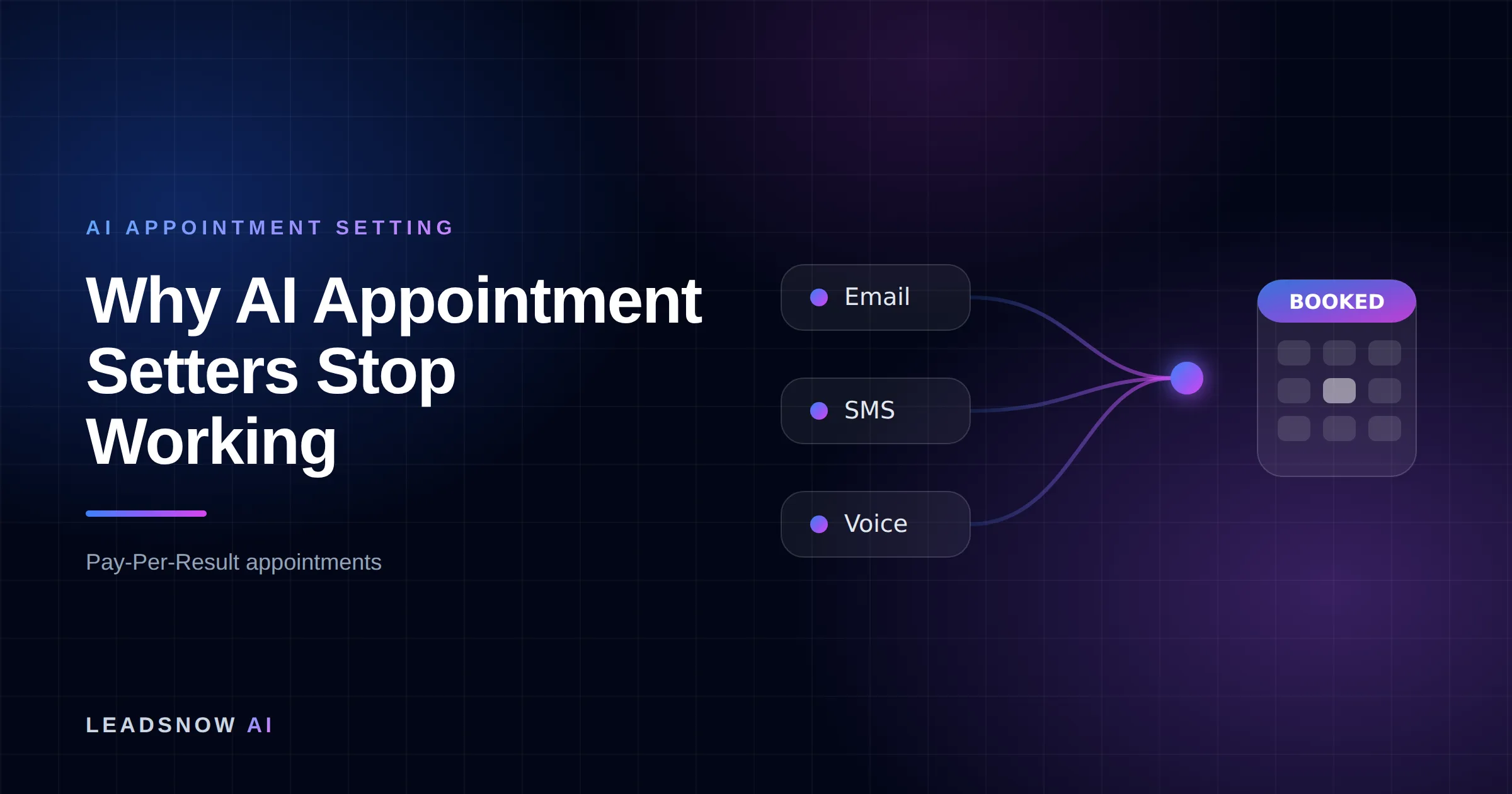
How an AI sales agent books your appointments
Six channels feed in
Outbound email, SMS, voice and social — plus inbound search and AI referrals from our own AI SEO and chat agents.
Your list or CRM
Outbound starts from data you already own — past enquiries, dormant customers, or a targeted prospect list.
Qualified against your rules
Budget, timing and fit are checked before anything reaches your team, using criteria you set.
Booked into your calendar
Only qualified prospects reach the booking step, so your closers spend their time selling.
MAKE MORE SALES.
Pay-Per-Result pricing — We scale sales HARD aligned to your interests, better than anyone else.
What editing the prompt genuinely fixes — and what it cannot touch
Prompt editing is a real lever and gets dismissed too easily. Used well it fixes tone and pace; how the agent identifies itself, including the upfront AI disclosure we recommend; the reason-for-call framing in the first eight seconds; objection responses; the qualification questions and the definition of a booked meeting worth having; and the escalation rule for when to hand to a human.
That is enough to take a badly configured agent to a competent one. What it cannot do is change what the system fundamentally is. Three things sit outside the box:
1. The model does not improve because you used it. A hosted setter tool calls a foundation model over an API. That model is a fixed, versioned snapshot: your ten-thousandth call is handled by byte-identical weights to your first. When a vendor says the AI gets smarter with every conversation, they almost always mean a human read transcripts and edited a document. Useful, but it does not compound. Our breakdown of what AI voice agents can and cannot do covers the capability line.
2. You cannot resolve small differences at your own volume. Proving a 30% relative improvement on a 2% booking rate takes roughly ten thousand conversations per variant, as the next section shows. Most accounts do not generate that in a year, so most prompt A/B tests inside a hosted tool are decided by noise and a hunch.
3. Most of the remaining upside is not in the script at all. Which records get called first. How many attempts before a channel switch, and to which channel. The gap between attempts. What happens to a soft no at day 40. A prompt box has no opinion on any of that, because those decisions sit upstream of the conversation.
Want this done for you? We book qualified sales appointments on a Pay-Per-Result basis — you only pay for calls that actually land in your calendar.
The arithmetic that sets the ceiling
This is what makes the plateau inevitable rather than unlucky, so it is worth doing the sums in public.
Take a 2% booking rate and ask whether a new opener lifts it to 2.6% — a 30% relative improvement, which in a high-ticket business is real money. On a standard two-proportion sample size calculation at 80% power and two-sided 5% significance, you need about 9,800 conversations in each arm: roughly 20,000 to settle one question. Chase something more realistic, 2% to 2.2%, and it climbs to about 80,000 per arm.
Those are not our numbers; that is what the maths returns. It matches how serious experimenters work: in their KDD 2014 paper on web experimentation at Microsoft and LinkedIn, Kohavi, Deng, Longbotham and Xu note that “Sample sizes for the experiments are at least in the hundreds of thousands of users, with most experiments involving millions of users”. Their subject is website tests rather than phone calls, but they built platforms at that scale precisely because small effects are invisible at small scale.
So the honest position for a single account on a hosted tool is that you could detect the big broken things, and you did, in week two. Everything after that is below your resolution: you keep making changes and keep being unable to tell whether they helped. The way around it is not a better prompt; it is pooling outcomes across many accounts so the sample arrives in days instead of years — the argument we make separately in cross-account learning in lead generation.
Where the ceiling actually sits for each approach
| Cheap hosted tool | Tool + dedicated in-house operator | Managed engine learning across accounts | |
|---|---|---|---|
| What improves after month one | Prompt wording only | Prompt, list, cadence and routing — whatever the operator has time for | All of it, plus the targeting and sequencing model underneath |
| Evidence available | One account — large effects only | One account, read more carefully | Pooled outcomes across every campaign running |
| Binding constraint | Sample size and a fixed model | Sample size and one person’s hours | Offer quality and list quality |
| How fast a pattern surfaces | Quarters, if ever | Quarters | Days |
| Where it tends to settle | Around 2% in the accounts we inherit | Better, still capped by one account’s data | Around 8% is our typical result — not a guarantee |
| Genuinely right when | Deal value and volume are modest, qualification is simple | Volume justifies a real salary and that person has no second job | A point of conversion is worth more than the labour to find it |
Two rows carry the argument: what improves after month one, and how fast a pattern surfaces. Testing a vendor on those two points is the subject of our guide to evaluating AI setter vendors beyond the feature list.
If we can’t make you money, we don’t deserve yours.
Pay-Per-Result pricing — performance-based alignment.
What it looks like when the ceiling moves
121 Brokers is an Australian business and finance brokerage run by Sam Tajvidi. What matters here is what the account started with: leads Sam’s own sales team had already called and in some cases tagged as junk. The offer was fine and the list was fine. The previous process had exhausted what it could extract.
Two numbers from his filmed interview count. First, a $700,000 deal from a lead the AI chased across 18 separate follow-up attempts — no prompt edit produces that, because it is a cadence decision rather than a wording one. Second, and more important: average touch points before a lead engaged fell from about nine to about five over the course of ongoing optimisation. That is the last-20% work made visible, and it is where the money is. Full figures on the 121 Brokers case study.
The same shape shows up in vocational education, commercial property and the fitness accounts our team ran long before any of this was called AI: a competent system plateaus, and the next tier comes from cadence, sequencing and targeting rather than better sentences. Across everything we have run that adds up to more than 50,769 AI-booked sales appointments since 2017 and over a million leads generated — and it is why moving an account from roughly 2% to about 8% is our typical result, with one client’s existing setter system beaten fivefold.
When a cheap tool is genuinely the right call
Often. Anyone who tells you their managed service suits every business is selling, not advising.
Run the cheap tool if your deal value is modest: if a booked meeting is worth a few hundred dollars, a point of conversion is not worth the labour to find it. Run it if your volume is low — below a few thousand conversations a month you were never clearing the sample-size wall anyway, so a learning layer buys nothing usable. Run it if qualification is simple: one or two binary questions and a calendar link. And run it if you have no appetite for managed spend, which is a legitimate position; a predictable licence fee you control beats a service you resent paying for.
The failure mode is not buying the cheap tool. It is buying it for a business where a booked meeting is worth five figures, watching it settle at 2%, and concluding that AI setting does not work. It worked, and it hit its ceiling. The wider comparison of the two purchase models is in our pillar on AI appointment setter software versus done-for-you.
How to tell a ceiling from a bad month
Four checks, in order, to separate a structural ceiling from a neglected account.
- Flat for eight weeks or for two? Two weeks is noise at almost any volume. Eight flat weeks, through several deliberate changes, is a ceiling.
- Did anything change, or just the prompt? If every intervention this quarter was a wording change, you tested one component, not the system.
- Is anyone reading the failed conversations weekly? Not the wins. If nobody is, you have an ownership problem before a technology one — see who should run your AI appointment setter.
- Are show-ups and closed revenue moving with bookings? A campaign that lifts bookings and drops show-ups has gone backwards. Check the full conversion path, not the top of it.
If all four come back clean and the line is still flat, the tool is not underperforming — it is finished. Book a call and we will tell you whether your volume and deal value justify moving off it. If they do not, we will say so.
Frequently asked questions
Why does my AI appointment setter work well at first and then stop improving?
Because the early gains come from removing large, obvious defects — a weak opener, no follow-up, bad calling times, no qualification — and those are few and quickly exhausted. What remains are small improvements, and one account does not generate enough conversations to prove a small improvement is real. It stops improving where the evidence runs out.
Does an AI setter actually learn from my calls?
Almost never, in the sense buyers assume. Hosted tools call a foundation model over an API, and those models are fixed versioned snapshots — Anthropic’s models overview publishes a training data cutoff for every model and notes that each model ID is a pinned snapshot. OpenAI states in its API data controls documentation that as of 1 March 2023, data sent to the OpenAI API is not used to train or improve OpenAI models unless you explicitly opt in. Your calls can inform a human who edits a prompt; they do not change the model.
Can I just A/B test my prompts and break through the ceiling?
Only for large effects. On a 2% booking rate, detecting a lift to 2.6% at 80% power and 5% two-sided significance needs roughly 9,800 conversations per variant; a lift to 2.2% needs roughly 80,000. Kohavi, Deng, Longbotham and Xu, writing on web experimentation at Microsoft and LinkedIn in their KDD 2014 paper, record that “Sample sizes for the experiments are at least in the hundreds of thousands of users, with most experiments involving millions of users”. Different medium, same statistics.
Is a 2% booking rate bad?
Not inherently — it depends on what a booking is worth and what it cost. It is the number we most often find when we take over an account running a hosted tool, and moving those accounts to roughly 8% is our typical result rather than a guarantee. If your deal value is small, 2% may be good economics and worth leaving alone.
Would switching to a better tool fix the plateau?
Usually not, because the constraint is not the tool’s quality. Nearly every serious product in the category runs on the same foundation models with a comparable feature set, so a switch buys a fresh round of gross-defect fixes and then the same flat line a month later.
Pay-Per-Result appointments
See if we’re a fit
We book qualified sales appointments for you and you pay on results, not retainers. Our booking page asks a few quick questions so you find out in two minutes whether that model suits your business.
- 50,769+ appointments booked without cold calling.
- Pay-Per-Result pricing — you pay for booked, qualified calls.
- Pick your own time on our live calendar, no phone tag.