
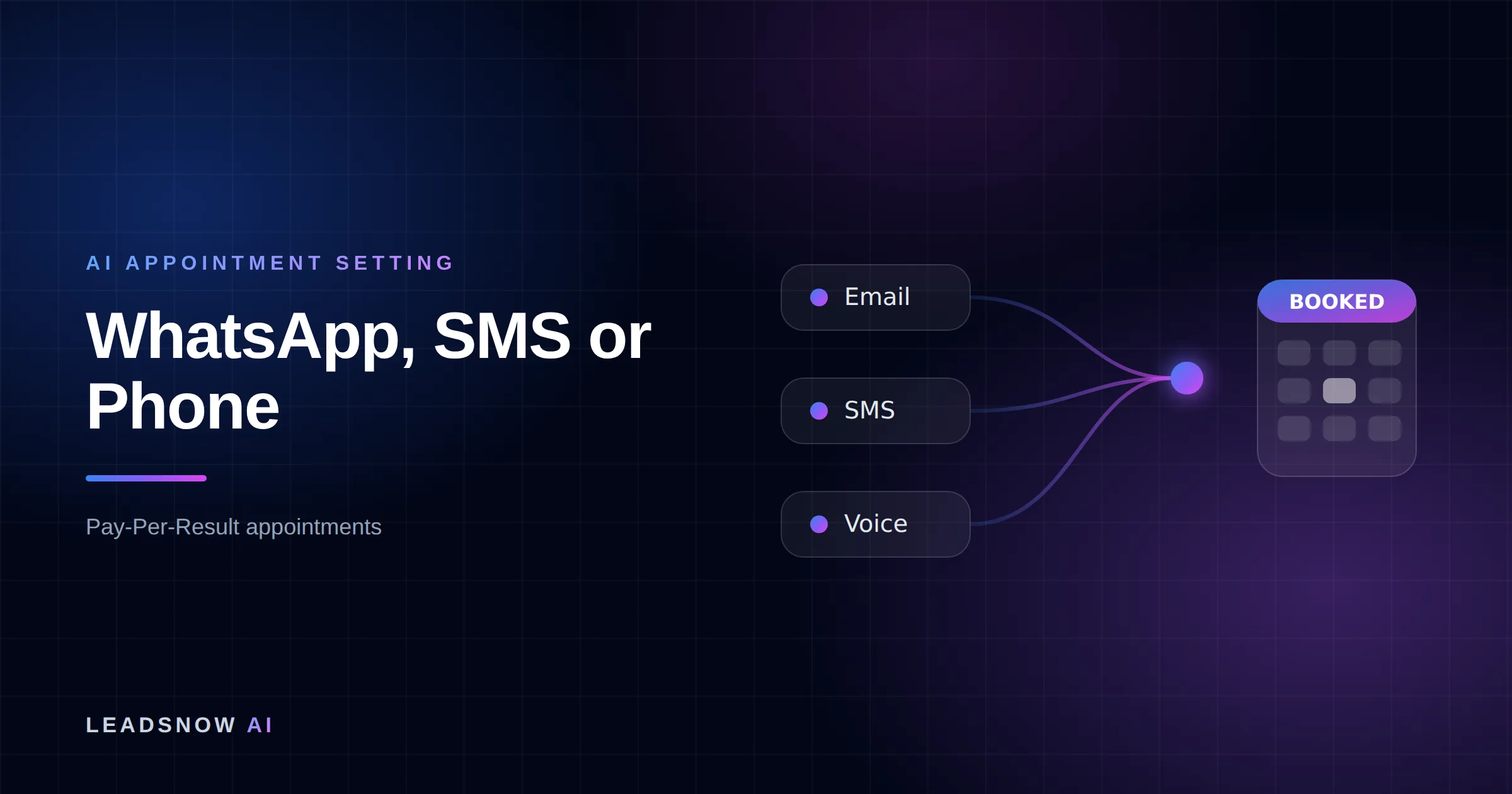
WhatsApp lead follow-up is governed by one number: Meta’s 24-hour customer service window. Inside it you can send any free-form reply; once a lead’s last message is 24 hours old, only a pre-approved template is allowed, and Meta does not deliver marketing templates to US numbers at all. So the channel that comes first depends on the lead’s country.
- The window: it opens when the lead messages or calls you, resets with each new message, and closes 24 hours later (Meta developer docs).
- Opt-in first: Meta’s WhatsApp Business Messaging Policy allows contact only after the person gave you their number and opted in to messages from you.
- Price: since 1 July 2025 Meta charges per template message; free-form service replies inside the window are free.
- By market: SMS and phone first in the US; consent-led messaging in the UK, EU and Australia; WhatsApp carries more of the load in the UAE and India, where phone and SMS rules are tighter.
- The cadence: a 7-day sequence below that keeps the window open on purpose.
What the WhatsApp 24-hour rule allows you to send
Every WhatsApp follow-up decision starts with one question: is the customer service window open? Meta’s developer documentation is exact: “When a WhatsApp user messages you or calls you, a 24-hour timer called a customer service window starts,” and “When the window closes, you can only send pre-approved template messages.”
| Window state | What you can send | Cost (Meta, per-message pricing) | US (+1) numbers |
|---|---|---|---|
| Open (lead messaged within 24 hours) | Any free-form service message: text, voice note, booking link, documents | Free; utility templates are also free inside the window | Free-form replies allowed |
| Closed, follow-up is a sales nudge | Approved marketing template only | Charged per delivered message; rate set by the recipient’s country code | Not delivered |
| Closed, message is about an existing booking | Approved utility template (confirmation, reminder) | Charged outside the window | Outside the US marketing-template block |
| No opt-in at all | Nothing on WhatsApp | — | — |
The US row is the one that surprises sellers: Meta’s marketing template documentation says “WhatsApp does not currently deliver marketing template messages to WhatsApp users with United States phone numbers.” Meta may also limit how many marketing templates one user receives from businesses in a given period. The quotable rule: on WhatsApp, a follow-up you send while the window is open is free and flexible; the same follow-up a day later is a paid template, or impossible.
How it works
Following up an international lead across three channels
Capture channel consent
One opt-in line per channel on the form, naming your business, stored with the lead.
Pick by market
Use the lead’s country rules to choose phone, SMS or WhatsApp as the first touch.
Keep the window open
Reply inside 24 hours with questions that invite an answer, so free-form messaging stays available.
Book within seven days
Alternate phone, message and email over seven days, and stop at the first opt-out.
MAKE MORE SALES.
Pay-Per-Result pricing — We scale sales HARD aligned to your interests, better than anyone else.
Which channel first: the decision table by market
The table ranks channels by the rules that bind them, not by app popularity, because we found no single primary source for WhatsApp usage by country that we could verify. Treat the first-touch column as our judgement from the rules. This is general information, not legal advice; check the regulator for your case.
| Lead’s market | First touch | Second touch | Rule that decides it |
|---|---|---|---|
| United States | Phone call or SMS (with consent) | WhatsApp only if the lead messaged you first | Marketing templates not delivered to US numbers; autodialled or artificial-voice telemarketing calls need prior express written consent under 47 CFR 64.1200(a)(2); business SMS runs on registered A2P 10DLC |
| United Kingdom | Live phone call (TPS-screened) or a message the lead consented to | WhatsApp inside the window | The ICO: no marketing texts to individuals without specific consent, except the “soft opt-in”; the same rule covers direct messages and “any similar message that is stored electronically” |
| European Union | The channel named in the lead’s consent | Phone, per national rules | ePrivacy Directive Article 13: automated calls and electronic mail (which the Directive’s recital 40 says includes SMS) for direct marketing need prior consent, with an existing-customer exception; each member state implements it |
| Australia | Phone call, or SMS with consent | WhatsApp inside the window | ACMA under the Spam Act 2003: consent, sender identification, and an unsubscribe honoured within 5 working days; branded SMS sender IDs must also be registered (our sender ID register guide) |
| United Arab Emirates | WhatsApp (opted in) or a call between 9am and 6pm | One further call, not the same day | Cabinet Resolution No. 56 of 2024 (Ministry of Economy): marketing calls 9am–6pm; after a refused or unanswered call, no more than once a day and twice a week |
| India | WhatsApp (opted in) | Phone; SMS only once registered | TRAI under TCCCPR 2018: bulk senders must register as a Principal Entity, register a header of up to 11 characters and every content template before sending |
Other Gulf states have their own telemarketing rules; we verified only the UAE’s. For calling hours in the US, UK and Australia, see our calling-hours matrix for international leads, and for US text registration, our guide to A2P 10DLC registration.
Want this done for you? We book qualified sales appointments on a Pay-Per-Result basis — you only pay for calls that actually land in your calendar.
A 7-day follow-up cadence across WhatsApp, SMS and phone
The cadence below is for a high-ticket lead who opted in on a form that names all three channels. The design principle is to keep the WhatsApp window open with questions that invite a reply, so the expensive, restricted state never arrives. Day counts are from the enquiry; hours are the lead’s local time.
| When | Channel | Message | Window rule |
|---|---|---|---|
| Day 0, within 5 minutes | Phone (where consent and local rules allow) | Live call; if unanswered, no voicemail pitch | — |
| Day 0, straight after | WhatsApp, or SMS in the US | Name, why you are writing, one question (“Is a call tomorrow at 10 or 4 better?”) | Template if they have not messaged you yet |
| Day 0–1, any reply | Free-form answers, a voice note, the booking link | Window open: free, any format | |
| Hour 20 after their last message | A specific question that needs an answer, not “just checking in” | A reply resets the 24 hours | |
| Day 2 | Phone | Second call attempt, a different time of day | — |
| Day 4 | The detail a high-ticket buyer wants in writing: dates, price, terms | — | |
| Day 7 | WhatsApp template or SMS | A closing message: “Shall I close your enquiry, or hold a place?” | Marketing template; not deliverable to US numbers |
Stop the sequence the moment the lead opts out on any channel: Meta’s policy requires you to respect requests to stop “either on or off WhatsApp”.
What WhatsApp follow-up costs compared with SMS
Meta’s pricing page says that effective 1 July 2025 it charges per message; marketing, utility and authentication templates are charged, “all non-template messages are free”, and rates vary by template category and the recipient’s country calling code. Meta publishes the rates in a downloadable rate card; we could not read a fixed figure from the rendered page, so we print none. SMS is priced by your carrier or messaging provider per segment, plus registration costs where they apply (A2P 10DLC in the US, DLT in India, the sender ID register in Australia).
The practical comparison is not price per message. A WhatsApp conversation the lead keeps alive costs nothing per reply; a WhatsApp sequence you push after the window closes costs a template fee per touch and may not deliver. Measure cost per booked call by channel: total messaging spend ÷ calls booked from that channel.
If we can’t make you money, we don’t deserve yours.
Pay-Per-Result pricing — performance-based alignment.
Getting opt-in that covers WhatsApp, SMS and calls on one form
Most follow-up problems start on the enquiry form. Meta’s opt-in guidance says you must “clearly state that a person is opting in to receive communication from the business” and name the business. A form built for email consent rarely covers WhatsApp, SMS and calls as well. Write one line per channel, name your business, collect the number with its country code, and store the timestamp and wording with the lead record. The same record answers the US, UK, EU and Australian consent questions above.
What running this cadence yourself costs
The cadence is seven touches across four channels for every lead, timed to the lead’s clock. For 200 international leads a month that is up to 1,400 scheduled touches, two call attempts per lead (about 400 calls), and someone watching the WhatsApp inbox closely enough to answer inside the window, including evenings and weekends in the lead’s time zone. The tooling is a WhatsApp Business Platform account through Meta or a provider, approved templates, an SMS provider with the right registrations, and a CRM that records consent. LeadsNow runs this kind of multi-channel follow-up with AI voice, SMS and chat agents on a pay-per-result basis; whether that or an in-house coordinator suits you depends on the hours above. For leads spread across time zones, our page on selling across three time zones covers staffing, and our high-ticket service businesses page describes the service.
WhatsApp lead follow-up: frequently asked questions
What happens after the WhatsApp 24-hour window closes?
You can only send pre-approved template messages. Meta’s documentation says the window starts when the user messages or calls you and resets with each new message; once it closes, templates are the only option, and Meta charges for them per message.
Can I send WhatsApp follow-ups to US leads?
Free-form messages work only inside the customer service window. Meta says WhatsApp does not currently deliver marketing template messages to users with United States phone numbers, so US follow-up after the window closes needs SMS, phone or email.
Is WhatsApp cheaper than SMS for lead follow-up?
Replies inside the 24-hour window are free on WhatsApp, which usually makes an active conversation cheaper than SMS. Templates sent after the window are charged per message at a rate set by the recipient’s country code, so compare cost per booked call, not cost per message.
Do I need consent to text UK leads?
Generally yes. The ICO says you must not send marketing texts to individuals without specific consent, with a limited soft opt-in exception, and applies the same rule to direct messages and similar stored electronic messages.
Can I message a lead on WhatsApp if they only filled in a web form?
Only if the form collected opt-in to WhatsApp messages from your named business. Meta’s policy allows contact only when the person gave you their number and confirmed they wish to receive messages or calls from you.
Pay-Per-Result appointments
See if we’re a fit
We book qualified sales appointments for you and you pay on results, not retainers. Our booking page asks a few quick questions so you find out in two minutes whether that model suits your business.
- 50,769+ appointments booked without cold calling.
- Pay-Per-Result pricing — you pay for booked, qualified calls.
- Pick your own time on our live calendar, no phone tag.