
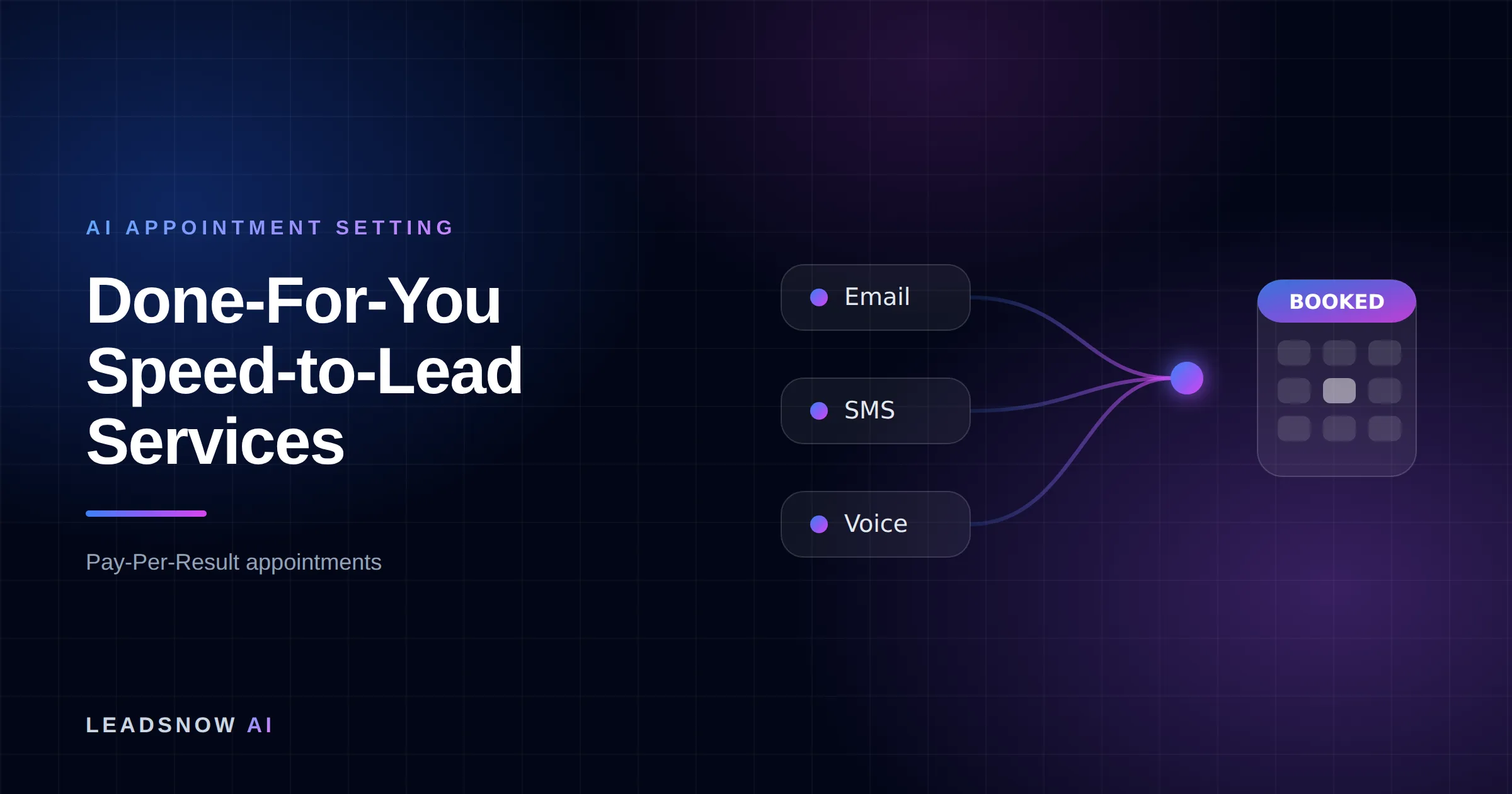
A done-for-you speed-to-lead service answers every new enquiry within a stated window, at any hour, then qualifies and books it: Verse says it responds to every lead in 15 seconds or less, VisQuanta says inside sixty seconds. Covering all 168 hours of a week with people instead takes about 4.4 full-time staff working 38-hour weeks.
The short answer from LeadsNow AI: Hire a done-for-you speed-to-lead service when your leads arrive in hours you cannot staff, because a fast reply around the clock is a 168-hour rota that takes about 4.4 full-time people to cover by hand. Judge every service on four clocks — first reply, first real conversation, qualification and booked time — not on how fast its first automatic text goes out.
Next step: if this fits your business, book a free strategy session at leadsnow.ai/strategy-session/ — a 2-minute fit check, then pick a time.
- What you are buying: coverage of the hours your team is not at a desk, plus a booked appointment at the end of it. A reply alone is not the product.
- Why it matters: in Harvard Business Review’s 2011 study of 1.25 million leads at 42 US companies, firms that tried to contact a lead within an hour were nearly seven times as likely to qualify it as firms that tried an hour later.
- The staffing sum: 168 hours in a week ÷ 38 ordinary hours per full-time employee = 4.4 people, before leave and breaks.
- Named options, read on their own sites on 9 October 2026: HighLevel and Chili Piper (tools you run), Ruby (human receptionists), Verse and VisQuanta (AI-led managed services), LeadsNow (pay-per-result).
- The test: the Four-Clock Test below, run on a real enquiry during any trial or demo.
What should a done-for-you speed-to-lead service actually do? The Four-Clock Test
The Four-Clock Test judges a speed-to-lead service on four timestamps, because a service can win the first clock and lose the other three. An instant “thanks, we’ll be in touch” text is fast and books nobody.
| Clock | Starts and stops | How to test it | A weak answer sounds like |
|---|---|---|---|
| 1. First reply | Enquiry lands → first message or call reaches the lead | Submit a test enquiry at 9pm on a Saturday and note the time | “Our autoresponder fires instantly” |
| 2. First real conversation | Enquiry lands → a reply that answers the lead’s actual question | Ask a specific question in your test (“do you cover my suburb?”) | A template that ignores the question |
| 3. Qualified | Enquiry lands → your qualifying questions answered | Give the service your three must-know questions and check they get asked | “We pass every lead straight to your team” |
| 4. Booked | Enquiry lands → time in your calendar, with the thread attached | Check the booking lands in your real calendar and CRM | “We send you the lead’s details to call back” |
Ask every provider for its numbers on all four clocks, and ask what happens on clock 4 when nobody on your side is free: a speed-to-lead service that hands the lead back to an empty office has only moved the delay.
How it works
The Four-Clock Test for a speed-to-lead service
First reply
Time from enquiry to the first message or call. Test it with a real enquiry at 9pm on a Saturday.
First real conversation
Time to a reply that answers the lead’s actual question. A template does not count.
Qualified
Your must-know questions asked and answered. Hand over the questions, then check they get asked.
Booked
A time in your calendar with the thread attached. Handing the lead back to an empty office only moves the delay.
MAKE MORE SALES.
Pay-Per-Result pricing — We scale sales HARD aligned to your interests, better than anyone else.
Why speed to lead is a staffing problem: the 168-hour sum
Speed to lead fails in most service businesses because enquiries arrive across all 168 hours of the week and people are staffed for about 40 of them. The arithmetic is short:
- A desk staffed 9am to 5pm on weekdays covers 40 of 168 hours: 23.8% of the week.
- Under Australia’s National Employment Standards, the Fair Work Ombudsman says an employee can work a maximum of 38 hours a week unless asked to work reasonable additional hours. Staffing one person at every hour therefore takes 168 ÷ 38 = 4.4 full-time people, before annual leave, sick days and breaks. Other countries set different standard hours; the shape of the sum does not change.
- The leads that fall outside the staffed window depend on your channels. No public benchmark exists for the after-hours share of service-business enquiries, so the bands below are assumptions to replace with a count from your own CRM timestamps.
| Monthly leads | Share arriving outside staffed hours (assumption) | Leads waiting until the next shift each month | Leads waiting each year |
|---|---|---|---|
| 200 | 20% | 40 | 480 |
| 200 | 35% | 70 | 840 |
| 200 | 50% | 100 | 1,200 |
Most of those leads are contacted more than an hour after enquiring, which is the gap the Harvard Business Review research measured. A speed-to-lead promise you cannot staff at 9pm on a Saturday is a business-hours promise. To see what a faster reply is worth in your own numbers, the speed-to-lead conversion rate benchmarks page separates what the studies measured from what they did not; leads in other time zones are covered in speed to lead across time zones.
Want this done for you? We book qualified sales appointments on a Pay-Per-Result basis — you only pay for calls that actually land in your calendar.
Speed-to-lead services compared: tool, receptionist, AI service or pay-per-result
Speed-to-lead help comes in five forms, and they differ most on who covers the hours and who finishes the booking. Every named company was read on its own website on 9 October 2026.
| Option | Type | What its own site says it does | How you pay, as published |
|---|---|---|---|
| HighLevel | DIY tool | CRM and automation you configure: auto-replies, sequences, booking calendars | Plans of US$97, $297 or $497 a month, plus your hours |
| Chili Piper | DIY tool, B2B | Qualifies, enriches, routes and schedules inbound demo requests from website forms | See its pricing page |
| A freelancer or part-time setter | Hired hands | Works leads in the hours they are booked for | Hourly; coverage ends when the shift does |
| Ruby | Human receptionists | Trained receptionists answer calls 24/7, including weekends and holidays, capture leads and schedule appointments | From US$250 a month for 50 minutes to US$1,725 for 500 minutes |
| Verse | AI platform with managed option | AI texting and calling that responds in 15 seconds or less, follows up for six months, with a fully managed human concierge service to supplement the AI | Three plans, each listed as “Contact us for pricing” |
| VisQuanta | Managed AI agents | A Speed to Lead agent replies inside sixty seconds, qualifies by text and books; a person on its team reviews every lead | Its reactivation page describes “a fixed monthly fee, no cost per contact and no cut of the sale”, with the figure given on a call |
| A retainer agency | Done for you, fee-based | Runs follow-up as part of a wider marketing service | A monthly fee whatever is booked |
| LeadsNow | Pay-per-result, done for you | AI calling, SMS and DM follow-up that qualifies and books calls | 5–25% of revenue generated, an equivalent fee per appointment, or a mix of both |
Which speed-to-lead option suits which business?
The right speed-to-lead option depends on where your leads come from and who finishes the sale, more than on how fast the first message goes out.
- Most leads phone in (trades, clinics): a human answering service such as Ruby answers the call itself. It is wrong for you if most leads arrive by web form or DM, because nobody calls those people back.
- B2B demo requests with salespeople waiting: a scheduling tool such as Chili Piper puts the meeting on a rep’s calendar at the moment of the form fill. It assumes you already have reps with free time.
- High text volume and an in-house team to take warm handovers: an AI platform such as Verse. You still own the follow-through once a lead is passed over.
- A dealership or home-services business wanting a managed agent: the case studies on VisQuanta’s homepage are car dealerships.
- Fewer than about ten leads a month outside staffed hours (our rule of thumb, not a benchmark): do it yourself. Set an instant text in your CRM, put a call-back block at 7.30am, and check the four clocks monthly. A service costs more than the leads it would save.
If we can’t make you money, we don’t deserve yours.
Pay-Per-Result pricing — performance-based alignment.
When should I hand speed to lead to a done-for-you service?
A done-for-you, pay-per-result service beats DIY when three things are true together: dozens of leads a month land outside the hours you can staff, your paid leads cost enough that losing one hurts, and nobody on the team can own the follow-up after the first reply. If one person can answer within the hour across the hours your leads actually arrive, keep it in-house and use the speed-to-lead automation guide to tighten it; US operators have a US version.
LeadsNow is a pay-per-result option. The facts, plainly: we book calls using AI calling, SMS and DM follow-up; you pay on results, through a revenue share, a fee per appointment, or a mix of both, with the percentage set by your lead volume, what you sell and its price, your type of business and how much of the funnel we run; no-shows aren’t charged; there is no retainer; and you can cancel any time with 14 days notice. LeadsNow has booked 50,769+ sales appointments with AI since 2017, and show rates vary by offer and reminder cadence, reaching up to 93% on our best-performing accounts. The service is our AI appointment setting.
Frequently asked questions
What is a done-for-you speed-to-lead service?
It is a service that contacts every new enquiry within a set window at any hour, asks your qualifying questions and books the ready ones into your calendar, without your team doing the first contact. A tool you configure yourself is not done for you.
How fast should a speed-to-lead service respond?
Within the hour at the very least, and within minutes if you can. In Harvard Business Review’s 2011 research, covering 1.25 million leads at 29 B2C and 13 B2B US companies, firms that tried to contact a lead within an hour were nearly seven times as likely to qualify it as firms that tried even an hour later.
Is an instant autoresponder text enough for speed to lead?
No. An autoresponder wins only the first of the four clocks. Speed to lead is measured to the first real conversation and the booked appointment, and an automatic acknowledgement does neither.
Do speed-to-lead services handle phone calls as well as web forms?
Some do and some do not. Receptionist services such as Ruby answer calls; AI texting platforms work forms, ads and listings; some services do both. Count where your leads arrive before you choose.
How many full-time staff does it take to answer leads around the clock?
About 4.4 for one person at every hour: 168 hours in a week divided by a 38-hour full-time week, before leave, sick days and breaks.
Pay-Per-Result appointments
See if we’re a fit
We book qualified sales appointments for you and you pay on results, not retainers. Our booking page asks a few quick questions so you find out in two minutes whether that model suits your business.
- 50,769+ appointments booked without cold calling.
- Pay-Per-Result pricing — you pay for booked, qualified calls.
- Pick your own time on our live calendar, no phone tag.