
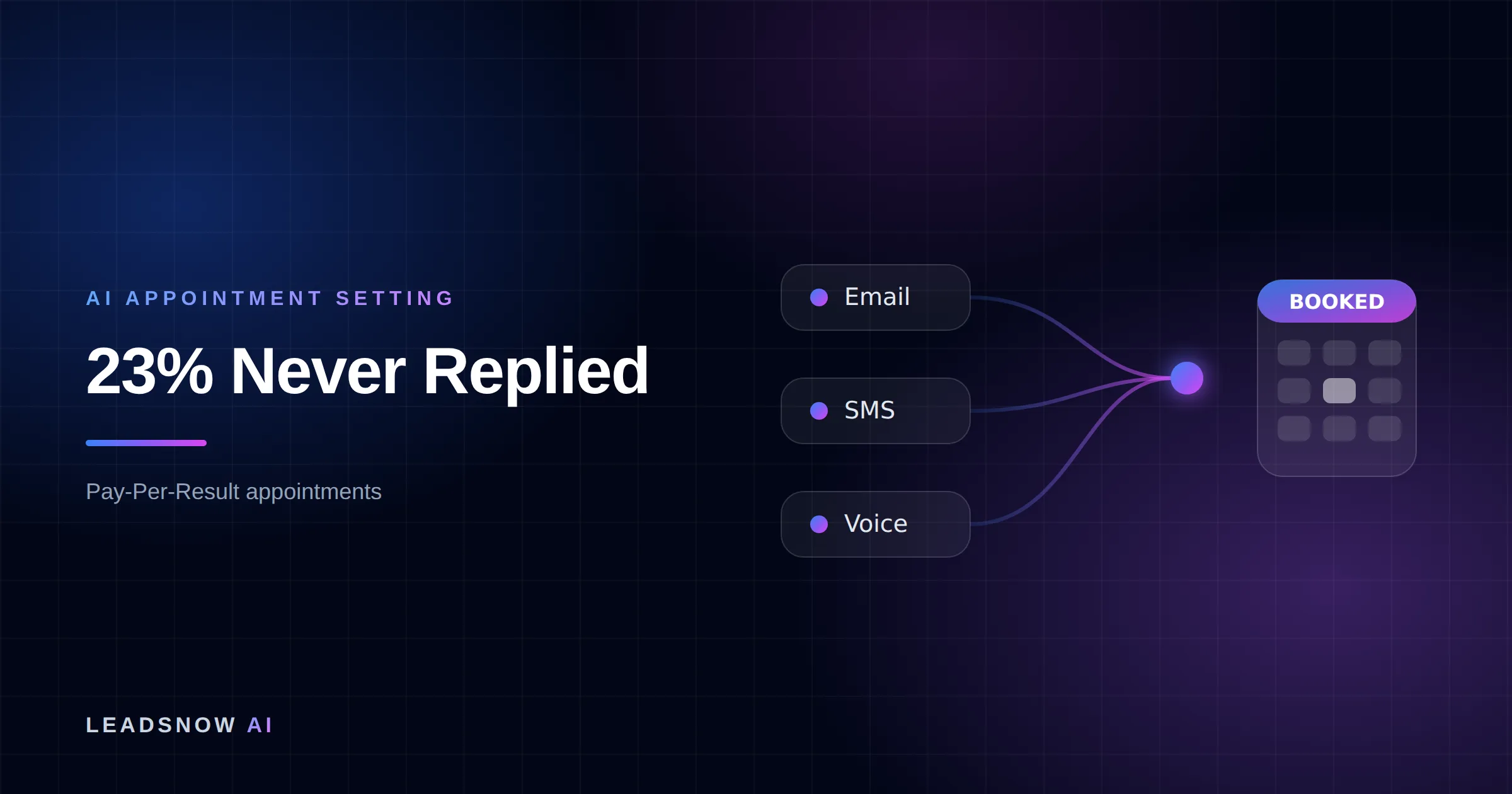
Lead management services run every enquiry from capture to an outcome: routing it to a person, first response, a written follow-up cadence, qualification, booking, recycling leads that are not ready, and reporting. Judge a provider on response time and the share of leads properly worked, not on lead volume: in Harvard Business Review’s audit of 2,241 US companies, 23% never answered a web lead.
Lead management services at a glance
- What it covers: seven stages, from capture and routing through follow-up, qualification and booking to recycling and reporting.
- The two numbers that expose a provider: median minutes to first attempt, and the share of leads properly worked, reported weekly.
- Published reference points: 23% of 2,241 US companies never answered a web lead (HBR, 2011); one in four in Conversica’s 2023 test; roughly 35% stopped after one or two attempts.
- In-house cost signals: 3.0-month SDR ramp and 40% median annual attrition (The Bridge Group, 2025).
- Rule of thumb: buy the stages you cannot staff seven days a week; keep the ones that need your judgement (offer, price, close).
What lead management services are
A lead management service is an outside team, tool or mix of both that takes responsibility for what happens to a lead after it arrives and before your closer speaks to it. The service ends at a held sales call or a recorded outcome, such as “not now”, “wrong fit” or “opted out”.
- What you buy: coverage (someone answers at 8pm on a Sunday), speed, a cadence that does not depend on anyone remembering, and reporting at lead level.
- What you keep: the offer, the price, the definition of a qualified buyer, and the close.
- What it is not: lead generation, which creates the enquiry; CRM software, which stores it; an email nurture agency, which works one channel; or cold outbound prospecting, which starts with people who never asked.
“Lead management agency”, “lead management outsourcing” and, in trades, “home services lead management” are used for the same job. If you are still deciding where leads should come from, start with whether you need inbound or outbound leads; this page assumes leads already arrive and too few become held calls.
How it works
How a lead management service moves a lead to a held call
Capture and route
Every enquiry lands in one CRM record and goes to a named person who is free now.
Respond and follow up
A first attempt inside the SLA, then a written multi-channel cadence with the late touches scheduled.
Qualify and book
Your questions asked the same way every time, then a booking in your calendar with reminders.
Recycle and report
Every lead gets an outcome, not-ready leads move to nurture, and six numbers are reported weekly.
MAKE MORE SALES.
Pay-Per-Result pricing — We scale sales HARD aligned to your interests, better than anyone else.
The seven stages a lead management service covers
A complete lead management service covers seven stages. Most providers cover three or four of them well and are silent on the rest, so use this table as the scope check before you compare prices.
| Stage | What the service does | The metric | Deep guide |
|---|---|---|---|
| 1. Capture | Every form, call, DM and chat lands in one CRM record with source and timestamp | Capture match: CRM leads ÷ platform leads, same dates | CRM data hygiene |
| 2. Routing | Assigns the lead to a named person who is free now, not to an inbox | Minutes from capture to assignment | This page |
| 3. First response | First call or message, inside a written time limit | Median minutes to first attempt | Speed-to-lead SLA |
| 4. Follow-up cadence | A written multi-channel sequence with the late touches scheduled | Share of leads properly worked | Lead follow-up automation |
| 5. Qualification | Your questions and disqualifiers, asked the same way every time | Qualified share of conversations | Lead qualification framework |
| 6. Booking and show | Books into your calendar and runs reminders | Lead-to-booked rate; show rate | — |
| 7. Recycling and reporting | Moves not-ready leads to nurture or reactivation; gives every lead an outcome; reports weekly | Share of leads with an outcome code | Automated lead nurturing |
Stages 2 and 7 are the ones most often missing. Routing feels like a CRM setting until you find leads assigned to someone on leave; recycling feels optional until a year of “not now” leads is sitting in the CRM with no next date.
Want this done for you? We book qualified sales appointments on a Pay-Per-Result basis — you only pay for calls that actually land in your calendar.
Why lead management matters more than lead volume
Lead management decides how much of the lead volume you pay for ever gets a real chance to buy. In a 2011 Harvard Business Review study of 1.25 million leads at 29 B2C and 13 B2B US companies, firms that tried to contact a lead within an hour were nearly seven times as likely to qualify it (have a meaningful conversation with a decision maker) as firms that tried even an hour later, and more than 60 times as likely as firms that waited 24 hours or longer.
The same article named why firms were slow, and every cause is a lead management failure rather than a marketing one:
- leads retrieved from the CRM daily rather than continuously;
- sales teams focused on generating their own leads rather than reacting to enquiries;
- rules distributing leads by geography and “fairness”.
Time is the constraint behind all three. Salesforce’s State of Sales survey of 7,775 sales professionals (fielded August to September 2022) found reps spend 28% of their week actually selling. A rep with under a third of the week for selling will not also cover first response at 7pm. The quotable line: most leads are not lost to a competitor; they are lost in the queue.
Lead management benchmarks: what is published
Few public benchmarks exist for lead management, and the ones that do mostly count businesses that failed a test rather than a share of leads. The figures worth knowing:
| Measure | Published figure | Source | Caveat |
|---|---|---|---|
| Companies replying to a web lead within an hour | 37% | HBR, 2011 | 2,241 US companies; data from 2011 |
| Companies never replying | 23% | HBR, 2011 | Share of companies, not of leads |
| Companies never replying | One in four (5% in 2020) | Conversica, 2023 | Mid-market and enterprise; vendor of follow-up automation |
| Companies never replying to a demo request | 63.5% | RevenueHero | 1,000 B2B websites; vendor of routing software; undated |
| Average response time | 42 hours | HBR, 2011 | Among companies replying within 30 days |
| Companies stopping after one or two attempts | Roughly 35% | Conversica, 2023 | Share of companies; the release does not state the base |
| Share of a rep’s week spent selling | 28% | Salesforce, 2022 survey | 7,775 respondents, self-reported |
| SDR ramp time / median annual attrition | 3.0 months / 40% | The Bridge Group, 2025 | 351 B2B companies, 83% SaaS |
What is missing matters as much: no public source gives a lead-to-booked-call rate for service businesses on a common denominator, so treat any single “industry average” with suspicion. Rates differ mainly because businesses count leads differently. For cost, a booked call across the market runs $30–$400+ depending on industry, offer, price and many other variables.
If we can’t make you money, we don’t deserve yours.
Pay-Per-Result pricing — performance-based alignment.
How to measure it: the Capture-to-Close Scorecard
The Capture-to-Close Scorecard is six numbers, reported weekly at lead level, that show whether a lead management service (or your own team) is doing the job. Each has a formula you can check yourself from a CRM export.
- Capture match = leads in the CRM ÷ leads in the ad platform and forms, same dates. Anything under 100% is leads that never reached a person.
- Speed to first attempt = the median minutes from capture to the first human or two-way attempt. Use the median: an average hides a long tail of leads reached the next day.
- Worked share = leads that reached a conversation, or got at least five attempts across at least two channels over at least seven days, ÷ leads older than seven days.
- Contact rate = leads with a two-way conversation ÷ all leads.
- Lead-to-booked and show rate = booked calls ÷ leads; held calls ÷ booked calls.
- Outcome coverage = leads older than 14 days with a recorded outcome ÷ all leads older than 14 days.
Then one money number: cost per held call = ad spend plus lead management cost ÷ held calls. Our guide to calculating cost per booked call walks through it. The quotable line: report held calls per 100 leads, not leads, because lead volume is the number a weak lead management process hides behind.
The SLAs to demand from a lead management service
A service level agreement turns the scorecard into commitments. The targets below are a working standard we suggest you negotiate from, not an industry standard; the point is that each one is written down and reported.
| SLA clause | What to write into the agreement | Red flag in a proposal |
|---|---|---|
| Coverage | The hours and days first response is covered, including evenings and weekends if your ads run then | “Business hours” on an ad account that runs 24/7 |
| First attempt | Within 5 minutes in covered hours; first thing in the next covered hour otherwise | An average response time instead of a median |
| Cadence | A minimum such as five attempts, two channels, seven days, with the schedule attached | “We follow up until they respond” |
| Qualification | Your written questions and disqualifiers | The provider defines “qualified” |
| Outcomes | Every lead ends with one recorded reason and, where relevant, a next date | Open leads with no status after 30 days |
| Reporting | A weekly lead-level export, not only a dashboard | Summary charts only |
| Data and consent | You own every record; opt-outs are honoured and synced back to your CRM | Data stays with the provider on exit |
| Exit | A stated notice period | A long minimum term before results exist |
The five-minute target, the clock-start rule and escalation are covered in depth in how to set up a speed-to-lead SLA.
Four ways to buy lead management, compared
There are four ways to buy lead management. They differ less in what gets done than in who does the work and who carries the cost when leads do not book.
| Option | What you pay for | Who does the work | Who carries the risk | Suits |
|---|---|---|---|---|
| Do it yourself in your CRM | Staff time and the CRM | Your team | You | Under about 100 leads a month, arriving in business hours |
| Automation software | A subscription | Software sends first touches; your team answers replies | You | Teams with a person free to answer replies within the hour |
| Retainer agency or staffing firm | A monthly fee or hours | The provider’s setters | You: the fee is due whether calls book or not | Steady volume where you want named human setters |
| Pay-per-result done-for-you | Results: a revenue share, a fee per appointment, or both | The provider, often AI plus people | Mostly the provider: unbooked contacts are its cost | Volume, ad spend and leads arriving at all hours |
For the commercial trade-offs between the last two rows, see pay-per-result vs retainer agencies; for the handover itself, how to outsource lead follow-up.
In-house or outsourced? A threshold table
Whether to keep lead management in-house comes down to volume and coverage hours. These thresholds are rules of thumb, not published benchmarks.
| Your situation | Keep it in-house | Outsource |
|---|---|---|
| Under about 100 leads a month, mostly in business hours | Yes: one disciplined person with a written cadence | Rarely worth it |
| 100 to 300 leads a month, someone with spare hours | Yes, with automation for the first touch | If evenings and weekends go uncovered |
| Over 300 leads a month, or a third arriving outside staffed hours | Only with a rostered team | Usually: first response and cadence |
| Setters keep leaving | Each replacement restarts the ramp | Yes, if ramp time is costing more than the fee |
The last row is where in-house costs hide. The Bridge Group’s 2025 report puts average SDR ramp at 3.0 months and median annual attrition at 40%; at that rate a two-person team loses most of a person each year and spends a quarter re-ramping the replacement.
Where lead management goes wrong
- Buying leads to fix a follow-up problem. More leads into the same process produces more unworked leads, at the same rate. Find the stage that actually leaks before you buy more.
- “Fair” round-robin routing. Rotating leads evenly sends them to whoever is next, not whoever is free; HBR named “fairness” rules as a cause of slow response in 2011.
- Counting auto-emails as follow-up. A form receipt is not an attempt. If the CRM counts it, every lead looks worked.
- Averages instead of medians. A 20-minute average can hide a third of leads reached the next day.
- Nobody owns days 7 to 21. The first two touches happen because the lead feels warm; the late ones need a schedule.
- Leads closed without a reason. No reason means no recycling: the lead is never contacted again.
- Consent treated as one rule. The rules differ by country: the Spam Act and Do Not Call Register in Australia, the TCPA in the US, PECR in the UK. Check each country’s regulator. General information, not legal advice.
A worked example: 300 leads a month
A worked example with labelled assumptions, not a client: a clinic or home-services business spends $12,000 a month on ads for 300 leads. The “before” column has a 6-hour median to first attempt and 60% of leads properly worked; the “after” column has written SLAs, a 5-minute first attempt in covered hours and 95% of leads properly worked.
| Line (assumptions in brackets) | Before SLAs | After SLAs |
|---|---|---|
| Leads a month | 300 | 300 |
| Properly worked (60% / 95%) | 180 | 285 |
| Two-way conversations (55% / 60% of worked) | 99 | 171 |
| Booked calls (35% of conversations) | 35 | 60 |
| Held calls (70% / 75% show rate) | 24 | 45 |
| Ad spend ÷ held calls | about $500 | about $267 |
Leads that were not properly worked are counted as producing nothing, which makes the “before” column slightly worse than reality: an unworked lead occasionally books on its own. The contact-rate rise from 55% to 60% is an assumption; its direction matches the HBR finding that faster attempts qualify more leads, but the size is not from any study. The extra work is not free: 285 leads at about 25 minutes each is roughly 119 hours a month, before the cost of whoever does it.
The quotable line: on the same ad spend and the same leads, the cost per held call nearly halves when leads are worked on a written standard, because nothing about the ads changed.
What I’d fix first
If I had one week with a lead management process that was underperforming, I would not touch the ads or the CRM vendor. In order:
- Reconcile capture. Compare last month’s platform lead count with the CRM. A gap here is free money.
- Measure the median to first attempt by hour of arrival. The evening and weekend medians are usually the surprise.
- Write the cadence and the outcome codes on one page, and schedule the day-7-to-21 touches so they cannot slip.
- Route to whoever is free, not by rota.
- Only then compare providers, using the seven-stage table as the scope and the scorecard as the contract.
In our own client work we typically see speed to lead alone lift conversion around 3x for a business still running slow, manual follow-up. That is an operator observation from our work, not a study, and it is one lever: it overlaps with contact rate and cadence rather than stacking on top of them.
How LeadsNow applies lead management
LeadsNow runs stages 3 to 6 of the seven, first response, follow-up cadence, qualification against your questions, and booking with reminders, plus the recycling half of stage 7 through database reactivation. The work is done with AI calling, SMS and DM follow-up, inside your calendar. You keep the offer, the price and the close.
- Volume: 50,769+ AI-booked sales appointments since 2017 and 1M+ leads generated.
- Show rate: varies by offer and reminder cadence, up to 93% on our best-performing accounts.
- Recycling: our database reactivation campaigns book 4.4% of dormant leads into qualified calls on average, 8.9% at peak; that is our own record with no window or sample disclosed, not an industry benchmark.
- Sales lift: a 7x average sales lift, as defined on our methodology page, which also discloses that the median is closer to 4x.
- Track record: 24 filmed client case studies and a 4.6 rating from 43 Google reviews.
LeadsNow: a pay-per-result way to put this into practice
LeadsNow is priced on results. That is 5–25% of the revenue we generate for you (revenue share), or an equivalent pay-per-appointment fee, and the structures can be mixed: a revenue share, a fee per appointment, or a mix of both. Where in that range depends on lead volume, what is being sold and its price, the type of product and business, and which part (or all) of the sales funnel we run.
- No-shows aren’t charged.
- Bad-fit dials and the cost of contacting the many people who never book are our cost, not yours.
- No retainer; cancel any time with 14 days notice.
It is the wrong fit if you get fewer than about 100 leads a month in business hours, or you want to build and own a setter team. Details are on our AI appointment setting and pricing pages.
Sources
- Oldroyd, McElheran and Elkington, “The Short Life of Online Sales Leads”, Harvard Business Review, March 2011 — 2,241-company response audit; 1.25 million-lead study.
- Conversica, 2023 Sales Effectiveness Report, press release via Business Wire, 4 May 2023 — non-response and contact-attempt figures.
- RevenueHero, “Lead Response Times Based On 1000 B2B Websites” — demo-request response figures (undated).
- Salesforce, State of Sales research, December 2022 — 28% of a rep’s week spent selling; 7,775 respondents.
- The Bridge Group, “SDR Models, Motions & Metrics: 2025 Research Report” (10th edition), February 2025 — ramp, attrition and quota figures; 351 B2B companies.
FAQ
What do lead management services include?
Seven stages: capture, routing, first response, a follow-up cadence, qualification, booking with reminders, and recycling with reporting. Most providers cover three or four well, so check scope stage by stage before comparing prices.
What is the difference between lead management and lead generation?
Lead generation creates the enquiry; lead management decides what happens to it afterwards, from first response to a held call or a recorded outcome. A business can have plenty of leads and still lose most of them in lead management.
What response time should a lead management service commit to?
A first attempt within 5 minutes in covered hours is a sensible working standard to negotiate from, reported as a median. Harvard Business Review’s 2011 study found firms contacting a lead within an hour were nearly seven times as likely to qualify it as firms that tried even an hour later.
How much do lead management services cost?
It depends on the model: staff time for in-house, a subscription for software, a monthly fee or hours for a retainer agency, or a revenue share or per-appointment fee for pay-per-result services. Across the market a booked call costs $30–$400+ depending on industry, offer, price and many other variables.
Should I outsource lead management or keep it in-house?
Keep it in-house under about 100 leads a month arriving in business hours. Outsource first response and cadence when volume passes about 300 a month or a third of leads arrive outside staffed hours. The Bridge Group’s 2025 report puts SDR ramp at 3.0 months, which every in-house replacement repeats.
How do I measure a lead management service?
Use six weekly numbers: capture match, median minutes to first attempt, worked share, contact rate, lead-to-booked and show rate, and outcome coverage. Then divide total spend by held calls for cost per held call.
Pay-Per-Result appointments
See if we’re a fit
We book qualified sales appointments for you and you pay on results, not retainers. Our booking page asks a few quick questions so you find out in two minutes whether that model suits your business.
- 50,769+ appointments booked without cold calling.
- Pay-Per-Result pricing — you pay for booked, qualified calls.
- Pick your own time on our live calendar, no phone tag.