
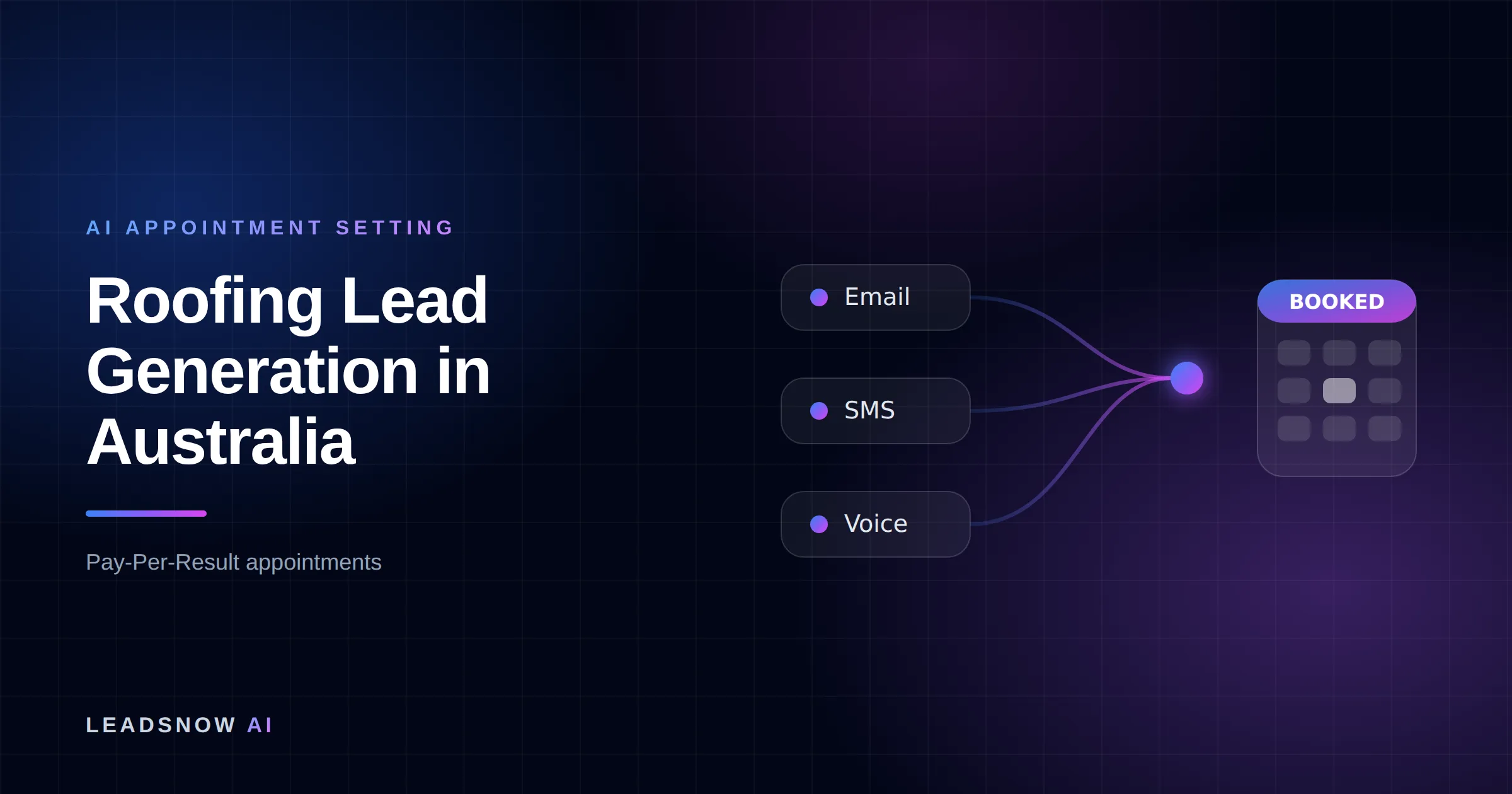
Roofing is the most brutal lead market in the Australian trades. The jobs are high-ticket — a full replacement runs five figures — so every platform and lead vendor bids the category up, then sells the same homeowner enquiry to your competitors and invites them to compare quotes. You pay for the enquiry, drive out, measure up, write a detailed quote — then lose it to whoever called first, or watch it go quiet while the homeowner patches the leak for a few hundred dollars instead. This guide breaks down what roofing lead generation actually costs in Australia in 2026, why the quote-shopper dynamic makes per-lead pricing misleading, and how pay-per-result appointment setting flips the risk. It’s written by LeadsNow AI, the Melbourne team behind 50,769+ AI-booked sales appointments since 2017 and 1M+ leads generated.
Roofing lead generation in Australia, at a glance (2026): Trade platforms like hipages charge a subscription of roughly $109–$419 a month plus per-lead credits on top — typical trade credits run $25–$50 per lead, per ServiceScale’s 2026 cost analysis — and the same analysis notes hipages shows homeowners “3-5 quotes side-by-side”. At the platform-average conversion of roughly one job in five leads, ServiceScale’s worked example lands at $125 in lead costs per booked job before your subscription and chase time. With Australian roof replacements running $10,000–$40,000 per What’s the Damage’s 2026 roofing cost guide, the alternative worth pricing is pay-per-result appointment setting: you pay only when a qualified homeowner is booked into your calendar — not for enquiries you still have to win.
What roofing leads cost in Australia in 2026
Most Australian roofers buying leads are buying them from hipages, ServiceSeeking or a private lead vendor. The hipages model is the one worth understanding, because it’s the biggest and the pricing structure is typical: per ServiceScale’s July 2026 analysis, you pay a monthly subscription ($109 basic, $219 mid-tier, $419 premium) that loads your account with lead credits, then spend those credits to accept individual leads. Credits expire after two to three months whether you use them or not. Per-lead pricing varies by trade and city — ServiceScale’s published examples put plumbers and electricians at $35–$50 per lead in major cities and painters and cleaners at $25–$35.
hipages doesn’t publish a per-trade rate card for roofing, so here’s the honest version:
Unverified industry folklore: roofers routinely report sitting in the platforms’ higher credit bands — figures of $30–$80+ per lead circulate in tradie forums and commentary for high-value job categories like roofing. We couldn’t verify a roofing-specific rate at an official published source this session, so treat that band as folklore, not fact. What is verifiable is the mechanism: credits are priced by job value and competition, and roofing is a high-value, heavily contested category.
Whatever your exact credit price, the per-lead number is the wrong one to optimise. ServiceScale’s worked example: a $25 lead converting at the platform-average one-in-five costs $125 in lead spend per booked job — before the subscription, before credit wastage, and before quoting time. Roofing quotes aren’t phone estimates; they’re site visits, measurements and written scopes. Losing several of those to win one is the real cost structure.
Why the job value changes the maths — in both directions
Per What’s the Damage’s roofing cost guide (verified August 2026, built from 90+ Australian trade pricing sources), a full roof replacement runs $10,000–$16,000 for a typical single-storey home and $15,000–$40,000 for two-storey homes needing scaffold access. Roof restorations run $2,500–$6,000, and installed material costs range from $80–$180/m² for Colorbond steel to $120–$250/m² for terracotta. At those job values, even expensive leads pay for themselves when they close — which is exactly why the category gets bid up, and why homeowners shop so hard before signing.
How it works
How an AI sales agent books your appointments
Six channels feed in
Outbound email, SMS, voice and social — plus inbound search and AI referrals from our own AI SEO and chat agents.
Your list or CRM
Outbound starts from data you already own — past enquiries, dormant customers, or a targeted prospect list.
Qualified against your rules
Budget, timing and fit are checked before anything reaches your team, using criteria you set.
Booked into your calendar
Only qualified prospects reach the booking step, so your closers spend their time selling.
MAKE MORE SALES.
Pay-Per-Result pricing — We scale sales HARD aligned to your interests, better than anyone else.
The quote-shopper problem: three-plus quotes is the standard
Nobody impulse-buys a roof. The platforms themselves train homeowners to collect quotes — ServiceScale notes hipages “shows customers 3-5 quotes side-by-side with price as the primary differentiator” — and for a $15,000 decision, most homeowners would do it anyway. That has three consequences for anyone buying roofing leads:
- Your real competition is baked into the lead. The enquiry you just paid for is, by design, also a paid enquiry for two to four other roofers. You’re not buying a customer; you’re buying an entry ticket to a tender.
- Speed decides who anchors the job. The first roofer to call gets to inspect first, frame the scope, and set the reference price everyone else quotes against. If your callback happens tomorrow, you’re quoting into someone else’s frame.
- A big share of quotes never close with anyone. Sticker shock sends many homeowners to a $250–$1,200 patch repair instead (What’s the Damage’s minor-repair range) — the job doesn’t disappear, it goes dormant. More on why that’s an asset below.
Want this done for you? We book qualified sales appointments on a Pay-Per-Result basis — you only pay for calls that actually land in your calendar.
Storm season: feast, famine, and the follow-up collapse
Roofing demand doesn’t arrive evenly — it arrives with the weather. The Insurance Council of Australia put insured losses from declared extreme weather events at $4.8 billion in 2025, up 727 per cent on the year before, across 294,000 claims. A single severe storm and hail event across Queensland and NSW in November 2025 generated almost 93,000 claims totalling $1.78 billion. When one of those systems moves through your service area, every roofer’s phone rings at once — and follow-up is the first thing that collapses. Paid leads go stale in days, and when the surge passes, the pipeline goes quiet again.
The operational answer is automation that answers, qualifies and books every enquiry within minutes regardless of volume — and a reactivation system that turns quiet months into harvest on enquiries you already own. We’ve written up the response-speed side in our guide to speed-to-lead automation in Australia.
Comparison: four ways roofing companies buy growth in 2026
| Shared platform leads | Exclusive leads | Your own marketing | Pay-per-result appointments | |
|---|---|---|---|---|
| What you pay for | Subscription + per-lead credits for a contact record (credits expire unused, per ServiceScale) | A higher per-lead price for a contact record only you receive | Ad spend, agency fees and creative — paid win or lose | A qualified homeowner booked into your calendar |
| Who else gets the lead | Multiple competing roofers — the platform sells the homeowner on comparing quotes | Only you (in theory — the homeowner still collects other quotes) | Only you | Only you |
| Who does the chasing | You — and the race starts the second the lead drops | You | You | Included — AI contact within minutes, multi-touch follow-up until booked or disqualified |
| No-show / dud risk | You carry it — renters, price-fishers and dead numbers all cost a credit | You carry it — exclusive ≠ qualified | You carry it entirely | Provider carries it — no booked appointment, nothing to pay for |
| Cost per signed job logic | Lead price ÷ low close rate + subscription + quoting hours (ServiceScale’s example: $125 in lead spend per booked job at 1-in-5) | Higher lead price ÷ better close rate — often cheaper per job than “cheap” shared leads | Whole budget ÷ jobs won — efficient at scale, brutal while you learn | Appointment price ÷ close rate on qualified, scheduled prospects — priced at the outcome end of the funnel |
If you’re weighing the last two columns in detail, we’ve published a straight comparison of pay-per-lead vs pay-per-appointment pricing in Australia.
If we can’t make you money, we don’t deserve yours.
Pay-Per-Result pricing — performance-based alignment.
The dead-quote goldmine: the pipeline you already paid for
Every roofing company that’s traded for a few years is sitting on the same buried asset: a stack of quoted-but-never-signed jobs. The homeowner got your $14,000 replacement quote, flinched, paid someone $600 to patch the worst of it, and went quiet. Here’s the thing — the roof didn’t get better. Patches buy seasons, not decades, and every storm season stresses it again. That homeowner already knows your name and already let you on the roof — warmer than any lead you can buy, and already paid for once.
Database reactivation is the systematic version of “someone should ring the old quotes”: AI-driven SMS and voice outreach across your entire dormant quote and enquiry list, with conversations that requalify (is the roof still unfixed? still the owner? timeframe now?) and book the live ones straight into your calendar. Across LeadsNow’s own historical database reactivation campaigns — the track record we built in our Colliers era — we’ve averaged a 4.4% booking rate, peaking at 8.9% on the best-performing lists. That’s our record across past reactivation campaigns, not a roofing-specific promise — but on a list of 1,500 old roofing quotes and enquiries, even the conservative end of that range is a meaningful run of booked inspections from people you’d written off. Full detail on our database reactivation services for Australian businesses page.
How pay-per-result appointment setting works for roofers
Pay-per-result means LeadsNow runs the campaigns, the AI qualification and the multi-touch follow-up at our own risk — and you pay only when a qualified prospect is booked into your calendar. Not per click, not per enquiry, not per contact record. For a roofing company that changes three things:
- Qualification happens before you pay, not after you quote. Criteria are agreed with you up front — owner-occupier, property and roof type, suburb, job scope (replacement/restoration vs minor repair), timeframe — so price-fishers and out-of-area enquiries are filtered at our cost, not yours.
- Speed-to-lead is automated and storm-proof. Our AI calls and messages every new enquiry within minutes, at any hour, at any volume — the exact discipline that wins the quote race, on the exact weeks your crews are flat out and can’t answer the phone.
- Your estimators quote, they don’t chase. Site visits get booked with qualified homeowners who are expecting you, instead of your best closer working a call sheet between jobs.
Be clear-eyed about the trade-off: a booked, qualified appointment costs more than a raw lead, because it should — it has survived qualification and been scheduled. In a trade where each signed job is worth $10,000–$40,000, the comparison that matters is cost per signed job, and on that basis tighter qualification usually wins, as the shared-lead maths above already shows.
Who this is a fit for — and who it isn’t
Good fit: established roofing companies doing replacements and restorations who can service more booked inspections than they’re getting; operators with an estimator or closer ready to take scheduled appointments; anyone with two or more years of dead quotes sitting in a spreadsheet or job-management system.
Not a fit: brand-new operators with no trading history or quote database; repair-only outfits whose job value can’t carry a qualified-appointment model; teams that want the cheapest per-contact number and are happy doing their own dialling. We’d rather say that plainly than win a client who churns in eight weeks.
The proof
Since 2017, LeadsNow’s AI systems have booked 50,769+ sales appointments and generated over 1 million leads for clients. We hold a 4.6-star average across 43 Google reviews and have published 25 filmed client case studies — clients on camera, not testimonial graphics. Those case studies span finance, property, fitness and education rather than roofing specifically; the mechanics — AI speed-to-lead, qualification, multi-touch follow-up, calendar booking — are industry-agnostic.
FAQ: roofing lead generation in Australia
How much do roofing leads cost in Australia?
There’s no published roofing-specific rate card, but the structure is well documented: platforms like hipages charge a $109–$419 monthly subscription plus per-lead credits, with published trade examples of $25–$50 per lead and credits expiring after two to three months, per ServiceScale’s 2026 analysis. Tradie folklore puts roofing toward the top of the credit bands because of the job value — we couldn’t verify an official roofing figure, so treat any specific number you’re quoted as negotiable. The number to actually track is lead spend per signed job, which ServiceScale’s worked example puts at $125 even for a cheap $25 lead at platform-average conversion.
How much does a roof replacement cost in Australia in 2026?
Per What’s the Damage’s 2026 guide, built from 90+ Australian trade pricing sources: $10,000–$16,000 for a typical single-storey home, $15,000–$40,000 for two-storey homes needing scaffolding, with restorations at $2,500–$6,000. Installed material costs range from $80–$180/m² for Colorbond to $120–$250/m² for terracotta. Those job values are why roofing is one of the most expensive and most competitive lead categories in the Australian trades.
Why do roofing enquiries spike after storms — and why does it matter for lead generation?
Because the demand literally falls out of the sky. The Insurance Council of Australia recorded $4.8 billion in insured losses from declared extreme weather events in 2025 — up 727 per cent year on year across 294,000 claims — with a single November storm and hail event in Queensland and NSW generating almost 93,000 claims. In a surge, every roofer’s follow-up collapses at exactly the moment enquiries peak, so the operators with automated response and booking systems capture a disproportionate share of the storm work — and the ones without them pay for leads they never get back to.
What is dead-quote reactivation for roofing companies?
It’s re-engaging every homeowner you’ve quoted who never went ahead. Most of them patched the problem instead of fixing it, which means the underlying job still exists and gets more urgent every storm season. Reactivation runs AI-driven SMS and voice conversations over that dormant list, requalifies each contact, and books the live ones back into your calendar. Since they’re prior enquiries you already paid to acquire, the incremental acquisition cost of a revived job is close to zero.
What’s the difference between paying per lead and paying per appointment?
A lead is a contact record — a name and number you still have to call, qualify, inspect and quote, and you pay whether or not any of that succeeds. A pay-per-result appointment is a qualified homeowner already booked into your calendar; the provider carries the cost of every contact that doesn’t qualify or doesn’t book. The per-unit price is higher, but you’re buying a later, more certain stage of the funnel — which matters most in trades like roofing where each quote costs you a site visit.
Does LeadsNow have roofing-specific case studies?
Our 25 filmed client case studies come from finance, property, fitness and education — we won’t pretend otherwise or invent a roofing logo wall. What we bring to roofing is the appointment-setting system behind 50,769+ booked sales appointments since 2017, applied to your service area, your job types and your qualification criteria. Book a call and we’ll map it to your sales cycle honestly, including whether we think you’re a fit.
Ready to see it on your own pipeline? Book a call — you’ll speak with us about your market, your lead flow, and whether the model fits before anything is signed.
Pay-Per-Result appointments
See if we’re a fit
We book qualified sales appointments for you and you pay on results, not retainers. Our booking page asks a few quick questions so you find out in two minutes whether that model suits your business.
- 50,769+ appointments booked without cold calling.
- Pay-Per-Result pricing — you pay for booked, qualified calls.
- Pick your own time on our live calendar, no phone tag.