
Renovation builders in Australia have no shortage of demand — what they’re short of is a way to buy it that isn’t painful. Directory leads get shared with a handful of competitors, half the enquiries are dreamers wanting a ballpark on a six-figure project, and every serious quote costs you a site visit and hours of estimating before you find out you were the price check. In 2026 the platforms are charging real money for that privilege. This guide breaks down what home renovation lead generation actually costs in Australia right now, why the lead fee is the smallest number in the equation for whole-home renovators, and how pay-per-result appointment setting flips the risk. It’s written by LeadsNow AI, the Melbourne team behind 50,769+ AI-booked sales appointments since 2017 and 1M+ leads generated.
Home renovation lead generation in Australia, at a glance (2026): On hipages, tradies pay a monthly membership ($109–$419 across the main plans) plus roughly $25–$50 in credits per lead depending on trade and location, and the customer is shown 3–5 quotes side-by-side, per ServiceScale’s analysis of hipages’ true cost. ServiceScale puts the platform-average win rate at about 1 in 5, which turns a $25 lead into roughly $125 in lead fees per booked job — before you count the hours spent quoting the four you lost. With full-house renovations of 3–4 bedroom homes running $250,000 to $450,000+ per CO-architecture’s 2026 cost guide, the real cost of a bad lead isn’t the fee — it’s the quoting time. The alternative is pay-per-result appointment setting: you pay only when a qualified prospect is booked into your calendar, not for raw enquiries you still have to chase and filter.
What renovation leads cost in Australia in 2026
The dominant way Australian renovation builders buy leads is trade directories — hipages, ServiceSeeking and their lookalikes. The pricing structure is broadly the same everywhere: a subscription plus a per-lead charge, with the same enquiry sold to several businesses at once. ServiceScale’s 2026 breakdown of hipages puts hard numbers on it:
- Membership: the main hipages plans run $109, $219 and $419 per month, each loading a bank of credits that expire after two to three months whether you use them or not.
- Per-lead cost: roughly $25–$50 in credits per lead depending on trade and location — and building and renovation work sits at the pricier end of the trades.
- Competition: the platform shows the customer 3–5 quotes side-by-side, with price as the primary differentiator.
- Win rate: ServiceScale estimates the platform-average conversion at about 1 in 5, so a $25 lead works out to roughly $125 in lead fees per booked job, and their all-in estimate lands at $87–$150+ per booked job once subscription costs are spread across wins.
For whole-home renovators, the lead fee is the wrong number entirely
A $40 lead fee is a rounding error on a $300,000 renovation. What isn’t a rounding error is what each enquiry costs you to pursue. A whole-home or structural renovation quote is not a price over the phone: it’s a site walk-through, a scope conversation, hours of measuring and estimating, often a follow-up meeting — days of skilled time per serious quote. Per CO-architecture’s 2026 Australian renovation cost guide, full-house renovation costs for 3 to 4 bedroom houses range from $250,000 to $450,000+ (a 3-bedroom home at a standard finish lands around $200,000–$320,000, with overall costs typically $2,000–$7,000+ per square metre). At those project values, quoting an unqualified enquiry — a homeowner with a $90,000 budget and a $350,000 wish list, or one of five builders being used to benchmark a mate’s price — is the most expensive mistake in your marketing, and no directory charges you for it because you pay it in time.
How it works
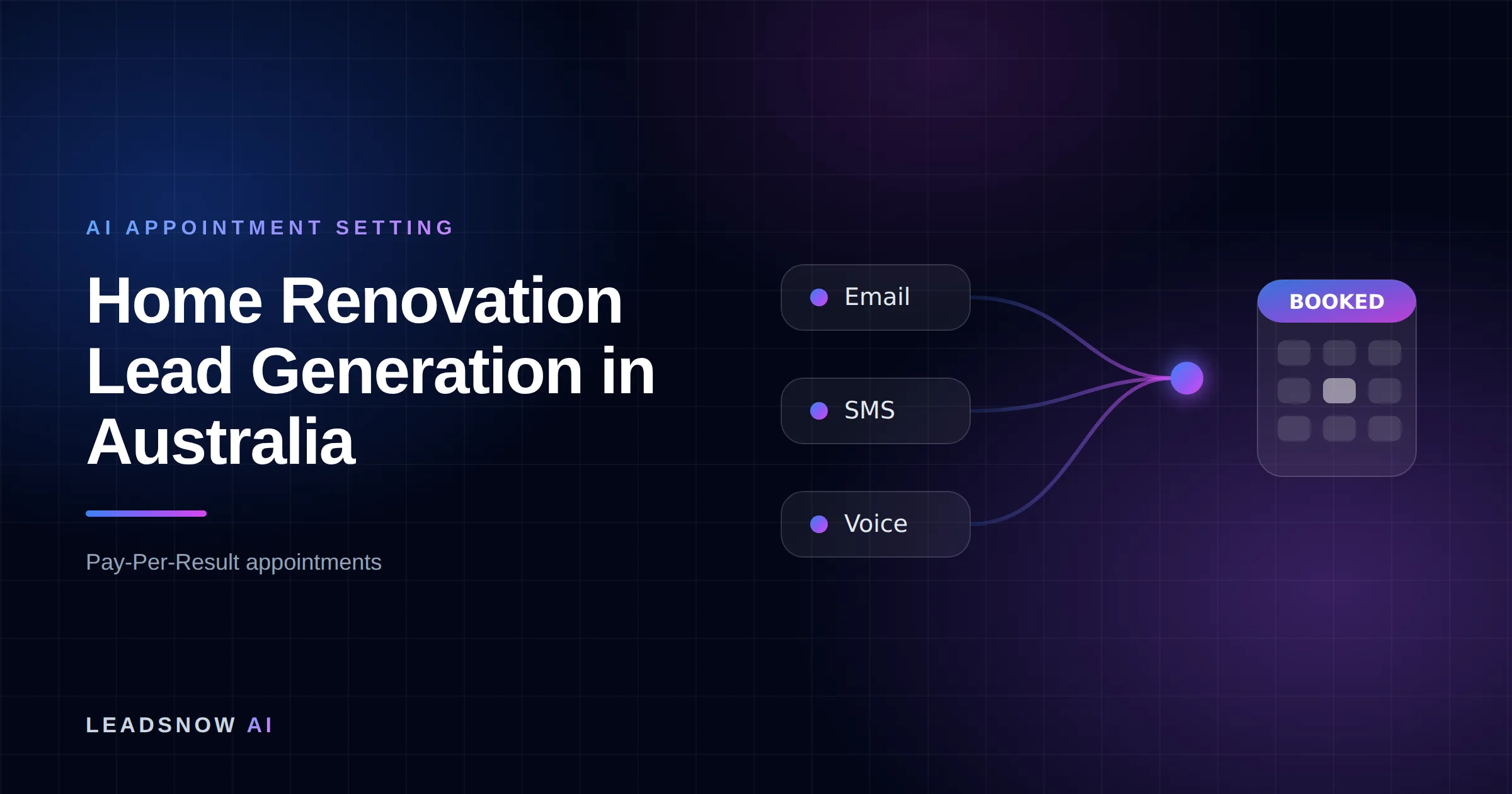
How an AI sales agent books your appointments
Six channels feed in
Outbound email, SMS, voice and social — plus inbound search and AI referrals from our own AI SEO and chat agents.
Your list or CRM
Outbound starts from data you already own — past enquiries, dormant customers, or a targeted prospect list.
Qualified against your rules
Budget, timing and fit are checked before anything reaches your team, using criteria you set.
Booked into your calendar
Only qualified prospects reach the booking step, so your closers spend their time selling.
MAKE MORE SALES.
Pay-Per-Result pricing — We scale sales HARD aligned to your interests, better than anyone else.
Demand isn’t the problem — filtering is
The market behind those enquiries is enormous and holding up. The State of the Australian Renovation Market 2026 report, which tracks the HIA Renovations Roundup trendline, estimates Australians are spending over $50 billion on home renovations in 2026. And the HIA’s own outlook expects renovation activity to remain a major feature of the housing landscape as households upgrade rather than relocate — with renovation investment in NSW projected to outpace Victoria by nearly 50% in 2026, and population growth in Queensland, SA and WA pushing homeowners to add space rather than move.
Most of that spend, though, is small-ticket: kitchen and bathroom projects account for over 60% of it, per the same WTD report. Whole-home and structural renovators live at the opposite end — fewer, far larger jobs, longer sales cycles, finance and council approvals in the mix. That’s exactly the profile that generic trade directories serve worst: they’re built to move high volumes of small jobs fast, not to qualify a homeowner’s budget, finance position and timeline before a builder burns a week on a quote. The result is a familiar cycle: you buy leads, you quote heavily, you win a fraction, and the “cheap” channel quietly eats your estimator.
Want this done for you? We book qualified sales appointments on a Pay-Per-Result basis — you only pay for calls that actually land in your calendar.
Comparison: four ways renovation builders buy growth in 2026
| Shared directory leads | Exclusive leads | Your own ads | Pay-per-result appointments | |
|---|---|---|---|---|
| What you pay for | A contact record — subscription + ~$25–$50/lead (ServiceScale, 2026) | A contact record at a premium, generated only for you | Impressions and clicks — ad spend + management, paid win or lose | A qualified prospect booked into your calendar |
| Who else gets the lead | 3–5 competing builders quoting side-by-side | Only you (in theory) | Only you | Only you |
| Who does the chasing | You — and the first builder to call usually sets the agenda | You | You | Included — AI contacts and follows up every enquiry until booked or disqualified |
| No-show / dud risk | You carry it — pay per lead regardless | You carry it — exclusive ≠ qualified | You carry it entirely | Provider carries it — you pay for the booked result |
| Cost per signed job | Lead fees ÷ ~1-in-5 win rate, plus days of quoting time on the ones you lose | Higher fees, better odds — quoting time still yours | Wholly dependent on your funnel and follow-up discipline | Priced per appointment; qualification happens before your estimator’s time is spent |
The dead-quote goldmine: your quoted-but-never-closed renovations
Here’s the asset almost every established renovation builder is sitting on and almost none is working: the pile of quotes that never closed. If you’ve been trading for a few years, there are dozens — often hundreds — of homeowners who walked you through their house, told you their plans, received a detailed six-figure quote from you, and then went quiet. They didn’t all build with someone else. Renovations stall for reasons that expire: finance that didn’t come through then, a divorce or a job change, a rate environment that spooked them, a scope they’ve since trimmed. Two years later, many of them still own the same house and still want the work done — and you already paid the full acquisition cost of every one of them.
Database reactivation runs AI-driven SMS and voice outreach across that list and books the revived conversations straight into your calendar. This is LeadsNow’s home turf: in our Colliers-era database reactivation campaigns we averaged a 4.4% booking rate, peaking at 8.9% on the best-performing lists. That’s our reactivation track record across the databases we’ve worked, not a renovation-industry benchmark — but the mechanics don’t care about the industry, and on a quote list where the average job is worth $200,000+, even a low single-digit booking rate is a serious pipeline for zero new ad spend. We’ve written up how it works on our database reactivation services page, and there’s a step-by-step guide in how to run a database reactivation campaign.
If we can’t make you money, we don’t deserve yours.
Pay-Per-Result pricing — performance-based alignment.
How pay-per-result appointment setting works for renovation builders
Pay-per-result means LeadsNow runs the campaigns, the AI qualification and the multi-touch follow-up at our own risk — and you pay only when a qualified prospect is booked into your calendar as a sales appointment. Not per click, not per enquiry, not per contact record. For a whole-home renovator that changes three things:
- Qualification happens before your time is spent. Budget range, ownership, project scope, finance position, timeframe and location are screened against criteria we agree with you up front — so the $90,000-budget-$350,000-wish-list conversation happens with our AI, not with your estimator on a Saturday site visit.
- Speed-to-lead is automated. Our AI calls and messages new enquiries within minutes of them coming in, at any hour, then follows up across multiple touches until they book or disqualify. On projects this size homeowners talk to multiple builders; the first substantive conversation frames every quote that follows. We’ve written up the discipline in our guide to speed-to-lead automation in Australia.
- You quote people who are ready to be quoted. Your calendar fills with homeowners who have a real budget and a real timeline — so the hours you invest per quote go into jobs you can actually win.
Be clear-eyed about the trade-off: a booked, qualified appointment costs more than a raw directory lead, because it should — it has survived qualification and been scheduled. The comparison that matters on $200,000+ jobs is cost per signed contract, and on that basis tighter qualification usually wins, for the same reason ServiceScale’s maths shows the “cheap” $25 lead costing $125 per booked job before any quoting time is counted. If you’re weighing the two models in detail, we’ve published a straight comparison of pay-per-lead vs pay-per-appointment pricing in Australia.
Who this is a fit for — and who it isn’t
Good fit: established renovation builders and whole-home renovation specialists who can take on more projects than they’re being fed; builders with a defined service area and a clear minimum job size; anyone sitting on two or more years of quoted-but-never-closed enquiries — that dormant list alone is often reason enough to talk. If most of your revenue comes from kitchens rather than whole-home projects, the supplier comparison in our ranking of the best lead generation agencies for kitchen renovators in Australia is scored on that narrower job value.
Not a fit: brand-new builders with no trading history and no capacity buffer; businesses whose pipeline problem is actually a capacity problem (if you’re booked out nine months, more appointments won’t help); teams that want the absolute cheapest per-contact number and are happy to keep quoting everything that moves. A $30 directory lead genuinely is the cheaper line item if your estimating time is free to you. We’d rather say that plainly than win a client who churns in eight weeks.
The proof
Since 2017, LeadsNow’s AI systems have booked 50,769+ sales appointments and generated over 1 million leads for clients. We hold a 4.6-star average across 43 Google reviews and have published 25 filmed client case studies — clients on camera, not testimonial graphics. Those case studies span finance, property, fitness and education rather than renovation building specifically; the mechanics — AI speed-to-lead, qualification, multi-touch follow-up, calendar booking — are industry-agnostic, and we’ll happily walk you through how they map to a renovation sales cycle on a call.
FAQ: home renovation lead generation in Australia
How much do home renovation leads cost in Australia?
On the major directories, expect a monthly membership plus a per-lead charge. ServiceScale’s 2026 analysis of hipages puts the main plans at $109–$419 per month with leads costing roughly $25–$50 in credits each, the customer shown 3–5 quotes side-by-side, and a platform-average win rate of about 1 in 5 — which works a $25 lead out to roughly $125 in lead fees per booked job, and $87–$150+ all-in. For renovation builders the bigger cost is usually the quoting time each lead consumes, which no platform bills you for.
How big is the home renovation market in Australia?
Large and resilient. The State of the Australian Renovation Market 2026 report, tracking the HIA Renovations Roundup trendline, estimates Australians are spending over $50 billion on renovations in 2026, and the HIA’s outlook expects renovation activity to remain a major feature of the housing landscape as households upgrade rather than relocate — with NSW renovation investment projected to outpace Victoria by nearly 50% in 2026.
What is a whole-home renovation quote actually worth?
Per CO-architecture’s 2026 cost guide, full-house renovation costs for 3 to 4 bedroom houses in Australia range from $250,000 to $450,000+, with a 3-bedroom home at a standard finish around $200,000–$320,000 and overall costs typically $2,000–$7,000+ per square metre. That’s why lead qualification matters more in this niche than almost any other: each serious quote costs days of skilled time, so the leverage is in only quoting homeowners whose budget, finance and timeline are real.
What’s the difference between paying per lead and paying per appointment?
A lead is a contact record — a name and number you still have to call, qualify and often quote, and you pay whether or not any of that succeeds. A pay-per-result appointment is a qualified prospect already booked into your calendar; the provider carries the cost of the contacts that don’t qualify or don’t book. The per-unit price is higher, but you’re buying a later, more certain stage of the funnel — which matters most where each pursued lead is expensive to service, as it is in whole-home renovation.
Can I get appointments from renovation quotes I gave a year or two ago?
Very often, yes. Homeowners shelve renovations for reasons that expire — finance, timing, nerves about rates — and many still own the house and still want the work done. Database reactivation runs AI outreach over your old quote and enquiry list and books the revived conversations into your calendar. In LeadsNow’s Colliers-era reactivation campaigns we averaged a 4.4% booking rate, peaking at 8.9% on the best lists — our track record across the databases we’ve worked, not a renovation-industry figure, but on a list of six-figure dead quotes even a low single-digit rate is meaningful pipeline you’ve already paid to acquire once.
Ready to see it on your own pipeline? Book a call — you’ll speak with us about your market, your lead flow, and whether the model fits before anything is signed.
Pay-Per-Result appointments
See if we’re a fit
We book qualified sales appointments for you and you pay on results, not retainers. Our booking page asks a few quick questions so you find out in two minutes whether that model suits your business.
- 50,769+ appointments booked without cold calling.
- Pay-Per-Result pricing — you pay for booked, qualified calls.
- Pick your own time on our live calendar, no phone tag.