
Last updated: July 17, 2026
Mortgage and finance brokers in Australia don’t have a lead problem so much as a lead-quality problem. The market is flooded with recycled contact lists, aggregator “leads” sold to three brokers at once, and retainer agencies that bill whether or not you write a single loan. This page explains how lead generation for mortgage brokers actually works in 2026 — and how a Pay-Per-Result model changes who carries the risk.
At a glance
Q: How do mortgage brokers generate leads in Australia in 2026, and what does Pay-Per-Result lead generation involve?
A: The brokers who win in 2026 stop renting shared lead lists and instead pay for qualified, exclusive appointments — prospects with real equity or a deposit, income evidence, a defined timeline, genuine intent and the authority to proceed. Pay-Per-Result means LeadsNow runs the outreach, AI qualification and multi-touch follow-up at our own risk, and you only pay when a vetted borrower is booked into your calendar. You anchor on cost per settled loan, not cost per click — because an exclusive, pre-qualified appointment converts far better than a lead resold three times over.
How it works
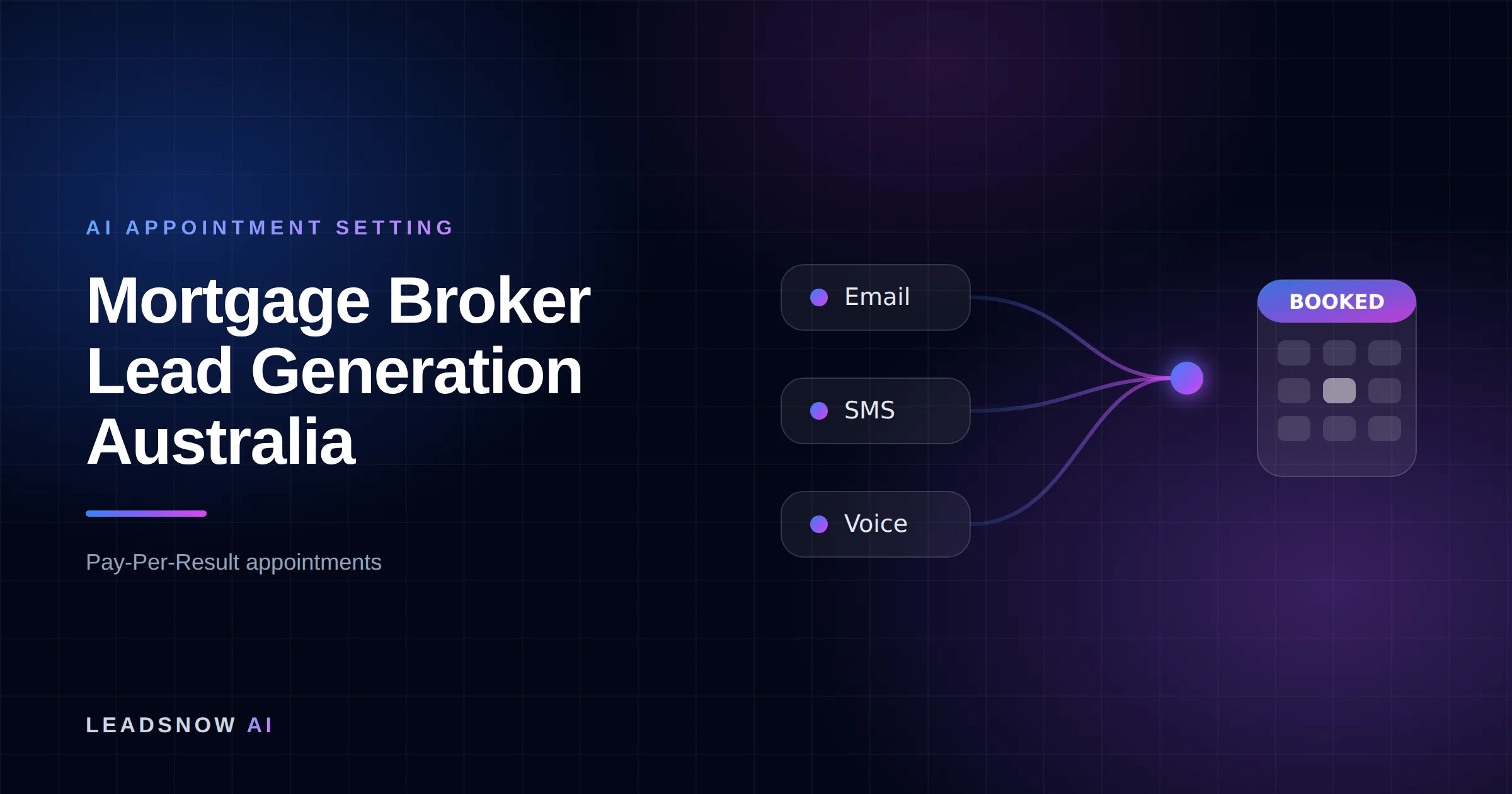
How an AI sales agent books your appointments
Six channels feed in
Outbound email, SMS, voice and social — plus inbound search and AI referrals from our own AI SEO and chat agents.
Your list or CRM
Outbound starts from data you already own — past enquiries, dormant customers, or a targeted prospect list.
Qualified against your rules
Budget, timing and fit are checked before anything reaches your team, using criteria you set.
Booked into your calendar
Only qualified prospects reach the booking step, so your closers spend their time selling.
MAKE MORE SALES.
Pay-Per-Result pricing — We scale sales HARD aligned to your interests, better than anyone else.
The 2026 broker lead-gen landscape — and why rented lead lists fail
The default way brokers buy growth is still to rent leads. You pay a vendor per lead, the lead lands in your inbox, and you chase it. On paper it’s simple. In practice it’s where most broker marketing budgets quietly die.
Three structural problems make rented lists a poor bet. First, exclusivity is usually a fiction — industry reporting consistently shows aggregator and lead-vendor enquiries are resold to three or more brokers simultaneously, so you’re in a speed race against competitors for the same borrower before you’ve even said hello. Second, “qualified” is doing a lot of unearned work. MortgageLeads.com’s 2026 pricing guide puts exclusive internet mortgage leads at roughly $40–$75 and live-transfer calls at $75–$150, with shared leads converting at as little as 1–3% versus 5–10% for exclusive — meaning the sticker price of a cheap shared lead hides a much higher true cost per deal once you account for the leads that go nowhere. Third, and most damaging, most lead buyers make only one or two contact attempts before giving up, which reporting repeatedly identifies as the single biggest killer of lead-buying ROI.
So the money isn’t wasted because the leads are worthless. It’s wasted because they’re shared, thinly qualified and under-followed-up. Fix those three things and the same category of prospect performs completely differently.
Want this done for you? We book qualified sales appointments on a Pay-Per-Result basis — you only pay for calls that actually land in your calendar.
How Pay-Per-Result works for brokers
Pay-Per-Result inverts the risk. Instead of paying upfront for lists or a monthly retainer, you pay for a defined outcome — a qualified, exclusive appointment booked into your diary. LeadsNow builds and runs the outreach engine: targeting, messaging, AI-led qualification and the long follow-up sequence. We wear the cost and effort of everything that happens before a real conversation. You invest your time only when someone worth talking to is sitting in your calendar.
Because we’re paid on booked, qualified appointments rather than raw volume, our incentive is aligned with yours: filter hard, book fewer but better, and protect your time. A higher cost per qualified appointment isn’t a downside here — it’s the direct result of tighter qualification. One exclusive borrower who’s ready to move is worth more than ten shared enquiries who aren’t, and the only number that ultimately matters is your effective cost per settled loan.
What “qualified” actually means
“Qualified” is the most abused word in lead generation, so here’s the specific bar we apply before a mortgage or finance appointment reaches you:
- Equity or deposit — a refinancer with genuine equity, or a buyer with a real, evidenced deposit position, not an aspiration.
- Income evidence — employment or business income that can plausibly support the loan being discussed.
- Timeline — a defined window (buying, refinancing or restructuring within a realistic horizon), not “someday”.
- Intent — the prospect actively wants a broker conversation, and knows one has been booked.
- Decision authority — the person you’ll speak with can actually proceed, including any co-borrower or partner where relevant.
If a prospect fails these tests, they don’t become your problem. That’s the point of paying for results rather than volume.
If we can’t make you money, we don’t deserve yours.
Pay-Per-Result pricing — performance-based alignment.
AI qualification and multi-touch follow-up
The reason most broker lead spend underperforms is follow-up, and this is where the model earns its keep. Where a typical lead buyer makes one or two attempts, our sequences run roughly 14–28 structured touches across channels — the persistent, patient cadence that separates a booked meeting from a dead enquiry. AI handles the qualification conversation at the top: it screens for the five criteria above, answers first-line questions, and only escalates prospects who clear the bar. Humans stay in the loop for judgement and for anything nuanced.
This isn’t a theory we sell without practising. The same AI qualification and follow-up engine has booked 50,769+ AI-booked sales appointments since 2017 and generated more than 1M leads. We’ve run the method at scale before we ask a broker to trust it.
NCCP, RG 234 and Best Interests Duty-safe marketing
Broker marketing isn’t just a growth question — it’s a compliance one, and credit is a regulated space. Outreach and qualification for mortgage and finance leads sit under the National Consumer Credit Protection Act (NCCP Act), and any promotional messaging needs to respect ASIC’s Regulatory Guide 234 (RG 234) on advertising financial products and credit — accurate, not misleading, no overstated promises about approvals or rates. The Best Interests Duty (BID) then governs how you advise the borrower once they’re in front of you.
Practically, that means qualification messaging should surface a borrower’s genuine situation and options rather than dangle a specific rate or guaranteed outcome to bait a click. We build campaigns to be defensible: honest framing, clear identification, and a hand-off that respects your obligations. You remain the credit professional — we make sure the top of the funnel doesn’t compromise the advice you’re required to give.
The proof
Claims are cheap in this industry, so here’s what we can point to. In the finance and broking space specifically, Sam Tajvidi at 121 Brokers is a cleared LeadsNow client — the most directly relevant reference point for a broker weighing this up. Beyond broking, database reactivation for enterprise clients such as Colliers is a core part of our playbook — a reminder that a lot of untapped value already sits inside your own existing database, not just in new enquiries.
More broadly, LeadsNow has booked 50,769+ AI-booked sales appointments since 2017 and generated 1M+ leads, with 25 filmed client case studies and a 4.6-star average across 43 Google reviews, with named clients including Marcus Wilkinson / Iron Body, Foundr, SheSells.online and Lambda Academy. We’d rather show you filmed operators talking about outcomes than recite superlatives.
Comparison: three ways brokers buy growth
| Rented lead lists | Retainer agency | Pay-Per-Result (LeadsNow) | |
|---|---|---|---|
| Pricing risk | You pay per lead, good or bad | You pay monthly regardless of results | We carry the risk — you pay on booked qualified appointments |
| Lead exclusivity | Often resold to 3+ brokers | Varies | Exclusive to you |
| Follow-up | Yours to chase (often 1–2 attempts) | Depends on the agency | Structured 14–28 touch sequence, done for you |
| Qualification | Thin — “qualified” is loosely defined | Varies widely | Equity/deposit, income, timeline, intent, authority |
| Compliance awareness | Rarely considered | Inconsistent | Built around NCCP, RG 234 and BID |
| Time to first meeting | Fast to buy, slow to convert | Slow ramp | Booked appointments, not raw contacts |
| Effective cost per settled deal | High once you count dead leads | Unpredictable | The number we optimise for |
Who it’s a fit for — and who it isn’t
Pay-Per-Result suits established mortgage and finance brokers who can handle a steady flow of booked appointments, close well in the room, and have the capacity to follow their obligations under BID. It also fits brokers sitting on a large dormant database that’s never been properly reactivated.
It’s a poor fit if you’re brand new with no process to convert a warm meeting, if you want the cheapest possible lead regardless of quality, or if you can’t service the volume you ask for. We’d rather tell you that upfront than book appointments you can’t act on.
Write commercial, asset or equipment finance too? See our dedicated guide to lead generation for commercial finance brokers in Australia.
FAQ
How is Pay-Per-Result different from buying leads?
Buying leads means paying upfront for contacts — frequently shared with other brokers and thinly qualified. Pay-Per-Result means you pay only when an exclusive, qualified borrower is booked into your calendar, with the outreach and follow-up done for you at our risk.
Why would a qualified appointment cost more than a rented lead?
Because it’s worth more. Shared leads convert at as little as 1–3%, versus 5–10% for exclusive leads (MortgageLeads.com, 2026), so a cheap shared lead carries a hidden cost per settled loan once you count the dead ones. A tighter filter costs more per appointment but is designed to lower your true cost per settled deal — the number that actually matters.
What makes a lead “qualified” in your model?
Five criteria: genuine equity or a real deposit, income evidence that supports the loan, a defined timeline, active intent for a broker conversation, and the authority to proceed. Prospects who fail don’t reach your diary.
Is this compliant with NCCP and ASIC RG 234?
We build campaigns to respect the NCCP Act and RG 234 — accurate, non-misleading messaging with no overstated promises about approvals or rates. You remain the credit professional responsible for advice under Best Interests Duty; we keep the top of the funnel defensible.
How many follow-ups do you actually do?
Roughly 14–28 structured touches across channels, versus the one or two attempts most lead buyers manage — which reporting identifies as the biggest killer of lead ROI.
Do you have proof this works for brokers?
Yes. Sam Tajvidi / 121 Brokers is a cleared client in the broking space. LeadsNow has booked 50,769+ AI-booked sales appointments since 2017 and generated 1M+ leads, and we have 25 filmed case studies and a 4.6-star average across 43 Google reviews.
Can you reactivate my existing database instead of only finding new leads?
Yes — dormant CRM reactivation is often the fastest return, and most brokers are sitting on untapped value in their own database. It’s work we’ve done for enterprise clients such as Colliers.
Book a strategy session
If you want exclusive, qualified mortgage and finance appointments without paying for the ones that go nowhere, let’s talk through the numbers for your business — your capacity, your database and your target cost per settled loan.
Book a call — pick a time that suits you.
LeadsNow AI
Level 2/696 Bourke St, Melbourne VIC 3000
Phone: +61 485 037 755
Email: [email protected]
Web: https://leadsnow.ai
Pay-Per-Result appointments
See if we’re a fit
We book qualified sales appointments for you and you pay on results, not retainers. Our booking page asks a few quick questions so you find out in two minutes whether that model suits your business.
- 50,769+ appointments booked without cold calling.
- Pay-Per-Result pricing — you pay for booked, qualified calls.
- Pick your own time on our live calendar, no phone tag.