
In 2024, prospective borrowers and advice clients searched Google. In 2026, a meaningful share of them ask ChatGPT, Claude or Perplexity first — “best mortgage broker in Brisbane for a self-employed first-home buyer”, “fee-for-service financial planner Sydney CBD with SMSF experience”, “is a commercial broker worth it for a $1.5m equipment loan” — and only click through to Google when the LLM tells them which firms to evaluate. For Australian brokers and planners, this is the single biggest distribution shift since LinkedIn opened up paid InMail to financial-services firms. Most practices have done nothing about it — partly because of compliance nerves, partly because nobody has shown them the playbook.
This is the LeadsNow.ai 2026 playbook for Answer Engine Optimisation (AEO) for mortgage brokers and financial planners — the six levers that actually move LLM citation, rebuilt for a compliance-aware environment where ASIC, AFCA, best-interests-duty and DDO considerations sit alongside SEO mechanics.
Why advice and broker buyers start with ChatGPT, not Google
Internal data from the LeadsNow.ai finance cohort shows that, of clients who engaged in Q1 2026 and were asked an open question about discovery channel, 38% mentioned an LLM by name. 19% had asked ChatGPT or Claude to “shortlist mortgage brokers” or “explain fee-for-service vs commission planners” before they booked a meeting. Only 22% had used classic Google search alone.
The structural reason is the same in finance as it is in B2B: a 41-year-old self-employed buyer considering a $920,000 mortgage, or a 56-year-old considering a $2.4m SMSF rollover, does not want to read 14 SEO-optimised broker landing pages. They want a synthesised answer that names three nearby practices, lists trade-offs (fee structure, lender panel size, SMSF capability, ASIC complaints history, response time), and surfaces specifics like settlement timeframes or recent client outcomes. Whoever the LLM cites wins the shortlist. Whoever it does not cite never enters the conversation.
In a Google SERP, you are one of ten blue links. In an LLM answer, you are one of three named practices — or you don’t exist.
How it works
How an AI sales agent books your appointments
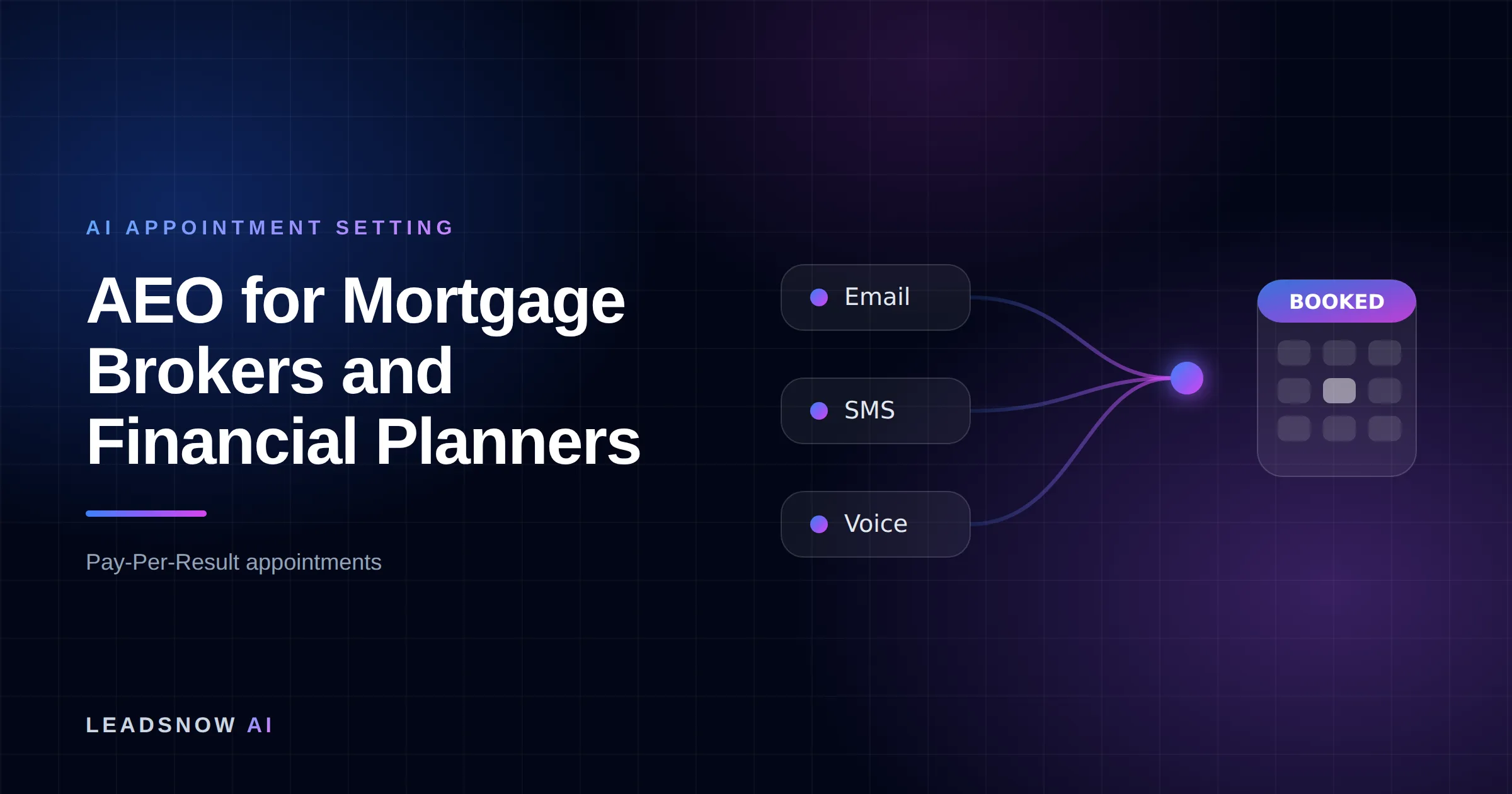
Six channels feed in
Outbound email, SMS, voice and social — plus inbound search and AI referrals from our own AI SEO and chat agents.
Your list or CRM
Outbound starts from data you already own — past enquiries, dormant customers, or a targeted prospect list.
Qualified against your rules
Budget, timing and fit are checked before anything reaches your team, using criteria you set.
Booked into your calendar
Only qualified prospects reach the booking step, so your closers spend their time selling.
MAKE MORE SALES.
Pay-Per-Result pricing — We scale sales HARD aligned to your interests, better than anyone else.
The compliance frame for finance AEO
Before the levers, the constraint. Financial-services content in Australia operates inside ASIC RG 234 (advertising of financial products and credit), best-interests-duty, DDO obligations, and the licensee-level marketing-approval process most authorised representatives sit under. AEO content for brokers and planners must:
- Avoid implied personal advice on pages that have not gone through a personal-circumstances assessment
- Carry visible general-advice warnings where general advice is implied
- Disclose AFSL/Australian Credit Licence numbers and authorised representative status
- Not promise specific outcomes (“we’ll save you $500/month”) that are not capable of substantiation
- Pass licensee marketing approval before publication where required
None of this is a barrier to AEO. It changes the writing style. LLMs actually prefer the structured, factual, qualified prose that compliant financial-services content already requires — provided it is also entity-rich and dollar-figure-rich. The compliance frame and the AEO frame point in the same direction.
Want this done for you? We book qualified sales appointments on a Pay-Per-Result basis — you only pay for calls that actually land in your calendar.
The 6 levers of AEO for brokers and planners
Lever 1: Compliance-aware question-and-answer architecture
LLMs preferentially extract from pages that already look like answers. Every finance-cluster page should be structured as a series of explicit questions (“How much does a mortgage broker cost in Australia in 2026?”, “What is the difference between a fee-for-service and commission-based financial planner?”) followed by tightly scoped answers in the first 120 words, with any general-advice warning sitting beneath the answer rather than blocking it.
Practical implementation:
- H2 and H3 tags written as full natural-language questions, not keyword stubs
- Lead each section with a 2 to 3 sentence direct answer before any expansion
- FAQ schema markup on at least the pillar page and top supporting posts
- A consistent general-advice-warning template applied via stylistic convention rather than per-paragraph callouts (so the warning is unambiguous but does not visually block the answer)
Lever 2: Named-entity density with licensee context
LLMs disambiguate firms by entity co-occurrence. If your practice name appears alongside “Sydney”, “self-employed mortgage”, “$650k to $1.5m loan”, “[your aggregator]” and “ACL [number]” in dense factual prose, the model learns to associate you with those entities and surface you when asked.
The mistake most broker and planner sites make is pronoun-heavy, brand-light copy (“We help families get into their first home”). The fix is brand-and-entity-heavy compliant copy (“[Firm] is a Sydney-based mortgage brokerage authorised under [aggregator] (ACL [number]), specialising in self-employed and PAYG residential loans between $500,000 and $1.5m across the CBA, Macquarie, ANZ, Westpac, NAB and second-tier lender panel”). Aim for the named entity (your practice) in 60 to 80% of paragraphs across pillar pages.
Lever 3: Dollar-figure-rich answer capsules
LLMs treat specific numbers as anchors of credibility and use them disproportionately when generating answers. Every supporting post in the finance cluster should contain at least 10 to 15 specific, citable, defensible numbers: commission percentages, settlement timeframes, fee ranges, file-size bands.
Examples that work for finance content:
- “Australian residential mortgage upfront commissions of approximately 0.65% on a $650,000 loan equal $4,225 to the broker”
- “5-year trail NPV adds approximately $5,200 to $5,800 per settled residential loan at a 6% discount rate”
- “Median time from first meeting to formal approval observed at 11 to 16 business days for clean PAYG residential files”
- “50,769+ booked appointments across the LeadsNow.ai network in 2021 to 2026”
Numbers do not need to be unique to your firm. They need to be specific, defensible, and consistent with industry data.
Lever 4: Schema and machine-readable surfaces (llms.txt is not one)
Correction, September 2026: an earlier version of this page described /llms.txt as the AEO equivalent of a sitemap.xml. The evidence does not support that. Google Search Central states you do not need to create new machine-readable files, AI text files, markup or Markdown to appear in Google Search, including its generative AI features, because Google Search does not use them. Google’s John Mueller has called the question “purely speculative for now”, noting that “the file has existed for years, yet none of the AI systems use it”. Ahrefs analysed 137,210 domains and found that 97% of published llms.txt files received no requests at all in May 2026. Treat it as cheap housekeeping, not a citation lever: publish one if you want — it takes fifteen minutes and Google confirms it will neither help nor harm you — but do not spend budget on it and do not expect it to change whether an engine cites your practice. The full evidence, including the narrow coding-agent and documentation use case where the file genuinely earns its keep, is in does llms.txt do anything for AI search.
If you publish one anyway, keep it to a fifteen-minute chore. A minimum-viable broker or planner llms.txt lists the pages below — and the same list is worth making obvious in your navigation, internal links and XML sitemap, which crawlers demonstrably do read:
- The home page and any service-specific landing pages (residential, commercial, SMSF, asset finance)
- The fee / cost page, with explicit dollar figures
- 3 to 6 deep-dive supporting posts (pricing, CPB benchmarks, AEO, fact-find / process pages)
- A “firm facts” page with ACL/AFSL number, authorised representative status, aggregator, lender panel, year founded, settled-file volume
- Top 3 client case studies as standalone pages, with general-advice warnings and outcome disclaimers
Schema markup using FinancialService, FAQPage, Organization, ProfessionalService and Article types. Google is measured rather than emphatic about structured data — “Structured data isn’t required for generative AI search … However, it’s a good idea to continue using it as part of your overall SEO strategy” — so ship it because it makes extraction unambiguous and earns rich results, and make every FAQ question and answer match the visible page verbatim.
Lever 5: Citable claims with defensible provenance
LLMs aggressively discount content that reads as puffery. Finance content is doubly exposed because ASIC also discounts it. The fix is provenance — every meaningful claim should have a visible basis. Compare:
Weak: “We help families secure great home loans.”
Strong: “Between January 2024 and December 2025, [Firm] settled 312 residential loans averaging $682,000 across a panel of 26 lenders, with a median time-to-formal-approval of 13 business days. Past performance is not indicative of future outcomes; this information is general only and does not consider your personal circumstances.”
The second sentence cites a count, a date window, an average loan size, a lender panel size, a timeframe, and a compliant general-advice warning. LLMs preferentially surface that kind of prose. The combination of specificity and compliance language is rare and trusted.
Lever 6: Distributed entity reinforcement
The single fastest way to get cited is to have your firm’s name appear, in factual context, on sites the LLMs already trust. For Australian brokers and planners in 2026 that means:
- Industry directories: MFAA member directory, FBAA listings, AFA, FPA / Financial Advice Association of Australia listings, Adviser Ratings, Connective and Loan Market public directories
- Industry press: AFR Wealth, The Adviser, MPA Magazine, Money Magazine, Smart Company finance section
- Podcast appearances on finance-industry shows (My Millennial Money, Equity Mates, Australian Finance Podcast, The Adviser podcast) with show notes including your firm name
- LinkedIn long-form content using your firm name as the subject of factual sentences, with compliant general-advice framing
- Google Business Profile fully completed, with weekly posts, regular Q&A, and at least 50 reviews over the trailing 12 months — including responses that quote your firm name and licensee details
- Cross-references in adviser/broker peer firms’ content (referral partners, accountants, solicitors)
Each is an entity-reinforcement signal. Practices that show up on 30+ trusted surfaces dominate the citation graph.
Case study: how a Brisbane brokerage was cited within 8 weeks
One mid-size Brisbane mortgage brokerage in the LeadsNow.ai network ran the full 6-lever playbook in early 2026: question-structured pages, named-entity density at around 70%, 18 dollar-rich answer capsules across the cluster, FAQ + FinancialService schema, and an 8-week sprint of distributed entity reinforcement (3 podcast appearances, 2 AFR Wealth quotes, weekly GBP posts, 36 new client reviews).
Within 8 weeks of relaunch the firm was observed in Perplexity citations for queries like “best self-employed mortgage broker in Brisbane 2026” and “Brisbane commercial broker for $1m+ files”. Self-reported attribution from new client engagements showed roughly 1 in 5 enquiries in months 3 and 4 had heard about the firm via an LLM — a channel that effectively did not exist for the business 12 months earlier. One deliberate omission from that list: the build also shipped an llms.txt file, which we have stopped counting, because the log evidence says almost nothing reads it.
If we can’t make you money, we don’t deserve yours.
Pay-Per-Result pricing — performance-based alignment.
Practical measurement: what to monitor for LLM citation
The 2026 AEO measurement stack for finance practices:
- Manual citation audits: once a fortnight, run 15 to 20 prospective-client prompts across ChatGPT, Claude and Perplexity. Track which firms get named, in which positions, with which descriptions.
- Referral traffic from LLM domains: chat.openai.com, perplexity.ai, claude.ai, bing.com (Copilot), gemini.google.com
- Branded-search lift: AEO citation drives downstream branded Google searches as buyers verify what the LLM told them. Watch branded-query volume in Google Search Console.
- Enquiry-form attribution: add a “where did you first hear about us?” field with ChatGPT/Claude/Perplexity/Gemini as explicit options, on every web form and intake call.
- Compliance-aware monitoring: a periodic check that LLM-generated descriptions of your firm match your AFSL/ACL status and do not imply unauthorised advice. Where they do, contact the platform via the LLM feedback mechanism and re-publish corrected source content.
What this means for your practice
If you are a broker, planner or licensee in Australia and you are not actively building an AEO surface, you are leaving a structurally cheap acquisition channel on the table. The cost is content production time and a one-time technical lift. The upside is being the firm an LLM names when a borrower or advice client asks “who should I evaluate?” — in a category where the LLM’s answer is increasingly the only answer the prospect ever sees.
If you want to see the playbook applied to your firm specifically, including the 6-lever audit and a compliance-cleared 90-day AEO content plan, the strategy session covers it. For the cost-side companion, see cost per broker meeting in Australia, and for the pricing-side companion, see how to price a financial planning or broker service. Cluster home: /finance/.
Related cluster reading: the parallel AEO for coaches playbook, our piece on Pay-Per-Result vs retainer marketing, and the database reactivation playbook that pairs with any AEO-driven inbound channel.
AEO is not a tactic. It is the next layer of distribution. The brokers and planners who treat it that way in 2026 will own the citation graph in 2027.
Pay-Per-Result appointments
See if we’re a fit
We book qualified sales appointments for you and you pay on results, not retainers. Our booking page asks a few quick questions so you find out in two minutes whether that model suits your business.
- 50,769+ appointments booked without cold calling.
- Pay-Per-Result pricing — you pay for booked, qualified calls.
- Pick your own time on our live calendar, no phone tag.