
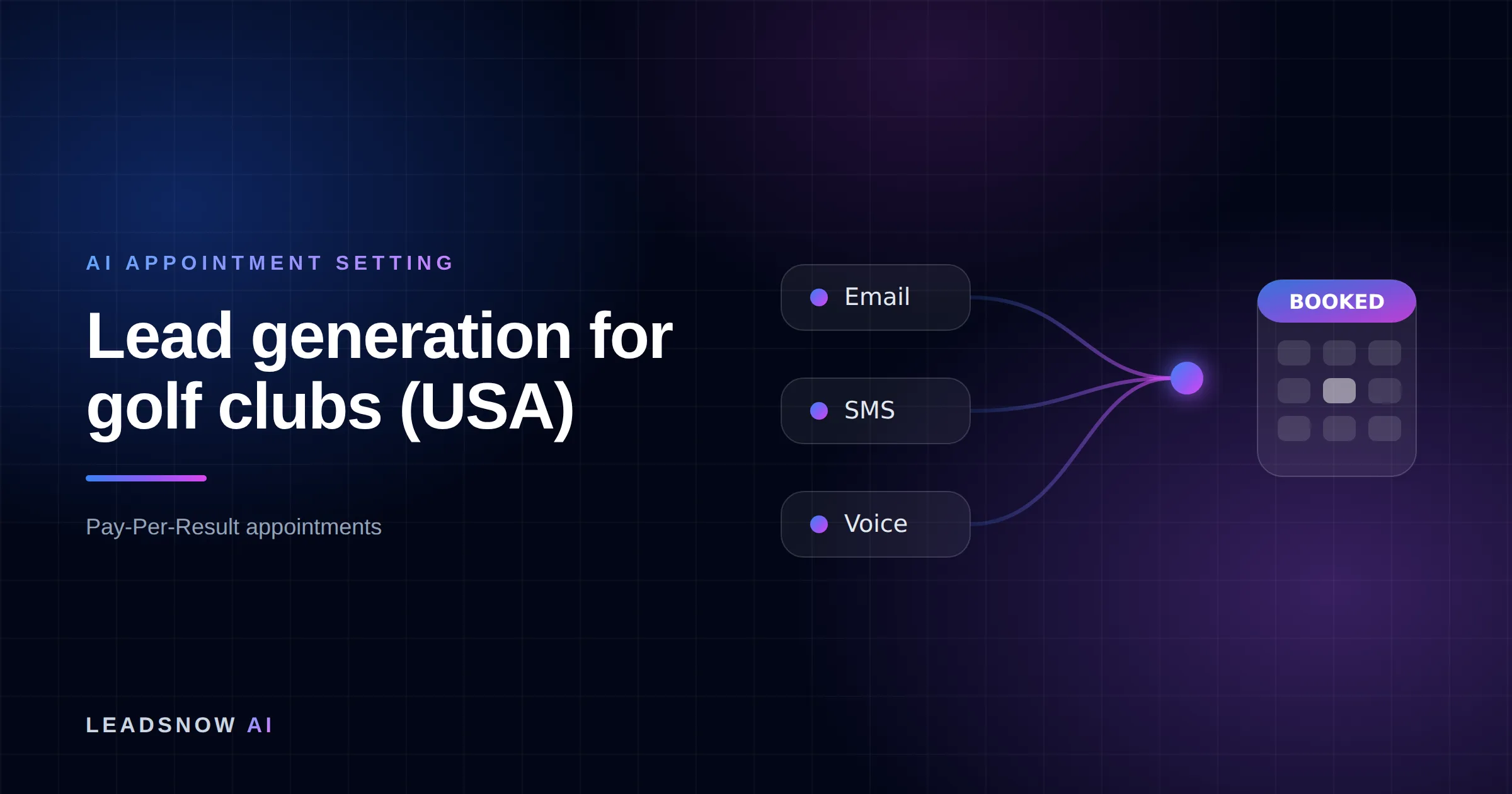
Lead generation for US golf clubs means booking membership tours and director calls, not buying clicks. The National Golf Foundation counts about 14,000 US golf facilities, three-quarters open to the public, and fewer than 8% of golfers are private-club members. A 770-member club at the CMAA median attrition of 4.3% must sign about 33 members a year to stand still.
At a glance
- Who it is for: private and semi-private clubs selling memberships, daily-fee courses selling annual passes, and the management companies that run portfolios of both.
- The sales motion: enquiry → call → tour or playing visit → application, sponsor or proposal → approval and joining. The lead is the first step of five.
- The market: NGF reports 29.1 million Americans played on a golf course in 2025, and 21.2 million non-golfers said they were “very interested” in playing, almost half of them lapsed golfers.
- The asset: the Portfolio Join Model below. A 12-club portfolio on labelled assumptions needs about 35 joins a month just to replace leavers, and 176 to 352 enquiries a month to get them.
- The rules: the FCC confirmed in 2024 that AI-generated voices count as “artificial” under the TCPA, and CAN-SPAM covers every promotional email, business-to-business included.
Who is lead generation for golf clubs in the US for?
Lead generation for a US golf club suits a club that has empty membership capacity and an enquiry flow nobody follows up fast enough. The National Golf Foundation (NGF) says roughly 2,600 municipal and 7,600 daily-fee facilities make up about three-quarters of US supply, and that private-club golfers, though under 8% of all golfers, have risen almost 50% since 2019.
- Private clubs with open categories (young executive, corporate, non-resident, social) or a full category that still loses members every year.
- Semi-private clubs whose best prospects are repeat public golfers already in the tee sheet.
- Daily-fee courses selling annual passes, leagues and outings, where the pass is a recurring product.
- Management companies that need the same pipeline across many clubs, covered in its own section below.
It is not for a club with a waiting list in every category. NGF notes that rosters and waiting lists at many popular private clubs have swelled, citing operator and anecdotal feedback. More enquiries into a full club produce people you have to turn away.
How it works
How a US golf club turns enquiries into members
Gather the warm lists
Repeat public golfers, former members, outing organisers and guests, each with a consent record.
Talk the same day
Reach every enquiry by call, text or DM while interest is fresh, including evenings and weekends.
Book the tour
Qualify category fit and timing, then book a tour or director call with a date agreed.
Club closes the join
The membership director runs the tour, application and committee approval.
MAKE MORE SALES.
Pay-Per-Result pricing — We scale sales HARD aligned to your interests, better than anyone else.
How does a US golf club membership sale actually work?
A US golf club membership is sold in five stages, and most leakage happens between the first two. The enquiry is cheap; the conversation that follows it is what the club is short of.
| Stage | What happens | Who owns it | Where it leaks |
|---|---|---|---|
| 1. Enquiry | Web form, call, guest visit, repeat tee-time booking | Front desk, website, pro shop | Arrives evenings and weekends when the office is closed |
| 2. First conversation | Category fit, playing pattern, family, timing | Membership director | No callback within the day; voicemail only |
| 3. Tour or playing visit | Course, clubhouse, a round with a member or the director | Director, golf professional | Not booked on the first call; no reminder |
| 4. Application or proposal | Sponsor letters, initiation and dues options, family visit | Director, sponsoring members | Proposal sent, then silence |
| 5. Approval and joining | Membership committee or board, payment | Committee, general manager | Long gaps between meetings |
The weekly numbers behind stages two to four are in our guide to selling country club memberships week by week, and the cost of a slow stage two is in how fast a club should answer a membership enquiry.
Want this done for you? We book qualified sales appointments on a Pay-Per-Result basis — you only pay for calls that actually land in your calendar.
Worked example: how many joins does a golf club portfolio need?
A portfolio’s join target is the sum of each club’s members multiplied by its attrition. Only the 4.3% attrition rate below is published, and it is the median for golf and country clubs, not private clubs alone (CMAA 2022 Finance and Operations Report, 2021 data, 440 clubs); the club mix, the other attrition rates and the enquiry-to-join rates are assumptions to replace with your own. We know of no published US club enquiry-to-join rate with a disclosed method.
| Club type in portfolio | Clubs | Members or pass holders each | Annual attrition | Joins a year to stand still |
|---|---|---|---|---|
| Private | 4 | 650 | 4.3% (CMAA golf and country club median) | 111.8 |
| Semi-private | 5 | 400 | 8% (assumption) | 160.0 |
| Daily-fee with annual pass | 3 | 250 | 20% (assumption) | 150.0 |
| Portfolio total | 12 | 5,350 | 7.9% blended | 421.8 (35.2 a month) |
At an assumed 10%, 15% or 20% of enquiries becoming joins, those 421.8 joins need 4,218, 2,812 or 2,109 enquiries a year: about 352, 234 or 176 a month across the portfolio. One private club in the model needs only 28 joins a year, about 2.3 a month, which is why a single club rarely staffs a full-time follow-up team and a portfolio can. At the CMAA median full family dues of US$8,850, the private clubs’ 111.8 replacement joins protect about US$989,000 a year in dues alone.
Why management companies make golf lead generation a multi-location sale
In the US, many clubs are run by companies that operate dozens or hundreds of properties, so the buyer of lead generation is often a regional or central team rather than one general manager. Troon describes itself as the world’s largest golf and golf-related hospitality management company, grown from one facility in 1990; its private-club management page says a club it manages becomes part of a network of 145+ private and 190+ daily-fee and resort courses for members to use when travelling. Invited Clubs, which its own history page says was ClubCorp until a 2022 rebrand, describes itself as the largest owner and operator of private clubs in North America, with more than 140 properties.
That changes three things about the work:
- The scorecard is a portfolio. Joins, tours and cost per join are compared club by club, so the reporting must be identical at every site.
- Reciprocal access is part of the offer. A network membership sells differently from a single-course one, and the first conversation has to explain it accurately.
- Approval runs centrally. Contracts, consent records and brand rules are set once and applied everywhere, which lengthens the start but shortens every club after the first.
Neither company is a LeadsNow client; we name them to describe how the US market is organised, using only what their own sites say.
If we can’t make you money, we don’t deserve yours.
Pay-Per-Result pricing — performance-based alignment.
Where do US golf club members come from?
New US golf club members come mostly from people who already play near the club. NGF counts 29.1 million on-course golfers in 2025 and 21.2 million “very interested” non-players, almost half of them lapsed golfers. For a single club, four lists matter more than any advert:
- Repeat public golfers in the tee sheet. Our comparison of lead generation agencies for US golf clubs sets out the Repeat-Golfer Ratio for deciding whether that list is enough.
- Former members, sorted by why they left: see how to win back lapsed club members.
- Corporate and outing organisers, who often become corporate members: see how to sell corporate club memberships and how golf clubs fill corporate golf days.
- Guests of members, the warmest list and the one most clubs never contact after the round.
Price affects how many enquiries become joins; published US initiation fees and structures are compared in country club initiation fees.
What US rules apply to calling, texting and emailing golfers?
US golf club outreach falls under the Telephone Consumer Protection Act (TCPA) for calls and texts and CAN-SPAM for email. In a February 2024 declaratory ruling, the Federal Communications Commission confirmed that the TCPA’s restrictions on “artificial or prerecorded voice” calls cover current AI technologies that generate human voices. The Federal Trade Commission’s CAN-SPAM guide says the law makes no exception for business-to-business email, opt-outs must be honoured within 10 business days, and each violating email can draw a penalty of up to US$53,088. State rules can add to both. Keep a consent record for every golfer you call or text. This is general information, not legal advice.
How LeadsNow runs lead generation for golf clubs
LeadsNow is a pay-per-result lead generation and appointment-setting agency. For a golf club, the work is stages two and three of the sale: we contact enquiries, repeat golfers and past members by AI calling, SMS and DM follow-up, qualify them, and book a tour or a call with the membership director. The club runs the tour, the application and the approval.
- Pricing: 5–25% of the revenue we generate for you (revenue share), or an equivalent pay-per-appointment fee, or a mix of both. The rate depends on lead volume, what is being sold and its price, the type of club, and which part, or all, of the sales funnel we run.
- Terms: no-shows aren’t charged, there is no retainer, and you can cancel any time with 14 days notice.
- Track record: 50,769+ AI-booked sales appointments since 2017 across our clients.
- The honest gap: we have no published golf club case study. Our club work to date includes a private members club and a global business network; neither is a golf club.
What does running golf club lead generation in-house cost?
Running it yourself needs a list, a phone, a CRM and someone who calls back the same day, including evenings and weekends. For one private club needing 28 joins a year at the mid-band 15% enquiry-to-join rate, that is about 187 enquiries a year to work, most of them several times. The cost is mostly the membership director’s hours, plus consent management for calls and texts. What breaks is coverage: an office staffed weekdays from 9 to 5 is open 40 of the week’s 168 hours. A portfolio can share one team across clubs; a single club usually cannot.
Frequently asked questions
How many golf courses are there in the US?
The National Golf Foundation counts approximately 16,000 golf courses at 14,000 golf facilities in the US at the end of 2025. About three-quarters of courses and facilities are open to the public, including roughly 2,600 municipal and 7,600 daily-fee facilities.
How many golfers are members of private clubs in the US?
Fewer than 8% of US golfers are members at private clubs, according to the National Golf Foundation, which also reports that the number of private-club golfers has risen almost 50% since 2019.
What is a normal member attrition rate for a US golf club?
The CMAA 2022 Finance and Operations Report executive summary gives a median of 4.3% for golf and country clubs, from 2021 data covering 440 responding clubs. At the 770-member average it reports for golf and country clubs, that is about 33 leavers a year.
Can a golf club use AI calls to follow up membership enquiries?
Yes, within the TCPA. The FCC’s February 2024 declaratory ruling confirmed that AI-generated voices are “artificial” voices under the TCPA, so the consent rules for artificial or prerecorded voice calls apply. General information only; take your own compliance advice.
Should a golf club pay per lead or per booked tour?
Per booked tour or conversation, where possible. A lead that never reaches the membership director costs the club time and produces no join. Our comparison of pay-per-result and retainer agencies sets out how each model shares the risk.
Pay-Per-Result appointments
See if we’re a fit
We book qualified sales appointments for you and you pay on results, not retainers. Our booking page asks a few quick questions so you find out in two minutes whether that model suits your business.
- 50,769+ appointments booked without cold calling.
- Pay-Per-Result pricing — you pay for booked, qualified calls.
- Pick your own time on our live calendar, no phone tag.