
Flight school marketing in Australia should be judged per booked admissions call, not per lead. A career student is weighing a CASA commercial pilot licence that needs 150 to 200 hours of aeronautical experience and an aviation diploma with a 2026 VET Student Loan cap of $96,467, so one unanswered enquiry can cost tens of thousands in fees.
- Who this is for: CASA-certified Part 141 and Part 142 flight training operators and pilot academies, including schools at Moorabbin, Bankstown, Archerfield, Jandakot and Parafield.
- The sales motion: enquiry → reply → trial instructional flight or campus visit → funding conversation → enrolment.
- The funding fact that shapes the call: all eight AVI aviation qualifications on the 2026 list, including AVI50222 (Commercial Pilot Licence – Aeroplane), carry a VET Student Loan cap of $96,467 each; international students on temporary visas are not eligible for HELP loans.
- The overnight problem: an enquiry sent at 8pm in Delhi lands at 1:30am in Sydney once daylight saving starts.
- The number to manage: cost per booked admissions call against your own call-to-enrolment rate (the Admissions Call Ceiling, worked below).
Who flight school lead generation in Australia is for
Australian flight schools sell three different products to three different buyers, and a marketing plan that treats them as one audience wastes most of its spend. The licence rules come from Part 61 of the Civil Aviation Safety Regulations, administered by CASA; the funding rules come from the Department of Employment and Workplace Relations and Study Assist.
| Pathway | CASA minimums (aeroplane) | Funding route | What the first call must settle |
|---|---|---|---|
| Recreational (RPL, then PPL) | RPL: aged 16+, at least 25 hours flying, including 20 dual and 5 as pilot in command (CASA) | Self-funded; no VET Student Loan for the licence alone | Weekly availability and budget per lesson |
| Domestic career (CPL diploma) | CPL: aged 18+, trained by a Part 141 or 142 operator, Class 1 medical to attempt the flight test, 150 hours integrated or 200 hours non-integrated (CASA) | VET Student Loan up to $96,467 per approved aviation diploma in 2026 (DEWR course list) | Medical eligibility, loan eligibility, gap fee above the cap |
| International career | Same CASA licence standard | Full fee; temporary visa holders are not eligible for HELP loans (Study Assist) | CRICOS-registered course, visa timing, total cost including living |
The integrated versus non-integrated split matters commercially: CASA describes the Part 142 integrated course as structured and quicker, and the Part 141 non-integrated route as more practical flying over a longer period. A school offering both should ask which one the enquirer wants in the first reply, because it changes the price conversation. International recruitment runs under its own regulatory stack, covered in our guide to CRICOS provider international student recruitment.
How it works
How an Australian flight-school enquiry becomes an enrolment
Answer in minutes, any hour
Reply in writing the moment the enquiry lands, including overnight enquiries from overseas time zones. Calls wait for the permitted calling window.
Sort by pathway
Separate recreational, domestic career and international career enquiries. Each needs a different first conversation.
Settle funding early
Confirm whether the student is self-funding, eligible for a VET Student Loan, or an international full-fee student before the trial flight.
Book the admissions call
Put qualified students into an admissions call or trial instructional flight with a named instructor and a date.
MAKE MORE SALES.
Pay-Per-Result pricing — We scale sales HARD aligned to your interests, better than anyone else.
How a flight-school enquiry becomes an enrolment
The path from enquiry to enrolment at an Australian flight school has five stages, and each one leaks. The enquiry arrives; someone replies; the prospect books a trial instructional flight or visits; the school has a funding and pathway conversation; the student enrols and pays a deposit or signs a loan form.
The first leak is the reply. Harvard Business Review’s audit of 2,241 US companies found 37% replied to a web lead within an hour, 24% took more than 24 hours and 23% never replied; among those that replied within 30 days, the average was 42 hours. That is US data across industries, not flight schools, but nothing suggests aviation is faster. Right Rudder Marketing, a US flight-school agency, says prospects fill in three schools’ forms in one sitting and the first school to respond usually gets the discovery flight. That is the agency’s claim, not a measured Australian figure.
The second leak is after the trial flight. The same Right Rudder page says on average only 20–40% of discovery flights convert to enrolment; again an agency figure with no published sample. No Australian body publishes a trial-flight-to-enrolment rate, so the only reliable benchmark is your own, measured per pathway.
Want this done for you? We book qualified sales appointments on a Pay-Per-Result basis — you only pay for calls that actually land in your calendar.
Why international enquiries arrive while the school is asleep
An Australian flight school recruiting from India or South-East Asia receives a large share of those enquiries outside its own office hours, because the prospect writes in their evening. The arithmetic below uses standard time-zone offsets; New South Wales and Victoria move to daylight saving time (UTC+11) from the first Sunday in October, Western Australia does not.
| Enquiry sent at | Sydney / Melbourne (AEDT, UTC+11) | Perth (AWST, UTC+8) |
|---|---|---|
| 8pm, New Delhi (UTC+5:30) | 1:30am next day | 10:30pm |
| 10pm, New Delhi | 3:30am next day | 12:30am next day |
| 8pm, Singapore (UTC+8) | 11pm | 8pm |
The written reply can go out at any hour; the phone call cannot. The ACMA lists telemarketing calling hours as 9am–8pm on weekdays and 9am–5pm on Saturdays, with no calls on Sundays or national public holidays. A workable design is an instant written reply with a booking link, then a call inside the permitted window. If your overseas enquiry volume has already fallen, separate policy from pipeline first with our test for why international student enquiries dropped.
What one booked admissions call is worth to an Australian flight school
The Admissions Call Ceiling is the most a flight school can pay to put one qualified prospect into an admissions call: course fee × call-to-enrolment rate × the share of fee you will spend to win a student. The inputs below are assumptions for illustration. Replace each one with your own numbers.
Assume a $90,000 integrated CPL diploma (an assumption, just under the 2026 VET Student Loan cap of $96,467) and an acquisition budget of 5% of the course fee per student ($4,500).
| Call-to-enrolment rate (assumption) | Ceiling per booked call | Booked calls needed for 10 career starts |
|---|---|---|
| 15% | $675 | 67 |
| 25% | $1,125 | 40 |
| 35% | $1,575 | 29 |
Two things follow. A school converting 15% of admissions calls can afford barely 43% of what a school converting 35% can, so improving the call itself raises the price you can pay for every lead. And the ceiling only applies to career enquiries: a recreational RPL enquiry is worth a fraction of it, so mixing the two in one cost-per-lead figure hides the number that matters. Our cost per enrolment call benchmarks for Australian education set the same calculation against other course types.
If we can’t make you money, we don’t deserve yours.
Pay-Per-Result pricing — performance-based alignment.
When to run flight-school lead generation in-house, and when to hand it over
| Your situation | Run it in-house | Hand it over |
|---|---|---|
| Enquiry volume | Fewer than about 10 a week, all domestic | Above that, or a steady overseas share |
| Reply time | Someone can reply within 5 minutes, 7 days | Replies wait for the next office day |
| Past trial-flight customers who never enrolled | Under about 200 records: call them yourself | Several hundred or more, untouched for 6+ months |
| Who runs the funding conversation | A chief or senior instructor with time for it | Instructors are flying all day |
The thresholds are rules of thumb, not measurements. Running it in-house honestly costs a rota that covers the 123 hours a week a weekday 9-to-6 office leaves unattended, a booking calendar the prospect can use without a phone call, and someone who knows the CASA pathways well enough to answer medical and loan questions. The 5-minute rule for speed to lead explains why the reply-time row is the one to fix first.
How LeadsNow runs lead generation for flight schools
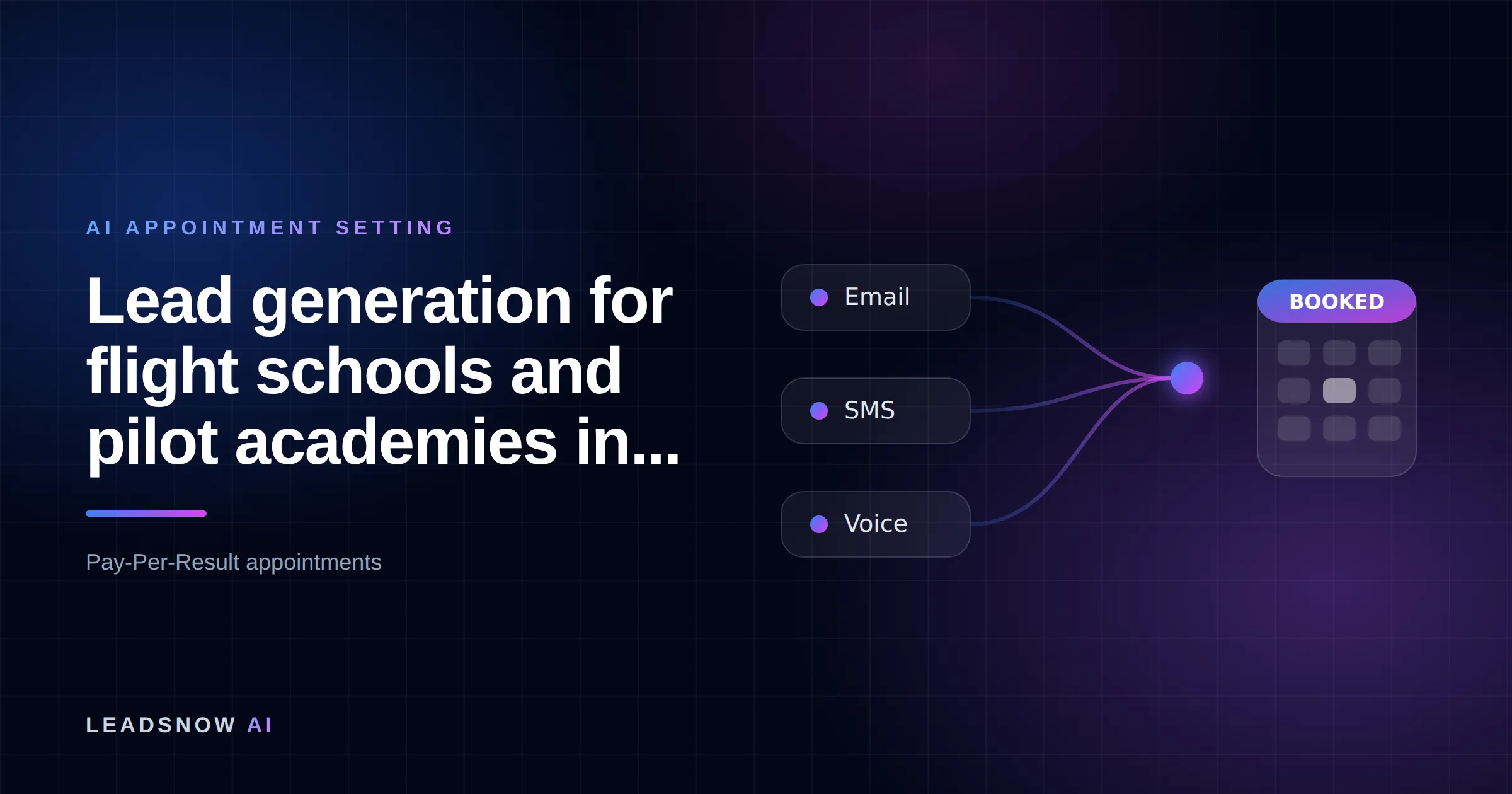
LeadsNow runs AI appointment setting as part of its lead generation for education companies: an AI agent replies to each enquiry by SMS, email or voice within seconds, at any hour, and qualifies it against rules the school sets, such as pathway, age, medical, funding route and intake date. It then books qualified prospects into the school’s admissions calendar or trial-flight schedule. Calls are held for permitted hours; written replies are not.
LeadsNow has delivered 50,769+ AI-booked appointments since 2017 and generated 1M+ leads across all its clients; we have no flight-school case study to publish. Appointment show rate varies by offer and reminder cadence — up to 93% on our best-performing accounts. The school still owns the trial flight, the instructor’s debrief and the enrolment decision. Pricing is $50–$750 per appointment and/or a 5–25% sales commission, depending on volume, the work required, the type of business and lead, which part (or all) of the sales funnel we run, and where the gaps are. Universities and higher-education providers use the same model, described on our higher education lead generation page.
Frequently asked questions
How much does pilot training cost in Australia?
It depends on the school, the aircraft and the pathway, and each school publishes its own fees. The government reference point is the VET Student Loan cap: the 2026 course list sets a maximum loan of $96,467 for the Diploma of Aviation (Commercial Pilot Licence – Aeroplane), AVI50222. Any fee above the cap is not covered by that loan.
Can international students get a VET Student Loan for flight training?
No. Study Assist states that temporary visa holders and other international students are not eligible for a HELP loan and are enrolled in a full fee-paying place. Your sales conversation with an overseas student is therefore about total cost and visa timing, not loan eligibility.
What does CASA require for a commercial pilot licence?
According to CASA, you must be at least 18, train with a Part 141 or Part 142 operator, pass the theory exams and flight test, and hold a Class 1 medical certificate to attempt the flight test. An aeroplane CPL needs 150 hours of aeronautical experience on an integrated course or 200 hours on a non-integrated one.
How is lead generation for a flight school priced?
LeadsNow charges $50–$750 per appointment and/or a 5–25% sales commission, depending on volume, the work required, the type of business and lead, which part (or all) of the sales funnel we run, and where the gaps are. Before comparing any provider, work out your own Admissions Call Ceiling (course fee × call-to-enrolment rate × acquisition share) so you know the most a booked call is worth to you.
Pay-Per-Result appointments
See if we’re a fit
We book qualified sales appointments for you and you pay on results, not retainers. Our booking page asks a few quick questions so you find out in two minutes whether that model suits your business.
- 50,769+ appointments booked without cold calling.
- Pay-Per-Result pricing — you pay for booked, qualified calls.
- Pick your own time on our live calendar, no phone tag.