
CRICOS providers recruiting international students operate under the ESOS Act 2000 and the National Code 2018, whose Standard 1 requires marketing to carry the provider’s CRICOS number and be free of misleading claims. The 2026 National Planning Level is 295,000 places, and visa processing priority now runs off each provider’s progress against its own allocation, not raw demand.
The short answer: international student recruitment is not domestic lead generation with a visa attached. It runs inside a named regulatory stack — ESOS Act, National Code 2018, CRICOS, ASQA or TEQSA, and a Ministerial Direction that reprioritises visa processing by provider — and the commercial target shifts from cost per lead to cost per commencement.
The regulatory stack, named
Five things govern how a CRICOS provider can recruit, and an agency that has not read all five will get your marketing wrong.
The Education Services for Overseas Students Act 2000 (ESOS Act) is the primary legislation. It sets up the whole framework — provider registration, tuition protection, and the standards regime — and is administered by the Department of Education. Sitting under it is the National Code of Practice for Providers of Education and Training to Overseas Students 2018, the legislative instrument that actually sets out what a registered provider must do, standard by standard, from marketing through to complaints handling. CRICOS — the Commonwealth Register of Institutions and Courses for Overseas Students, published at cricos.education.gov.au — is the public register both instruments feed: only institutions and courses listed there can enrol a student visa holder.
Two separate regulators police compliance depending on sector. TEQSA is the ESOS agency for registered higher education providers and for ELICOS courses delivered by or in entry arrangements with a higher education provider. ASQA is the ESOS agency for the VET sector — RTOs and standalone ELICOS providers not attached to a higher education provider. The Department of Education administers the ESOS Act, CRICOS and PRISMS — the system providers use for confirmations of enrolment and agent records. If your marketing team cannot say which of the two regulates your registration, that is worth fixing before the next campaign brief.
How it works
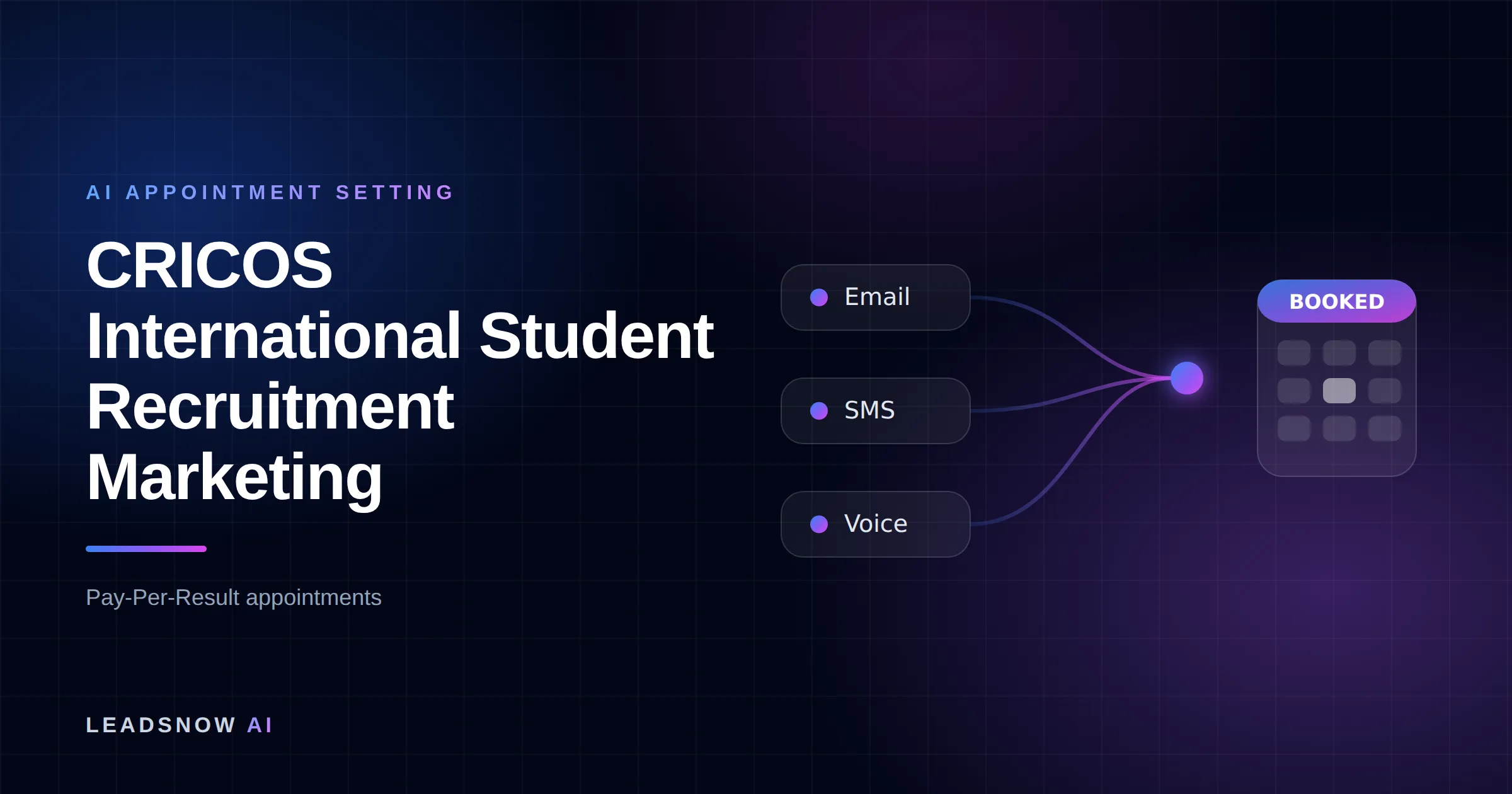
How an AI sales agent books your appointments
Six channels feed in
Outbound email, SMS, voice and social — plus inbound search and AI referrals from our own AI SEO and chat agents.
Your list or CRM
Outbound starts from data you already own — past enquiries, dormant customers, or a targeted prospect list.
Qualified against your rules
Budget, timing and fit are checked before anything reaches your team, using criteria you set.
Booked into your calendar
Only qualified prospects reach the booking step, so your closers spend their time selling.
MAKE MORE SALES.
Pay-Per-Result pricing — We scale sales HARD aligned to your interests, better than anyone else.
What Standard 1 actually requires of your marketing
Standard 1 of the National Code 2018, Marketing information and practices, is short and specific. Clause 1.1 requires that marketing and promotion of courses to overseas or intending overseas students — including through an education agent — is not false or misleading and is consistent with Australian Consumer Law. Clause 1.2 rules out false or misleading claims about a provider’s association with other institutions, work-based training requirements, entry prerequisites including English proficiency, and outcomes. Clause 1.3 is blunt: a provider must not claim to secure a migration outcome for a student, and must not guarantee a successful assessment outcome. Clause 1.4 requires the provider’s registered name and CRICOS registration number in any written or online material offering, inviting applications for, or advertising availability of a course to overseas students — landing pages and paid ads included.
Course codes are a separate obligation, one worth not confusing with Standard 1. Standard 2.1.2 requires the CRICOS course code, content, mode of study and assessment methods to be given to a prospective student before enrolment, as comprehensive, current, plain-English information — it is a pre-enrolment disclosure requirement, not a blanket ad-copy rule. In practice most compliant providers put both the provider CRICOS number and the relevant course code on recruitment landing pages anyway, because it is cheap insurance and it is what a genuinely informed applicant expects to see.
Education agents carry their own standard. Standard 4.1 requires a written agreement with every education agent a provider engages, plus entry and maintenance of the agent’s details in PRISMS. Standard 4.2 sets out what that agreement has to cover, including that the provider — not the agent — remains responsible at all times for ESOS Act and National Code compliance, and the provider’s process for monitoring the agent and correcting or terminating the relationship if things go wrong. Standard 4.3 requires the provider to make its agents declare conflicts of interest in writing, act honestly and in the students’ best interests, and understand the Australian international education system, including the Australian International Education and Training Agent Code of Ethics. None of that liability transfers away from the provider. If your agent misrepresents a course, the National Code holds you, not them.
Want this done for you? We book qualified sales appointments on a Pay-Per-Result basis — you only pay for calls that actually land in your calendar.
The 2026 policy environment — and why it keeps moving
This is the part that dates fastest, so treat everything below as current as of 1 September 2026 and re-check before you act on it.
The Government set a National Planning Level of 295,000 for 2026, 25,000 places higher than 2025. It is not a hard cap on total enrolments; it is a prioritisation mechanism. No active provider received a 2026 indicative allocation lower than its 2025 allocation, and public universities could apply for additional growth places tied to two government priorities: deeper engagement with Southeast Asia and delivery of student accommodation.
Ministerial Direction 115 replaced Ministerial Direction 111 for offshore Subclass 500 visa applications lodged on or after 14 November 2025. Under MD115, visa processing runs on three tiers instead of MD111’s two: Priority 1 for providers who have not yet reached their prioritisation threshold, Priority 2 once a provider passes 80 per cent of its New Overseas Student Commencement allocation, and Priority 3 once a provider exceeds its allocation by 15 per cent. The Department of Home Affairs’ target processing start times are 1–4 weeks for Priority 1, 5–8 weeks for Priority 2, and 9–12 weeks for Priority 3 — based on 2025 lodgement volumes and explicitly subject to change. In the announcement, the Assistant Minister for International Education noted student visa lodgements were down over 26 per cent and commencements down 16 per cent year-on-year through 2025 — the managed-growth policy working as designed, from the Government’s perspective.
Separately, and specific to the VET sector, ASQA suspended new CRICOS applications from private VET and standalone ELICOS providers from 19 May 2026 for 12 months, to 19 May 2027 — both new provider registrations and new course additions to existing registrations. It does not touch publicly funded providers, and it does not touch a provider’s existing registered courses or its ability to recruit against its current CRICOS scope. If you are already a registered CRICOS provider recruiting against your existing course list, the suspension is background noise, not a constraint on you. If you were planning to add a new course to CRICOS this year, it now sits in a 12-month queue with narrow exemptions.
The throughline across all three changes: the constraint has moved from raw application volume to provider-level throughput against an allocation. A provider sitting at 60 per cent of its 2026 allocation gets faster visa processing for every new applicant than one sitting at 90 per cent. That changes what marketing is actually for.
From cost per lead to cost per commencement
When application volume was the constraint, the marketing brief was simple: generate more applications, as cheaply as possible, and let admissions sort the good from the bad. That brief is now actively counterproductive for a provider close to its threshold. Every additional application that does not convert to a granted visa and a started enrolment is dead weight against an allocation that determines how fast your next hundred applicants get processed.
The metric that matters is cost per commencement, not cost per lead — and it is worth reading our cost-per-enrolment benchmarks for RTOs alongside this if you want the domestic-market comparison. Three things move that number for international recruitment specifically, and none of them are things a generalist marketing agency is built to do well:
- Speed to contact across time zones. A prospective student in Ho Chi Minh City or Bogotá who submits an enquiry at 9pm their time and hears nothing until your admissions team opens at 9am Melbourne time has usually enquired somewhere else by then. Genuine 24-hour response, not a queued autoresponder, is a conversion lever most providers are not pulling.
- Qualification before an agent’s time is spent. Course-eligibility screening — English proficiency band, academic prerequisites, funds evidence, intake timing — before a human touches the enquiry means your admissions and compliance staff spend their hours on applicants who can actually get a CoE and a visa, not on volume that looks good in a weekly report.
- Multilingual follow-up at the hours your domestic team does not cover. Nurture sequences that run in the applicant’s language and time zone, consistently, are where most manual follow-up processes quietly fail.
This is the exact gap AI voice, SMS and chat agents are built to close — always-on speed to contact, consistent qualification against your actual course-eligibility criteria, and follow-up that does not depend on a staff member’s shift roster. It does not replace your admissions team or your compliance obligations under Standard 1 and Standard 4; it removes the volume of unqualified, poorly timed contact that makes those obligations harder to meet cleanly.
If we can’t make you money, we don’t deserve yours.
Pay-Per-Result pricing — performance-based alignment.
Agent networks vs. direct recruitment
Most established CRICOS providers already run agent networks, and the honest position is that agents remain close to irreplaceable in some source markets — local trust, local language, local knowledge of what a family needs to hear before it commits a child to studying abroad. In other markets, particularly ones you already have brand recognition in, agent commissions are an expensive and comparatively opaque way to generate an enquiry you could reach directly. The two are not mutually exclusive; direct digital recruitment is the hedge against over-reliance on any one channel or any one agent’s conduct.
| Channel | Typical cost structure | Control over quality | Compliance exposure | Speed to contact |
|---|---|---|---|---|
| Education agent networks | Commission per enrolment, often 10–20% of first-year tuition | Indirect — depends on the agent’s own recruitment practices | Provider remains liable under Standard 4.2.1 for agent conduct at all times | Variable — depends entirely on agent responsiveness |
| Direct digital recruitment (unmanaged) | Media spend plus admissions headcount | Direct, but only as good as follow-up discipline | Standard 1 applies to every asset; easy to drift without a compliance review process | Limited by staff hours and time zone coverage |
| Direct digital recruitment with AI-qualified follow-up | Media spend plus a pay-per-result agency fee | Direct, with consistent qualification criteria applied every time | Standard 1 still applies; consistent process makes it easier to demonstrate compliance | 24-hour, across time zones, in the applicant’s own hours |
What we bring to this
LeadsNow AI has generated 1M+ leads and booked 50,769+ AI-driven sales appointments since 2017, across 25 filmed client case studies, with a 4.7 rating from 60 Google and Facebook reviews. Our clients include Lambda Academy, an education-sector provider, alongside names like Colliers and 121 Brokers in other verticals. We do not publish a phone number for a reason — every enquiry into our own book runs through the same AI voice, SMS and chat qualification we build for clients, so we experience the model we sell.
If you also recruit domestically, our RTO lead generation page and our page on ASQA-compliant marketing for RTOs cover that ground without repeating the international-specific material here. And if international recruitment is one of several education verticals you operate in, our education companies hub is the wider index.
We do not claim to replace your compliance function or your agent relationships. What we replace is the gap between when a genuinely eligible student enquires and when a qualified human first speaks to them — a gap that, under a threshold-based visa system, now costs providers processing priority as well as enrolments.
Frequently asked questions
What is CRICOS and who has to register on it?
CRICOS — the Commonwealth Register of Institutions and Courses for Overseas Students — is the public register of every Australian institution and course approved to enrol student visa holders. Any provider delivering a course to an overseas student in Australia must be registered under the ESOS Act and listed on CRICOS, administered by the Department of Education.
What does the National Code 2018 say about marketing to international students?
Standard 1 of the National Code 2018 requires that marketing not be false or misleading, prohibits claiming to guarantee a migration or assessment outcome, and requires the provider’s registered name and CRICOS number on any written or online recruitment material.
Do I need to put the CRICOS course code in every ad?
Not under Standard 1 — that clause only requires the provider name and CRICOS registration number in marketing material. The course code is a pre-enrolment disclosure requirement under Standard 2.1.2, meaning it must reach the student with comprehensive course information before they enrol, not necessarily in every piece of ad creative.
What changed with Ministerial Direction 115?
MD115 replaced MD111 for offshore Subclass 500 applications lodged from 14 November 2025, moving from two visa processing priority tiers to three, based on each provider’s progress against its indicative allocation under the 2026 National Planning Level. It is a processing-order mechanism, not a cap on individual visa grants.
Is ASQA still accepting new CRICOS applications in 2026?
Not for new private VET or standalone ELICOS provider registrations, or new course additions, between 19 May 2026 and 19 May 2027 — confirmed on ASQA’s suspension notice. Existing registered providers recruiting against their current CRICOS scope are unaffected, as are publicly funded institutions.
What is the difference between ASQA and TEQSA for international student recruitment?
TEQSA is the ESOS regulator for higher education providers and for ELICOS courses tied to a higher education provider. ASQA is the ESOS regulator for the VET sector and standalone ELICOS providers. Both sit under the Department of Education for the wider ESOS framework.
Do I need a written agreement with every education agent I use?
Yes. Standard 4.1 of the National Code 2018 requires a written agreement with every education agent a provider engages to represent it, and requires the agent’s details to be entered and maintained in PRISMS. The provider remains responsible for ESOS Act and National Code compliance regardless of what the agreement says.
Pay-Per-Result appointments
See if we’re a fit
We book qualified sales appointments for you and you pay on results, not retainers. Our booking page asks a few quick questions so you find out in two minutes whether that model suits your business.
- 50,769+ appointments booked without cold calling.
- Pay-Per-Result pricing — you pay for booked, qualified calls.
- Pick your own time on our live calendar, no phone tag.