
Most Australian granny flat builders grow the same way the rest of the trades do: a hipages subscription, a trickle of shared enquiries, and a sales pipeline that lives in the ute console. In 2026 that’s an expensive habit — platform subscriptions run $139–$649 a month before GST, reported per-lead costs run anywhere from 42 to 120 credits, and every one of those leads goes to up to three competing businesses. Meanwhile the secondary-dwelling market itself has never been hotter, with NSW, Victoria and Queensland all loosening the rules that used to kill granny flat projects at the approval stage. This guide breaks down what granny flat builder leads actually cost in Australia right now, why the boom makes speed-to-lead matter more than ever, and how pay-per-result appointment setting flips the risk. It’s written by LeadsNow AI, the Melbourne team behind 50,769+ AI-booked sales appointments since 2017 and 1M+ leads generated.
Granny flat builder lead generation in Australia, at a glance (2026): There’s no published market rate for granny-flat-specific leads, so most builders buy through general trade platforms — hipages plans run $139–$649/month plus GST with 155–810 monthly credits, and reviewers report per-lead costs anywhere from 42 to 120 credits, per KingTradie’s July 2026 hipages review — with each lead capped at three competing businesses. The prize is worth chasing properly: a two-bedroom granny flat is a $95,000–$120,000 build per Granny Flat Prices’ 2026 guide. The alternative to buying shared enquiries is pay-per-result appointment setting: you pay only when a qualified prospect is booked into your calendar — not for raw enquiries you still have to chase.
Why granny flat demand is booming — and why that cuts both ways
Three planning shifts have turned the secondary dwelling from a niche product into one of the busiest corners of Australian residential building:
- NSW: secondary dwellings can be approved through a development application or a complying development certificate under the Housing SEPP, per the NSW Department of Planning’s secondary dwellings page — and Granny Flat Solutions’ state-by-state guide notes the CDC route can take up to 20 days on lots of 450m² or more.
- Victoria: per the same state-by-state guide, homeowners no longer need a planning permit for a small second home under 60m² on a lot of at least 300m² with no overlays — and where the older rules restricted occupancy to relatives, the dwelling can now be rented out.
- Queensland: rental income from a secondary dwelling can now come from anyone, not just a family member, with size allowances varying by council — Brisbane permits granny flats up to 80m² while neighbouring Ipswich caps them at 50m².
The rental-side maths is what’s pulling homeowners in. Granny Flat Prices’ 2026 guide puts metro rent for a two-bedroom granny flat at $480–$580 a week against a $95,000–$120,000 build, and claims gross yields of 17–28% are typical. Whatever discount you apply to a kit-seller’s yield claims, the direction is clear: more homeowners want a secondary dwelling, more of them are allowed to build one, and more builders are fighting for the same enquiries. A boom doesn’t hand you jobs. It hands you competitors.
How it works
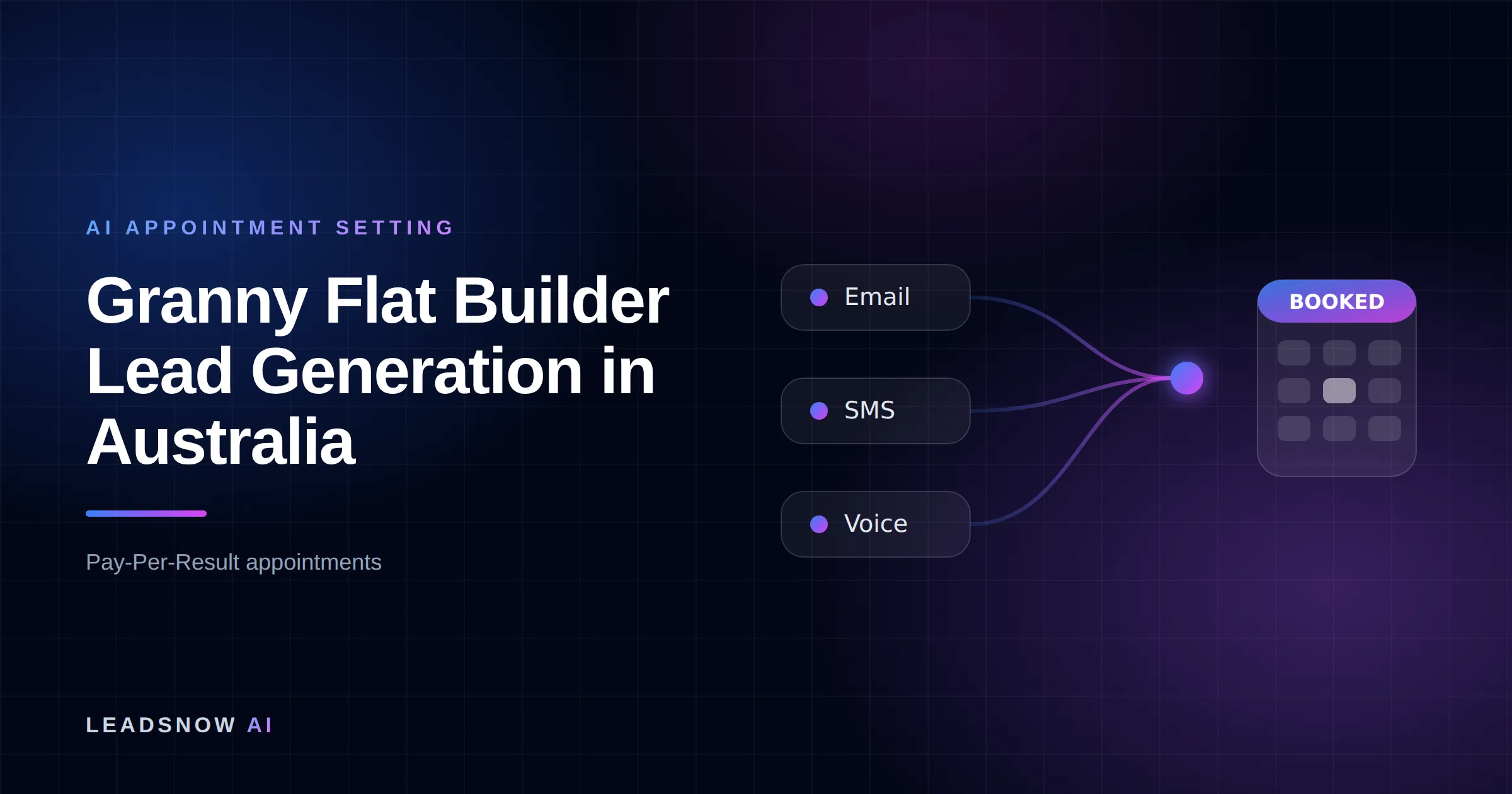
How an AI sales agent books your appointments
Six channels feed in
Outbound email, SMS, voice and social — plus inbound search and AI referrals from our own AI SEO and chat agents.
Your list or CRM
Outbound starts from data you already own — past enquiries, dormant customers, or a targeted prospect list.
Qualified against your rules
Budget, timing and fit are checked before anything reaches your team, using criteria you set.
Booked into your calendar
Only qualified prospects reach the booking step, so your closers spend their time selling.
MAKE MORE SALES.
Pay-Per-Result pricing — We scale sales HARD aligned to your interests, better than anyone else.
What granny flat builder leads cost in Australia in 2026
Here’s the awkward truth we’d rather tell you than paper over: nobody publishes a per-lead price for granny flat enquiries specifically. What granny flat builders actually pay is the general tradie-platform rate, and that’s well documented:
- Subscription first, leads second. hipages runs four plans — Starter at $139, Advanced at $249, Premium at $449 and Platinum at $649 per month plus GST — with monthly credit allowances from 155 to 810 that you spend accepting leads, per KingTradie’s July 2026 review.
- Credits per lead are volatile. hipages doesn’t publish a fixed price per lead. KingTradie cites a ProductReview.com.au reviewer (July 2026) reporting their average lead climbing from 42 to 75 credits, with a single lead running anywhere from 75 to 120 credits. On a Starter plan’s 155 credits, that can mean a month’s subscription buys two or three leads.
- You’re never alone. Per the same review, every hipages lead is capped at three businesses — so up to three builders pay to quote the same job, and only one of them can win it.
Honesty box: You’ll hear granny flat leads quoted at anywhere from $40 to $150+ from private lead vendors and Facebook-ads agencies. We could not verify any published granny-flat-specific per-lead rate at a source we’d cite, so treat those numbers as unverified industry folklore — and treat any vendor quoting a firm “market rate” for granny flat leads with the same scepticism.
Per-lead price is the wrong number anyway
A granny flat is a considered, six-figure purchase with a long research phase. The enquiry that costs you 80 credits isn’t a job — it’s a maybe, often one of three builders’ maybes, from a homeowner who may still be working out whether their block even qualifies. The number that matters is cost per signed contract: leads accepted, divided into jobs won, with your estimator’s site-visit hours and your own chase time priced in. On a $110,000 average contract, losing one winnable job a month to a faster competitor costs you more than any lead platform ever will.
Want this done for you? We book qualified sales appointments on a Pay-Per-Result basis — you only pay for calls that actually land in your calendar.
Why buying leads keeps disappointing granny flat builders
- The shared-lead race. When three builders get the same enquiry, the site visit usually goes to whoever calls first. If you’re on the tools until 4pm, you’re quoting against someone who rang at 9:05am.
- You pay for enquiries, not outcomes. A “lead” can be a homeowner pricing a dream two years out, a block that fails the lot-size test, or a tyre-kicker collecting quotes to negotiate with a builder they’ve already chosen. You’ve spent the credits either way.
- Long sales cycles punish weak follow-up. Granny flat buyers compare designs, check council rules and talk to the bank. An enquiry that isn’t nurtured across weeks of touches quietly signs with whoever stayed in contact. Most builders don’t have anyone whose actual job is chasing.
Running your own ads fixes exclusivity but not the rest: you carry the ad spend, the creative testing and the follow-up workload yourself, and you pay whether or not anything converts.
Comparison: four ways granny flat builders buy growth in 2026
| Shared platform leads | Exclusive bought leads | Your own ads | Pay-per-result appointments | |
|---|---|---|---|---|
| What you pay for | Subscription + credits per contact record (hipages: $139–$649/mo + GST, leads 42–120 credits) | A higher per-lead fee for an unshared contact record | Impressions and clicks, win or lose | A qualified prospect booked on your calendar |
| Who else gets the lead | Up to 3 competing builders | Only you (in theory) | Only you | Only you |
| Who does the chasing | You | You | You | The provider — multi-touch AI follow-up until booked or disqualified |
| No-show / dud risk | You carry it — credits are spent regardless | You carry it — exclusive ≠ qualified | You carry it entirely | Provider carries it — you pay for the booked result |
| Cost per signed job logic | Leads ÷ low win rate in a 3-way race, + chase time | Fewer competitors, same follow-up burden | Ad spend ÷ whatever converts, + your time | Appointments ÷ your close rate — the only inputs are qualified meetings |
If we can’t make you money, we don’t deserve yours.
Pay-Per-Result pricing — performance-based alignment.
The dead-quote goldmine: granny flats you quoted but never built
If you’ve been building for a few years, you’re sitting on the best lead source in this article and it’s already paid for: every homeowner you quoted who never signed. Granny flat quotes die for reasons that expire — the bank said no in a tighter year, the council rules didn’t allow renting it out, the numbers didn’t stack up at the old rent. Look at what’s changed since many of those quotes were written: Victorian small second homes under 60m² no longer need a planning permit and can be rented out, Queensland secondary dwellings can be let to anyone, and metro granny flat rents are sitting at $480–$580 a week. A quote that died in 2023 can be a live project in 2026 without you changing a thing.
Database reactivation is the discipline of working that list properly: AI-driven SMS and voice outreach across your old quote and enquiry database, conversations revived, and the warm ones booked straight into your calendar. This is LeadsNow’s home turf — our Colliers-era database reactivation campaigns averaged a 4.4% booking rate, peaking at 8.9%. That’s our reactivation track record across client databases, not a granny-flat-specific promise, but the mechanism doesn’t care what was quoted: on a 500-contact dead-quote list, even the average rate is a calendar’s worth of site visits from people who already know your name. We’ve written up how to run a database reactivation campaign, and the done-for-you version lives on our database reactivation services page.
Pay-per-result appointment setting: how it works for granny flat builders
Pay-per-result means LeadsNow runs the campaigns, the AI qualification and the multi-touch follow-up at our own risk — and you pay only when a qualified prospect is booked into your calendar as a sales appointment. Not per click, not per enquiry, not per contact record. For a granny flat builder that changes three things:
- You stop paying for duds. Renters, out-of-area enquiries, undersized blocks and “just pricing the dream” contacts get filtered before they cost you anything. Qualification criteria — homeowner, suburb, block, budget band, timeframe — are agreed with you up front.
- Speed-to-lead is automated. Our AI calls and messages new enquiries within minutes of them coming in, at any hour, then follows up across weeks of touches — exactly the discipline a long, considered purchase like a granny flat rewards. The mechanics are in our guide to speed-to-lead automation in Australia.
- Your closers close. You or your estimator walk into booked appointments with qualified homeowners instead of working a call sheet between site visits.
Be clear-eyed about the trade-off: a booked, qualified appointment costs more than a raw lead, because it should — it has survived qualification and been scheduled. The comparison that matters is cost per signed contract, and on a $100,000+ job the qualification premium is a rounding error against one extra signing a quarter. If you’re weighing the two models in detail, we’ve published a straight comparison of pay-per-lead vs pay-per-appointment pricing in Australia.
Who this is a fit for — and who it isn’t
Good fit: established granny flat and secondary-dwelling builders who can service more site visits than they’re getting; builders with a display, a design range or a signing process ready to take booked meetings; anyone sitting on two or more years of dead quotes — especially quotes written before the recent Victorian and Queensland rule changes.
Not a fit: brand-new builders with no trading history or capacity buffer; teams that want the cheapest possible per-contact number and are happy to do their own dialling — a shared platform lead genuinely is the cheaper line item if your chase time is free to you. We’d rather say that plainly than win a client who churns in eight weeks.
The proof
Since 2017, LeadsNow’s AI systems have booked 50,769+ sales appointments and generated over 1 million leads for clients. We hold a 4.6-star average across 43 Google reviews and have published 25 filmed client case studies — clients on camera, not testimonial graphics. Those case studies span finance, property, fitness and education rather than granny flat building specifically; the mechanics — AI speed-to-lead, qualification, multi-touch follow-up, calendar booking — are industry-agnostic, and we’ll happily walk you through how they map to a secondary-dwelling sales cycle on a call.
FAQ: granny flat builder leads in Australia
How much do granny flat builder leads cost in Australia?
There’s no published granny-flat-specific per-lead rate, so most builders pay general trade-platform prices. Per KingTradie’s July 2026 review, hipages plans run $139–$649 per month plus GST with 155–810 monthly credits, reviewers report per-lead costs of 42–120 credits, and every lead is shared with up to three businesses. Private vendors quote all sorts of per-lead figures for granny flats, but we couldn’t verify any of them at a citable source — judge any lead channel on cost per signed contract, not cost per lead.
Do granny flats still need council approval in NSW, Victoria and Queensland?
It’s easier than it used to be, but the rules are state- and council-specific. In NSW, secondary dwellings can be approved via a development application or a complying development certificate under the Housing SEPP, per the NSW Department of Planning, with the CDC route taking up to 20 days on qualifying lots per Granny Flat Solutions’ state-by-state guide. In Victoria, small second homes under 60m² on lots of at least 300m² with no overlays no longer need a planning permit. In Queensland, building approval is still required and size limits vary by council — Brisbane allows up to 80m², Ipswich caps at 50m².
Why is granny flat demand rising in Australia?
Two forces: planning reform and rental maths. NSW, Victoria and Queensland have all eased approval or occupancy rules — Victoria and Queensland now let owners rent secondary dwellings to anyone, where older rules restricted them to family. Meanwhile Granny Flat Prices’ 2026 guide puts a two-bedroom build at $95,000–$120,000 earning $480–$580 a week in metro rent, with the seller claiming typical gross yields of 17–28%. More approvals plus investor-grade returns means more enquiries — and more builders competing for each one.
What is pay-per-result appointment setting for granny flat builders?
Instead of buying leads — contact records you still have to call, qualify and book — you pay only when a qualified homeowner is booked into your calendar as a sales appointment. The provider carries the cost of the enquiries that don’t qualify or don’t book. The per-unit price is higher than a raw lead because you’re buying a later, more certain stage of the funnel; on a six-figure granny flat contract, cost per signed job is what decides which model wins.
Are my old granny flat quotes worth reactivating?
Usually, yes — and right now more than ever. Many quotes died under conditions that no longer apply: occupancy rules that blocked renting the flat out have been lifted in Victoria and Queensland, and metro rents of $480–$580 a week have rewritten the owner’s business case. Database reactivation re-engages your quoted-but-never-signed list with AI-driven SMS and voice outreach and books the revived conversations into your calendar. You’ve already paid to acquire those contacts once; the second bite is the cheapest pipeline you’ll ever run.
Ready to see it on your own pipeline? Book a call — you’ll speak with us about your market, your lead flow, and whether the model fits before anything is signed.
Pay-Per-Result appointments
See if we’re a fit
We book qualified sales appointments for you and you pay on results, not retainers. Our booking page asks a few quick questions so you find out in two minutes whether that model suits your business.
- 50,769+ appointments booked without cold calling.
- Pay-Per-Result pricing — you pay for booked, qualified calls.
- Pick your own time on our live calendar, no phone tag.