
Lead generation for consultants in the USA means filling first meetings with buyers who can sign a proposal, then working back from revenue. A boutique firm needing $1.2 million of new work at $75,000 an engagement signs 16 engagements; on our assumption bands that takes about 46 proposals and 114 held first meetings a year.
At a glance
- The unit that matters: a held first meeting with someone who owns the problem and the budget. Leads, downloads and connections are inputs to it.
- The Proposal-Back Count: engagements needed ÷ proposal win rate ÷ meeting-to-proposal rate ÷ show rate = first meetings to book. Worked for three firm sizes below.
- The market: the US Bureau of Labor Statistics counts 1,077,100 management analyst jobs in 2025, projects 10% growth to 2035, and lists 14% of the occupation as self-employed.
- The lever most firms miss: in the boutique example, lifting the proposal win rate from 35% to 45% removes about 30 booked first meetings a year.
- US rules: most business-to-business calls are exempt from the FTC’s Telemarketing Sales Rule, but not from the TCPA on mobile numbers, and CAN-SPAM makes no exception for business-to-business email.
- LeadsNow’s model: pay-per-result, as a revenue share, a fee per appointment, or a mix of both. No retainer.
Who is lead generation for consultants in the US for?
This page is for US consulting practices that sell bespoke work to organizations and win it through a first meeting and a proposal. The BLS Occupational Outlook Handbook gives a sense of scale: management analysts held 1,077,100 jobs in 2025, 14% of them self-employed, with about 94,100 openings projected each year over the decade. It also notes that self-employed analysts are paid “typically by either the hour or the project”.
- Independent consultants selling their own expertise, where the partner is the whole sales team and every selling hour is an unbilled one.
- Boutique firms of 3 to 30 people with a repeatable offer (operations, revenue operations, HR, strategy) and a referral flow that is lumpy.
- Specialist functional consultancies selling into a defined role, such as a head of sales or a COO, where the buyer can be named before the first call.
It is the wrong page for two adjacent businesses with different sales motions. Admissions consultants sell to families, not companies: see our guide to lead generation agencies for US admissions consultants. Executive education programs sell sponsored seats to employers: see the ranking of lead generation agencies for US executive education providers. Training consultants who sell courses or certifications rather than engagements are closer to an education business; our lead generation for education companies page covers that model.
How it works
How lead generation feeds a US consulting sale
Build the contact pool
Start from dormant contacts, past proposals and trigger-based target lists. Check consent before any call or text to a mobile.
Contact and qualify
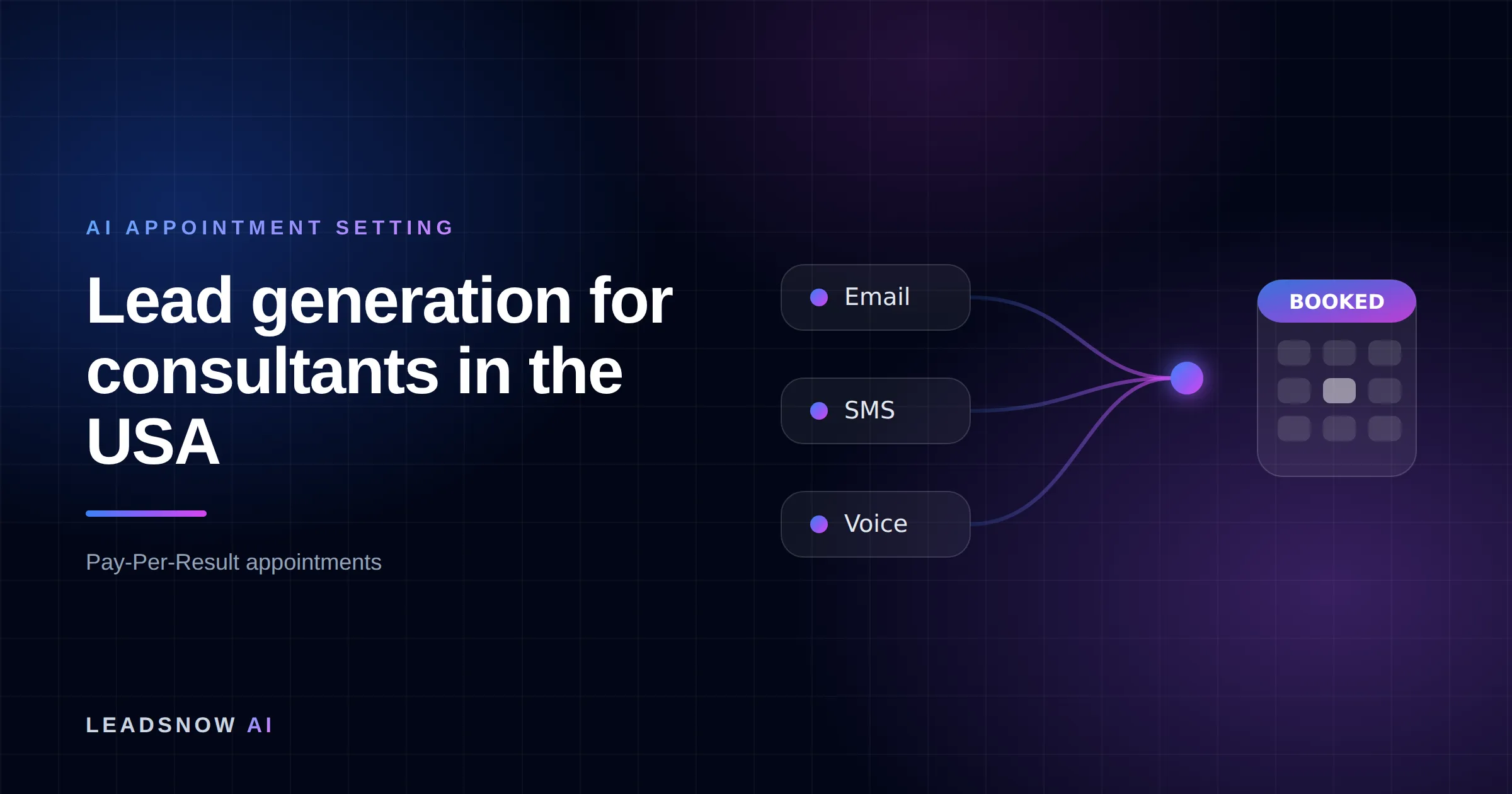
Reach each contact by call, SMS or email and qualify against criteria the partner agreed in writing.
Book the first meeting
Book a 45-to-60-minute first meeting in the partner’s calendar, with reminders and a rebooking offer on a miss.
Partner runs the sale
The partner holds the meeting, scopes the work and writes the proposal. Track win rate, since it sets how many meetings you need.
MAKE MORE SALES.
Pay-Per-Result pricing — We scale sales HARD aligned to your interests, better than anyone else.
How does a US consulting sale work, and where does lead generation fit?
A consulting engagement is usually bought in four steps, and lead generation owns only the first.
- Enquiry or contact to a held first meeting. Someone who owns a problem agrees to a 45-to-60-minute conversation. This is where lead generation starts and stops.
- First meeting to scoping. The buyer agrees the problem is real and worth a diagnostic or a scoping session.
- Scoping to proposal. A partner writes a proposal with a fee, a timeline and named deliverables.
- Proposal to signature. Often with a second stakeholder, procurement, or a budget cycle in the way.
The shape of the offer changes how fast step four closes. Retainers and projects sit on different budget lines, which is worked through in retainer vs project consulting: which sells faster. Some firms add a paid workshop as a lower-risk first purchase; the seats-per-company arithmetic for that is in how to fill a corporate masterclass.
For a US consulting firm, lead generation is finished when a qualified first meeting is held; everything after that is the partner’s sale, and no agency can do it for them.
Want this done for you? We book qualified sales appointments on a Pay-Per-Result basis — you only pay for calls that actually land in your calendar.
Worked example: the Proposal-Back Count for three US consulting firms
The Proposal-Back Count works backwards from the new revenue a firm needs to the first meetings it must book. No credible public benchmark exists for consulting proposal win rates or meeting-to-proposal rates, so every rate below is our labelled assumption. Replace each one with your last 12 months of proposals.
| Step | Independent consultant | Boutique firm | Mid-size firm |
|---|---|---|---|
| New revenue needed a year (assumption) | $300,000 | $1,200,000 | $4,000,000 |
| Average engagement value (assumption) | $30,000 | $75,000 | $200,000 |
| Engagements to sign | 10 | 16 | 20 |
| Proposal win rate (assumption) | 40% | 35% | 30% |
| Proposals to write | 25 | 45.7 | 66.7 |
| First meetings that lead to a proposal (assumption) | 50% | 40% | 35% |
| Held first meetings a year | 50 | 114 | 190 |
| Show rate on booked meetings (assumption) | 85% | 85% | 85% |
| Booked first meetings a year | 59 | 134 | 224 |
| Booked first meetings a month | 4.9 | 11.2 | 18.7 |
| Partner hours in first meetings (1.5 hours each, assumption) | 75 | 171 | 286 |
Worked boutique column: $1,200,000 ÷ $75,000 = 16 engagements. 16 ÷ 0.35 = 45.7 proposals. 45.7 ÷ 0.40 = 114 held meetings. 114 ÷ 0.85 = 134 booked meetings, or 11.2 a month.
The same column shows where the cheapest gain is. Lift the proposal win rate from 35% to 45% and the firm needs 35.6 proposals, 89 held meetings and about 105 booked meetings: roughly 30 fewer first meetings a year for the same revenue. The usual way to move it is to qualify harder before a proposal is written, so fewer go to buyers who were never going to sign. A scored first-call structure, like the one in our admissions call script for high-ticket programs, adapts well to a consulting first meeting.
For a consulting firm, the number of first meetings it must book is set by its proposal win rate more than by the size of its lead list.
The cost side of the same chain, including the partner hours that never appear on a bank statement, is modeled in how much lead generation costs consultants in the US.
Where do US consultants’ first meetings come from?
- Referrals and repeat clients. The highest win rate and the least control. When they slow, the cause is usually a shrinking pool of recent clients, not your reputation: see what to do when consulting referrals dry up.
- Your own dormant contacts. Past proposals that did not sign, former clients and old enquiries. Usually the cheapest first meetings available, and the least worked.
- Trigger-based outbound. Lists built from the events that preceded your last engagements (a new leader, a funding round, a failed system rollout) rather than from industry codes.
- Talks, workshops and masterclasses. Slow to organize, but the audience self-selects on the problem.
- Search and AI assistants. Some buyers ask an assistant who solves a named problem. Specific, published method pages are what get named.
Our lead generation for consultants page sets out how each of these feeds a booked-meeting system.
If we can’t make you money, we don’t deserve yours.
Pay-Per-Result pricing — performance-based alignment.
What US rules apply when a consultant calls, texts or emails prospects?
Selling to businesses does not exempt a consultant from every US rule. General information only, not legal advice; check your own program with an attorney.
- Calls to businesses and the TSR. The FTC’s Telemarketing Sales Rule guidance says “most phone calls between a telemarketer and a business are exempt from the TSR”. The same guidance lists exceptions that stay covered, including calls selling nondurable office or cleaning supplies and calls urging employees to buy for their own personal use. It is also the FTC’s rule only.
- Mobile numbers and the TCPA. Under 47 CFR 64.1200(a)(2), telemarketing calls to a mobile number using an autodialer or an artificial or prerecorded voice need the called party’s prior express written consent. A decision-maker’s mobile is still a mobile.
- AI voices. In Declaratory Ruling FCC 24-17 (adopted February 2, 2024), the FCC confirmed that the TCPA’s “artificial or prerecorded voice” restrictions encompass current AI technologies that generate human voices.
- Email. The FTC’s CAN-SPAM compliance guide says “the law makes no exception for business-to-business email”. Opt-outs must be honored within 10 business days, and each violating email can draw penalties of up to $53,088.
How LeadsNow runs lead generation for US consultants
LeadsNow is an Australian pay-per-result lead generation and appointment-setting agency serving US clients. For a consulting firm, we do step one of the sale: we contact enquiries, dormant contacts and agreed target lists using AI calling, SMS and email follow-up where consent allows, qualify against criteria you set, and book first meetings into the partner’s calendar with reminders. The partner runs the meeting, the scoping and the proposal.
- Pricing: 5–25% of the revenue we generate for you (revenue share), or an equivalent pay-per-appointment fee, or a mix of both. The rate depends on lead volume, what is being sold and its price, the type of product and business, and which part, or all, of the sales funnel we run.
- Terms: no-shows aren’t charged, there is no retainer, and you can cancel any time with 14 days notice. Bad lists and the cost of contacting the many people who never book are our cost, not yours.
- Track record: 50,769+ AI-booked sales appointments and 1M+ leads generated since 2017, 24 filmed client case studies, and a 4.7 rating from 60 Google and Facebook reviews. Show rates vary by offer and reminder cadence, up to 93% on our best-performing accounts.
- The honest gap: we have no published US consulting case study, and our team is in Australia, so live overlap with US business hours is limited. Automated first contact and booking run on the prospect’s local time.
Australian firms should read the Australian version of this page, which covers different rules.
Should a US consulting firm run lead generation in-house?
Below about five booked first meetings a month, usually yes. The independent column above needs 4.9, which a partner can source and book alongside delivery. The crossover comes when the touches behind each meeting (researching, writing, chasing, rebooking) start displacing billable hours. In the mid-size column, 286 partner hours go into first meetings alone before a single follow-up is sent, which is the point at which most firms either hire a setter or hand the booking out. Keep the first meeting and the proposal in-house in every case: they are where the engagement is won.
Frequently asked questions
How many first meetings does a US consulting firm need a month?
Work it back: engagements needed ÷ proposal win rate ÷ meeting-to-proposal rate ÷ show rate, then divide by 12. On our assumptions, a boutique firm needing $1.2 million of new work at $75,000 an engagement books about 11 first meetings a month. Replace every rate with your own.
Is cold calling businesses legal for consultants in the US?
Live calls to business lines are largely outside the FTC’s rule: its TSR guidance says most calls between a telemarketer and a business are exempt. The TCPA still requires prior express written consent for autodialed or artificial-voice telemarketing calls to mobile numbers. General information, not legal advice.
Does CAN-SPAM apply to cold email sent to other businesses?
Yes. The FTC’s CAN-SPAM guide says the law makes no exception for business-to-business email. Each message needs accurate headers, a valid physical postal address and a working opt-out honored within 10 business days.
How big is the US consulting market?
For the core occupation, the BLS counts 1,077,100 management analyst jobs in 2025, a median pay of $101,860 a year, and projects 10% growth from 2025 to 2035. Fourteen percent of the occupation is self-employed.
What does LeadsNow charge consultants?
5–25% of the revenue we generate for you, or an equivalent pay-per-appointment fee, or a mix of both, depending on lead volume, what you sell and its price, your type of business, and how much of the funnel we run. No-shows aren’t charged and there is no retainer.
Related: see Best Marketing Agencies for Consultants in the US (2026).
Related: see Best Appointment Setting Agencies for Consultants (US, 2026).
Pay-Per-Result appointments
See if we’re a fit
We book qualified sales appointments for you and you pay on results, not retainers. Our booking page asks a few quick questions so you find out in two minutes whether that model suits your business.
- 50,769+ appointments booked without cold calling.
- Pay-Per-Result pricing — you pay for booked, qualified calls.
- Pick your own time on our live calendar, no phone tag.