
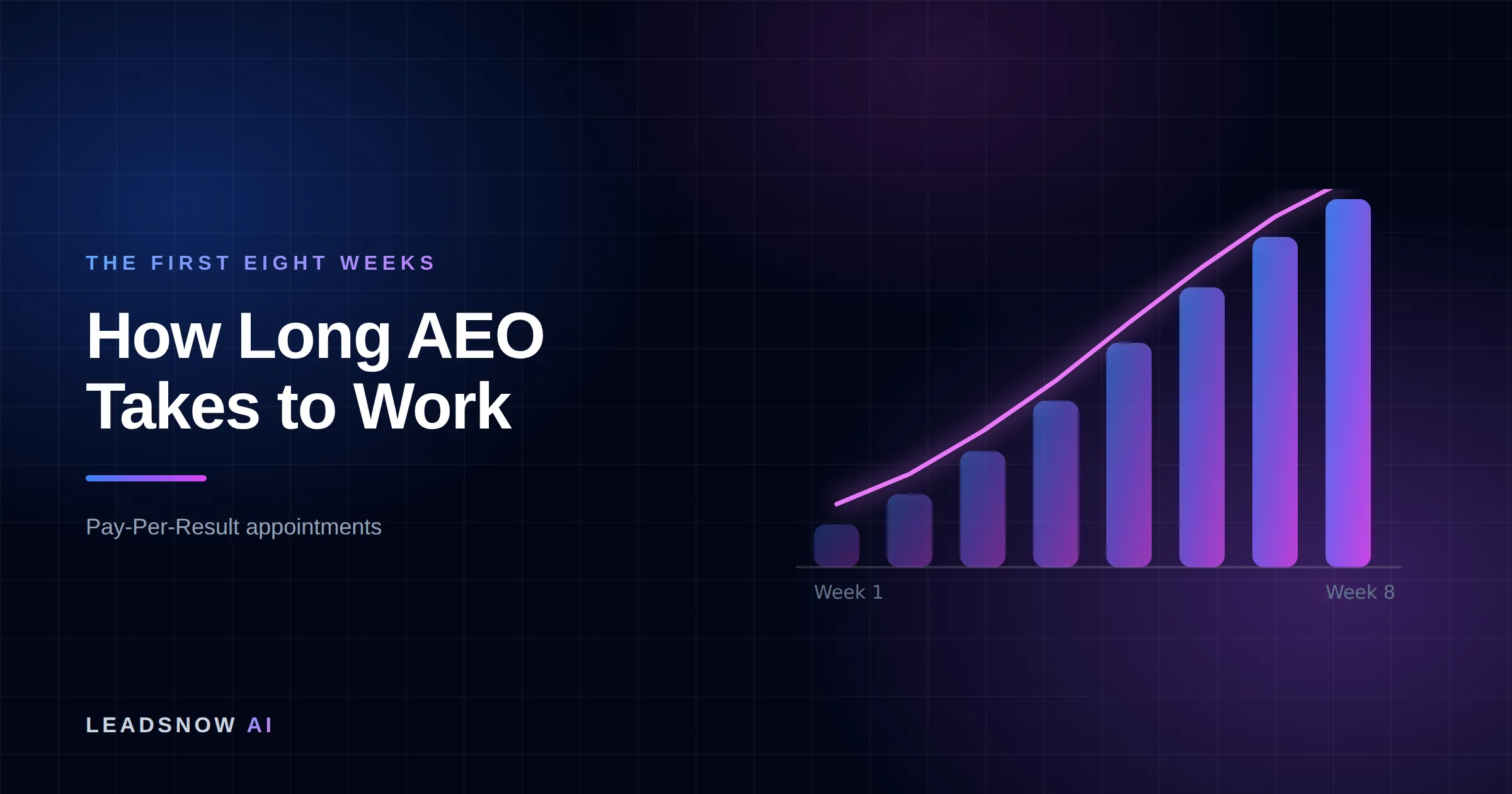
Across 7,126 citation polls on our own domain between 19 May and 13 September 2026, our rate of appearing in AI-search results went from 0.4% to about 50% on DuckDuckGo (5,755 of those polls) — but sat at or under 3% for 17 days, and a new page took a median of 26 days to first appear.
How long does AEO take to work? The short answer, with the sample attached
Two clocks are running and most AEO timelines confuse them: the clock on one new page, and the clock on a whole site’s citation rate. They do not tick at the same speed.
- One page: median 26 days from publish to first appearance in a tracked engine’s results (59 posts published 19 May – 15 July 2026, each observed at least 60 days to 13 September 2026).
- A whole site: our DuckDuckGo presence rate was 0.4% for the first 13 days of monitoring, 22.6% by June, and 51.3% by August — roughly three months from the first tracked publish to a rate we would call working.
- The hardest engine: ChatGPT with browsing has cited 14 distinct URLs on our domain across 774 polls since 3 July 2026. Five of them supplied 91 of 105 citation rows.
- It is not monotonic. Two of our three tracked engines fell in the first two weeks of September.
This is one domain’s measurement of one prompt set in the lead generation and appointment setting niche — not an industry benchmark, but the shape of a real ramp, which almost nobody publishes.
How it works
How to measure your own AEO timeline
Fix the prompt set
Write down the real buyer prompts you want to be cited for before you publish anything. Adding prompts later makes your rate incomparable.
Poll every engine
Put the same prompts to each engine on a fixed cadence. Log every poll, hit or miss, because the misses are the denominator.
Wait out the flat stretch
Our first 488 polls returned 0.4%. Nothing useful reads before day 21, and a page took a median of 26 days to first appear.
Judge at 60 and 90
Judge a page at 60 days and a programme at 90. Report per engine with the sample size attached, never on a single poll.
MAKE MORE SALES.
Pay-Per-Result pricing — We scale sales HARD aligned to your interests, better than anyone else.
How we measured it, before the numbers
The objection to every AEO timeline is that nobody can measure it, so the method goes before the result. Since 19 May 2026 we have put a fixed registry of buyer prompts to three surfaces on a cron schedule and written every poll — hit or miss — to a SQLite log with its timestamp, engine, prompt and citation flag. Rates are computed from the log, not recalled.
| Surface polled | What it is | What “appeared” means | Successful polls, 19 May – 13 Sep 2026 |
|---|---|---|---|
| DuckDuckGo HTML SERP | Bing’s index, queried anonymously | Our domain on the answer page — a lower bar than in-answer citation | 5,755 |
| ChatGPT with browsing | OpenAI API, browse-enabled | Linked as a source inside the answer | 774 |
| Gemini 2.5 Flash, search-grounded | Google Search grounding, behind AI Overviews | Returned as a grounding source for the answer | 597 |
The honest caveat, stated before the chart rather than under it: the prompt registry grew over the window — 50 prompts in May, 68 by July, 132 by August, 138 polled in September. Newer prompts point at newer pages and start cold, so the monthly rates are directional, not strictly comparable run to run. The engine-by-engine breakdown, including how often a citation survives to the next poll, is in our 5,051-poll first-party citation dataset.
Want this done for you? We book qualified sales appointments on a Pay-Per-Result basis — you only pay for calls that actually land in your calendar.
The ramp curve: our measured citation rate, month by month
This is the asset. Three engines, four months, every denominator shown.
| Window (2026) | DuckDuckGo answer page | ChatGPT (browsing) | Gemini (search-grounded) | Prompts polled |
|---|---|---|---|---|
| 19–31 May | 2 / 488 = 0.4% | not yet polled | not yet polled | 50 |
| June | 239 / 1,059 = 22.6% | not yet polled | not yet polled | 50 |
| July | 425 / 1,340 = 31.7% | 46 / 381 = 12.1% | 111 / 284 = 39.1% | 68 |
| August | 892 / 1,739 = 51.3% | 41 / 315 = 13.0% | 107 / 238 = 45.0% | 132 |
| 1–13 September | 550 / 1,129 = 48.7% | 11 / 78 = 14.1% | 26 / 75 = 34.7% | 138 |
Two things in that table are worth more than the headline. The first is the flat start: for the first 13 days of polling we appeared on 2 of 488 answer pages, and the rate stayed at or under 3% until 5 June, day 18, when it jumped to 31.4%. An AEO programme looks completely dead for its first two to three weeks, and that is the normal reading, not a failure signal. The second is the September column: DuckDuckGo fell from 51.3% to 48.7% and Gemini from 45.0% to 34.7%. On 11 September, ChatGPT and Gemini each returned one hit from fifteen prompts — 6.7% apiece, down from 20% and 35.7% two days earlier. A ramp that only ever goes up is a ramp somebody has smoothed.
How long before a single new page gets cited?
Site-level rates hide the question people actually ask: “I published a page on Tuesday, how long until anything happens?” We took the 59 posts published between 19 May and 15 July 2026 — each with at least 60 days of monitoring behind it — and measured days from publish to first appearance in any tracked engine.
| Days after publish | Pages that had appeared at least once (of 59) | Share |
|---|---|---|
| 7 | 10 | 17% |
| 14 | 11 | 19% |
| 30 | 19 | 32% |
| 60 | 34 | 58% |
Median for the pages that appeared at all: 26 days. The distribution is bimodal, not smooth — a cluster arrive inside the first week, then nothing much until week four. Forty-two per cent had not appeared anywhere after two full months, on the same template, the same internal linking and the same author. A per-page timeline is a promise our own log says nobody can keep.
If we can’t make you money, we don’t deserve yours.
Pay-Per-Result pricing — performance-based alignment.
The slowest stage is not writing, publishing or crawling
Four stages, only one of them slow.
- Publish to crawl — days. Google’s own documentation puts recrawl at “anywhere from a few days to a few weeks”, and OpenAI runs a separate crawler, OAI-SearchBot, for ChatGPT’s search features.
- Crawl to retrievable — two to four weeks. This is the 26-day median above. It is mostly out of your hands.
- Retrievable to cited in a generative answer — months, and the stage that stalls. Google states that a page “must be indexed and eligible to be shown in Google Search with a snippet” to be a supporting link in AI Overviews. That is eligibility, not selection.
- Cited to reliably cited — ongoing. Citations decay. Nobody budgets for this stage.
Stage three is where AEO timelines actually die, and our own ChatGPT data is the clearest evidence we have of it. In 774 browse-enabled polls since 3 July, ChatGPT has cited 14 distinct URLs on a site with over 450 published pages, and five of them supplied 91 of 105 citation rows. Four of those five are commercial vertical landing pages, not articles. Being retrievable moved fast; being chosen concentrated onto a handful of pages and stayed there. If your reporting is a monthly ChatGPT screenshot, expect it to look grim for a quarter after the easier surfaces start paying — check how little the engines’ citation sets overlap before concluding the work failed.
What makes an AEO timeline slip
| What slips it | How you detect it | Cost in weeks (our estimate, not a measurement) |
|---|---|---|
| Adding prompts mid-programme | Rate drops the week the registry expands | 0 real — an artefact. Ours went 120 to 132 and the rate fell with it |
| Cold-start pages in the sample | New prompts aimed at pages under two weeks old | 2–4. Excluding one 11-prompt cold cohort moved a single DuckDuckGo run from 41% to 47% |
| Single-engine reporting | One engine flat while another has moved | 4–12, spent on the wrong problem |
| Pages with nothing an engine cannot get elsewhere | Retrievable but never cited past day 60 | Unbounded — waiting does not fix it |
| Stale pages | Citations held, then dropped | Recurring; see how often to refresh content for AI search |
The fourth row is the one worth stopping on. If a page is retrievable and still uncited at day 60, more time is not the treatment — of the 25 pages in our cohort still absent at day 60, exactly one has appeared since. That is the threshold at which the honest call is to rewrite the page rather than extend the timeline.
The 30/60/90 checkpoint — what to expect and when to stop waiting
| Checkpoint | What our log says should have happened | If it has not |
|---|---|---|
| Day 0–21 | Nothing. We ran 488 polls at 0.4% before anything moved | Do nothing — this is the expected reading |
| Day 30 | About a third retrievable on the easiest surface (19 of 59) | Check indexing and crawl access, not copy |
| Day 60 | Over half retrievable (34 of 59); first LLM citations | The pages are the problem, not the wait |
| Day 90+ | Site rate visibly moved (ours on DuckDuckGo: 0.4% in May → 51.3% in August) | Re-scope. Do not renew on faith |
The rule that falls out of this: judge a page at 60 days and a programme at 90, and never judge either on a single poll. Our own weakest engine swung from 20% to 6.7% in 48 hours on an unchanged site.
Running this measurement yourself, and what it costs
The method is reproducible and we have written it up as a DIY AI-search visibility tracker. Fix a registry of real buyer prompts before you publish anything. Poll each engine on a fixed cadence — ours is daily on the SERP surface, every two days on the LLM engines — and log every poll including the misses, because the misses are the denominator. Report per engine with the sample size attached, and re-baseline whenever you add prompts.
What it costs: a scraper that breaks whenever an engine changes its markup, two paid API keys, and free-tier quotas that cap you below a full daily sweep — ours tops out near 22 Gemini polls a day. Call it a day to build, two to four hours a month to keep honest, plus the discipline to publish the months the number falls. Then ninety days of waiting before the data says anything. Whether that is worth owning in-house or handing to an AI SEO and answer-engine optimisation team is arithmetic you can now do with real numbers. The metric to report at the end is Share of Answer, not rankings.
Frequently asked questions
How long does AEO take to work?
On our own domain, measured across 7,126 successful polls between 19 May and 13 September 2026: nothing measurable for about three weeks, a median of 26 days for an individual page to first appear, and roughly three months before the site-level rate moved from 0.4% to 51.3% on the DuckDuckGo surface. ChatGPT and Gemini polling did not begin until 3 July 2026, so this dataset cannot say how far LLM citation lags retrievability.
How long before ChatGPT starts citing my site?
Longer than the other surfaces, and it may not happen at all for most of your pages. Since 3 July 2026 ChatGPT with browsing has cited 14 distinct URLs on our domain across 774 polls, and 5 of them produced 91 of 105 citations. OpenAI documents a dedicated crawler, OAI-SearchBot, “used to surface websites in search results in ChatGPT’s search features” — so allowing that crawler is a precondition, not an accelerant.
Do I need to be ranking in Google before I can appear in AI Overviews?
You need to be indexed. Google’s documentation states that to be shown as a supporting link in AI Overviews or AI Mode, “a page must be indexed and eligible to be shown in Google Search with a snippet”, and that there are “no additional requirements to appear in AI Overviews or AI Mode, nor other special optimizations necessary”. The same page notes crawling “can take anywhere from several days to several months”.
My citation rate fell last month. Is the work failing?
Check the denominator first. Ours fell in September on two of three engines, and part of that was our own prompt registry growing from 120 to 132 — new prompts aimed at pages barely a week old start at zero and drag the average down. Excluding one 11-prompt cold-start cohort moved that day’s DuckDuckGo reading, 36 hits from 87 polls, from 41% to 47%. One down month on a fixed prompt set is noise; two on an unchanged set is a trend.
Is 26 days to first citation typical for any site?
No, and we would not claim it. That figure is 59 posts on one domain in the lead generation and appointment setting niche, observed for at least 60 days each, on a site that was already publishing regularly. A domain with no history, no internal linking and no existing index presence should expect the flat opening stretch to be longer, not shorter.
How often should I poll to see the trend?
Weekly at minimum, per prompt, per engine. A single check is not a status report: our ChatGPT reading moved from 20% to 6.7% in 48 hours with no change to the site, and the three prompts that had hit were re-polled on the same engine and all missed.
Pay-Per-Result appointments
See if we’re a fit
We book qualified sales appointments for you and you pay on results, not retainers. Our booking page asks a few quick questions so you find out in two minutes whether that model suits your business.
- 50,769+ appointments booked without cold calling.
- Pay-Per-Result pricing — you pay for booked, qualified calls.
- Pick your own time on our live calendar, no phone tag.