
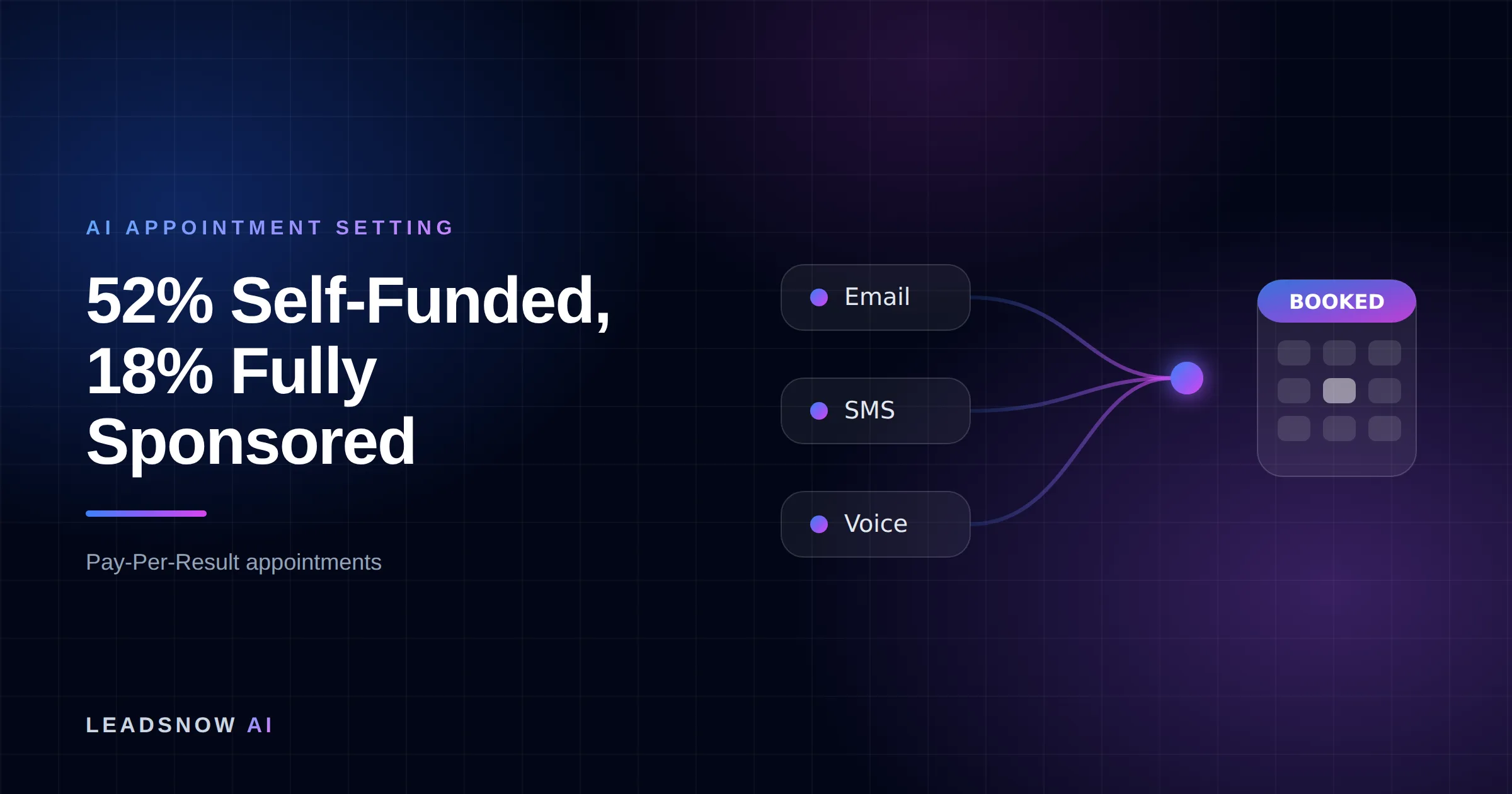
Executive education marketing is two funnels sharing one brochure. In the 2025 EMBAC survey of executive MBA programs, 52.1% of students paid their own way, 30% had partial and 18% full employer sponsorship. Self-funders decide on outcome and price within weeks; sponsored applicants need a manager, an approval case and a budget date.
At a glance
- The split: 52.1% self-funded, 30% partially sponsored, 18% fully sponsored (EMBAC 2025 Membership Program Survey, executive MBA students). Full sponsorship was 23.2% in 2015.
- The price range you are marketing across: Harvard Business School lists its online Leadership Principles course at $1,949 and its Advanced Management Program at $95,000. Different prices, different buyers.
- The rule: the Funding-Path Split — ask “who is paying for this?” at first touch, then run self-funders and sponsored applicants on separate cadences and calendars.
- Benchmarks: Mailchimp’s Education and Training average is 35.64% open and 3.02% click. No public enquiry-to-enrolment benchmark exists for executive programs.
- The calendar consequence: sponsored enquiries have to start weeks earlier than self-funded ones for the same cohort date.
What executive education marketing is
Executive education marketing is the work of filling non-degree and post-experience programs for working managers — short open-enrolment courses, multi-week leadership programs, certificates and executive MBAs — with applicants who will complete and pay. It is enrolment marketing for buyers in their late thirties with budgets, bosses and calendars, not for school leavers.
Three things make it its own discipline:
- The buyer is often not the payer. A learner who wants a seat may need a line manager or learning and development team to fund it.
- The product is dated. Cohorts start on fixed days, so every campaign works backwards from a start date.
- The audience is senior. EMBAC’s 2025 profile of executive MBA students: average age 39, 15 years of work experience, 9.1 years in management.
Out of scope here: custom programs designed for a single company. That is a business-to-business sale to HR or a chief learning officer, with its own cycle. This page covers open programs sold seat by seat.
How it works
The Funding-Path Split for an executive program
Ask who is paying
The first form or reply asks one question: myself, my employer, or a mix. The answer tags the record.
Route to two tracks
Self-funders get a short, fast sequence; sponsored applicants get a sponsor pack and a cadence tied to their approval date.
Work back from start date
Each track gets its own last useful week for advisor calls, with sponsored calls booked weeks earlier.
Book the advisor call
Qualified applicants land in an advisor’s calendar, with the budget holder invited when an employer is paying.
MAKE MORE SALES.
Pay-Per-Result pricing — We scale sales HARD aligned to your interests, better than anyone else.
Who pays for executive education: the self-funder vs corporate-sponsor split
The best published funding split we found is for executive MBAs, not open short programs, so treat it as a directional guide. The Executive MBA Council’s 2025 Membership Program Survey reports 52.1% of students self-funded, 30% partially sponsored and 18% fully sponsored by an employer.
| Year | Self-funded | Full employer sponsorship | Source |
|---|---|---|---|
| 2015 | 41% | 23.2% | EMBAC, as reported in its 2019 survey release |
| 2019 | Nearly 53% | Just over 15% | EMBAC 2019 survey release |
| 2025 | 52.1% | 18% (plus 30% partial) | EMBAC 2025 Membership Program Survey |
Two consequences for marketing. First, the self-funder is the larger group, so a funnel built only for corporate approval misses half the market. Second, nearly half still involve an employer’s money, fully or partly, so a funnel built only for individuals stalls at the approval step.
Price shifts the mix. In the US, the IRS lets an employer exclude up to $5,250 a year of educational assistance from an employee’s wages under a qualifying plan. Our rule of thumb is that programs priced above that line need a sponsor conversation as well as a learner one. We covered that line, and the Australian tax context, in our guides to agencies for US executive education providers and Australian executive education providers, so we will not repeat it here.
Want this done for you? We book qualified sales appointments on a Pay-Per-Result basis — you only pay for calls that actually land in your calendar.
Executive education marketing benchmarks
There are good published numbers for the top of the executive education funnel and almost none for the bottom. Know which is which before you set targets.
| Metric | Figure | Source | What it tells you |
|---|---|---|---|
| Email open rate, Education and Training | 35.64% | Mailchimp benchmarks, last updated December 2023 | Delivery check only; Apple Mail Privacy Protection inflates opens |
| Email click rate, Education and Training | 3.02% | Same dataset | Comparing subject lines and offers |
| Unsubscribe rate, Education and Training | 0.18% | Same dataset | Warning line for list fatigue |
| Average salary at program start (EMBA) | $192,644, rising to $226,428 at completion | EMBAC 2025 Student Exit Survey, 724 students from 25 EMBA programs | Who you are writing for, and the outcome self-funders weigh |
| Enquiry to enrolment | No public benchmark | — | Measure your own, split by funding path |
The missing row is the one that matters. Without a public enquiry-to-enrolment figure, your own data, split by who pays, is the only benchmark worth setting targets against. Our page on how long enrolment marketing takes to work explains why intake dates, not campaign effort, set the pace.
The Funding-Path Split: two funnels, two clocks
The Funding-Path Split is a simple rule: ask who is paying in the first exchange, tag the record, and run each funding path on its own cadence and calendar. A self-funder and a sponsored applicant may read the same page, but they buy on different evidence, at different speeds, with different people in the room.
| Self-funded applicant | Partially sponsored | Fully sponsored applicant | |
|---|---|---|---|
| Who signs | The learner | The learner plus a manager | Manager, L&D or HR budget holder |
| Question to ask first | “What do you want to be doing in two years?” | “How much is your employer covering?” | “Who approves training spend, and when is it set?” |
| Main objection | Price and time away from work | The gap they fund personally | Fit with the company’s priorities |
| What closes it | Outcomes, alumni voices, payment options | Both packs, plus a clear split of the fee | A sponsor pack: business case, invoice terms, dates |
| Time from enquiry to enrolment (assumption) | 2–6 weeks | 6–12 weeks | 8–16 weeks |
| Follow-up cadence (assumption) | Same-day reply, then every 2–3 days for two weeks | Weekly, keyed to the employer’s answer | Every 1–2 weeks, keyed to the approval meeting and budget date |
| What to book | An advisor call with the learner | An advisor call, then a fee conversation | An advisor call, then a call that includes the sponsor |
The timing and cadence rows are our planning assumptions, not measured figures; replace them with your own enquiry-to-enrolment data once you have tagged a cohort. The structure is the point: a single nurture sequence that emails everyone every three days is too slow for a self-funder deciding this month and too pushy for a sponsored applicant waiting on a budget meeting.
If we can’t make you money, we don’t deserve yours.
Pay-Per-Result pricing — performance-based alignment.
How to measure executive education marketing
Measure executive education marketing by funding path, not by channel alone. A blended conversion rate hides the fact that two different funnels are running at two different speeds.
- Enquiry to advisor call = advisor calls booked ÷ enquiries, per path.
- Advisor call to application = applications ÷ calls held.
- Application to funding confirmed = sponsored applicants with approval ÷ sponsored applications. Self-funders skip this stage.
- Cost per enrolment = marketing and admissions cost ÷ enrolments, per path.
- Days to enrol = median days from first enquiry to paid enrolment, per path.
The one field that makes all five possible is a funding-path tag captured on the first form or first call. Without it, every report blends the two clocks. Our lead qualification framework shows how to add a question like that without killing form completion.
How to market an executive program, step by step
The method below works for a single open program or a portfolio. It assumes you already have a program page and a cohort date.
- Write two value cases. One for the learner (career outcome, network, time cost). One for the sponsor (capability built, what the manager gets back, total cost including travel).
- Pick channels by intent. Search catches people already comparing programs; LinkedIn reaches managers by seniority and function; alumni referrals and information sessions convert both paths.
- Ask the funding question on the first form. Three options: myself, my employer, a mix.
- Reply within minutes. An enquirer comparing three programs can book with whoever answers first. Lead follow-up automation covers the mechanics.
- Book an advisor call, not a brochure download. The advisor call is where funding, fit and timing get settled. Use structured discovery call questions so every call captures the same fields.
- Split the follow-up. Self-funders get a short, fast sequence. Sponsored applicants get the sponsor pack and a cadence tied to their approval date.
- Close the calendar. Stop paid acquisition for a cohort when the remaining weeks are shorter than the self-funder cycle; move the remaining budget to the next cohort.
What a sponsored applicant needs from you
A sponsored applicant who wants the program still has to sell it internally. Hand them the materials and the sale gets easier; leave them to write it and it waits for the next budget cycle.
- A one-page business case written for the manager: the capability, how it applies to the applicant’s role, what the company gets back.
- The full cost, itemised: fee, what it includes, travel and time away. Harvard’s Advanced Management Program, for example, states that its $95,000 fee covers tuition, materials, accommodation and most meals, and that the program runs as three modules: 6 weeks on campus, 5 weeks virtual, plus 40–50 hours of pre-work.
- Invoice and payment terms a finance team can process, plus the cancellation and deferral policy.
- A nominating statement or reference template if your admissions process asks for one; HBS lists a “Letter of Reference or Nominating Statement” among its admissions requirements.
- Dates far enough ahead to land inside the employer’s approval window.
Booking a call with the sponsor present is a separate skill from booking a learner; our B2B appointment setting guide covers it.
Where executive education marketing goes wrong
When an executive education campaign misses its numbers, the cause is usually one of these:
- One funnel for two buyers. The same nurture to everyone, so neither path is served.
- Late starts for sponsored seats. Campaigns launch eight weeks out, inside the self-funder window but too late for an approval cycle.
- Brochure downloads counted as pipeline. A PDF download is not an enquiry; an advisor call is.
- Slow replies. An enquiry that arrives in the evening and is answered the next afternoon competes with every school that answered overnight.
- No sponsor pack. The applicant wants to come and cannot get the manager to read a 40-page brochure.
- Blended reporting. Cost per enrolment rises and nobody can tell which path broke.
The pattern under all six: executive education marketing fails when it treats a two-buyer sale as a one-buyer sale.
A worked example: filling a 40-seat cohort
This is arithmetic on labelled assumptions, not a client result. The mix is rounded from the EMBAC split; the conversion rates and cycle times are assumptions to replace with your own.
| Input | Self-funded | Partial sponsor | Full sponsor | Total |
|---|---|---|---|---|
| Share of seats (assumption) | 50% | 30% | 20% | 100% |
| Seats to fill | 20 | 12 | 8 | 40 |
| Advisor call to enrolment (assumption) | 25% | 20% | 30% | — |
| Advisor calls needed | 80 | 60 | 27 | 167 |
| Days to enrol (assumption, upper end) | 42 | 84 | 112 | — |
| Last useful week to book the call | 6 weeks before start | 12 weeks before start | 16 weeks before start | — |
Sponsored calls: 8 ÷ 0.30 = 26.7, rounded up to 27. Read the last row as the planning output. If your cohort starts on 1 March, fully sponsored advisor calls have to be booked by early November, partial-sponsor calls by early December and self-funded calls by mid-January. A campaign that starts in January can still fill self-funded seats, but by then it has run out of time for the sponsored ones, which on this mix is half the cohort.
The DIY cost is mostly advisor time. 167 advisor calls at an assumed 45 minutes each, plus 15 minutes of notes and follow-up, is about 167 hours, before the time spent chasing the calls that never get booked.
What I’d fix first
If I took over an executive education marketing function tomorrow, this is the order I would work in:
- Add the funding question to every enquiry form. One field: myself, my employer, a mix. It costs nothing and every later decision depends on it.
- Back-tag the last two cohorts. Ask admissions which enrolments were sponsored. It gives you your own days-to-enrol per path within a week.
- Move the sponsored campaign start earlier. Work back from the cohort date using your own sponsored cycle, not the self-funder one.
- Build the sponsor pack. One page, itemised cost, invoice terms, dates. Send it automatically to anyone who ticks “my employer”.
- Measure advisor calls, not downloads. Report enquiries to calls to enrolments by path every week.
- Fix out-of-hours replies. Enquiries arriving after 6pm should get a human-quality answer that evening.
How LeadsNow applies executive education marketing
LeadsNow works the part of the executive education funnel between enquiry and advisor call. AI calling, SMS and DM follow-up answer new enquiries quickly, ask the funding question, and book qualified applicants into an advisor’s calendar with reminders; a dormant enquiry list from past cohorts can be worked the same way. The service is described on our AI appointment setting page.
- Track record: 50,769+ AI-booked sales appointments since 2017, and 1M+ leads generated.
- Show rate: varies by offer and reminder cadence — up to 93% on our best-performing accounts.
- Evidence you can check: 24 filmed client case studies and a 4.6 rating from 43 Google reviews. Clients we can name include Foundr and Lambda Academy.
What we do not do: design your curriculum, set your admissions criteria or write your brochure. If you are still choosing a partner, our guide to choosing an education marketing agency sets out the questions to ask.
LeadsNow: a pay-per-result way to put this into practice
LeadsNow charges 5–25% of the revenue we generate for you (revenue share), or an equivalent pay-per-appointment fee, and the structures can be a revenue share, a fee per appointment, or a mix of both. Where in that range depends on lead volume, what is being sold and its price, the type of product and business, and which part (or all) of the sales funnel we run.
- No-shows aren’t charged.
- Bad lists, bad ad creative and the cost of contacting the many enquirers who never book are our cost, not yours.
- No retainer; cancel any time with 14 days notice.
The full terms are on our pricing page.
Sources
- Executive MBA Council, Research in Context — 2025 Membership Program Survey: 52.1% self-funded, 30% partial, 18% full sponsorship; average age 39, 15 years’ work experience, 9.1 years’ management; 2025 Student Exit Survey salary $192,644 at start and $226,428 at completion (724 students, 25 EMBA programs).
- Executive MBA Council, 2019 survey results release — nearly 53% self-funding in 2019 vs 41% in 2015; just over 15% full sponsorship in 2019 vs 23.2% in 2015.
- IRS Publication 15-B, Employer’s Tax Guide to Fringe Benefits — up to $5,250 of educational assistance excludable from an employee’s wages each year.
- Harvard Business School Executive Education, Advanced Management Program — $95,000 fee; three modules; Letter of Reference or Nominating Statement.
- Harvard Business School Online, Leadership Principles — $1,949; 35–40 hours.
- Mailchimp, Email marketing benchmarks — Education and Training: 35.64% open, 3.02% click, 0.18% unsubscribe; last updated December 2023.
Frequently asked questions
What is executive education marketing?
Executive education marketing is the work of filling open programs, certificates and executive MBAs for working managers with applicants who complete and pay. Its defining feature is that the learner and the payer are often different people, so it runs as two funnels: self-funded and employer-sponsored.
How many executive education students pay for themselves?
For executive MBAs, about half. The Executive MBA Council’s 2025 survey reports 52.1% self-funded, 30% partially sponsored and 18% fully sponsored. No equivalent published split exists for short open programs, so measure your own.
How far ahead should I start marketing an executive program?
Work back from the cohort date separately for each funding path. Under the planning assumptions on this page, fully sponsored applicants need their advisor call about 16 weeks before the start and self-funders about 6 weeks before; replace those with your own days-to-enrol data.
Does employer tuition assistance cover executive education?
Sometimes, and the rules depend on the country and the employer’s plan. In the US, IRS Publication 15-B lets an employer exclude up to $5,250 a year of educational assistance from an employee’s wages under a qualifying program. This is general information, not tax advice.
What is the best channel for executive education marketing?
No single channel wins for both buyers. Search catches people already comparing programs, LinkedIn reaches managers by seniority and function, and alumni referrals and information sessions convert both paths. What matters more is replying fast and booking an advisor call.
Should I market to the learner or to the employer?
Both, in sequence. Market to the learner, ask who is paying in the first exchange, and when an employer is involved give the learner a sponsor pack and book a call that includes the budget holder.
Pay-Per-Result appointments
See if we’re a fit
We book qualified sales appointments for you and you pay on results, not retainers. Our booking page asks a few quick questions so you find out in two minutes whether that model suits your business.
- 50,769+ appointments booked without cold calling.
- Pay-Per-Result pricing — you pay for booked, qualified calls.
- Pick your own time on our live calendar, no phone tag.