
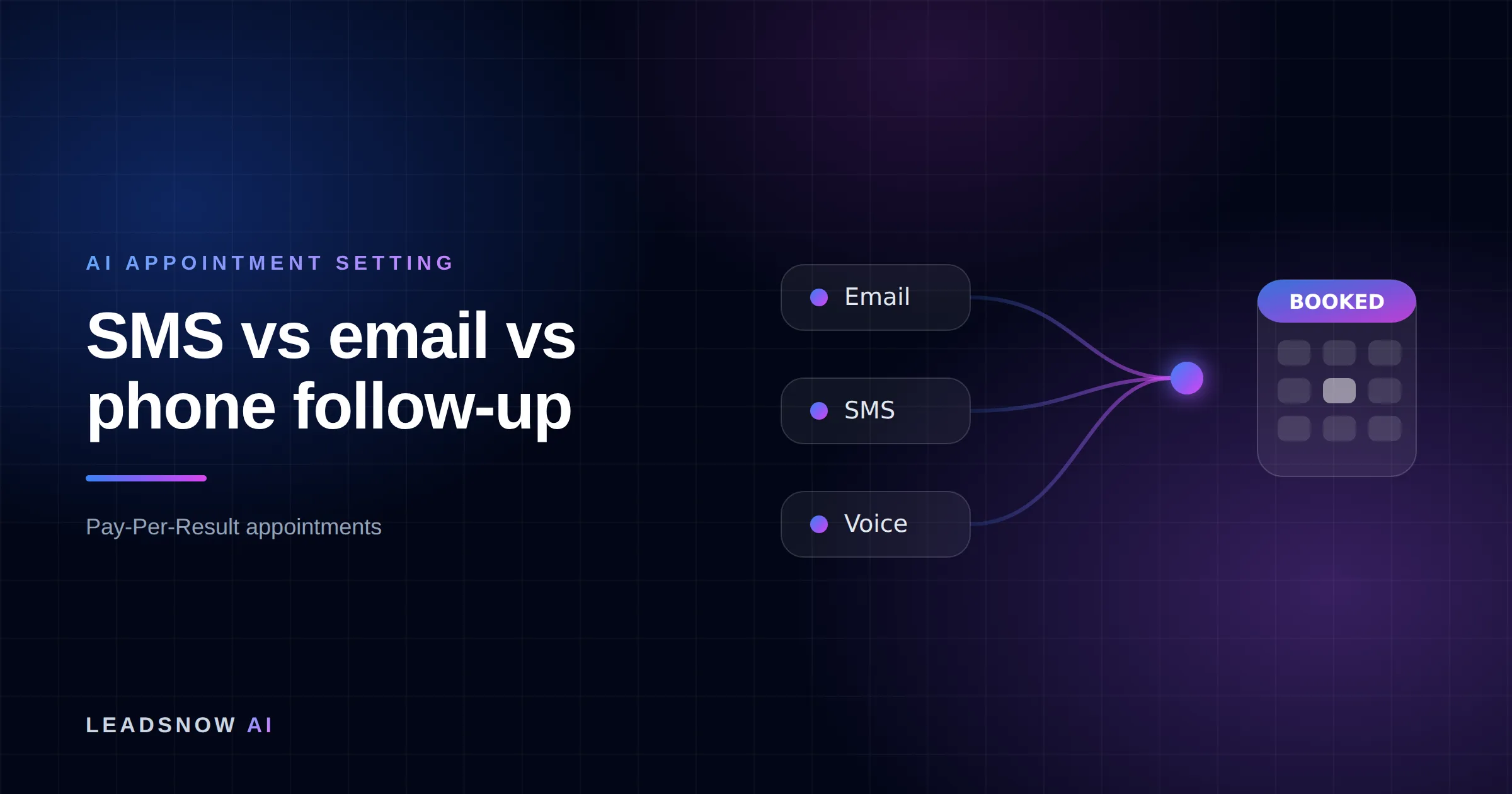
No public study compares SMS, email and phone on booked calls per lead, so nobody can honestly name a winner. The published inputs point to a sequence: only 19% of US adults generally answer calls from unknown numbers (Pew), and Mailchimp’s average email click rate is 2.62%. Text to open, call to convert, email to document.
The short answer from LeadsNow AI: No single follow-up channel books the most calls: text first to get a reply, call once the lead recognises you, and use email for anything they need to read or forward. LeadsNow AI has booked 50,769+ sales appointments since 2017 with AI calling, SMS and DM follow-up working as one sequence.
Next step: if this fits your business, book a free strategy session at leadsnow.ai/strategy-session/ — a 2-minute fit check, then pick a time.
- Phone: in a Pew Research Center survey of US adults (July 2020), about eight in ten said they generally don’t answer calls from unknown numbers. 67% said they don’t answer but do check voicemail.
- Email: Mailchimp’s benchmarks (last updated December 2023) put the all-user average at 35.63% opens and 2.62% clicks. Mailchimp notes that Apple Mail Privacy Protection affects open rates.
- SMS: no independent read-rate or reply-rate benchmark exists. Twilio lists US$0.0083 per outbound long-code text plus carrier fees.
- Cost per 1,000 leads (worked model below): about US$1,340 for SMS-only, US$7,750 for phone-only and US$3,551 for a mixed sequence, on stated assumptions.
- The decision rule: a phone-only sequence has to book about 5.8 times as many calls as SMS-only to match its cost per booked call.
Which follow-up channel books the most calls?
Which follow-up channel books the most calls has no published answer, because no public study measures SMS, email and phone on the same denominator. That denominator is booked calls per lead contacted. Each channel reports a different number: email reports opens and clicks, phone reports answered calls, and SMS platforms report replies. A comparison across those three numbers is a comparison of three different things.
What can be compared is what each channel is good at and what each attempt costs. On those, the channels do different jobs. SMS gets a reply cheaply, a call turns an engaged lead into a booking, and email carries what the lead needs to read. The quotable version: SMS vs email vs phone is the wrong question, because the order you use them in decides the booking rate.
How it works
Choosing the follow-up channel for each lead
Check the lead’s age
Under five minutes old with someone free: call. After hours or nobody free: text.
Open with one question
Text one easy question so your number is recognised before the next call.
Send documents by email
Pricing, brochures and proposals go by email, followed by a text saying they were sent.
Book on the call
Once the lead has replied, call or offer two times in the thread to book.
MAKE MORE SALES.
Pay-Per-Result pricing — We scale sales HARD aligned to your interests, better than anyone else.
How should you compare SMS, email and phone follow-up?
Compare follow-up channels on six criteria, in this order, before you look at any open-rate claim:
- Reach: will the lead see the message at all, from a sender they don’t know?
- Reply speed: how quickly can a conversation start?
- Booking inside the channel: can the lead pick a time without leaving it?
- Cost per attempt: message fees plus the staff minutes each attempt takes.
- Consent and compliance burden: what the law in the lead’s country requires before you send. Our TCPA guide for AI voice and SMS covers the US.
- Depth: can it carry a price list, a proposal or a case study the lead will forward to a partner?
Want this done for you? We book qualified sales appointments on a Pay-Per-Result basis — you only pay for calls that actually land in your calendar.
SMS vs email vs phone: what the published numbers say
The table below puts the three channels side by side using only figures published by the source named in each cell. Where no credible public figure exists, the cell says so.
| Criterion | SMS | Phone | |
|---|---|---|---|
| Published reach figure | None independent (see the note on the 98% figure below) | 35.63% average open rate (Mailchimp, all users, Dec 2023; Mailchimp says Apple MPP affects opens) | 19% of US adults generally answer unknown numbers; about eight in ten don’t (Pew, July 2020) |
| Published response figure | None independent | 2.62% average click rate (Mailchimp) | 67% don’t answer but check voicemail; 14% generally ignore voicemail (Pew) |
| Cost per attempt | US$0.0083 plus a carrier fee such as US$0.0035 (AT&T) or US$0.0045 (T-Mobile) (Twilio US pricing, long code) | Close to zero per send on an existing platform plan | Staff time: US$1.00 per dial in the model below (assumption) |
| Booking inside the channel | Yes, by offering times in the thread | Slow, usually via a link | Yes, live on the call |
| Carries documents | No (160 GSM-7 characters per segment) | Yes | No |
Our AI SMS outbound automation guide explains why we don’t use the widely repeated 98% SMS open rate.
What does a seven-touch follow-up cost per 1,000 leads?
A seven-touch follow-up sequence costs very different amounts depending on the channel mix, and almost all of the difference is staff time, not message fees. The model below uses stated assumptions, not measured results. Replace each one with your own figures.
- Staff cost US$30 an hour, loaded (assumption).
- Two minutes of staff time per dial attempt, including voicemail and notes (assumption).
- Ten minutes per lead who engages, by call or text thread (assumption).
- Engagement: 25% of leads reply to SMS-only, 15% answer phone-only, 30% engage with the mixed sequence (assumptions).
- SMS at US$0.0083 plus the US$0.0045 T-Mobile carrier fee, so US$0.0128 a text (Twilio’s published US rates, read 2026-10-05). Email at US$0 marginal cost.
| Per 1,000 leads | A: SMS only (7 texts) | B: Phone only (7 dials) | C: Mixed (2 calls, 4 texts, 1 email) |
|---|---|---|---|
| Message fees | 7,000 × $0.0128 = $89.60 | $0 | 4,000 × $0.0128 = $51.20 |
| Dialling time | 0 hours | 7,000 × 2 min = 233.3 hours = $7,000 | 2,000 × 2 min = 66.7 hours = $2,000 |
| Conversation time | 250 × 10 min = 41.7 hours = $1,250 | 150 × 10 min = 25 hours = $750 | 300 × 10 min = 50 hours = $1,500 |
| Total | US$1,339.60 | US$7,750.00 | US$3,551.20 |
| Bookings needed to match A’s cost per booked call | 1.0× | 5.8× | 2.7× |
That last row is the decision rule. On these assumptions, a phone-only sequence has to book about 5.8 times as many calls as SMS-only to cost the same per booked call, and a mixed sequence about 2.7 times. If the mixed sequence books three times what SMS-only does, it is the cheaper way to fill the calendar. Run your own numbers through the same rows.
If we can’t make you money, we don’t deserve yours.
Pay-Per-Result pricing — performance-based alignment.
Should you call or text a new lead first? A decision table by situation
Whether to call or text a new lead first depends on how old the lead is, what time it is, and what the lead asked for. The table gives a starting rule for each situation. The thresholds are rules of thumb, not published benchmarks.
| Situation | Lead with | Then |
|---|---|---|
| Lead is under 5 minutes old and a person is free | Call now | If unanswered, leave a 20-second voicemail and text straight after, so the number is recognised next time |
| Lead arrives after hours or at the weekend | Text now, with one question | Call next business morning if there’s no reply |
| Lead asked for pricing, a brochure or a proposal | Email the document | Text to say it has been sent and ask one question about it |
| Lead has said “text me” or “email me” | That channel only | Ask before switching channel |
| Lead is 90+ days old and never booked | Text or email | Call only those who reply |
| Lead is in another country | Check the country’s rules and preferred apps | See our WhatsApp follow-up guide for high-ticket leads |
A home-services firm whose quote requests arrive at 8pm should start with SMS. A consultancy whose enquiries come in at 10am, with a partner free to call, should pick up the phone. The same firm can be in both rows in the same week.
Who each follow-up channel is wrong for
- SMS is wrong for leads who haven’t consented to texts, landline numbers, and anything longer than a few lines: a proposal squeezed into texts reads as spam.
- Email is wrong for speed. A lead who enquired five minutes ago and hears back by email is waiting in an inbox while a competitor calls.
- Phone is wrong for teams with nobody free when leads arrive, for after-hours leads, and for leads who asked not to be called. It is also the most expensive attempt by a wide margin.
If your booking rate is low whatever the channel, the problem is usually coverage or follow-up depth rather than channel choice. Our page on how to increase your sales call booking rate covers those levers.
When should you hand multi-channel follow-up to someone else?
Hand multi-channel follow-up to a done-for-you service when the mixed sequence is clearly the right answer but you can’t staff it. In the model above it takes about 117 staff hours per 1,000 leads, much of it in the evenings and at weekends when leads arrive, and calls, texts and email have to run as one conversation rather than three tools. That is when pay-per-result beats hiring.
Do it yourself if your leads arrive mostly in office hours, your volume is low enough for one person to call every new lead within minutes, or you only need the SMS-only sequence, which needs about 42 staff hours per 1,000 leads in the model.
The facts about LeadsNow, stated plainly: we book calls using AI calling, SMS and DM follow-up through our AI appointment setting service. You pay on results: a revenue share, a fee per appointment, or a mix of both. No-shows aren’t charged. There is no retainer, and you can cancel any time with 14 days’ notice. Since 2017 we have booked 50,769+ AI-booked sales appointments and generated 1M+ leads.
Frequently asked questions
Is SMS better than email for lead follow-up?
For a fast first reply, usually yes. For carrying detail, no. There is no independent benchmark that compares the two on booked calls per lead, so treat any single winner with suspicion and test both on one cohort of your own leads.
Do people still answer sales calls from unknown numbers?
Mostly not. In Pew Research Center’s 2020 survey, about eight in ten US adults said they generally don’t answer their mobile when an unknown number calls. 67% said they check the voicemail, so a short voicemail followed by a text still reaches most of them.
What is a good email open rate for follow-up emails?
Mailchimp’s benchmarks put the all-user average at 35.63% opens and 2.62% clicks, last updated December 2023. Mailchimp notes that Apple Mail Privacy Protection affects open rates, so clicks and replies are the safer measure.
Should I call or text a new lead first?
Call first if the lead is under five minutes old and someone is free to call. Text first after hours, at weekends, or when no one can call within minutes. Either way, use the other channel straight after if the first gets no answer.
How many follow-up touches should a sequence have?
There is no published standard. The model on this page uses seven touches across about two weeks. Stop any channel immediately when the lead opts out of it.
Pay-Per-Result appointments
See if we’re a fit
We book qualified sales appointments for you and you pay on results, not retainers. Our booking page asks a few quick questions so you find out in two minutes whether that model suits your business.
- 50,769+ appointments booked without cold calling.
- Pay-Per-Result pricing — you pay for booked, qualified calls.
- Pick your own time on our live calendar, no phone tag.