
On 1 July 2026, the rules for branded text messages in Australia changed. Under the ACMA’s SMS Sender ID Register, businesses that send texts with a branded sender ID (your business name at the top of the message instead of a phone number) now need that sender ID registered — and ACMA confirms that SMS sent using unregistered sender IDs are now being labelled as ‘Unverified’ on people’s phones, grouped into the same thread as potential scam messages.
That is a big deal if SMS is part of how you win customers. And for most Australian businesses, it should be — done properly, SMS is still the fastest way to start a real conversation with a lead. We have booked 50,769+ AI-booked sales appointments since 2017 and generated 1M+ leads, and a large share of those conversations started or ran over SMS.
This guide covers what AI SMS outbound automation actually is in 2026, exactly where the compliance lines sit (verified against ACMA’s own pages, not vendor blogs), where it pays off, and how it compares with email, AI voice and human calling.
At a glance: AI SMS outbound automation is two-way conversational AI over text — it sends the first message, then reads and answers replies, qualifies the lead and books the appointment. It is not blast messaging. The one compliance thing every Australian business must know in 2026: branded sender IDs now need to be registered with the ACMA’s SMS Sender ID Register, or your texts get labelled ‘Unverified’.
What AI SMS outbound automation actually is
Five years ago, “SMS marketing” meant blasting a promo code at your whole list and hoping. That is not what we are talking about.
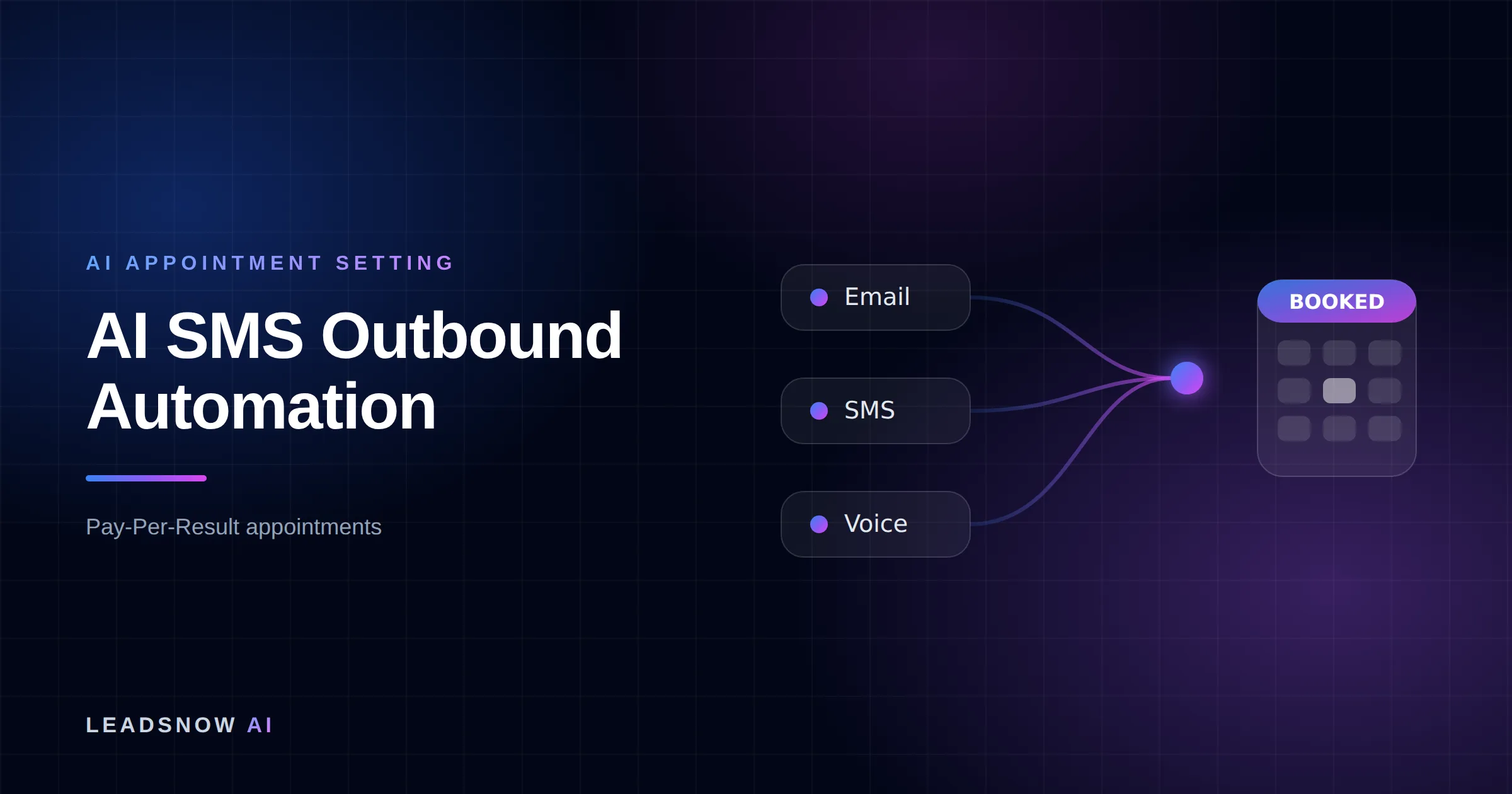
AI SMS outbound automation in 2026 means a conversational AI agent that works a lead over text the way a good SDR would:
- It opens the conversation — usually within seconds of an enquiry, or as part of a planned nurture or reactivation sequence.
- It reads and handles replies. “How much is it?”, “Who is this?”, “Can you call me after 5?” — the AI answers in context, in your voice, without a human watching the inbox.
- It qualifies. Budget, timeline, suburb, whatever your criteria are — asked naturally across a few messages, not as a form.
- It books. The end goal is a confirmed appointment in your calendar, not a click.
The difference matters commercially. A blast gets you unsubscribes and the occasional sale. A conversation gets you booked appointments. It also matters for compliance: two-way conversations from a reply-capable number sit far more comfortably inside Australia’s rules than one-way broadcasts, as you will see below.
How it works
How an AI sales agent books your appointments
Six channels feed in
Outbound email, SMS, voice and social — plus inbound search and AI referrals from our own AI SEO and chat agents.
Your list or CRM
Outbound starts from data you already own — past enquiries, dormant customers, or a targeted prospect list.
Qualified against your rules
Budget, timing and fit are checked before anything reaches your team, using criteria you set.
Booked into your calendar
Only qualified prospects reach the booking step, so your closers spend their time selling.
MAKE MORE SALES.
Pay-Per-Result pricing — We scale sales HARD aligned to your interests, better than anyone else.
The compliance picture in 2026 (verified at the source)
Two frameworks govern outbound SMS in Australia: the new SMS Sender ID Register and the Spam Act 2003. Here is what each actually requires, taken from ACMA’s own pages rather than the folklore that circulates in marketing blogs.
The SMS Sender ID Register: where it is actually at
Per ACMA’s SMS Sender ID Register page: “From 1 July 2026, new rules mean texts sent with an organisation’s name at the top of a message (known as a branded sender ID) will need to have the sender ID registered.” That date has now passed, and ACMA’s page currently carries the notice that SMS sent using unregistered sender IDs “are now being labelled as ‘Unverified’”.
The consequence of not registering is not that your messages get blocked. It is arguably worse: ACMA states that an unregistered sender ID “will be replaced with the word ‘Unverified’” and that all texts from ‘Unverified’ senders “will be grouped together in the same message thread on people’s phones, indicating to them it may be a scam”. Your carefully written follow-up lands in the same thread as actual scam attempts.
Three practical points, all per ACMA:
- If you send from a normal phone number, you do not need to register. ACMA is explicit: “If you don’t use a sender ID, or you send messages from a phone number, you don’t need to do anything.” Most two-way conversational AI SMS runs from reply-capable numbers for exactly this reason — an alphanumeric sender ID generally cannot receive replies, which kills the conversation before it starts.
- Registration goes through your telco or message provider, not directly through a public portal, and your Australian Business Register contact details need to be current.
- Sender IDs must be 2–11 characters and clearly linked to your organisation — your registered business name, trademark or domain name, or a recognisable shortening of it.
The Spam Act 2003: the three obligations
The Spam Act has covered commercial SMS since 2003, and ACMA’s guidance for senders boils it down to three things you must have before and in every commercial message:
1. Consent. Express consent (a form, a ticked box, a verbal yes) is best practice. Inferred consent exists but is narrower than most people assume: ACMA says it usually requires “a provable, ongoing relationship with your business” where the marketing is directly related to that relationship — and notes specifically that it “does not cover sending messages after someone has just bought something from your business”. The burden of proof sits with you, and you cannot text someone to ask for consent, because that message is itself marketing.
2. Sender identification. Every message must accurately identify your business and include correct contact details, and that information must remain correct for at least 30 days after sending. If an agency sends on your behalf, the message must still identify you as the authorising business.
3. A functional unsubscribe. ACMA’s requirements: the unsubscribe must be clearly presented, honoured within 5 working days, free (beyond a standard text charge), functional for at least 30 days after sending, and must not force people to log in or hand over extra personal information. For SMS, “Reply STOP” is ACMA’s own example of clear wording.
A well-built AI SMS system does not treat this as a legal afterthought. It sends from an identified, reply-capable number, processes STOP instantly rather than in five days, and only works lists it can prove consent for. If a vendor waves these questions away, walk.
Want this done for you? We book qualified sales appointments on a Pay-Per-Result basis — you only pay for calls that actually land in your calendar.
An honest note about SMS statistics
You will have seen the claim that “SMS has a 98% open rate”. We went looking for the primary source, because we cite it or we drop it. What we found: the figure traces back through years of vendor blogs to a 2016 Gartner article that itself attributed the number to unnamed “various sources”. No underlying study is identifiable, and carriers do not publish read-receipt data that could support it. So we do not use it, and we would be wary of anyone selling SMS services on the back of it.
What we can say from a verifiable source: Mailchimp’s own platform benchmarks put the average email open rate at 35.63% and the average click rate at 2.62% across industries (their data, last updated December 2023, with Mailchimp’s own caveat that Apple’s Mail Privacy Protection inflates reported opens). SMS does not have an equivalent independent benchmark. Our view, from running both channels since 2017: texts get seen and answered faster than email, and the honest way to prove it for your business is a measured test on your own list, not a folklore statistic.
Where AI SMS outbound pays off, ranked
Not every use case is equal. Here is where we see it earn its keep, in order.
1. Speed-to-lead: the SMS-first first response
When a lead fills in your form, the clock starts. A text lands in their pocket while they are still on your website; a phone call from an unknown number often goes to voicemail, and an email waits in a tab. An AI agent that texts within seconds, answers the reply, and offers times converts enquiries your team would otherwise reach the next morning — after the prospect has filled in three competitors’ forms. We cover the full workflow in our guide to speed-to-lead automation for Australian businesses.
2. Long-term lead nurture
Most leads that do not buy this month are not dead — they are early. No human rep will run disciplined touchpoints over a year, but an AI over SMS will: a short, useful message every few weeks, with the AI handling whatever comes back and booking the ones that warm up. Consent rules apply for the whole life of the sequence — the unsubscribe has to work in month eleven exactly as it did in week one.
3. Database reactivation
The old leads sitting in your CRM are the cheapest appointments you will ever book, because you already paid to acquire them. A reactivation campaign texts that dormant list with a genuine reason to reply, and the AI works every response through to a booking. In our own reactivation campaigns for Colliers, we averaged a 4.4% reply-to-appointment rate across the database, peaking at 8.9% on the best-performing sends — internal campaign figures, but on a list of a few thousand contacts you can do that arithmetic yourself. Consent still matters here: a dormant list is not automatically a consented list, so audit it before you send. Our step-by-step guide to running a database reactivation campaign covers the mechanics.
4. Appointment reminders and show-rate protection
The least glamorous use case and the easiest win. A confirmation text at booking, a reminder the day before, and a same-day nudge — with the AI handling “can we move it to Thursday?” instead of letting the booking silently die. Every no-show you prevent is revenue you already earned once.
If we can’t make you money, we don’t deserve yours.
Pay-Per-Result pricing — performance-based alignment.
AI SMS vs email vs AI voice vs human calling
No channel wins everywhere. Here is the honest comparison:
| Channel | Engagement reality | Compliance burden | Best use |
|---|---|---|---|
| AI SMS | Read quickly, easy to answer; no verified industry open-rate benchmark exists (see note above) — test on your own list | Spam Act 2003: consent, sender ID, working unsubscribe. Branded sender IDs must be registered with ACMA or get labelled ‘Unverified’; phone-number senders are exempt from registration | Speed-to-lead, nurture, reactivation, reminders — any conversation that benefits from being asynchronous |
| 35.63% average open rate and 2.62% click rate per Mailchimp’s platform benchmarks (Dec 2023 data; opens inflated by Apple MPP) | Spam Act 2003: same consent, identification and unsubscribe rules as SMS | Longer-form content, proposals, documents — anything a text cannot carry | |
| AI voice | Real-time conversation; reaches people who never read messages, but interrupts them to do it | Telemarketing rules: the Do Not Call Register and calling-hour restrictions apply to marketing calls | Instant callback on hot enquiries, qualification at scale — see our guide to AI voice agents for sales |
| Human calling | Highest-trust conversation available; capacity capped by headcount, hours and consistency | Same telemarketing rules as AI voice, plus training and QA burden sits with you | High-value, complex or sensitive deals where a relationship closes the sale |
In practice the strongest systems stack channels: text first, voice for the ones who want to talk, email for the paperwork, humans for the close. That is how our own campaigns run.
What good looks like when you build it
If you take one operating principle from this guide: build the system around conversations and compliance, not around volume. Concretely, that means a reply-capable number (which also keeps you outside the sender ID registration problem, per ACMA), consent records you could produce if asked, STOP handled instantly, an AI that has been trained on your offer and objections rather than a generic script, and calendar integration so a “yes” becomes a booked slot inside the same conversation.
It is worth saying plainly: you can assemble this yourself from off-the-shelf tools, and some businesses should. The gap between a working demo and a system that books appointments month after month is the unglamorous part — list hygiene, message iteration, handling the weird replies, watching the compliance edges. That part is our job. It is why we have 25 filmed client case studies and a 4.6/5 rating from 43 Google reviews, and why clients like Sam Tajvidi at 121 Brokers and Marcus Wilkinson at Iron Body let us put their names on the results. We charge on results, so the ROI conversation is about closed deals, not software licences.
If you send under a branded alphanumeric sender ID in Australia, registration is now the first operational step — see SMS sender ID registration in Australia.
Frequently asked questions
Do I need to register my SMS sender ID in Australia?
If you send texts with a branded sender ID (your business name at the top of the message), yes. According to the ACMA’s SMS Sender ID Register page, from 1 July 2026 texts sent with a branded sender ID need that sender ID registered, and messages from unregistered sender IDs are now being labelled as ‘Unverified’. If you send from a normal phone number, ACMA says you don’t need to do anything.
Is AI SMS outbound legal in Australia?
Yes, provided you comply with the Spam Act 2003: you need consent (express or properly inferred) before sending, every message must identify your business with correct contact details, and every message needs a functional unsubscribe that is honoured within 5 working days and stays functional for at least 30 days. The fact that an AI writes the messages doesn’t change any of these obligations.
How is AI SMS different from SMS blasting?
Blasting sends one message to many people and stops. AI SMS outbound is two-way: the system reads every reply, answers questions in context, qualifies the lead against your criteria and books appointments directly into your calendar. The message is the start of a conversation, not the end of one.
Can an AI really book appointments over text without a human?
Yes. The AI handles the back-and-forth (questions, objections, scheduling preferences) and confirms a time slot in your calendar within the conversation. Humans stay in the loop for the appointment itself and for any conversation the AI escalates. We’ve booked 50,769+ AI-booked sales appointments since 2017 on exactly this model.
What happens when someone replies STOP?
They must be unsubscribed and receive no further commercial messages. The Spam Act allows up to 5 working days to action an unsubscribe, but a properly built AI SMS system processes STOP instantly and suppresses the contact across all future campaigns. Instant suppression is also just good business: nobody warms up to a brand that keeps texting after being told to stop.
Can I text my old database of past leads and customers?
Only if you have consent that is still valid. Inferred consent generally requires a provable, ongoing relationship where the marketing relates directly to that relationship, and a list going cold for years weakens that claim. Before any reactivation campaign, audit how each contact was collected, remove anyone you can’t establish consent for, and make the unsubscribe prominent in the first message.
Ready to see what AI SMS could book for you?
If you want a straight answer on whether AI SMS outbound fits your business — and what a compliant, conversation-first system would look like on your actual lead flow and database — the fastest way is a call. We’ll look at your numbers together and tell you honestly, including if the answer is “not yet”.
Book a call — pick a time that suits you.
Pay-Per-Result appointments
See if we’re a fit
We book qualified sales appointments for you and you pay on results, not retainers. Our booking page asks a few quick questions so you find out in two minutes whether that model suits your business.
- 50,769+ appointments booked without cold calling.
- Pay-Per-Result pricing — you pay for booked, qualified calls.
- Pick your own time on our live calendar, no phone tag.