
Predictive lead scoring uses machine learning trained on historical CRM outcomes to calculate a numeric probability that a given lead will convert. The business payoff is simple: sales reps stop working leads in the order they arrived and start working them in the order they’re likely to close. Evaluation standards like ROC AUC and precision give teams a way to check the math, and some lead generation agencies now build entire outbound operations around this kind of prioritization.
TL;DR:
- Predictive lead scoring uses machine learning trained on historical CRM data to assign realistic conversion probabilities, improving prioritization accuracy.
- Effective models require at least several hundred consistently labeled closed deals to identify reliable sales patterns and prevent noise influence.
- Evaluation metrics like ROC AUC and F1-score are more meaningful than accuracy, especially with low conversion rates, to measure true model performance.
- Starting with simple logistic regression and pilot testing leads in a small sales segment helps ensure measurable improvements before full deployment.
- Outsourcing lead scoring through pay-per-result services can skip internal building, providing immediate prioritization benefits for teams lacking data science resources.
Table of Contents
- What Is Predictive Lead Scoring vs. Traditional Rules-Based Scoring?
- What Data Sources and Features Actually Drive Accurate Scores?
- Which Model Types and Metrics Should You Trust?
- How Do You Roll Out a Predictive Scoring Model, Step by Step?
- How Should Sales Actually Use the Score Once It’s Live?
- Where Do Predictive Models Break, and How Do You Keep Them Honest?
- What I’d Prioritize First If I Were Starting From Scratch
- A Faster Path if You’d Rather Not Build This In-House
- Sources
- FAQ
How it works
How an AI sales agent books your appointments
Your list or CRM
We start from data you already own — past enquiries, dormant customers, or a targeted prospect list.
The agent makes contact
Email, SMS and voice, with follow-up that persists for weeks instead of stopping after two attempts.
Qualified against your rules
Budget, timing and fit are checked before anything reaches your team, using criteria you set.
Booked into your calendar
Only qualified prospects reach the booking step, so your closers spend their time selling.
MAKE MORE SALES.
Pay-Per-Result pricing — We scale sales HARD aligned to your interests, better than anyone else.
What Is Predictive Lead Scoring vs. Traditional Rules-Based Scoring?
Traditional lead scoring assigns points by hand. A marketer decides a demo request is worth 20 points, an email open is worth 5, and a job title containing “director” is worth 10. Add them up, set a threshold, and call anything above 100 a “hot lead.” It’s fast to build and almost impossible to keep accurate, because nobody revisits the point values once the market shifts.
Predictive lead scoring flips that process. Instead of guessing weights, a supervised machine learning model studies thousands of closed-won and closed-lost records and learns which combinations of signals actually preceded a sale. The output isn’t an arbitrary point total. It’s a probability, something like “this lead has a 71% chance of converting based on patterns from leads that looked just like it.”
That distinction changes how routing works in practice:
- Rules-based scores rank leads by what a marketer assumes matters.
- Predictive scores rank leads by what the historical data proves matters.
- Probabilities can be recalibrated automatically as new deals close, while point systems require manual rewrites.
A more advanced variant, uplift modeling, goes a step further by ranking leads on how much outreach itself would move the needle, rather than just their raw likelihood to buy, according to NVIDIA’s documentation on uplift and propensity approaches. That’s useful for teams with limited SDR capacity who want to avoid spending calls on leads who’d convert anyway.
Want this done for you? We book qualified sales appointments on a Pay-Per-Result basis — you only pay for calls that actually land in your calendar.
What Data Sources and Features Actually Drive Accurate Scores?
A model is only as good as what you feed it, and most teams underestimate how much signal lives in behavior rather than firmographics.
Explicit features describe who the lead is:
- Firmographic data: company size, industry vertical, annual revenue
- Job title and seniority
- Stated purchase intent (form fields, budget range, timeline)
Implicit features describe what the lead does:
- Page views and time spent on pricing or product pages
- Email opens, clicks, and reply behavior
- Form completions and demo requests
- Time elapsed since first touch
A case study published in PMC found that lead source and lead status were among the strongest predictors of conversion, often outperforming firmographic assumptions marketers had relied on for years. Behavioral signals like repeated page views frequently carry more weight than a title on a business card.
None of this works without clean CRM outcome labels. If “closed-won” and “closed-lost” are recorded inconsistently, or reps mark deals lost without a reason code, the model learns from noise. Third-party enrichment (firmographic databases, intent data providers) can fill gaps, but always check consent and data-sourcing terms before importing external records.
Pro Tip: Before you build anything, run a label audit. Pull 100 random closed deals and check whether the outcome field actually matches what happened in the deal. If more than 10% are wrong, fix your CRM hygiene before you touch a model.
Which Model Types and Metrics Should You Trust?
Most teams start with logistic regression because it’s interpretable and fast to train, then move to tree-based ensembles (random forest or gradient boosting) once they have enough labeled history to capture nonlinear patterns.
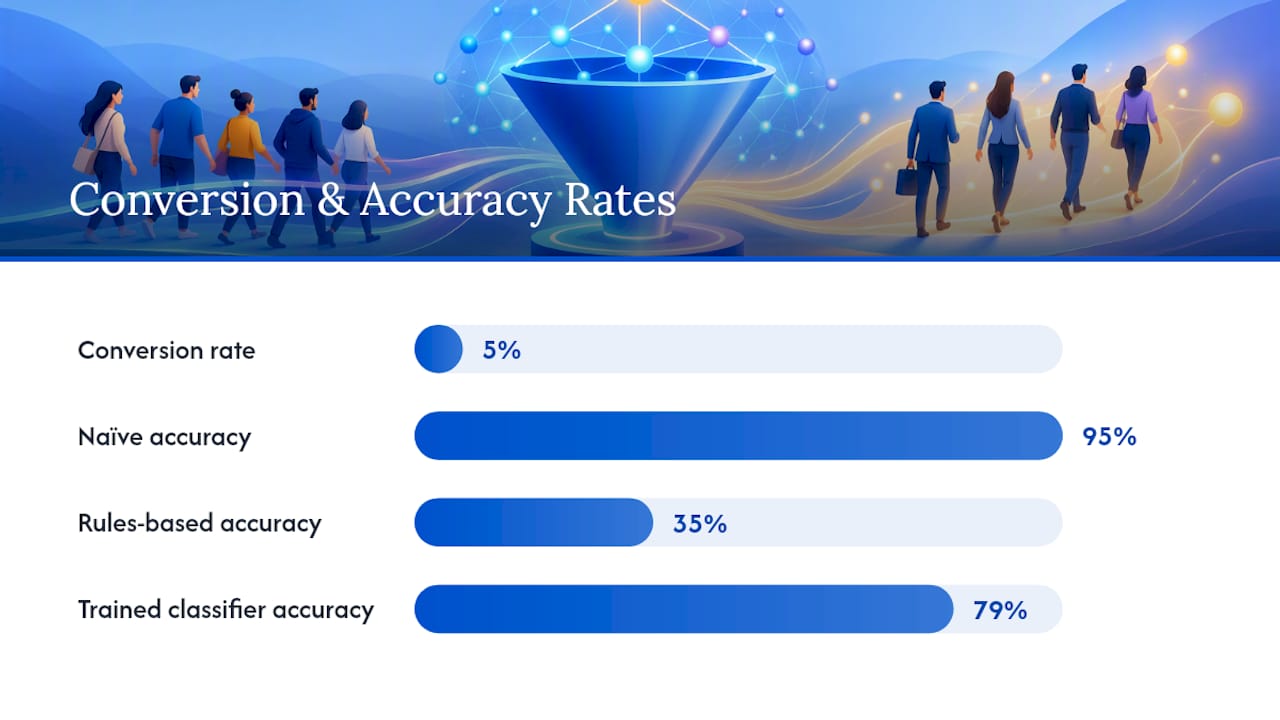
Whatever model you choose, resist the temptation to judge it on raw accuracy. If only 5% of leads convert, a model that predicts “never converts” for everyone will be 95% accurate and completely useless. That’s why practitioners lean on a different toolkit:
- ROC AUC to measure how well the model separates converters from non-converters
- Precision at top-k to check how many of your highest-ranked leads actually convert
- Recall and F1-score to balance missed opportunities against wasted outreach
- Calibration checks to confirm a “70% probability” lead actually converts about 70% of the time
Research on classification tasks with imbalanced outcomes recommends exactly this shift, favoring ROC AUC and F1-score over accuracy when conversion rates are low.
An open-source lead-scoring project on GitHub illustrates the scale of improvement possible: in that worked example, moving from a rules-based baseline to a trained classifier lifted accuracy from roughly 35% to 79% while sharply cutting false positives. Results like that are illustrative rather than universal, but they show why the metric shift matters. Feature-importance tools and SHAP values also matter here, not for math’s sake, but because sales reps won’t trust a score they can’t interrogate.
If we can’t make you money, we don’t deserve yours.
Pay-Per-Result pricing — performance-based alignment.
How Do You Roll Out a Predictive Scoring Model, Step by Step?
Skipping steps here is how well-intentioned projects turn into ignored dashboards. Work through this in order:
- Check data readiness. You generally need at least several hundred closed-won and closed-lost records with consistent labels before a model can find reliable patterns. Fewer than that, and you’re better off with a well-built rules system for now.
- Clean and prepare the data. Standardize field formats, deduplicate contacts, and resolve conflicting outcome labels.
- Train a baseline model. Start with logistic regression so you have an interpretable reference point.
- Run champion/challenger testing. Compare a more complex model (gradient boosting, for example) against the baseline on held-out data before deploying either.
- Validate against business KPIs, not just statistical metrics. Does the top-scored decile actually close at a meaningfully higher rate than average?
- Publish scores into the CRM on a defined cadence, daily or hourly depending on lead volume, using a repeatable sync pattern.
- Set a retrain schedule and rollback plan before launch, not after something breaks.
Teams on modern data warehouses can shortcut some of this. Snowflake’s ML-powered classification guide walks through building a training view, running predictions, and pushing scored leads back into an activation table, a pattern worth studying even if you’re on a different stack.
Pro Tip: Don’t publish scores CRM-wide on day one. Pilot with one sales pod for two to four weeks and compare their conversion rate against a control group still working the old queue. That’s your real proof, not the model’s training metrics.
How Should Sales Actually Use the Score Once It’s Live?
A number in a CRM field changes nothing by itself. It only works when it triggers a specific action.
- Band the scores. Top decile goes straight to your fastest closers with a same-day outreach SLA; mid-band leads go into a standard queue; bottom-band leads go into automated nurture instead of live outreach.
- Set and measure response-time SLAs. A lead scored in the top 10% that sits untouched for three days is a wasted signal, so track acceptance time alongside conversion lift.
- Build a feedback loop. Have reps flag when a high-scored lead was clearly a bad fit, and feed that outcome back into the next training cycle.
Lower-scored leads shouldn’t just get ignored. Routing them into a structured nurture sequence keeps them warm until behavior signals push their score up. A logistics company that replaced fixed pipeline-stage probabilities with a trained model saw its per-stage prediction accuracy jump from 50% to 87%, which fed directly into better revenue forecasting, not just better lead lists.
Where Do Predictive Models Break, and How Do You Keep Them Honest?
Most failures trace back to one root cause: bad labels in, bad predictions out. If reps mark “closed-lost” inconsistently or skip reason codes, the model inherits that mess and repeats it at scale.
- Audit labels quarterly, not just at launch, since CRM discipline tends to erode over time.
- Test for bias by removing protected or proxy features (zip code standing in for income, for instance) and running disparate-impact checks before scores go live.
- Watch for drift. A model trained on last year’s buyer behavior degrades as markets, products, and messaging change, so set a retraining cadence rather than a “set it and forget it” schedule.
- Keep a human override in the loop. Reps who can’t see why a lead scored high tend to ignore the score entirely, which defeats the entire project.
For teams operating in Europe, it’s worth knowing that routine marketing lead scoring generally falls outside the EU AI Act’s Annex III high-risk category, though GDPR’s profiling rules still apply and shouldn’t be treated as optional. LeadsNow AI builds compliance-aware scripting and human qualification steps directly into its AI outbound process for exactly this reason, treating explainability as an operational requirement rather than an afterthought.
What I’d Prioritize First If I Were Starting From Scratch
Audit your labels before you touch a single model. Garbage-in problems kill more scoring projects than bad algorithms ever will. Once labels are clean, build the simplest baseline you can, logistic regression, not a neural network, and route only the top percentile to your best closers while everyone else stays in the existing process.
Hire outside data science help when your data volume or timeline outpaces your internal bandwidth; build in-house when you have the historical depth and the patience to iterate slowly and earn sales trust over time.
— Riley
A Faster Path if You’d Rather Not Build This In-House
Building a predictive scoring pipeline from scratch takes clean historical data, a data scientist’s time, and months of champion/challenger testing before it pays off. Some agencies skip that build phase entirely: they run AI sales agents and data-driven qualification against your funnel and charge only when a qualified appointment lands on the calendar, so you’re never paying for a model that hasn’t proven itself yet.
That pay-per-result structure makes the most sense when you don’t have several hundred clean closed-won records to train on, when you need pipeline moving faster than a build-test-retrain cycle allows, or when your team simply doesn’t have the bandwidth to own model governance on top of quota. Leadsnow’s AI Appointment Setting service pairs AI-powered outbound with human qualification and compliance-aware scripting, so leads arrive pre-scored and ready for a rep’s calendar rather than sitting in a queue waiting on a model to catch up. Check current pricing and revenue-share terms to see what a per-result setup would look like for your funnel.
Sources
- The relevance of lead prioritization: a B2B lead scoring model based on machine learning – PMC
- Nativerse/lead-scoring-ml-model (GitHub)
FAQ
What Is Predictive Lead Scoring in Simple Terms?
Predictive lead scoring is a machine learning process that studies your past closed-won and closed-lost deals and assigns each new lead a conversion probability. Unlike manual point systems, the weights come from actual outcome data rather than a marketer’s assumptions.
How Much Data Do You Need to Start?
You generally need several hundred labeled closed-won and closed-lost records with consistent CRM outcomes before a model can find reliable patterns. Below that threshold, a well-maintained rules-based system usually performs better until you accumulate more history.
Which Metric Matters Most for Evaluating a Lead Scoring Model?
Raw accuracy is misleading when conversion rates are low, so ROC AUC and F1-score are the preferred metrics for imbalanced data. Precision at top-k and calibration checks matter too, since they confirm your highest-ranked leads actually convert at the rate the model predicts.
Can I Outsource Predictive Lead Scoring Instead of Building It?
Yes. Leadsnow runs AI-driven lead qualification and appointment setting on a pay-per-result basis, charging 1 to 5% per booked result or a revenue-share arrangement, so teams without in-house data science can still prioritize leads without building a model first.
Does Predictive Lead Scoring Replace Human Judgment?
No. The strongest implementations keep a human-in-the-loop override so reps can flag mismatches between a score and what they see in a real conversation. Models trained without that feedback loop tend to drift and lose sales trust over time.
Recommended
- AI Appointment Setter vs Human SDR for Coaches: 2026 Cost & Performance Breakdown
- How To Re-Engage Old Fitness Client Leads
- Best Lead Generation Agencies for High-Ticket Coaches in Australia (2026)
- Database Reactivation: How We Hit 4.4% Average (and 8.9% Peak) Conversion on Dormant CRM Leads
Pay-Per-Result appointments
See if we’re a fit
We book qualified sales appointments for you and you pay on results, not retainers. Our booking page asks a few quick questions so you find out in two minutes whether that model suits your business.
- 50,769+ appointments booked without cold calling.
- Pay-Per-Result pricing — you pay for booked, qualified calls.
- Pick your own time on our live calendar, no phone tag.