
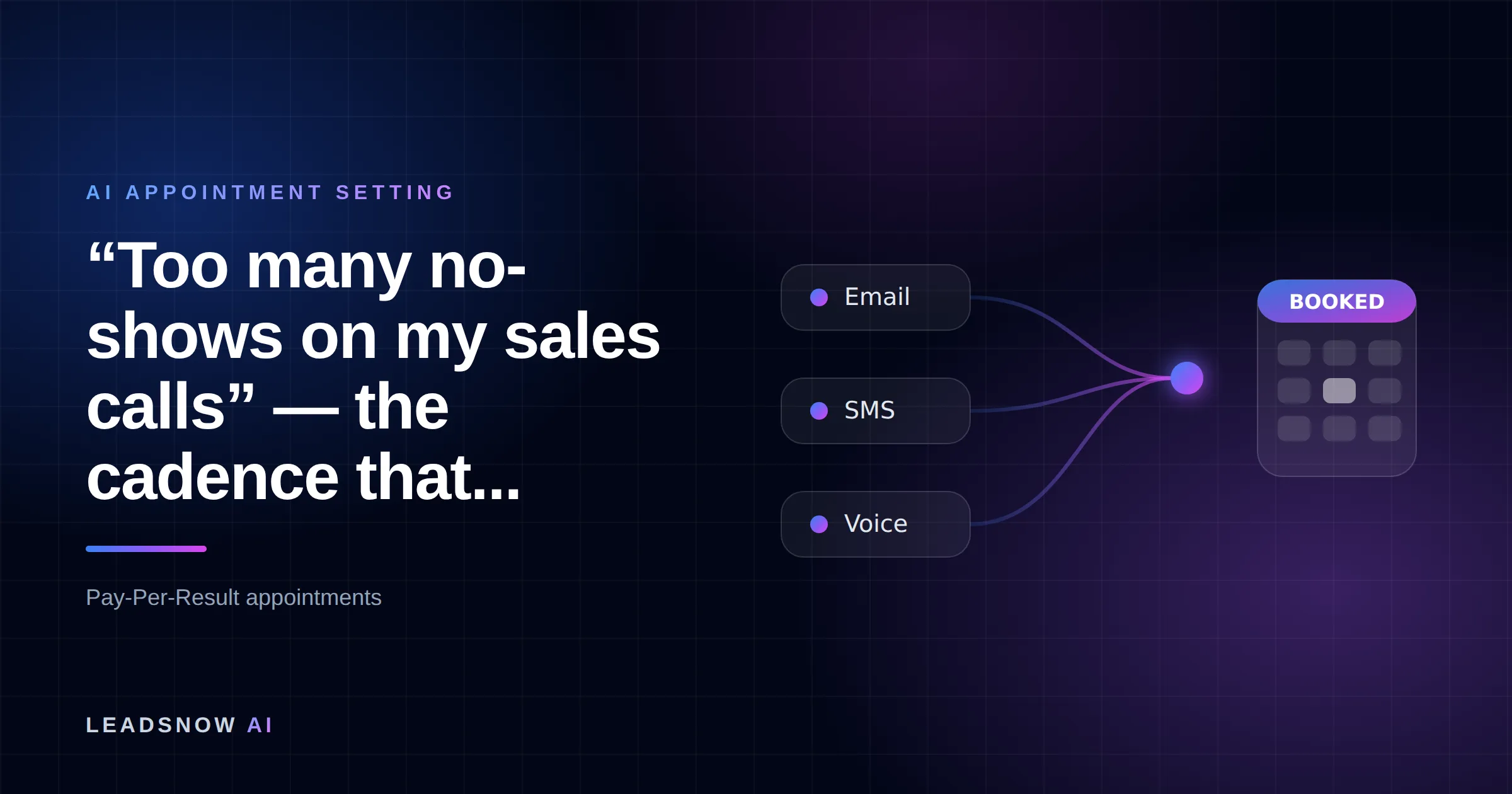
Re-confirm every call already on this week’s calendar by hand today, then install a four-touch cadence: SMS within 60 seconds of booking, again at 24 hours out, 2 hours out and 10 minutes out. In RevenueHero’s December 2024 benchmark of 6,428 booked B2B meetings, only 76.1% were actually completed — roughly one booked meeting in four never happens anywhere.
At a glance
- Today, free: personally re-confirm every meeting in the next five days and ask for a reply. Do not touch your lead source.
- The benchmark: 6.5% outright no-shows but only 76.1% completed across 6,428 inbound B2B meetings (RevenueHero, week of 13 December 2024). Outbound-sourced calls run worse.
- The cadence: the 60/24/2/10 — 60 seconds after booking, 24 hours out, 2 hours out, 10 minutes out, each on a different channel.
- The structural fix: book inside 14 days. In a 51,529-appointment clinic study, no-shows rose from 9.1% at 0–2 weeks’ lead time to 38.3% at six months.
- The honest part: one bad month at 20 bookings is inside normal random variation. Three is a trend.
How it works
Triage for a collapsing sales-call show rate
Re-confirm this week
Personally message every meeting booked in the next five days and ask for a reply. Costs nothing and recovers calls tonight.
Split the four outcomes
Separate completed, no-show, cancellation and reschedule in the CRM. You cannot fix a number that does not exist yet.
Install 60/24/2/10
Four touches: 60 seconds after booking, 24 hours out, 2 hours out, 10 minutes out, each on its own channel.
Shorten the lead time
Book inside 14 days. Any slot further out gets an extra confirmation touch before the day.
MAKE MORE SALES.
Pay-Per-Result pricing — We scale sales HARD aligned to your interests, better than anyone else.
“I’m getting too many no-shows on my sales calls” — how bad is it actually?
Find out first whether you have a problem or a bad month. Show rate is held meetings ÷ booked meetings over a fixed window, and at low volume it is a noisy number. At 20 booked meetings a month and a true show rate of 70%, one standard error is √(0.7×0.3÷20) = ±10.2 percentage points — so a 60% month is statistically indistinguishable from an 80% month.
The three-month show-rate test: at 20 bookings a month you need roughly 60 meetings before a 10-point drop is signal rather than a month. At 100 bookings the same margin shrinks to ±4.6 points and you can read a single month.
| What you are seeing | Volume behind it | Is it urgent? | What to do |
|---|---|---|---|
| Show rate fell 10 points for one month | Under 60 booked meetings | No — inside normal variation | Nothing structural. Log it, wait a month. |
| Show rate fell 10 points for three consecutive months | 60+ booked meetings | Yes | Install the cadence below and audit booking lead time. |
| Show rate under 50% at any volume | Any | Yes | Check qualification before reminders. This is usually a booking problem. |
| Show rate fine, revenue down | Any | No — wrong metric | They are turning up. The leak is after the call. |
| Cancellations up, no-shows flat | Any | No | Different event, different fix — see cancelled appointment recovery. A cancellation is a message; a no-show is silence. |
Want this done for you? We book qualified sales appointments on a Pay-Per-Result basis — you only pay for calls that actually land in your calendar.
What to do in the next 24 hours
All four of these cost nothing and need no software you do not already have.
- Re-confirm this week by hand. Every meeting in the next five days, personally, by SMS or a short call, asking for a reply. Not an automated blast — the reply is the point.
- Split the four outcomes in your CRM. Completed, no-show, cancellation, reschedule. Most calendars dump all four into one “didn’t happen” field, and you cannot fix a number that does not exist. An afternoon’s work, and the prerequisite for everything else.
- Text whoever already missed you. Everyone who no-showed in the last seven days, today, offering two named times rather than a calendar link — a separate discipline with its own metric, no-show recovery rate.
- Put a one-tap reschedule link in every confirmation. Someone who can move the meeting in two taps moves it; someone who cannot, ghosts. A reschedule is still live pipeline.
Do not, today, pause your ads, fire your setter or rewrite your offer. Those decisions are hard to reverse inside a week, and a single month of data does not support any of them.
The 60/24/2/10 cadence: what to send, when, and on which channel
Four touches before the meeting, each doing a different job. A fifth and sixth touch buys opt-outs rather than attendance, and we have not found evidence that it helps; under Australia’s Spam Act and the US TCPA, consent to be messaged is a legal question, not a volume question.
| Touch | When | Channel | What it does | The job it is doing |
|---|---|---|---|---|
| 1. Confirm | Within 60 seconds of booking | SMS + calendar invite | Date, time and time zone. Asks for a one-word reply. | Turns a click into a stated commitment, and proves the mobile number works. |
| 2. Repeat back | 24 hours before | SMS from the person running the call | One line on what will be covered, then “still good for 10:30 tomorrow?” | Asks for an active reply, not a passive notification. The highest-value touch in the ladder. |
| 3. Remove friction | 2 hours before | Join link, who is dialling, how long it runs, one-tap reschedule. | Kills the “couldn’t find the link” no-show; turns wobblers into reschedules. | |
| 4. Live nudge | 10 minutes before | SMS | “Starting in 10 — link’s in your email.” | Catches the person whose previous meeting ran over. |
| 5. Handle the miss | 2 minutes after the start time | Call, then SMS | “Just tried you — run it now, or move it?” | Not part of the ladder — recovery is its own sequence. |
Touch 2 is the one to get right, and the reason is evidential rather than stylistic: asking someone to actively restate a commitment outperforms telling them about it. In two NHS Bedfordshire practices (Martin, Bassi & Dunbar-Rees, Journal of the Royal Society of Medicine, 2012), asking patients to verbally repeat back the time and date before hanging up cut did-not-attends by 3.5% the following month, and having patients write the appointment down themselves cut them by 18% against the previous six-month average. That is general practice healthcare, not B2B sales: what we are borrowing is the mechanism — an active reply beats a passive notification — not the size of the effect, which will not transfer.
If we can’t make you money, we don’t deserve yours.
Pay-Per-Result pricing — performance-based alignment.
The next 7 days: shorten the gap between booking and meeting
Lead time — the gap between the booking and the meeting — is the structural driver almost nobody in sales touches. McMullen and Netland analysed 51,529 appointments over 12 months at the University of Virginia Eye Clinic (Clinical Ophthalmology, 2015) and found the no-show rate climbed from 9.1% at 0–2 weeks of lead time to 38.3% at six months in the high-no-show clinic, with the same gradient in the low-no-show clinic (2.4% to 6.9%).
That is a clinic, not a sales team, and the absolute rates will not transfer. The gradient does: intent decays, and everything competing for that hour has more time to intervene. Book inside 14 days, and treat any slot beyond that as one needing an extra confirmation touch. Open more near-term slots, stop offering “week after next” as the polite default, and if your setter books three weeks out because the closers’ calendars are full, your show rate is reporting a capacity problem, not a commitment problem.
Why a good cadence stops working: the failure nobody writes down
The same NHS study contains the result most reminder advice leaves out. Its first intervention — giving patients a four-digit appointment reference to write down — increased no-shows. Not because the theory was wrong: reception staff quietly stopped doing it. Swapped for something they were willing to run every time, the effect appeared immediately.
A cadence that is 80% executed beats a better cadence that is 40% executed, every time. Run the 60/24/2/10 by hand and it costs roughly six to eight minutes per booked meeting including reply handling; at 40 bookings a month that is four to five hours, and it breaks the first week its owner is on leave or busy closing. The real decision is not which messages to send but whether the sending survives a bad week. Automating touches 1, 3 and 4 and keeping touch 2 human is where most teams land — and running the boring touches without exception is most of what AI appointment setting systems are doing when they report higher show rates.
What a 15-point show-rate recovery is worth
Work it with your own numbers; here is the arithmetic end to end.
- 40 booked calls a month at a 65% show rate = 26 held meetings.
- Same 40 bookings at 80% = 32 held meetings. Six more, 72 a year.
- At a 25% close rate and an $8,000 average deal, that is 18 extra closed deals a year, or about $144,000 — on identical lead spend.
- Substitute your own four numbers. The point is the denominator: those 40 bookings are already paid for, so every recovered meeting is margin, not cost.
Our own record is 50,769+ AI-booked sales appointments since 2017. We deliberately do not publish a held-rate figure from that book of work: the spread between clients is wide, and a number we cannot pin to a stated window and sample is not evidence, it is decoration. Use your own baseline instead — the booked, held, cancelled and no-show counts you separate in step 2 above are the only ones that describe your pipeline. The calm, non-urgent version of all this is our sales appointment show rate playbook.
When no-shows are not yours to fix
Three cases where a reminder cadence is the wrong tool:
- They never really agreed. Where a calendar slot is the easiest way to end a conversation, the fix is qualification depth before the calendar appears, not messaging after it. A show rate under 50% is almost always this.
- Somebody else is paid per booking. If an outsourced setter is paid on meetings booked rather than meetings held, no cadence outruns the incentive. That is a contract conversation — our guide to judging appointment-setting vendors on show rate lists the questions to ask.
- It is not a sales problem. Non-payment, a disputed contract or a messaging-consent complaint is work for a lawyer or an accountant; in Australia the Spam Act is administered by the ACMA, not by your CRM vendor. Nothing here is legal or financial advice.
Frequently asked questions
Is a 30% no-show rate normal on sales calls?
It is high for inbound and unremarkable for cold outbound. RevenueHero’s no-show benchmark of 6,428 inbound B2B meetings found a 6.5% outright no-show rate but only 76.1% completion once cancellations and reschedules were counted, with developer tools at 1.2% and education software at 18.1%. Those are instantly-booked inbound demos — the friendliest possible conditions — so a 30% miss rate on outbound-sourced calls is a cadence problem, not a catastrophe.
Do SMS reminders actually reduce no-shows, or is that vendor marketing?
The effect is real but modest, and it comes from the commitment rather than the notification. In Martin, Bassi and Dunbar-Rees (Journal of the Royal Society of Medicine, 2012), asking patients to repeat back the appointment time cut did-not-attends 3.5%, having them write it down themselves cut them 18%, and the full set of changes produced a 31.7% reduction against the previous 12-month average — with the effect disappearing when the interventions were paused. A reminder someone reads does less than a reminder someone answers.
If they no-show, weren’t they just unqualified?
Sometimes — and below a 50% show rate, usually. But it is a testable claim rather than an article of faith: text your last 20 no-shows, offer two named times instead of a calendar link, and count how many hold a rebooked meeting. A missed call is more often a collision with the rest of someone’s day than a verdict on your offer, and no-show recovery rate is the metric that settles it.
Should I charge a deposit or a no-show fee?
Be careful. Penalties for non-attendance can backfire: the same Journal of the Royal Society of Medicine paper notes the finding that penalising late or non-attending parents at children’s day care centres actually increased lateness and non-attendance, because a fine converts a social obligation into a purchasable service. A deposit also suppresses booking volume, which may cost more than the no-shows. If you do charge, consumer law and your payment terms apply; that is a question for your accountant or lawyer, not for a sales page.
How many reminders is too many?
Four before the meeting is the practical ceiling in the cadence above, and the constraint is legal as well as editorial: in Australia the Spam Act requires consent and a functional unsubscribe on commercial electronic messages, and in the US the TCPA governs SMS consent. Volume past the point of usefulness buys opt-outs and complaints, not attendance.
What show rate should I actually target?
For qualified, confirmed appointments, 75–80% held is a realistic ceiling for most outbound-sourced pipelines, and the last five points cost more than the first twenty. Aim to get from wherever you are to 75%, then stop optimising the cadence and start optimising the call itself.
Pay-Per-Result appointments
See if we’re a fit
We book qualified sales appointments for you and you pay on results, not retainers. Our booking page asks a few quick questions so you find out in two minutes whether that model suits your business.
- 50,769+ appointments booked without cold calling.
- Pay-Per-Result pricing — you pay for booked, qualified calls.
- Pick your own time on our live calendar, no phone tag.