
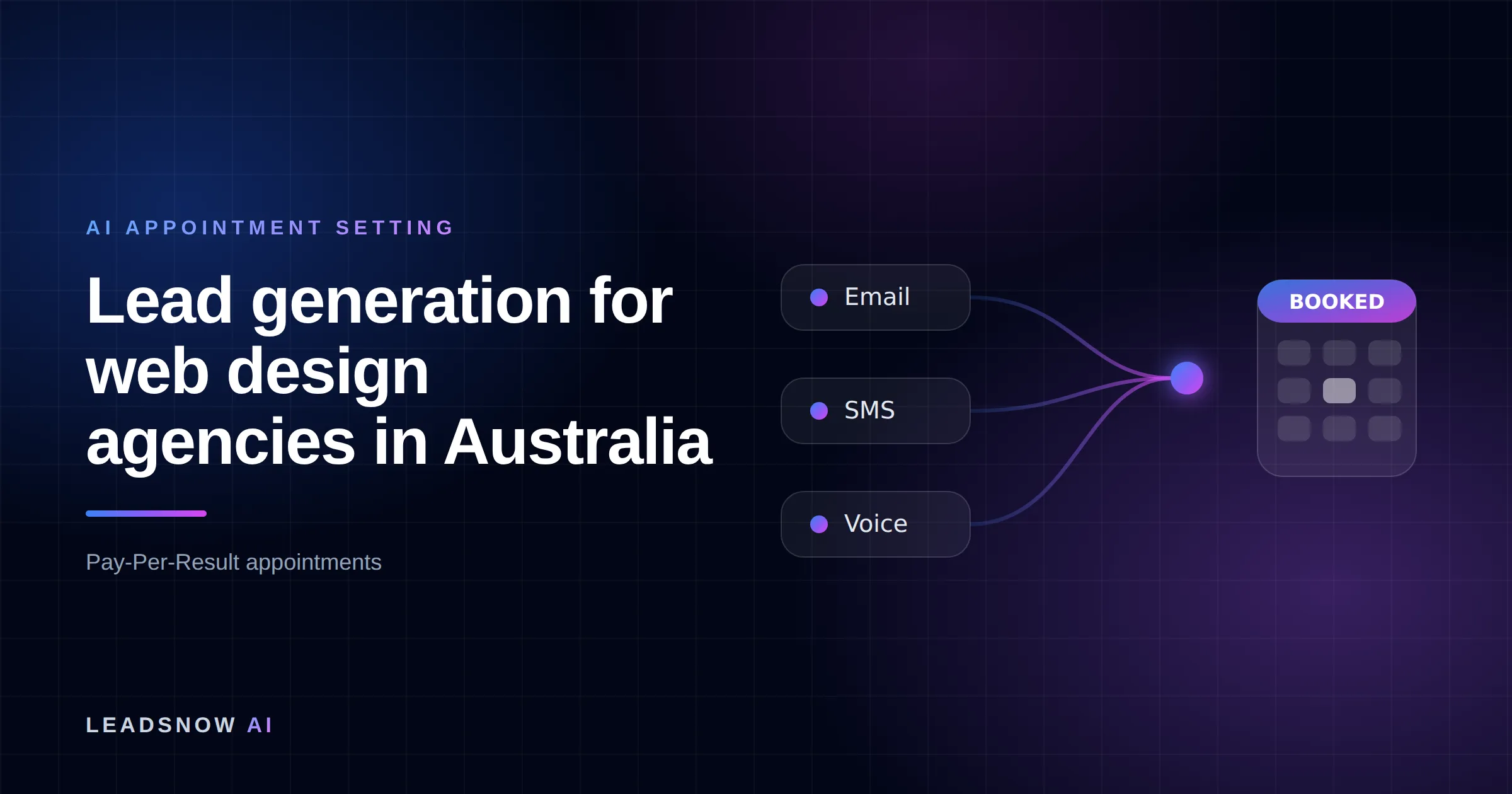
Lead generation for a web design agency in Australia starts with arithmetic: to win 3 builds a month at an 80% show rate, proposals on 60% of calls and a 35% win rate, you need about 18 booked discovery calls a month, and prospecting must start once booked work drops below two sales cycles.
At a glance: lead generation for Australian web design and development studios
- The formula: booked calls needed = projects wanted ÷ (show rate × proposal rate × win rate). The inputs above are illustrative; use your last 12 months.
- The timing rule: the build-gap rule says prospecting has to start when booked work falls below two sales cycles, not when the calendar empties.
- The cheapest source: your own proposals that went quiet and past clients without a care plan, not new traffic.
- The recurring fix: convert finished builds into monthly care, hosting or growth plans, so each project lead is worth more than one invoice.
- The compliance line: the ACMA requires consent, sender identification and a working unsubscribe for marketing emails and SMS.
- How LeadsNow is paid: a share of the revenue we help generate (5-20%) or a per-appointment fee, not a retainer.
Why web design agencies run out of pipeline between projects
Web design agencies run out of pipeline between projects because the people who sell are the same people who build. When a studio is busy delivering, nobody prospects; when the builds ship, the pipeline is empty and the next signed deposit is still a full sales cycle away. The revenue gap is created a full sales cycle before anyone notices it.
Three features of the web build market make this worse than in most service businesses:
- One-off purchases. A client who buys a site may not need another for years, so project revenue does not compound unless something recurring is attached to it.
- Long, lumpy decisions. A build usually needs sign-off from more than one person at the client, plus content, copy and budget approval, so a proposal can sit for weeks without being lost.
- Referral dependence. Word of mouth delivers good clients at an unpredictable rate, which is the opposite of what a studio with fixed salaries needs.
How it works
How a web studio closes the gap between builds
Measure the build gap
Compare weeks of booked build work with your median days from first call to signed deposit. Below two cycles, prospecting starts.
Rework stalled proposals
Re-contact quiet proposals and past clients with consent and a specific reason, such as a platform end-of-support date.
Book discovery calls
Qualify on budget band, timing, decision-makers and current platform, then book with reminders. Target = projects / (show x proposal x win rate).
Sell the plan at launch
Confirm a monthly care or growth plan at the launch meeting so each project keeps paying after the build.
MAKE MORE SALES.
Pay-Per-Result pricing — We scale sales HARD aligned to your interests, better than anyone else.
The build-gap rule: when a web studio should start prospecting
The build-gap rule compares your weeks of booked work with your own sales cycle, measured as the median days from first discovery call to signed deposit. If your sales cycle is six weeks, then five weeks of booked work means the gap is already locked in: nothing you start today can sign before the current work ends. The thresholds are a decision rule, not an industry benchmark; no reliable public benchmark for Australian web studio sales cycles exists.
| Weeks of booked build work | What it means | What to do this month |
|---|---|---|
| More than 2× your sales cycle | Pipeline is ahead of delivery | Convert every build finishing this month to a care or growth plan; ask each launch client for one introduction |
| Between 1× and 2× your sales cycle | Pipeline is on time, not ahead | Keep booked discovery calls at your formula target; re-contact proposals older than 90 days |
| Less than 1× your sales cycle | A revenue gap is already locked in | Work every open and lost proposal from the last 24 months this week; offer past clients a scoped upgrade that can start immediately |
| No signed work beyond this month | Cash-flow risk, not a marketing problem | Past clients first (they sign fastest), then partner agencies with overflow, then new outbound |
The build-gap rule in one sentence: a web studio should prospect hardest in the month it feels least able to, because that is when the next gap is being created.
Want this done for you? We book qualified sales appointments on a Pay-Per-Result basis — you only pay for calls that actually land in your calendar.
How many discovery calls does a web design agency need?
A web design agency needs booked discovery calls equal to the projects it wants divided by the product of its show rate, proposal rate and proposal win rate. Here is the worked calculation from the answer above, with inputs you should replace with your own:
- Projects wanted per month: 3.
- Show rate: 80% of booked calls happen.
- Proposal rate: 60% of held calls are qualified enough to receive a proposal.
- Win rate: 35% of proposals sign.
- Calculation: 0.8 × 0.6 × 0.35 = 0.168 projects per booked call. 3 ÷ 0.168 = 17.9, so 18 booked calls a month.
Two things follow. First, raising the show rate from 80% to 90% cuts the requirement to 16 calls, which is why reminders and a short confirmation call matter as much as lead volume. Second, 18 booked calls a month means about 14 held calls and 9 proposals. At four hours per proposal and 45 minutes per call, the founder spends roughly 45 hours a month selling, before a single prospect has been found or chased.
Where a web studio’s best leads already are
A web studio’s best leads are usually already in its own inbox and CRM: proposals that stalled, enquiries that went quiet after a first call, and past clients whose sites are now two or three years old. They already know the studio’s work, which removes most of the trust-building a cold prospect needs.
Two practical checks before contacting them:
- Consent. The ACMA’s guidance says inferred consent usually depends on a provable, ongoing relationship, and that it does not cover sending messages after someone has just bought something from you. A client on a monthly hosting or care plan has an ongoing relationship; a client who bought one build three years ago may not. Collecting express consent at project handover solves this for the future.
- Relevance. Re-contact with something specific: a platform end-of-support date, a performance audit of their current site, the scope you left out of the original proposal, or a capability they did not need when the site was built. The ABS found 12% of all Australian businesses reported using AI in 2024-25, and 32% received orders online.
The step-by-step method, including message sequencing and when to stop, is on our guide to running a database reactivation campaign.
If we can’t make you money, we don’t deserve yours.
Pay-Per-Result pricing — performance-based alignment.
Comparing lead generation channels for web design agencies
Each channel below is compared on how you pay, who owns the client relationship, and who it is wrong for. Prices vary too much by city and scope to benchmark honestly, so the table compares structure.
| Channel | How you pay | Who owns the lead | Main constraint | Wrong for |
|---|---|---|---|---|
| Referrals and past clients | Time; sometimes a referral fee | You | Unpredictable volume | Studios with fixed payroll and no other source |
| B2B directories and review platforms | Listing or sponsored placement | You, once they enquire, but they compare you side by side with competitors | Price-shopping buyers | Premium studios competing on process, not price |
| Paid search on “web design [city]” | Per click | You | High-competition terms in Sydney and Melbourne | Studios without a tested landing page and fast follow-up |
| Partner agencies (white-label or overflow) | Margin share | The partner owns the client | Your brand stays invisible | Studios trying to build their own brand |
| In-house cold email and LinkedIn | Tools plus founder or SDR time | You | Spam Act consent rules; deliverability | Founders who cannot protect 10+ hours a week |
| Pay-per-result appointment setting | Revenue share or per appointment | You | Needs a clear offer and a calendar that can take calls | Studios with no sales process after the call |
If you want to resell appointment setting to your own clients rather than use it yourself, that is a separate model with different economics; see white-label lead generation for agencies.
Turning one-off web projects into retainers
A web project becomes a retainer when the studio sells the next twelve months at the launch meeting, not six months later. The build is the moment of highest trust and the moment the client first sees what the site is not yet doing: rankings, conversion tracking, content, speed.
- At proposal: price the care or growth plan as an optional line so it is anchored before the build starts.
- At launch: book a 30-day review before the launch meeting ends, and collect consent for ongoing contact.
- At 30 and 90 days: send the site’s own numbers (traffic, enquiries, speed) and propose one change.
The arithmetic is simple: if a studio offers a monthly plan on 30 builds a year and 10 clients take it up, the studio starts the next year with 10 recurring clients, and each new project lead is worth the build plus the plan.
How a pay-per-result setter programme runs for a web studio
For a web studio, a done-for-you programme covers the parts of the build-gap rule the founder cannot keep up while delivering: answering new enquiries within minutes, qualifying on budget band, timing, decision-makers and current platform, reworking stalled proposals and past clients with consent, and booking discovery calls with reminders. The founder keeps the call, the proposal and the close.
LeadsNow is paid on results: a revenue share of 5-20% of the sales we help generate, or roughly 1-5% of closed-deal value per appointment, not a retainer. Our headline record is 50,769+ AI-booked sales appointments since 2017 and 1M+ leads generated, and show rate varies by offer and reminder cadence, up to 93% on our best-performing accounts. How this compares with paying a marketing retainer is set out in pay-per-result versus retainer, and our wider work with studios and agencies is on the agencies page.
It is the wrong fit for a studio whose typical job is a small template site with no follow-on plan: the revenue per booked call is too low to carry a setter, and referrals plus a well-run directory profile will do more.
Frequently asked questions
How do web design agencies get clients in Australia?
Mostly through referrals and past clients, supported by paid search, directories and partner agencies. The studios with steady revenue add two things: a booked-call target calculated from their own show, proposal and win rates, and a care or growth plan sold at launch so each client keeps paying after the build.
Can a web design agency send cold emails to businesses in Australia?
Only within the Spam Act. The ACMA says you need consent before sending marketing emails or messages, must identify yourself as the sender, and must honour unsubscribe requests within 5 working days. You remain responsible for consent even when you buy a list or someone else sends for you.
Can I cold call businesses about web design?
The Do Not Call Register does not stop it: the ACMA says business numbers cannot be added to the register, which covers home, personal mobile and fax numbers. A mobile used mostly for personal purposes can be registered even if its owner also uses it for work, so wash any list containing mobiles before calling.
How many leads does a web design agency need each month?
Work backwards from projects. Divide the projects you want by show rate × proposal rate × win rate. At 80%, 60% and 35%, three projects a month needs about 18 booked discovery calls. Use your own last 12 months of numbers, not an industry average.
How do web designers get recurring revenue?
By selling a monthly care, hosting, SEO or growth plan as part of the original proposal and confirming it at launch. Past build clients without a plan are the easiest recurring revenue to win, provided you have consent to contact them.
Pay-Per-Result appointments
See if we’re a fit
We book qualified sales appointments for you and you pay on results, not retainers. Our booking page asks a few quick questions so you find out in two minutes whether that model suits your business.
- 50,769+ appointments booked without cold calling.
- Pay-Per-Result pricing — you pay for booked, qualified calls.
- Pick your own time on our live calendar, no phone tag.