
Swimming pool builders in Australia buy growth the hard way: a hipages subscription here, a boosted Facebook post there, and a stream of enquiries that turn out to be renters, dreamers with a plunge-pool budget and a resort-pool wishlist, or families who collect three quotes every October and sign none of them. Unlike most trades, a pool can’t be quoted over the phone — every dud enquiry that reaches a site visit costs you half a day plus design time on a job that may never exist. This guide breaks down what pool builder lead generation actually costs in Australia in 2026, why the platforms’ per-lead price hides the real number, and how pay-per-result appointment setting flips the risk. It’s written by LeadsNow AI, the Melbourne team behind 50,769+ AI-booked sales appointments since 2017 and 1M+ leads generated.
Pool builder lead generation in Australia, at a glance (2026): hipages charges pool builders a subscription from $139/month (Starter, 155 credits) to $649/month (Platinum, 810 credits) plus GST, with per-lead credit prices set dynamically rather than published — and up to three builders can accept the same homeowner enquiry, per Made4Tradies’ 2026 breakdown. The jobs at stake are big: fibreglass inground pools run $45,000–$85,000 and concrete $65,000–$110,000, per What’s The Damage’s 2026 cost guide. The alternative to buying enquiries is pay-per-result appointment setting: you pay only when a qualified prospect is booked into your calendar — not for raw leads you still have to chase, qualify and site-visit.
What pool builder leads cost in Australia in 2026
There’s no published per-lead price list for pool builders, and that’s part of the problem. Here’s what the 2026 numbers look like on the biggest platform, per Made4Tradies’ hipages-for-pool-builders analysis:
- Subscription first, leads second. hipages plans run from Starter at $139/month (155 credits, one postcode) up to Platinum at $649/month (810 credits, ten postcodes), plus GST. You pay the subscription whether or not a single pool enquiry lands in your area that month.
- Dynamic credit pricing. The credits each lead costs are set by hipages and can change daily, weekly or monthly — there’s no flat published per-lead figure for pool jobs, so you can’t even budget a stable cost per enquiry.
- Shared with up to three builders. Up to three pool builders in total can accept and connect with the same homeowner, so accepting a lead means quoting against as many as two competitors from the first phone call.
Set against job value — Made4Tradies notes typical builds run $60,000–$200,000 — the credit cost looks trivial. But the credit is the smallest line item. The real cost of a pool lead is what happens after you accept it.
Why the per-lead price is even more misleading for pools than for other trades
A plumber can qualify and price most jobs in a ten-minute call. A pool builder can’t: quoting requires a site visit, custom design work and often engineering input before a number goes on paper. That means every enquiry you chase carries hours of unbillable senior time before you find out whether the family is serious, whether the block is buildable, and whether their budget matches their Pinterest board. Per What’s The Damage’s August 2026 guide, a fibreglass inground pool runs $45,000–$85,000 (typically around $65,000), a concrete pool $65,000–$110,000 (typically around $85,000), and premium concrete builds with spa and heating reach $120,000–$220,000+. When the gap between “plunge pool budget” and “concrete resort dream” is six figures, an unqualified enquiry isn’t a cheap lead — it’s an expensive site visit waiting to happen.
Seasonality makes it worse
Pool enquiries run on a seasonal cycle that peaks in the run-up to summer, per Made4Tradies — which is exactly when every builder’s platform feed is busiest and the shared-lead race is most crowded. The build timelines cut the other way: What’s The Damage puts fibreglass installs at 2–4 weeks once approved but concrete builds at 3–6 months. A family who first enquires in November wanting to swim by Christmas has already missed the window for concrete — so spring enquiries skew rushed, price-shocked and prone to “we’ll do it next year”. Which brings us to the biggest asset most pool builders are sitting on.
How it works
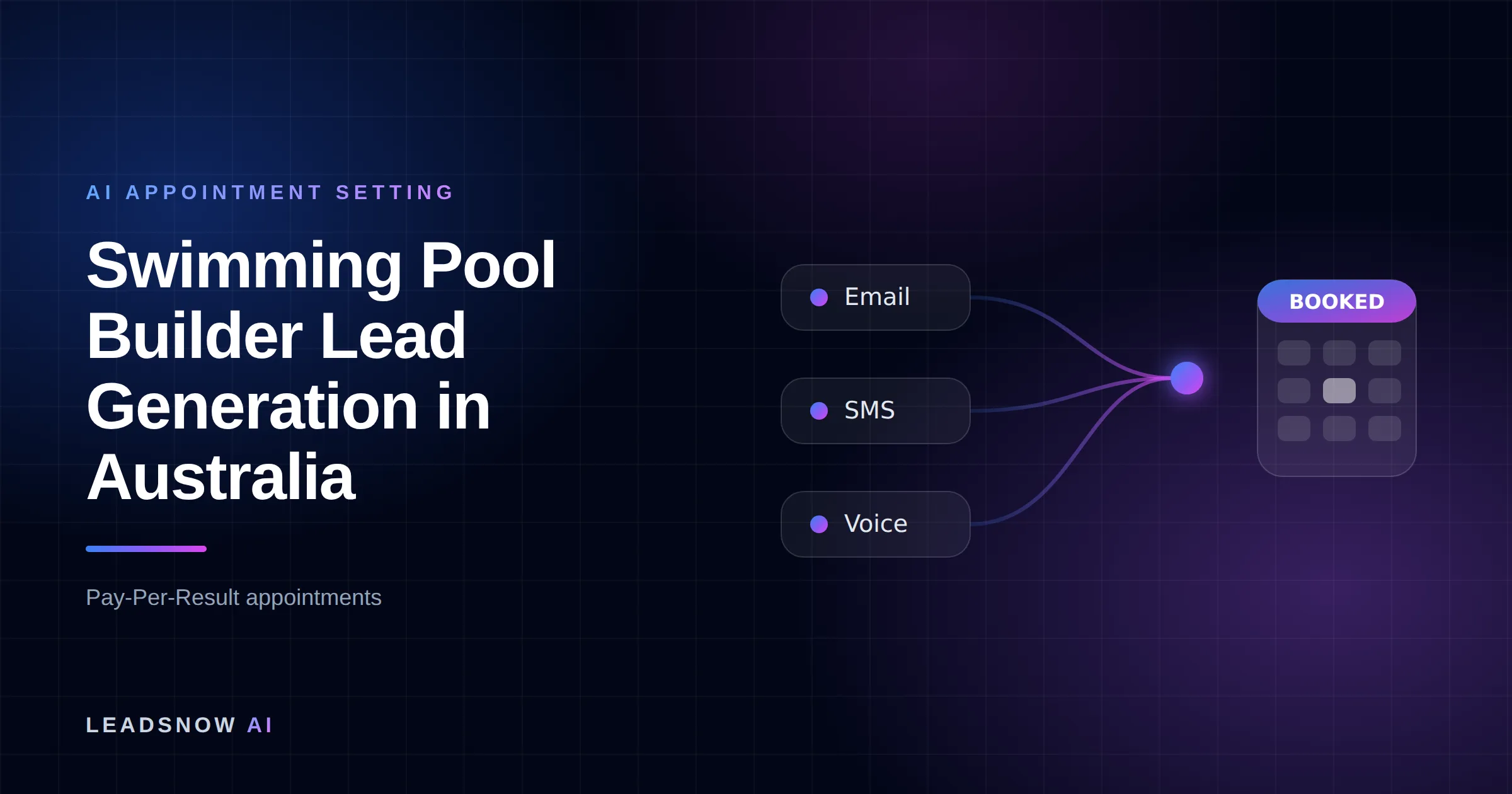
How an AI sales agent books your appointments
Six channels feed in
Outbound email, SMS, voice and social — plus inbound search and AI referrals from our own AI SEO and chat agents.
Your list or CRM
Outbound starts from data you already own — past enquiries, dormant customers, or a targeted prospect list.
Qualified against your rules
Budget, timing and fit are checked before anything reaches your team, using criteria you set.
Booked into your calendar
Only qualified prospects reach the booking step, so your closers spend their time selling.
MAKE MORE SALES.
Pay-Per-Result pricing — We scale sales HARD aligned to your interests, better than anyone else.
Comparison: four ways pool builders buy growth in 2026
| Shared platform leads | Exclusive leads | Your own marketing | Pay-per-result appointments | |
|---|---|---|---|---|
| What you pay for | Subscription ($139–$649/mo + GST on hipages) plus dynamically priced credits per enquiry | A verified contact record, exclusive to you | Ad spend, agency fees and creative — paid win or lose | A qualified prospect booked into your calendar |
| Who else gets the lead | Up to 3 builders on hipages | Only you (in theory) | Only you | Only you |
| Who does the chasing | You — and the first builder to call usually sets the frame | You | You | Included — AI contacts, qualifies and follows up until booked or disqualified |
| No-show / dud risk | You carry it — credits spent regardless | You carry it — verified ≠ qualified for a $65k+ build | You carry it entirely | Provider carries it — you pay for the booked result |
| Cost per signed contract logic | Credits + subscription + site visits across every lead worked, divided by the minority you win against 2 competitors | Higher per lead, fewer wasted quotes — if the vendor’s qualification is real | Whatever your funnel maths says this quarter | Higher per unit, but every unit is a qualified meeting — you’re buying the last step before the quote, not the first |
Want this done for you? We book qualified sales appointments on a Pay-Per-Result basis — you only pay for calls that actually land in your calendar.
The dead-quote goldmine: families who were quoted and never signed
Pools are the classic sit-on-the-quote purchase. A family gets excited in spring, books three site visits, receives three detailed quotes — then hits the real number, blinks, and decides to “wait until after Christmas”. Your quote, your design work and your site visit are filed away, and next season they’re either quoted again from scratch or lost to whoever happens to catch them next. Every pool builder with a couple of years of trading history is sitting on dozens or hundreds of these quoted-but-never-signed jobs — people who have already told you their block, their budget and their dream pool.
Database reactivation is the discipline of re-engaging that list properly: AI-driven SMS and voice outreach over your dead-quote file, opening conversations (“still thinking about the pool?”) and booking the revived ones straight into your calendar. This is LeadsNow’s oldest playbook: across our own historical database reactivation campaigns we’ve averaged a 4.4% booking rate, peaking at 8.9% on the best-performing lists. That’s our reactivation record across the campaigns we’ve run, not a pool-industry statistic — but the mechanics transfer, because a family you quoted last winter is warmer than any lead you can buy this spring. They already invited you onto their block. On a few hundred dead quotes at pool job values, even a low single-digit booking rate is a serious pipeline. More detail on our database reactivation services for Australian businesses page, including how a campaign is structured.
How pay-per-result appointment setting works for pool builders
Pay-per-result means LeadsNow runs the campaigns, the AI qualification and the multi-touch follow-up at our own risk — and you pay only when a qualified prospect is booked into your calendar as a sales appointment. Not per click, not per enquiry, not per contact record. For a pool builder that changes three things:
- Duds get filtered before they cost you a site visit. Qualification criteria are agreed with you up front — homeowner, block suitability, realistic budget band against real build costs, decision timeframe — so renters and $30k-budget concrete dreamers never reach your diary.
- Speed-to-lead is automated. Our AI calls and messages new enquiries within minutes, at any hour, then follows up across multiple touches through the long pool consideration cycle — the months of “still deciding” where most builders’ follow-up quietly dies. We’ve written up the mechanics in our guide to speed-to-lead automation in Australia.
- Your senior people quote, they don’t chase. The person who can price a $85,000 concrete build should be walking into booked meetings with qualified families, not working through a list of numbers that ring out.
Be clear-eyed about the trade-off: a booked, qualified appointment costs more than a raw platform lead, because it should — it has survived qualification and been scheduled. The comparison that matters on a $45,000–$110,000 job is cost per signed contract, and one extra signed pool a quarter pays for a lot of qualification. If you’re weighing the two models in detail, we’ve published a straight comparison of pay-per-lead vs pay-per-appointment pricing in Australia.
If we can’t make you money, we don’t deserve yours.
Pay-Per-Result pricing — performance-based alignment.
Who this is a fit for — and who it isn’t
Good fit: established residential pool builders who can service more quotes than they’re getting; builders whose bottleneck is qualified site visits, not construction capacity; and above all, anyone sitting on a season or more of dead quotes — that list alone is usually the fastest win.
Not a fit: brand-new builders with no trading history and no quote file; teams already at build capacity through next season; or anyone who wants the cheapest possible per-contact number and is happy doing their own dialling — a platform credit genuinely is the cheaper line item if your team’s chase time and site visits are free to you. We’d rather say that plainly than win a client who churns in eight weeks.
The proof
Since 2017, LeadsNow’s AI systems have booked 50,769+ sales appointments and generated over 1 million leads for clients. We hold a 4.6-star average across 43 Google reviews and have published 25 filmed client case studies — clients on camera, not testimonial graphics. Those case studies span finance, property, fitness and education rather than pool construction specifically; the mechanics — AI speed-to-lead, qualification, multi-touch follow-up, database reactivation, calendar booking — are industry-agnostic, and we’ll happily walk you through how they map to a pool builder’s long, seasonal sales cycle on a call.
FAQ: pool builder lead generation in Australia
How much do swimming pool builder leads cost in Australia?
There’s no flat published figure. On hipages, pool builders pay a subscription from $139/month (155 credits) to $649/month (810 credits) plus GST, with the credits each lead costs set dynamically by the platform — and up to three builders can accept the same enquiry, per Made4Tradies’ 2026 analysis. The bigger cost is downstream: because pools can’t be quoted over the phone, every lead you work carries site-visit and design time before you learn whether it’s real.
How much does a swimming pool cost to build in Australia in 2026?
Per What’s The Damage’s August 2026 cost guide, fibreglass inground pools run $45,000–$85,000 (typically around $65,000), concrete pools $65,000–$110,000 (typically around $85,000), plunge pools $25,000–$45,000, and premium concrete builds with spa and heating $120,000–$220,000+. Extras stack on top: glass pool fencing at $350–$600 per metre, heating at $3,000–$14,000, and paving and surrounds at $8,000–$45,000. Those job values are why lead qualification matters so much more for pool builders than for most trades.
When do pool enquiries peak in Australia?
In the run-up to summer — pool enquiries run on a slow, seasonal cycle that peaks before the warm months, per Made4Tradies. The catch is build time: fibreglass pools can be installed in 2–4 weeks once approved, but concrete builds take 3–6 months per What’s The Damage, so a November enquiry can’t swim by Christmas in concrete. Smart builders work the shoulder seasons — and their dead-quote file — instead of fighting hardest when the platforms are most crowded.
What is dead-quote reactivation for pool builders?
It’s re-engaging the families you quoted who never signed — the classic pool-buyer behaviour of collecting quotes in spring and deferring the decision. AI-driven SMS and voice outreach works back through that list, restarts the conversation and books the still-interested ones into your calendar. Across LeadsNow’s own historical reactivation campaigns we averaged a 4.4% booking rate, peaking at 8.9% on the best lists — our track record across industries, not a pool-specific statistic, but a dead-quote list is the warmest audience a pool builder owns.
What’s the difference between paying per lead and paying per appointment?
A lead is a contact record — a name and number you still have to call, qualify and site-visit, and you pay whether or not any of that succeeds. A pay-per-result appointment is a qualified prospect already booked into your calendar; the provider carries the cost of the contacts that don’t qualify or don’t book. The per-unit price is higher, but you’re buying a later, more certain stage of the funnel — which matters most in trades like pools where the step after the lead costs you half a day on site.
Does LeadsNow have pool-builder-specific case studies?
Our 25 filmed client case studies come from finance, property, fitness and education — we won’t pretend otherwise or invent a pool-builder logo wall. What we bring is the appointment-setting and reactivation system behind 50,769+ booked sales appointments since 2017, applied to your service area, your qualification criteria and your quote file. Book a call and we’ll map it to a pool sales cycle honestly, including whether we think you’re a fit.
Ready to see it on your own pipeline? Book a call — you’ll speak with us about your market, your lead flow, and whether the model fits before anything is signed.
Pay-Per-Result appointments
See if we’re a fit
We book qualified sales appointments for you and you pay on results, not retainers. Our booking page asks a few quick questions so you find out in two minutes whether that model suits your business.
- 50,769+ appointments booked without cold calling.
- Pay-Per-Result pricing — you pay for booked, qualified calls.
- Pick your own time on our live calendar, no phone tag.