
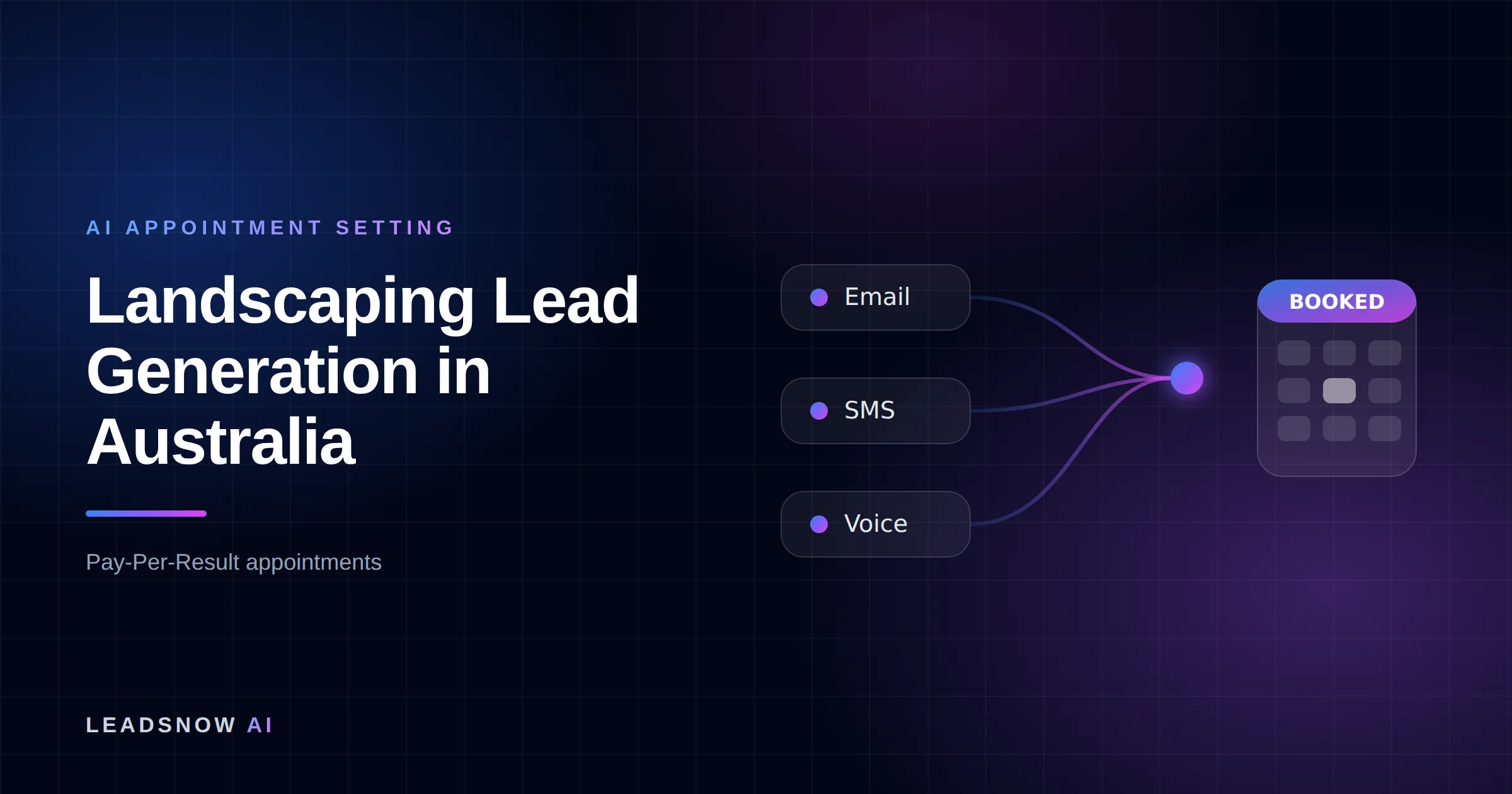
Most Australian design-and-construct landscapers win $30,000 projects but buy their leads like $80 mowing jobs: a hipages subscription, credits burned per enquiry, and the same homeowner’s job sent to two competitors at the same time. In 2026 the platforms charge landscapers $139–$649 a month plus GST before a single credit is spent, price-shoppers eat the credits either way, and the quotes you lovingly design too often go quiet forever. This guide breaks down what landscaping lead generation actually costs in Australia right now, why per-lead pricing is the wrong lens for high-ticket outdoor construction, and how pay-per-result appointment setting flips the risk. It’s written by LeadsNow AI, the Melbourne team behind 50,769+ AI-booked sales appointments since 2017 and 1M+ leads generated.
Landscaping lead generation in Australia, at a glance (2026): hipages subscriptions run from $139 to $649 a month plus GST for 155–810 credits, individual leads have been reported at 42–75 credits (some reaching 75–120), and every job posting is capped at 3 competing businesses, per KingTradie’s July 2026 review. The jobs those leads represent are anything but small: mid-range design-and-construct projects run $15,000–$50,000 and large transformations $50,000–$100,000+, per Ethereal Gardens’ 2026 Sydney cost guide. The alternative to feeding the credit meter is pay-per-result appointment setting: you pay only when a qualified prospect is booked into your calendar — not for raw enquiries you still have to chase.
What landscaping leads cost in Australia in 2026
hipages, the biggest tradie lead platform in the country, doesn’t publish a per-lead price list — as KingTradie’s July 2026 review puts it, “hipages never publishes a fixed price per lead.” What it does publish is the subscription structure, and KingTradie’s breakdown of the current tiers is the clearest we’ve found:
- Plans: Starter $139, Advanced $249, Premium $449 and Platinum $649 a month plus GST, carrying 155, 310, 595 and 810 monthly credits respectively.
- Credits per lead: one member in that review reported average lead costs climbing from 42 to 75 credits, with single leads ranging from 75 to 120 credits. Credit pricing “moves with trade, location, job size, urgency and demand” and can change week to week.
- Sharing: each job posting is “capped at 3 businesses” — so up to three landscapers can pay credits to chase the same homeowner.
Run the arithmetic on those published numbers and a credit works out to roughly 80–90 cents depending on plan ($139 for 155 credits at the bottom, $649 for 810 at the top). At 42–75 credits, a single lead is roughly $35–$67 of plan spend; at 120 credits it tops $100. And on a Starter plan’s 155 credits, a month’s subscription buys you two or three leads — before you’ve won anything.
The altitude problem: landscaping leads are priced like handyman leads
Here’s the mismatch that makes lead platforms so frustrating for design-and-construct operators. ServiceSeeking’s 2026 landscaper pricing guide puts average landscaping labour at $80.12 an hour and $577.39 a day — but that’s the mowing-and-maintenance end of the trade. Structured projects live in another postcode entirely: Ethereal Gardens’ 2026 guide puts courtyard makeovers at $5,000–$15,000, mid-range projects with paving, decking, fencing and irrigation at $15,000–$50,000, and full landscape construction with retaining walls and pool surrounds at $50,000–$100,000+. Retaining walls alone run “approximately $450–$1,000+ per square metre”.
A platform lead costs you roughly $35–$100 of plan spend whether the enquiry is a $500 garden-bed tidy or a $70,000 structural build. The credit is trivial against the project value — which is exactly why the credit is not the number that matters. What matters is what it costs you, in credits and in design-and-quoting hours, to land one signed construction contract. A design-and-construct quote isn’t a number scribbled on a card; it’s a site visit, a concept, sometimes a drawn plan. Losing that race two times out of three is the real bill.
How it works
How an AI sales agent books your appointments
Six channels feed in
Outbound email, SMS, voice and social — plus inbound search and AI referrals from our own AI SEO and chat agents.
Your list or CRM
Outbound starts from data you already own — past enquiries, dormant customers, or a targeted prospect list.
Qualified against your rules
Budget, timing and fit are checked before anything reaches your team, using criteria you set.
Booked into your calendar
Only qualified prospects reach the booking step, so your closers spend their time selling.
MAKE MORE SALES.
Pay-Per-Result pricing — We scale sales HARD aligned to your interests, better than anyone else.
Why buying landscaping leads keeps disappointing operators
- The shared-lead race. With each posting capped at three businesses, two competitors can be quoting the same backyard you are. Whoever gets on site first usually frames the project; everyone else is a price check.
- You pay for enquiries, not intent. KingTradie’s review notes that negative member feedback clusters on paying credits for leads that “go quiet, price-shop, or were never serious.” For a landscaper, “not serious” often means someone who wants a $50,000 outcome on an $8,000 budget — and you find that out after the site visit.
- Seasonality whiplash. Every landscaper knows the shape of the year: enquiries flood in as spring hits and thin out through winter, and the spring flood carries the highest share of daydreamers. We can’t point you at a clean public dataset quantifying that curve, so treat it as trade knowledge rather than a statistic — but it means the months with the most leads are also the months with the most expensive tyre-kickers, right when your build calendar is already filling.
- The chase falls on the person who should be building. In most landscaping businesses the owner is the salesperson, the designer and often the foreman. Multi-touch follow-up on lukewarm enquiries is precisely the job that never gets done from a ute at 5pm.
Running your own marketing — ads, SEO, a portfolio site — fixes exclusivity but not the rest: you carry the spend win or lose, and the follow-up workload still lands on you.
Want this done for you? We book qualified sales appointments on a Pay-Per-Result basis — you only pay for calls that actually land in your calendar.
Comparison: four ways landscapers buy growth in 2026
| Shared platform leads | Exclusive leads | Your own marketing | Pay-per-result appointments | |
|---|---|---|---|---|
| What you pay for | Credits per enquiry ($139–$649/mo plans; leads reported at 42–120 credits — KingTradie, 2026) | A contact record sold to you alone, at a premium per lead | Ad spend, SEO and agency fees, paid win or lose | A qualified prospect booked into your calendar |
| Who else gets the lead | Up to 3 competing businesses per posting | Only you (in theory) | Only you | Only you |
| Who does the chasing | You — between site visits | You | You | Provider — AI contact within minutes, multi-touch follow-up until booked or disqualified |
| No-show / dud risk | You carry it — credits are spent regardless | You carry it — exclusive ≠ qualified | You carry it entirely | Provider carries it — you pay for the booked result |
| Cost per signed job logic | Credits × every enquiry it takes, plus a site visit and design time per quote — if you win one in five, you’ve paid for five chases per contract (your close rate decides the multiple) | Fewer competitors, same chase and quote workload | Can be cheapest at scale, if you have time to run it and a system to follow up | Higher per unit, but every unit is a qualified meeting — compare on cost per signed contract, not per contact |
The dead-quote goldmine: your designed-and-quoted list
Here’s the asset almost every established landscaping business is sitting on and almost none is working: the pile of projects you designed, quoted and never heard back on. Design-and-construct sales cycles are long — homeowners collect quotes, get sticker shock, park the project “until after the renovation” or “until next spring”, and then life moves on. Two years of trading leaves you with dozens or hundreds of people who wanted a landscape badly enough to walk their yard with you and take a detailed quote — and still don’t have one. Many of them still want it. Some have since finished the renovation that was blocking it. Their budget objection may have aged out with a pay rise or an equity draw.
That list is warmer than any lead you can buy on any platform, because those people already chose you once. Database reactivation runs AI-driven SMS and voice outreach over your old enquiry and quote list and books the revived conversations straight back into your calendar. Our track record on this comes from LeadsNow’s own historical campaigns across industries — Colliers-era database reactivation campaigns: 4.4% average / 8.9% peak booking rates — not from landscaping specifically, and we’d rather scope that honestly than imply otherwise. But on a list of 500 dead quotes, even the average rate is a meaningful run of booked conversations with people who’ve already seen your design work — acquired for money you spent long ago. More detail on our database reactivation services for Australian businesses page.
If we can’t make you money, we don’t deserve yours.
Pay-Per-Result pricing — performance-based alignment.
Pay-per-result appointment setting: how it works for landscapers
Pay-per-result means LeadsNow runs the campaigns, the AI qualification and the multi-touch follow-up at our own risk — and you pay only when a qualified prospect is booked into your calendar as a sales appointment. Not per click, not per enquiry, not per credit. For a design-and-construct landscaper that changes three things:
- You stop doing site visits for duds. Qualification criteria — homeowner, project type, indicative budget band, suburb, timeframe — are agreed with you up front, and enquiries that don’t meet them never reach your calendar or cost you anything. The $8,000-budget-$50,000-dream conversations get filtered before you’ve driven anywhere.
- Speed-to-lead is automated. Our AI calls and messages new enquiries within minutes of them coming in, at any hour, then follows up across multiple touches until they book or disqualify — the discipline that decides shared-lead races, applied to leads that are yours alone. We’ve written up how this works in our guide to speed-to-lead automation in Australia.
- You design and build; the system chases. Your calendar fills with qualified homeowners expecting a design conversation, instead of your evenings filling with callbacks.
Be clear-eyed about the trade-off: a booked, qualified appointment costs more than a platform credit, because it should — it has survived qualification and been scheduled. On projects worth $15,000–$100,000+, the comparison that matters is cost per signed contract, and tighter qualification is how that number comes down: fewer quotes drawn for people who were never going to build. If you’re weighing the two models in detail, we’ve published a straight comparison of pay-per-lead vs pay-per-appointment pricing in Australia.
Who this is a fit for — and who it isn’t
Good fit: design-and-construct landscapers with a portfolio and capacity to take on more projects; operators sitting on a year or more of dead quotes; businesses where the owner is losing selling (or building) hours to lead-chasing.
Not a fit: mowing and maintenance rounds — the job value doesn’t support appointment-setting economics, and a cheap shared lead genuinely is the right tool for an $80 job. Also not a fit: brand-new operators with no trading history, no quote list and no capacity buffer. We’d rather say that plainly than win a client who churns in eight weeks.
The proof
Since 2017, LeadsNow’s AI systems have booked 50,769+ sales appointments and generated over 1 million leads for clients. We hold a 4.6-star average across 43 Google reviews and have published 25 filmed client case studies — clients on camera, not testimonial graphics. Those case studies span finance, property, fitness and education rather than landscaping specifically; the mechanics — AI speed-to-lead, qualification, multi-touch follow-up, calendar booking — are industry-agnostic, and we’ll happily walk you through how they map to a design-and-construct sales cycle on a call.
FAQ: landscaping lead generation in Australia
How much do landscaping leads cost in Australia?
The major platforms don’t publish fixed per-lead prices. Per KingTradie’s July 2026 hipages review, subscriptions run Starter $139, Advanced $249, Premium $449 and Platinum $649 a month plus GST (for 155–810 monthly credits), one member reported leads at 42–75 credits with some reaching 75–120, and each job posting is capped at 3 businesses. At the implied 80–90 cents per credit, that’s roughly $35–$67 per lead, with big or urgent jobs topping $100 — shared with up to two competitors.
What is a design-and-construct landscaping project worth in 2026?
Per Ethereal Gardens’ 2026 Sydney cost guide, courtyard makeovers run $5,000–$15,000, mid-range projects with paving, decking, fencing and irrigation run $15,000–$50,000, and full landscape construction with retaining walls and pool surrounds runs $50,000–$100,000+. ServiceSeeking’s 2026 pricing guide puts average landscaping labour at $80.12 an hour and $577.39 a day, which reflects the maintenance end of the trade — the gap between those two pictures is exactly why one signed construction contract justifies a serious acquisition system.
Is hipages worth it for a design-and-construct landscaper?
It can fill gaps in a build calendar, and for maintenance work the economics are reasonable. The problems at the construction end are structural: every posting can be shared with up to 3 businesses, member complaints cluster on credits spent on leads that go quiet or price-shop, and each quote you chase costs a site visit and design time on top of the credits. Judge it on cost per signed contract — credits plus chase hours divided by jobs actually won — not on the per-lead price.
Is there still demand for landscaping work in Australia in 2026?
The new-build pipeline that feeds structural landscaping is holding up. ABS Building Approvals data for June 2026 records 10,631 private sector houses approved in the month (seasonally adjusted, up 0.4% after a 2.4% rise in May), and 18,328 total dwellings approved (up 7.2%). Every one of those houses is a bare block that will eventually need landscaping — the constraint for most operators isn’t demand, it’s turning enquiries into signed projects without drowning in quotes that go nowhere.
What is database reactivation for a landscaping company?
It’s AI-driven SMS and voice outreach over your existing list of past enquiries and quoted-but-never-closed projects, re-opening those conversations and booking the live ones back into your calendar. It works in this trade because dead quotes are usually deferrals, not rejections — the homeowner still wants the landscape; the timing or budget was wrong that season. LeadsNow’s own historical reactivation campaigns across industries have averaged 4.4% booking rates, peaking at 8.9% — figures from our track record generally, not landscaping-specific ones.
What’s the difference between paying per lead and paying per appointment?
Paying per lead buys you a contact record: a name and a number, plus the job of calling, qualifying, site-visiting and quoting — with the fee owed whether or not any of that comes off. Paying per appointment buys a later stage of the funnel: a qualified prospect already booked into your calendar, with the provider wearing the cost of every contact that never qualifies or books. Per unit it’s dearer, but in a trade where each serious quote costs a site walk and a drawn concept, paying only for booked conversations is usually the cheaper route to a signed contract.
Ready to see it on your own pipeline? Book a call — you’ll speak with us about your market, your lead flow, and whether the model fits before anything is signed.
Pay-Per-Result appointments
See if we’re a fit
We book qualified sales appointments for you and you pay on results, not retainers. Our booking page asks a few quick questions so you find out in two minutes whether that model suits your business.
- 50,769+ appointments booked without cold calling.
- Pay-Per-Result pricing — you pay for booked, qualified calls.
- Pick your own time on our live calendar, no phone tag.