
Most Australian solar installers grow the same way: buy leads, chase leads, lose half of them to whoever called first, and eat the no-shows. In 2026 that habit is getting expensive — shared residential leads run $20–$50 each and commercial leads $150–$250, before a single kilowatt is quoted. This guide breaks down what solar lead generation actually costs in Australia right now, why per-lead pricing hides the real number, and how pay-per-result appointment setting flips the risk. It’s written by LeadsNow AI, the Melbourne team behind 50,769+ AI-booked sales appointments since 2017 and 1M+ leads generated.
Solar lead generation in Australia, at a glance (2026): Installers typically pay $20–$50 for a shared residential lead, $50–$100 for an exclusive SMS-verified lead, and $150–$250 for a commercial lead, per LeadsHQ’s 2026 pricing guide. Shared leads convert to signed jobs at roughly 3–8%, versus 15–30% for verified exclusive leads, per QuoteLeads. The alternative to buying leads is pay-per-result appointment setting: you pay only when a qualified prospect is booked into your calendar — not for raw enquiries you still have to chase.
Not sure you should be buying leads at all? We’ve run the full comparison — vendor leads vs building your own pipeline vs pay-per-result — in Buying solar leads vs generating your own in Australia: the 2026 maths.
What solar leads cost in Australia in 2026
Three Australian lead providers published 2026 pricing guides, and they broadly agree on the tiers:
- Shared leads (sold to 3+ installers): roughly $20–$50 each per LeadsHQ’s 2026 guide; QuoteLeads quotes $15–$35 and notes they’re typically sold to four to six installers simultaneously.
- Exclusive, unverified leads: $35–$50 (both LeadsHQ and QuoteLeads land on this band).
- Exclusive, SMS-verified residential leads: $50–$100, with LeadsHQ calling $50–$70 the sweet spot and $70–$100 the premium high-intent tier.
- Commercial solar leads (30–99kW systems): $150–$250 per LeadsHQ; QuoteLeads places them at $100–$200+.
Location moves the number too. LeadsHQ’s city breakdown for exclusive verified leads puts Melbourne at $50–$60 and Sydney at $60–$70, while Adelaide and Newcastle run $80–$90 — supply of installers, not demand for solar, drives most of the gap.
Per-lead price is the wrong number to optimise
The figure that actually matters is cost per signed job. QuoteLeads’ worked example: a $20 shared lead converting at 5% costs you $400 in leads per job won, while a $60 exclusive verified lead converting at 25% costs $240 — the “cheap” lead is two-thirds more expensive where it counts. WhySolar’s 2026 analysis reaches the same conclusion from the other direction, estimating it takes 3–4 exclusive leads or 7–12 shared leads to close one residential sale, with overall acquisition costs averaging $300–$600 per customer. And none of those numbers include the hidden line item: your salesperson’s hours spent dialling numbers that never pick up.
How it works
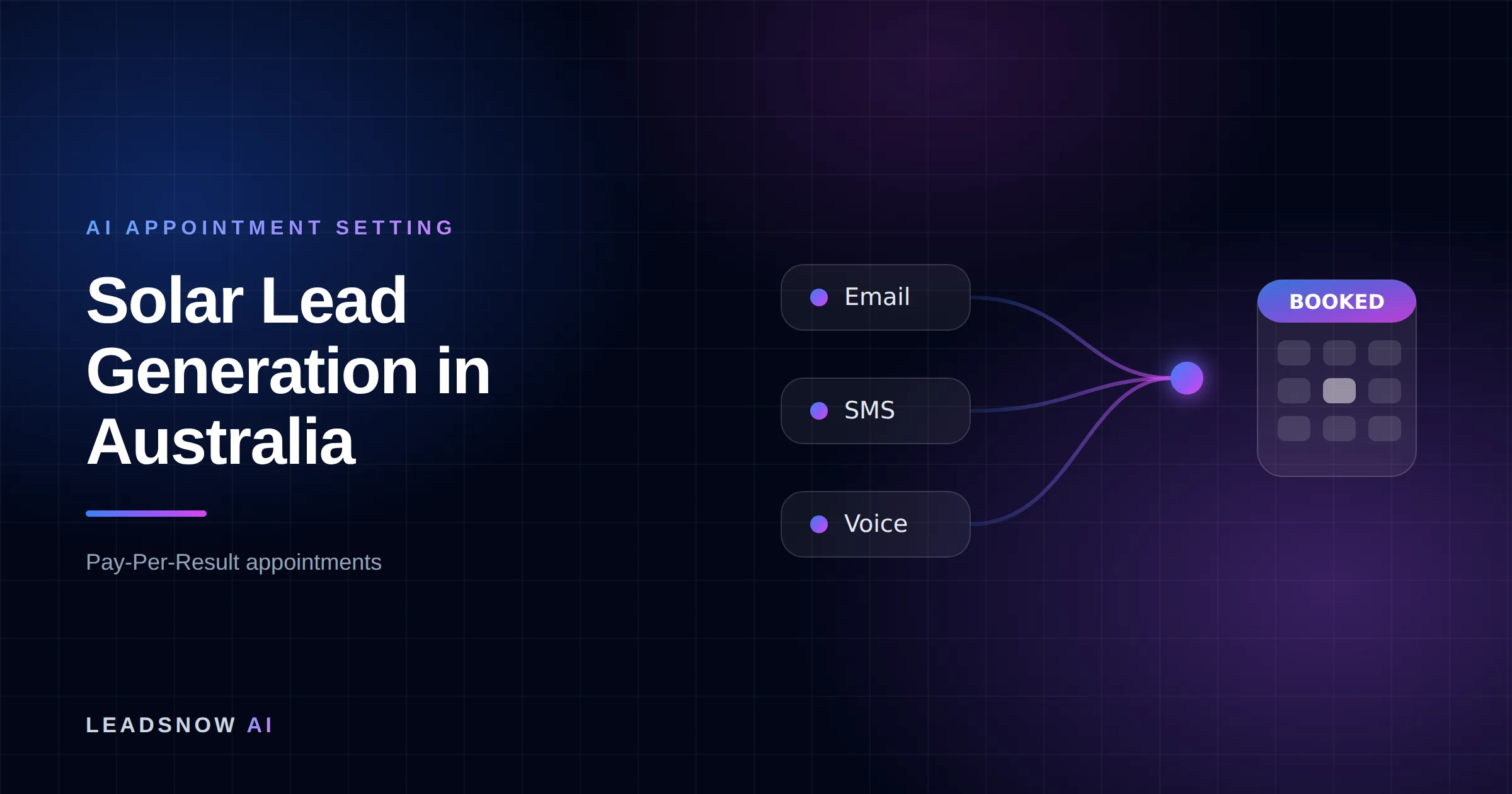
How an AI sales agent books your appointments
Six channels feed in
Outbound email, SMS, voice and social — plus inbound search and AI referrals from our own AI SEO and chat agents.
Your list or CRM
Outbound starts from data you already own — past enquiries, dormant customers, or a targeted prospect list.
Qualified against your rules
Budget, timing and fit are checked before anything reaches your team, using criteria you set.
Booked into your calendar
Only qualified prospects reach the booking step, so your closers spend their time selling.
MAKE MORE SALES.
Pay-Per-Result pricing — We scale sales HARD aligned to your interests, better than anyone else.
Why buying leads keeps disappointing installers
Three failure modes come up in almost every conversation we have with installers:
- The shared-lead race. When four to six installers get the same enquiry, the sale usually goes to whoever calls first. If your team rings back at 4pm, you’re quoting against someone who called at 9:05am.
- You pay for enquiries, not outcomes. A “lead” can be a tyre-kicker comparing feed-in tariffs, a renter, or a number that rings out. You’ve paid either way.
- No-shows and ghosting. Even a genuine enquiry goes cold fast without structured multi-touch follow-up — QuoteLeads puts exclusive verified leads at 15–30 per cent conversion, depending on follow-up speed and sales process. Most installers don’t have anyone whose actual job is chasing.
Running your own ads fixes exclusivity but not the rest: you carry the ad spend, the creative testing, and the follow-up workload yourself, and you pay whether or not anything converts.
Want this done for you? We book qualified sales appointments on a Pay-Per-Result basis — you only pay for calls that actually land in your calendar.
Pay-per-result appointment setting: how it works for solar
Pay-per-result means LeadsNow runs the campaigns, the AI qualification and the multi-touch follow-up at our own risk — and you pay only when a qualified prospect is booked into your calendar as a sales appointment. Not per click, not per enquiry, not per contact record. For a solar installer that changes three things:
- You stop paying for duds. Renters, out-of-area enquiries and “just researching” contacts get filtered out before they cost you anything. Qualification criteria (homeowner, property type, timeframe, location) are agreed with you up front.
- Speed-to-lead is automated. Our AI calls and messages new enquiries within minutes of them coming in, then follows up across multiple touches — the exact discipline the follow-up-speed data rewards. We’ve written up how this works in our guide to speed-to-lead automation in Australia, and the calling side runs on the same technology as our AI voice agents for sales.
- Your closers close. Your team walks into booked appointments with qualified homeowners or facility managers instead of working a call sheet.
Be clear-eyed about the trade-off: a booked, qualified appointment costs more than a raw lead, because it should — it has survived qualification and been scheduled. The comparison that matters is cost per closed deal, and on that basis tighter qualification usually wins, as the shared-vs-exclusive maths above already shows at the cheaper end of the funnel. If you’re weighing the two models in detail, we’ve published a straight comparison of pay-per-lead vs pay-per-appointment pricing in Australia.
The overlooked asset: your old quote list
Most installers sitting on two or more years of trading history have hundreds or thousands of past enquiries who got a quote and went quiet. That database is warmer than any lead you can buy — those people already asked you about solar, and many of them still haven’t installed (or are now shopping for a battery). Database reactivation runs AI-driven SMS and voice outreach over that list and books the revived conversations straight into your calendar. Across our own historical reactivation campaigns we’ve averaged a 4.4% reply-to-booking rate, peaking at 8.9% on the best-performing lists. On a 2,000-contact quote list, that’s real appointment volume from people you’ve already paid to acquire once. More detail on our database reactivation services for Australian businesses page.
If we can’t make you money, we don’t deserve yours.
Pay-Per-Result pricing — performance-based alignment.
Comparison: four ways solar installers buy growth in 2026
| Shared leads | Exclusive leads | Your own ads | Pay-per-result appointments | |
|---|---|---|---|---|
| Cost basis | $20–$50 per lead (LeadsHQ, 2026) | $50–$100 SMS-verified residential; $150–$250 commercial (LeadsHQ, 2026) | Ad spend + agency/management fees, paid win or lose | Per booked, qualified sales appointment |
| Who else gets the lead | 3–6 competing installers | Only you (in theory) | Only you | Only you |
| No-show / dud risk | You carry it — pay per lead regardless | You carry it — verified ≠ qualified | You carry it entirely | Provider carries it — you pay for the booked result |
| Time-to-first-contact | Whenever your team gets to it — and the race is on | Whenever your team gets to it | Whenever your team gets to it | AI contacts new enquiries within minutes, automatically |
| Follow-up | Your job | Your job | Your job | Included — multi-touch AI follow-up until booked or disqualified |
| What you actually pay for | A contact record | A verified contact record | Impressions and clicks | A qualified prospect on your calendar |
Who this is a fit for — and who it isn’t
Good fit: residential and commercial installers doing steady volume who can service more appointments than they’re getting; installers with a sales process (or at least a closer) ready to take booked meetings; anyone sitting on a large dormant quote database.
Not a fit: brand-new installers with no capacity buffer or trading history; teams that want the absolute cheapest possible per-contact number and are happy to do their own dialling — a $20 shared lead genuinely is the cheaper line item if your team’s chase time is free to you. We’d rather say that plainly than win a client who churns in eight weeks. If you are still drawing up a shortlist, our ranking of the best lead generation agencies for solar companies in Australia compares the main suppliers side by side.
The proof
Since 2017, LeadsNow’s AI systems have booked 50,769+ sales appointments and generated over 1 million leads for clients. We hold a 4.6/5 average across 43 Google reviews and have published 25 filmed client case studies — clients on camera, not testimonial graphics — including Sam Tajvidi of 121 Brokers, Colliers, Marcus Wilkinson of Iron Body, Foundr, SheSells.online and Lambda Academy. Those case studies span finance, property, fitness and education rather than solar specifically; the mechanics — AI speed-to-lead, qualification, multi-touch follow-up, calendar booking — are industry-agnostic, and we’ll happily walk you through how they map to a solar sales cycle on a call.
FAQ: solar lead generation in Australia
How much do solar leads cost in Australia?
In 2026, shared residential leads cost roughly $20–$50, exclusive SMS-verified residential leads $50–$100, and commercial solar leads $150–$250, per LeadsHQ’s 2026 pricing guide. QuoteLeads’ guide quotes similar bands, with shared leads from $15–$35 and commercial leads from $100–$200+. Prices vary by city — Adelaide and Newcastle run $80–$90 for exclusive verified leads versus $50–$60 in Melbourne.
What is a good conversion rate for solar leads?
Per QuoteLeads’ 2026 guide, shared solar leads convert to signed jobs at around 3–8%, while exclusive verified leads convert at 15–30% depending on follow-up speed. WhySolar’s analysis puts it another way: expect to work 3–4 exclusive leads, or 7–12 shared leads, per closed residential sale. Booked appointments convert at higher rates again because unqualified contacts have already been filtered out before you spend sales time.
Is buying solar leads worth it?
It can be, if you judge it on cost per signed job rather than cost per lead. WhySolar estimates overall customer acquisition costs of $300–$600 for Australian installers, and QuoteLeads’ worked example shows a $60 exclusive lead beating a $20 shared lead on cost per job won ($240 vs $400). Cheap shared leads are usually the worst value once you price in the contact race and your team’s chase time.
How competitive is the Australian solar market in 2026?
Very — and still active. Clean Energy Regulator postcode data (current as at 31 July 2026) records more than 4.5 million small-scale solar PV installations in Australia, with 187,876 systems installed in 2026 so far. The installed base means fewer greenfield rooftops, so installers increasingly compete on speed-to-quote and on upgrade, battery-add and commercial work — which is exactly where lead quality and follow-up discipline decide who wins.
What’s the difference between paying per lead and paying per appointment?
A lead is a contact record — a name and number you still have to call, qualify and book, and you pay whether or not any of that succeeds. A pay-per-result appointment is a qualified prospect already booked into your calendar; the provider carries the cost of the contacts that don’t qualify or don’t book. The per-unit price is higher, but you’re buying a later, more certain stage of the funnel.
How fast should you contact a new solar enquiry?
Within minutes, not hours. QuoteLeads’ 2026 guide ties exclusive-lead conversion (15–30%) directly to follow-up speed, and with shared leads sold to four to six installers at once, the first caller usually wins the quote. LeadsNow automates this: our AI calls and messages every new enquiry within minutes of it arriving, at any hour, then keeps following up until the prospect books or disqualifies.
Does LeadsNow have solar-specific case studies?
Our 25 filmed client case studies come from finance, property, fitness and education — we won’t pretend otherwise or invent a solar logo wall. What we bring to solar is the appointment-setting system behind 50,769+ booked sales appointments since 2017, applied to your offer, your service area and your qualification criteria. Book a call and we’ll map it to your sales cycle honestly, including whether we think you’re a fit.
Pay-Per-Result appointments
See if we’re a fit
We book qualified sales appointments for you and you pay on results, not retainers. Our booking page asks a few quick questions so you find out in two minutes whether that model suits your business.
- 50,769+ appointments booked without cold calling.
- Pay-Per-Result pricing — you pay for booked, qualified calls.
- Pick your own time on our live calendar, no phone tag.