
Every Australian solar installer hits this fork in the road, usually about the third time a lead vendor invoice lands in the same week as a no-show: do you keep buying leads, or do you build a machine that generates your own? It sounds like a marketing question. It’s actually a capital-allocation question — rented audience versus owned asset, speed versus compounding, and a monthly bill that either stops producing the moment you stop paying or keeps producing long after. This post runs the 2026 maths on all three paths: buying leads, generating your own, and the third option most installers haven’t priced — pay-per-result appointment setting. It’s written by LeadsNow AI, the Melbourne team behind 50,769+ AI-booked sales appointments since 2017 and 1M+ leads generated.
Buy, build, or pay for results — at a glance (2026): Buying gets you enquiries this week — shared residential solar leads run $20–$50 and exclusive SMS-verified leads $50–$100 per LeadsHQ’s 2026 pricing guide — but the flow stops the day you stop paying, and shared leads put you in a phone race with several competitors. Building your own pipeline (website, SEO, AI-search visibility, ads, referrals) compounds into an asset you own, but it carries real payroll: SEEK’s salary data lists average marketing specialist salaries of roughly $88,000–$102,500 in most Australian regions, before super, ad budget or software. The third path is pay-per-result appointment setting: someone else carries the marketing risk and you pay only when a qualified prospect is booked into your calendar.
The three paths, side by side
| Buying leads | Generating your own | Pay-per-result appointments | |
|---|---|---|---|
| What you pay for | Contact records — $20–$50 shared, $50–$100 exclusive verified (LeadsHQ, 2026) | Salaries, ad spend, software and time — paid win or lose | A qualified prospect booked into your calendar |
| Speed to first job | Days — leads arrive as soon as you top up | Weeks for ads, months to a year for SEO and AI-search visibility | As soon as campaigns go live and the first appointments book |
| Who owns the asset | The vendor — you’re renting their audience | You — every ranking, review and citation compounds for you | Shared — the pipeline system is the provider’s, the booked relationships are yours |
| What happens when you stop paying | Flow stops the same day | Ads stop; SEO, reviews and referrals keep producing | New bookings stop, but you’ve paid nothing for pipeline that never eventuated |
| Who does the chasing | Your team — and on shared leads, so do 3–6 competitors | Your team — you generated it, you still have to work it | The provider — qualification and multi-touch follow-up happen before you’re charged |
| Cost per signed job over time | Flat at best; rises as vendors resell harder | High at first, falls as the asset compounds | Steady and predictable — priced at the outcome, not the attempt |
How it works
How an AI sales agent books your appointments
Six channels feed in
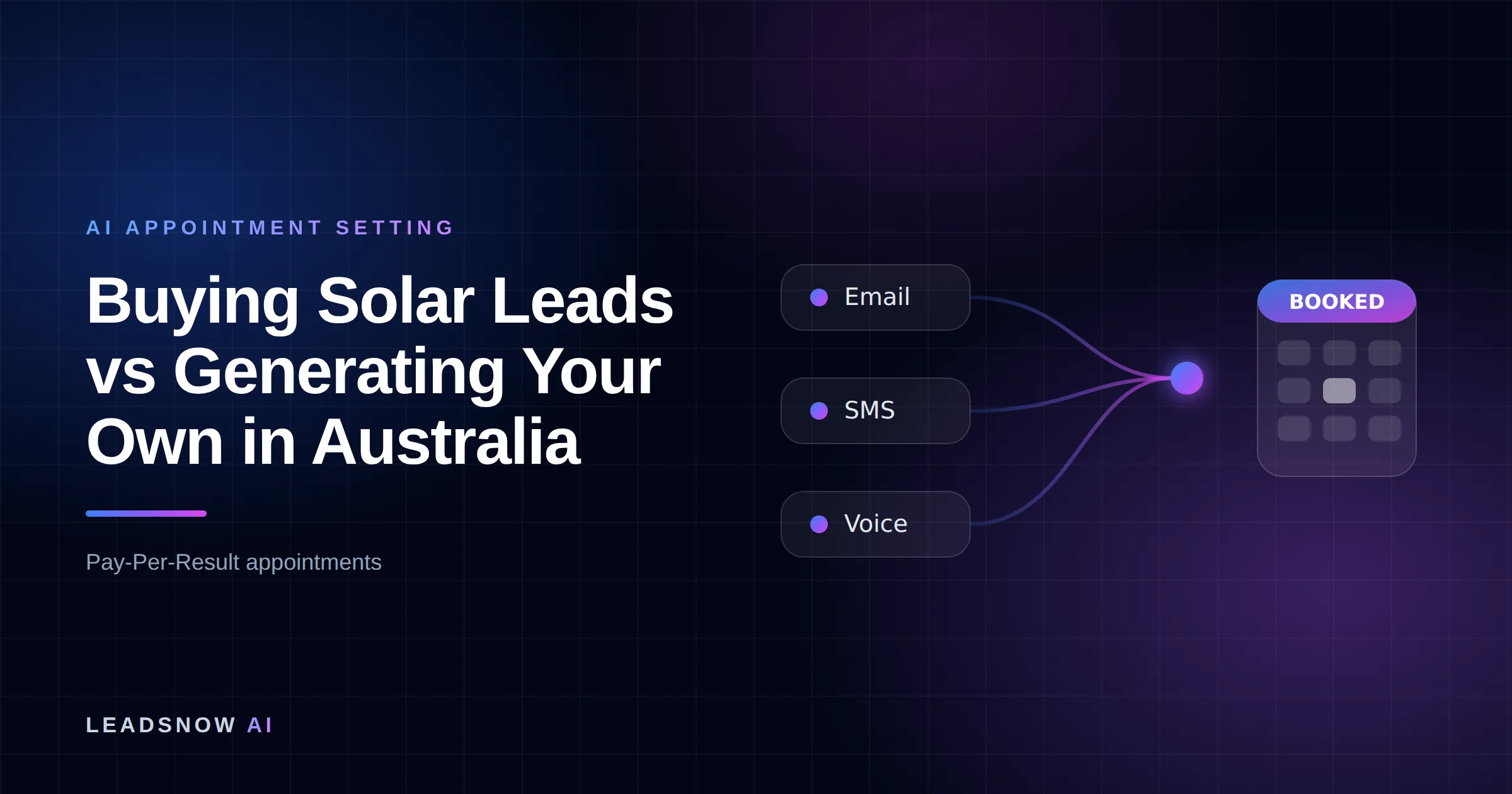
Outbound email, SMS, voice and social — plus inbound search and AI referrals from our own AI SEO and chat agents.
Your list or CRM
Outbound starts from data you already own — past enquiries, dormant customers, or a targeted prospect list.
Qualified against your rules
Budget, timing and fit are checked before anything reaches your team, using criteria you set.
Booked into your calendar
Only qualified prospects reach the booking step, so your closers spend their time selling.
MAKE MORE SALES.
Pay-Per-Result pricing — We scale sales HARD aligned to your interests, better than anyone else.
Path one: buying leads
The appeal is honest enough: money in, enquiries out, this week. In 2026 the Australian market has settled into recognisable tiers — per LeadsHQ’s 2026 guide, roughly $20–$50 for a shared residential lead, $35–$50 exclusive but unverified, $50–$100 exclusive and SMS-verified, and $150–$250 for commercial. We’ve already published a full breakdown of those tiers, city-by-city variations and the cost-per-signed-job maths in our guide to lead generation for solar companies in Australia, so we won’t rehash the pricing here.
What matters for the buy-versus-build decision is the structure of the deal, not the sticker price:
- You’re renting an audience you never meet. The vendor owns the website, the ad account, the ranking and the relationship with Google. Your brand appears at the quote stage, not before. Ten years of buying leads leaves you with exactly as much marketing asset as year one: none.
- The vendor’s incentive is volume, not your close rate. A shared lead sold to several installers is the same revenue to the vendor whether you win the job or your competitor does. Nobody in that transaction is paid on your outcome.
- Price discipline is out of your hands. When installer demand rises in your postcode, per-lead prices rise with it — you’re a price-taker in someone else’s auction.
- It scales instantly, in both directions. That’s the genuine upside: a quiet fortnight can be patched with a budget top-up in a way SEO never will. The equally instant downside is that a paused card means a silent phone.
Want this done for you? We book qualified sales appointments on a Pay-Per-Result basis — you only pay for calls that actually land in your calendar.
Path two: generating your own
“Doing your own marketing” gets discussed as if it were one thing. For a solar business in 2026 it’s at least five: a website that converts, SEO, paid ads (Google and Meta), a referral and review engine, and — new to the list — visibility in AI search. Owning that stack is the strongest long-term position an installer can hold. It’s also a genuine second business bolted to your first one, and it should be costed that way.
The real cost of an in-house marketing function
The first honest line item is a human. SEEK’s salary data for marketing specialists lists average salaries of roughly $88,000–$102,500 across most Australian regions (with some regions higher again) — before superannuation, before a single dollar of ad spend, and before the design, landing-page and tracking tools the role needs to function. Hire cheaper or make it half of someone’s job, and you generally get half-run campaigns; outsource to an agency and the retainer replaces the salary rather than removing the cost. We won’t quote agency retainer figures here because they vary too widely to verify at a single source — the honest framing is that a competently run in-house or agency function is a six-figure annual commitment once salary or retainer, ad budget and tooling are added up. Against that, a few thousand dollars a month in purchased leads can look cheap for years — which is exactly why most installers never make the jump.
Why people make the jump anyway: control and compounding
Every dollar into your own pipeline buys two things a purchased lead never does. Control: your qualification criteria, your service area, your brand in front of the customer from first click, no competitor holding the same phone number. And compounding: the review profile, the ranking, the referral network and the content library are still working next year. Ad spend behaves like buying leads (stop paying, stop appearing), but the organic layers keep producing after the invoices stop — the exact opposite of the vendor treadmill.
The 2026 wrinkle: your next customer may never see a search results page
Here’s what’s changed since the last time you weighed this decision. A meaningful share of consumers now ask an AI assistant instead of (or before) searching: an AP-NORC survey of 1,437 US adults (July 2025) found 60% have used AI to search for information — the most common AI use measured — and among under-30s who use AI, 28% say they search with it at least several times a day. That’s US data, and we haven’t found an equivalent verified Australian figure, but the behaviour shift is not staying offshore. For “generating your own” it means the job description grew: it’s no longer just ranking on Google, it’s being the installer that ChatGPT, Gemini and Copilot cite when a homeowner asks “who should install solar in my suburb?” Answer-engine optimisation — structured pages, genuine review signals, clear pricing and FAQ content that AI systems can quote — is now part of the build. It raises the ceiling on owning your pipeline (early movers in a trade get cited disproportionately) and raises the workload at the same time.
Path three: pay-per-result appointment setting
There’s a version of “someone else does the marketing” that isn’t buying leads: pay-per-result appointment setting. The provider runs the campaigns, the AI qualification and the multi-touch follow-up at its own risk, and you pay only when a qualified prospect — homeowner, right postcode, real timeframe — is booked into your calendar as a sales appointment. Clicks, enquiries and contact records that never make it that far cost you nothing.
Structurally, it fixes the specific things that make bought leads disappointing: nobody else gets the appointment, the chasing is done before you’re charged, and the duds are the provider’s cost rather than yours. The trade-off is equally structural: the per-unit price sits well above a raw lead’s, because what you’re buying has already been filtered, qualified and scheduled. The comparison that matters is cost per closed deal, and on that measure paying later in the funnel usually wins — we’ve written up the full comparison in pay-per-lead vs pay-per-appointment in Australia. For what it’s worth on the trust side: LeadsNow holds a 4.6-star average across 43 Google reviews and has published 25 filmed client case studies — from finance, property, fitness and education rather than solar specifically, and we’d rather tell you that plainly than invent a solar logo wall.
It’s also not a forever choice against building your own. Plenty of operators use pay-per-result as the bridge: predictable appointment flow now, while the compounding assets — reviews, rankings, AI-search citations — get built underneath without the pressure of feeding this month’s pipeline.
If we can’t make you money, we don’t deserve yours.
Pay-Per-Result pricing — performance-based alignment.
The lead source cheaper than all three: your old quote list
Before you spend another dollar in any direction, look at the leads you’ve already paid for. Years of trading leaves every installer with hundreds or thousands of quoted-but-never-closed enquiries — people who raised their hand to you, went quiet, and in many cases still haven’t installed (or have since become battery shoppers). Database reactivation points AI SMS and voice agents at that dormant list; whoever is ready to move gets their conversation restarted and a time locked into your calendar. Across our own historical reactivation campaigns — the work we built with clients like Colliers — we’ve averaged a 4.4% booking rate, peaking at 8.9% on the best-performing lists; that’s our reactivation track record across industries, not a solar-specific promise. Because the acquisition cost is already sunk, it’s the cheapest lead source any established installer owns. We cover how it works on our database reactivation services page, and the solar-specific angle in the solar lead generation guide.
So which path is yours?
Keep buying (for now) if you’re new, need volume this week, and treat it knowingly as renting — while judging every vendor on cost per signed job, not cost per lead. Our ranking of the best lead generation agencies for solar companies in Australia scores the main vendors on exactly that basis.
Build your own if you have the cash flow to fund a six-figure function through its unprofitable first year, the patience for SEO and AI-search visibility to compound, and the discipline to keep it staffed. It’s the best end-state; it’s a poor emergency plan.
Pay per result if you can service more appointments than you’re getting and you’d rather buy outcomes than attempts — especially as the bridge that keeps the calendar full while your owned assets grow. And whichever you choose, reactivate the database first. It’s the only option on this page you’ve already paid for.
FAQ: buying solar leads vs generating your own
Is it cheaper to buy solar leads or generate your own in Australia?
Per lead, buying usually wins early: shared residential solar leads cost $20–$50 and exclusive SMS-verified leads $50–$100 in 2026, per LeadsHQ’s pricing guide, while a self-generated lead initially carries the full cost of salaries, ads and tools behind it. Per signed job over several years, generating your own usually wins, because the organic assets — rankings, reviews, referrals, AI-search citations — keep producing leads after the spend that created them. The crossover point depends on your volume and how well the in-house function is run.
What happens to lead flow when you stop paying?
That’s the sharpest difference between the paths. Stop buying leads and the flow stops the same day — you own nothing after years of spend. Stop funding your own marketing and the paid-ads portion stops immediately, but SEO, reviews and referrals keep producing for months or years. Stop a pay-per-result arrangement and new bookings stop, but you’ve only ever paid for appointments that actually landed on your calendar.
Does AI search really matter for solar installers in 2026?
The behaviour shift is measurable: an AP-NORC survey of 1,437 US adults conducted in July 2025 found that 60% have used AI to search for information — the most common AI use it measured — and among under-30s who use AI, 28% search with it at least several times a day. We haven’t found an equivalent verified Australian figure, but if you’re generating your own leads, being citable by ChatGPT, Gemini and Copilot is now part of the job alongside Google rankings — and installers who structure their sites for it early tend to be the ones AI assistants quote.
How long does it take to generate your own solar leads?
Paid ads can produce enquiries within weeks of launch, but behave like bought leads — the flow stops when the budget does. The compounding channels are slower: expect months to a year of consistent work before SEO, review volume and AI-search visibility deliver steady inbound enquiries, which is why the realistic plan funds a bridge (bought leads, or pay-per-result appointments) while the owned assets mature.
What’s the third option if I don’t want to buy leads or build a marketing team?
Pay-per-result appointment setting: a provider runs the campaigns, AI qualification and follow-up at its own risk, and you pay only when a qualified prospect is booked into your calendar. You give up the per-unit cheapness of raw leads and the asset-building of in-house marketing, and in exchange you buy the most certain stage of the funnel — a scheduled conversation with a qualified prospect — with the no-show and dud risk sitting on the provider’s side of the table.
Ready to see it on your own pipeline? Book a call — you’ll speak with us about your market, your lead flow, and whether the model fits before anything is signed.
Pay-Per-Result appointments
See if we’re a fit
We book qualified sales appointments for you and you pay on results, not retainers. Our booking page asks a few quick questions so you find out in two minutes whether that model suits your business.
- 50,769+ appointments booked without cold calling.
- Pay-Per-Result pricing — you pay for booked, qualified calls.
- Pick your own time on our live calendar, no phone tag.