
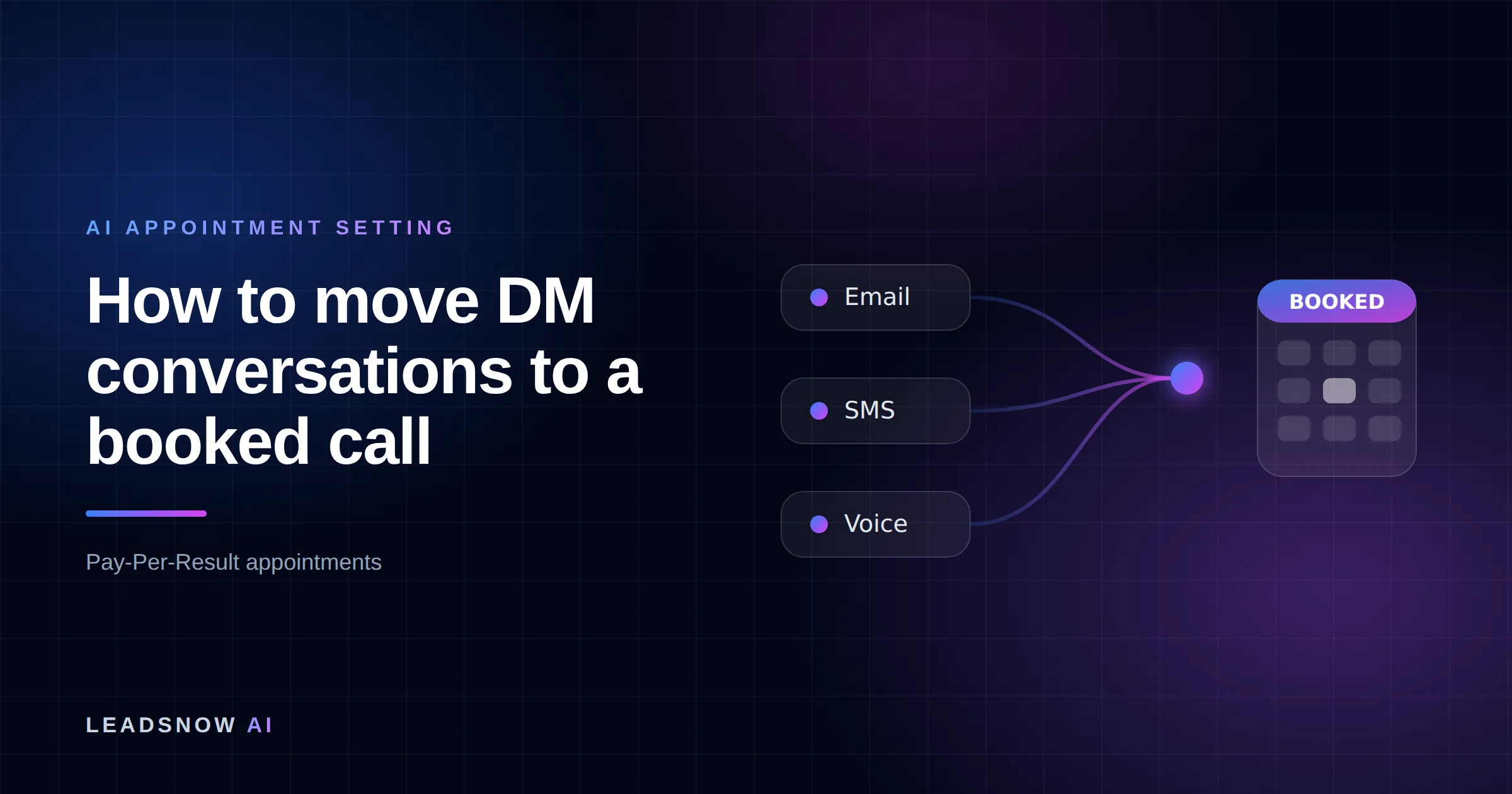
To move a DM conversation to a booked call, act within 15 minutes of the lead’s first “yes”: offer two specific times, get one accepted, take a mobile number, then send the invite and a confirmation text. The slowest stage is the soft yes before a time is confirmed; Meta gives API tools 24 hours.
The short answer from LeadsNow AI: A DM lead becomes a booked call when the “yes” is turned into a specific time, a phone number and a confirmation text within minutes, not when a booking link is dropped into the thread and left there. Treat the hours after a soft yes as a clock, because once Meta’s 24-hour window closes on an automated tool, only a person or a phone number can reach that lead again.
Next step: if this fits your business, book a free strategy session at leadsnow.ai/strategy-session/ — a 2-minute fit check, then pick a time.
- The question people ask: “How do I get my DM leads to actually book a call?”
- Where this page starts: the lead has already said yes, or something like it. Qualifying them comes before this and is covered separately.
- The four steps: offer two times → get one accepted → capture mobile and email → invite and confirm off Instagram.
- The clock that matters: Meta’s API window is 24 hours from the lead’s last message; a person replying by hand can use a 7-day Human Agent tag.
- The worked example: on stated assumptions, 100 soft yeses become about 22–46 held calls with a link alone and about 42–72 with all four steps.
What happens between a lead saying yes in the DMs and a booked call?
Moving a DM conversation to a booked call is a four-step handoff that should finish within about 15 minutes of the lead’s yes. The 15-minute target is our working rule, not a published benchmark; the point is that every step happens while the lead is still holding the phone.
| Step | Target clock from the yes | What you send | What makes it slip |
|---|---|---|---|
| 1. Offer two times | 0–5 minutes | “I have Tuesday 10:30am or Wednesday 4pm your time. Which suits?” | Sending only a link; not naming the time zone |
| 2. Get a time accepted | 5–15 minutes | Nothing new; wait for the pick, then lock it | Adding another question after the yes |
| 3. Capture mobile and email | Immediately after the pick | “Great. What’s the best mobile to text the confirmation to, and an email for the invite?” | Asking with no reason given; skip this step if you already have the number |
| 4. Invite and confirm off Instagram | Within 5 minutes of step 3 | Calendar invite by email, a confirmation text, and a one-line DM: “Done, sent to your phone.” | Confirmation that lives only in the DM thread |
A booked call that exists only inside an Instagram thread is a booked call you cannot remind. Getting the questions right before the yes is its own skill; our page on how to qualify leads in Instagram DMs covers the five replies that lead up to it.
How it works
From a DM yes to a confirmed call
Offer two times
Reply to the yes with two specific times in the lead’s time zone. Keep the booking link as a fallback.
Get one accepted
Wait for the pick and ask nothing new. Every extra question reopens the decision.
Take a mobile and email
Ask straight after the pick, giving the reason: the confirmation goes there. Keep the booking even if they decline.
Invite and confirm
Send the calendar invite and a confirmation text outside Instagram. Reminders can now reach the lead after the DM window closes.
MAKE MORE SALES.
Pay-Per-Result pricing — We scale sales HARD aligned to your interests, better than anyone else.
The Soft-Yes Clock: what to do at each hour after a DM lead says yes
The Soft-Yes Clock is a timetable for the hours after a lead says “yeah, keen” but before a time is confirmed. Its hard edges come from Meta’s own rules: Meta’s Instagram messaging API documentation gives an app 24 hours to respond to a user’s message, and Meta’s messaging policy describes a Human Agent tag that lets businesses manually respond within 7 days.
| Time since the lead’s last message | Who can send | What to do |
|---|---|---|
| 0–15 minutes | You, a setter or an API tool | Offer two times; take the pick; ask for mobile and email |
| 15 minutes–4 hours | You, a setter or an API tool | One nudge that repeats the two times, nothing else |
| 4–20 hours | You, a setter or an API tool | Offer two fresh times for the next day |
| 20–24 hours | You, a setter or an API tool | Last automated message: a time plus “or send me your mobile and I’ll text you” |
| 24 hours–7 days | A person, by hand | One human message in the app; API tools are outside their standard window |
| After 7 days, no number | Only if the lead writes again | Close the thread in your tracker; retarget, don’t chase |
| Any time, number captured | Text or phone, with consent | Move the booking to text or a call and stop relying on the DM |
Every new message from the lead restarts the 24-hour clock, so a thread can stay technically open for days. The lead’s attention does not: the DM-to-call step is decided in minutes, and the clock only tells you when you lose the right to try.
Want this done for you? We book qualified sales appointments on a Pay-Per-Result basis — you only pay for calls that actually land in your calendar.
Which stage of moving a DM to a call takes longest, and why does it slip?
The soft yes takes longest: the stretch between a lead agreeing to talk and a time being confirmed. The other three steps are typing; this one waits on the lead. It slips for four reasons, roughly in order of how often you will find them in your own threads:
- A link instead of times. A booking link asks the lead to open a page, scan a week and decide. Two named times ask them to type one word. If you want the trade-offs in detail, our comparison of calendar links versus call-backs models both.
- No time zone. “4pm” to a lead in another state or country is a question, not an offer. Write “4pm your time” and check their location first.
- A new question after the yes. Every question asked after agreement reopens the decision. Park anything else for the call.
- The yes arrives out of hours. If a lead says yes at 9pm and nobody replies until 9am, the soft yes is 12 hours old before step 1 starts.
Measure it: for your last 30 threads that reached a yes, record minutes from the yes to a confirmed time. If the median is over an hour, fix this stage before you touch the ad.
How do I get a DM lead’s phone number without losing them?
If you already took the mobile number while qualifying, skip straight to the invite and confirmation. If you did not, ask for it straight after the lead picks a time, and give the reason in the same sentence: the confirmation goes there. Asked cold after a yes, a number request can read as a hurdle; tied to a time the lead has just chosen, it reads as service.
- Wording that works: “Locked in for Tuesday 10:30am. What’s the best mobile to text the confirmation and the call link to?”
- If they hesitate: “No problem, I’ll send it here and by email.” Keep the booking; don’t trade it for the number.
- Consent travels with the number. A number given for a confirmation is not blanket permission to market. Rules differ by country; for US senders, our guide to TCPA compliance for AI voice and SMS agents sets out what applies.
The phone number is what turns an Instagram booking into one you can confirm, remind and rebook. Reminder cadence is its own topic; our page on how to increase your sales call show rate covers it.
If we can’t make you money, we don’t deserve yours.
Pay-Per-Result pricing — performance-based alignment.
Worked calculation: what 100 soft yeses become
This model compares two ways of handling the same 100 DM leads who have said yes to a call. There is no credible public benchmark for DM-to-booking or DM-booked show rates, so every rate here is a labelled assumption, not a measured figure and not a LeadsNow result. Replace each with your own.
| Per 100 soft yeses | Low | Middle | High |
|---|---|---|---|
| A. Link only: share who confirm a time (assumption) | 45% | 55% | 65% |
| A. Show rate, reminders only in the DM (assumption) | 50% | 60% | 70% |
| A. Held calls | 22.5 | 33.0 | 45.5 |
| B. Four steps: share who confirm a time (assumption) | 65% | 75% | 85% |
| B. Show rate, text confirmation and reminders (assumption) | 65% | 75% | 85% |
| B. Held calls | 42.25 | 56.25 | 72.25 |
| Extra held calls from the four steps | +19.75 | +23.25 | +26.75 |
The arithmetic is confirm rate × show rate × 100. In every band the four-step handoff lifts held calls by about 20 to 27 per 100 yeses. Split the middle band and both halves matter: changing only the confirm rate adds 12.0 held calls (75% × 60%), changing only the show rate adds 8.25 (55% × 75%). Offering times does slightly more than the phone number, but neither does the job alone. Your own figures will differ; the method is what transfers.
When should you hand the DM-to-call step to someone else?
Hand the DM-to-call handoff to a done-for-you, pay-per-result service when your median time from yes to confirmed time is over an hour, most yeses arrive outside your working hours, and you are also the person taking the calls. In that situation the Soft-Yes Clock runs out while you are on other calls, and every lost yes is a conversation you already paid the ad platform for.
Keep it in-house if you get a handful of yeses a week, someone replies within minutes during the hours your leads write, and you already capture a phone number on most bookings. The four steps above are free to run, and doing them yourself teaches you what your leads need to hear.
LeadsNow is one option. We book calls using AI calling, SMS and DM follow-up through our AI appointment setting service, and LeadsNow has booked 50,769+ AI-booked sales appointments since 2017. Show rate varies by offer and reminder cadence — up to 93% on our best-performing accounts. You pay on results: a revenue share, a fee per appointment, or a mix of both. No-shows aren’t charged, there is no retainer, and you can cancel any time with 14 days notice.
Frequently asked questions
Should I send a booking link or offer times in a DM?
Offer two specific times first and keep the link as a fallback. Two named times need a one-word answer; a link asks the lead to leave the chat and choose from a whole week. Send the link only if neither time suits.
Can I keep messaging a DM lead after 24 hours?
An API-connected tool cannot send standard messages after 24 hours from the lead’s last message. Meta’s messaging policy describes a Human Agent tag that lets businesses manually respond within a 7-day period, and a person can still reply by hand in the Instagram app.
How fast should I book a call after a DM lead says yes?
Aim to have a time confirmed within 15 minutes of the yes. That is our working rule rather than a published benchmark; measure your own median minutes from yes to confirmed time and shorten whichever step holds most of it.
Is it OK to move a DM lead to text messages?
Yes, when the lead gives you their number for that purpose and you follow the consent rules where they live. Ask for the number after they pick a time and say it is for the confirmation; do not treat it as permission for marketing.
What should the confirmation text say?
The day, the time with time zone, how the call happens (phone or video link), who they will speak with, and a one-tap way to reschedule. Keep it to one message so it is read, not skimmed.
Pay-Per-Result appointments
See if we’re a fit
We book qualified sales appointments for you and you pay on results, not retainers. Our booking page asks a few quick questions so you find out in two minutes whether that model suits your business.
- 50,769+ appointments booked without cold calling.
- Pay-Per-Result pricing — you pay for booked, qualified calls.
- Pick your own time on our live calendar, no phone tag.