
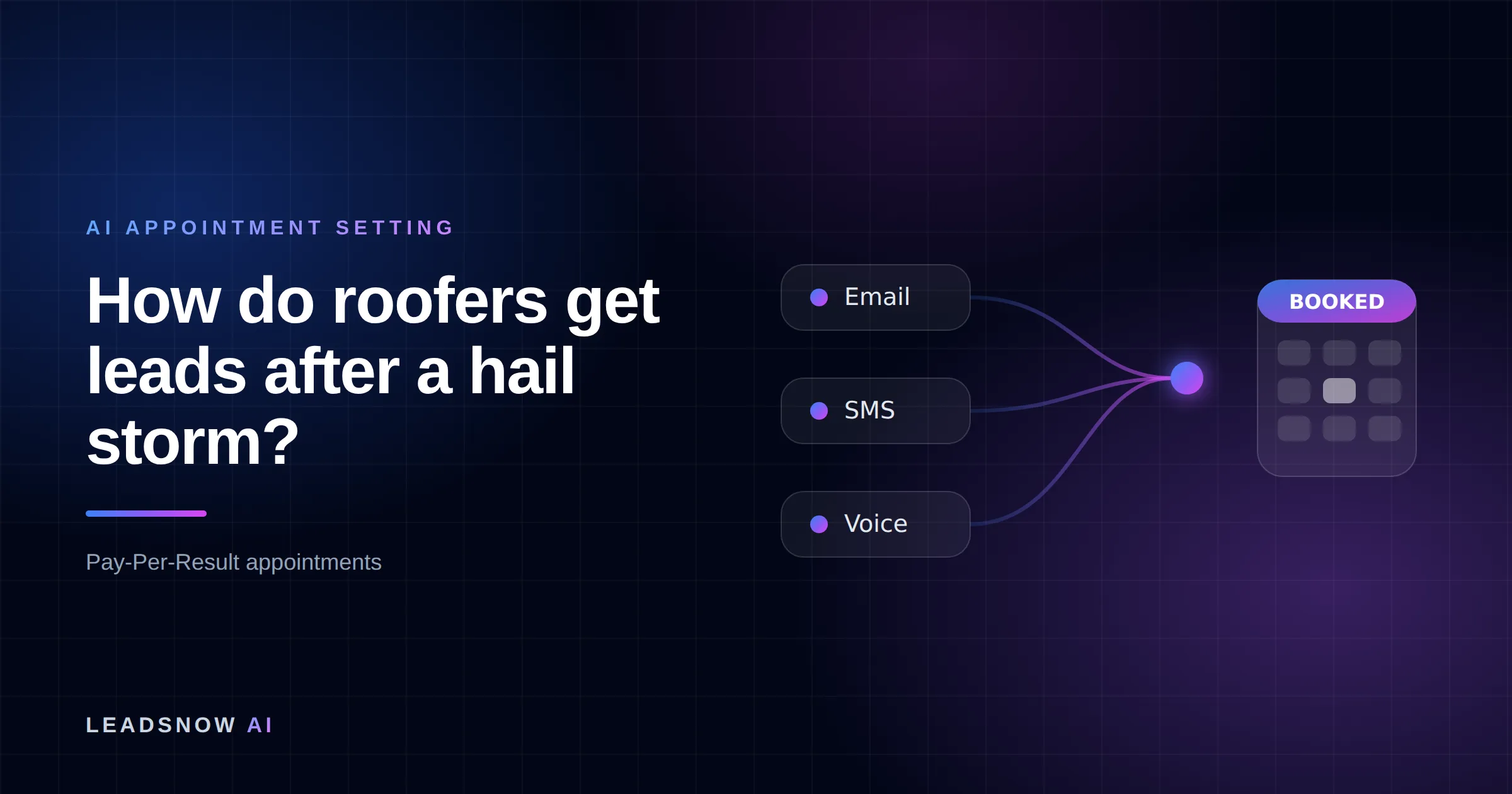
Roofers get leads after a hail storm by working the 72 hours after a Bureau of Meteorology severe thunderstorm warning for large hail (2 cm or more): answer every enquiry the same day, recall past customers and open quotes in the warned suburbs, and stop adding new enquiries once the inspection queue passes 3 days.
The short answer from LeadsNow AI: LeadsNow recommends that roofers treat a Bureau of Meteorology hail warning as the start of a 72-hour schedule: answer and book every enquiry, then recall past customers and dead quotes in the warned suburbs before buying any extra leads. The limit after a hail storm can be inspection capacity rather than lead volume, so size the response to what your inspectors can see within about 3 days.
Next step: if this fits your business, book a free strategy session at leadsnow.ai/strategy-session/ – a 2-minute fit check, then pick a time.
Rules of thumb (each is sourced inline or is arithmetic from the worked example below):
- A BoM warning for hail of 2 cm or more is the trigger; 5 cm or more is “giant hail” (BoM).
- In the worked example, 90 enquiries in 72 hours against 2 inspectors doing 5 inspections a day leaves 60 homeowners waiting at hour 72, a 6-day queue.
- At 90 enquiries, a third inspector cuts the hour-72 queue from 6 days to 3 days.
- A storm-damage agreement negotiated at the homeowner’s door, even after they asked for a quote, can be an unsolicited consumer agreement with a 10 business day cooling-off period (WA Consumer Protection).
What starts the clock: Bureau of Meteorology severe thunderstorm warnings
A Bureau of Meteorology Severe Thunderstorm Warning listing large hail (2 cm or more) is the cleanest trigger for a roofer’s storm response; giant hail is 5 cm or more. The Bureau issues one when a severe thunderstorm is occurring, likely or reported, and lists the forecast districts and locations that may be affected (BoM).
Detailed Severe Thunderstorm Warnings cover the capital cities and surrounding areas, mapping each storm and its track for up to 60 minutes; Regional warnings cover broad forecast districts for the next 3 hours. The detailed warning gives you suburbs to turn into a postcode list; a regional one needs narrowing with your own job records.
How it works
A roofer’s 72 hours after a hail warning
Read the hail warning
Take the locations from the Bureau of Meteorology Severe Thunderstorm Warning. Turn them into a postcode list.
Answer every enquiry
Roster the phones so no call or message waits overnight. Book inspections into set time slots.
Work the recall list
Contact past customers and open quotes in the warned postcodes, recent customers first. Check consent and the Do Not Call Register before calling.
Watch the inspection queue
Divide homeowners waiting by inspections per day. Past 3 days, pause paid ads and add inspection capacity.
MAKE MORE SALES.
Pay-Per-Result pricing — We scale sales HARD aligned to your interests, better than anyone else.
FAQ: getting roofing leads after a hail storm
How soon should a roofer respond to hail damage enquiries?
Answer every enquiry on the day it arrives and clear any backlog first thing the next morning. In the worked example, 10 enquiries went unanswered at hours 24 and 48.
Should roofers buy more leads after a hail storm?
Buy more leads only while your inspection queue is under 3 days. With 2 inspectors doing 5 inspections a day, more than 30 enquiries in 72 hours already builds a queue.
Can roofers help homeowners with their insurance claim?
This page gives no insurance-claim advice. Whether hail damage is covered, and how to claim, is a matter between the homeowner and their insurer. A roofer can offer an inspection and a written report of what was found.
Can a roofer start storm repairs straight after the homeowner signs?
If the agreement is an unsolicited consumer agreement, WA Consumer Protection says the trader must not accept payment during the 10 business day cooling-off period, and supplying services in that period is prohibited. Check with your state fair trading office before starting work on a deal signed at the door.
Pay-Per-Result appointments
See if we’re a fit
We book qualified sales appointments for you and you pay on results, not retainers. Our booking page asks a few quick questions so you find out in two minutes whether that model suits your business.
- 50,769+ appointments booked without cold calling.
- Pay-Per-Result pricing — you pay for booked, qualified calls.
- Pick your own time on our live calendar, no phone tag.
The 72-hour storm response timeline, with the call-capacity maths
The 72-hour storm response timeline splits the work into three 24-hour windows and checks each against two limits: enquiries your office can answer and roofs your inspectors can see. No Australian body publishes a benchmark for post-hail enquiry volume or inspections per day, so every input below is a labelled assumption to replace with your own numbers.
Assumptions: 40 enquiries in the first 24 hours after the warning, 30 in the next 24 and 20 in the third. One office person can answer and book about 30 enquiries a day. Two inspectors each complete 5 inspections a day (about 60 minutes on the roof plus 30 minutes of travel, in an 8-hour day).
| Window | New enquiries (assumed) | Enquiries to date | Answered to date (30 a day) | Unanswered backlog | Inspected to date (10 a day) | Waiting for inspection | Queue in days |
|---|---|---|---|---|---|---|---|
| Hour 0-24 | 40 | 40 | 30 | 10 | 10 | 20 | 2 |
| Hour 24-48 | 30 | 70 | 60 | 10 | 20 | 40 | 4 |
| Hour 48-72 | 20 | 90 | 90 | 0 | 30 | 60 | 6 |
The table shows two leaks. The unanswered backlog of 10 at hours 24 and 48 is a phone problem: those homeowners will ring the next roofer. The queue of 60 at hour 72 is a capacity problem that more marketing cannot fix.
What to do in each window:
- Hour 0-24: pull the warning’s locations, roster the phones so every call and message is answered, book inspections in set time slots and start the recall list for the warned postcodes.
- Hour 24-48: clear day one’s unanswered enquiries first, confirm tomorrow’s inspections by SMS and work tier 1 of the recall list.
- Hour 48-72: check the queue. If it is over 3 days, pause paid ads in the area, tell new callers the honest wait and confirm booked inspections so faster competitors do not take them.
Response-time targets for urgent jobs are covered in speed to lead for trade businesses.
Want this done for you? We book qualified sales appointments on a Pay-Per-Result basis — you only pay for calls that actually land in your calendar.
How many hail-storm enquiries can a roofing crew inspect in 72 hours?
A roofing crew with 2 inspectors at 5 inspections a day can see 30 roofs in 72 hours, so any storm that brings more than 30 enquiries builds a queue. The table runs three assumed enquiry bands against one to three inspectors: queue days = (enquiries minus 72-hour capacity) divided by daily capacity.
| 72-hour enquiries (assumed band) | 1 inspector (15 in 72 hours) | 2 inspectors (30 in 72 hours) | 3 inspectors (45 in 72 hours) |
|---|---|---|---|
| 45 (small local storm) | 30 waiting, 6-day queue | 15 waiting, 1.5-day queue | 0 waiting |
| 90 (mid band, worked example) | 75 waiting, 15-day queue | 60 waiting, 6-day queue | 45 waiting, 3-day queue |
| 180 (large metro storm) | 165 waiting, 33-day queue | 150 waiting, 15-day queue | 135 waiting, 9-day queue |
The 3-day queue rule is a planning threshold applied to this table, not a measured benchmark: once the inspection queue passes 3 days, new paid enquiries mostly add homeowners who wait, and a waiting homeowner can book another roofer. Above it, spend on another inspector or tighter routing by suburb instead. If inspected roofs are not becoming signed jobs, why roof inspections are not turning into jobs maps the leaks after the visit.
How to build a past-customer and dead-quote recall list by postcode
A past-customer and dead-quote recall list is every address you have roofed, repaired or quoted, filtered to the warned postcodes and ranked by relationship. These homeowners already know your name.
| Tier | Who | Filter | Contact basis to check first | Offer |
|---|---|---|---|---|
| 1 | Customers whose roof you installed or repaired | Address postcode inside the warned locations | Express consent on file; the ACMA says inferred consent needs an ongoing relationship the message relates to, and a past purchase alone does not cover it | Check of a roof you already worked on |
| 2 | Quotes sent but not accepted, last 12 months | Same postcodes, quote not lost to a stated reason such as moving house | Whatever consent you recorded when they asked for the quote; Do Not Call Register wash for calls | Inspection before re-quoting |
| 3 | Older enquiries and quotes | Same postcodes, older than 12 months | Treat inferred consent as weak; call only after a register wash | Plain notice that you are inspecting in the area |
Build it before the season: export jobs and quotes with street addresses, add a postcode column and save a filter you can run against a warning’s locations in minutes.
Tier 2 dead quotes are what LeadsNow works in database reactivation, where LeadsNow’s Colliers-era campaigns booked appointments from 4.4% of dormant contacts on average and 8.9% at peak; no window or sample is disclosed for those figures, and they are LeadsNow’s own record, not a roofing benchmark.
A recall message should offer an inspection and a written report, nothing more: insurance cover and claims are between the homeowner and their insurer.
If we can’t make you money, we don’t deserve yours.
Pay-Per-Result pricing — performance-based alignment.
Can roofers door-knock after a hail storm in Australia?
Roofers can door-knock after a hail storm in Australia, but a deal over $100 struck at the door is an unsolicited consumer agreement with a 10 business day cooling-off period. WA Consumer Protection lists the rules: no visits on Sundays or public holidays, before 9am or after 6pm on weekdays, or before 9am or after 5pm on Saturdays, unless an appointment was made beforehand by phone or in writing (WA Consumer Protection).
At the door you must explain the purpose of the visit, show identification and leave if asked, then not contact them again for at least 30 days. Homes with a “Do Not Knock” sign are off limits. The same page says you must not accept payment during the cooling-off period, and supplying services (other than electricity and gas) in that period is prohibited.
The trap for storm work is the inspection visit itself. Both WA Consumer Protection and the NSW Government say that when a homeowner invites a quote and the trader negotiates a deal on that visit, the agreement can still be unsolicited under the Australian Consumer Law. This is general information, not legal advice; check your state fair trading office before door-knocking.
Can I call or text past customers after a storm?
Calling or texting past roofing customers after a storm is allowed with consent, but the ACMA’s November 2026 SpinTel case shows that an old customer relationship is not automatically consent. SpinTel paid a $653,400 penalty after emailing former customers, some of whom had left up to 13 years earlier (ACMA).
Under the Spam Act, the ACMA says every SMS needs express or inferred consent, must identify you as the sender and must carry an unsubscribe option honoured within 5 working days (ACMA). Telemarketing calls are limited to 9am to 8pm on weekdays and 9am to 5pm on Saturdays, with none on Sundays or public holidays (NSW Government). The Do Not Call Register washing rules and consent periods for roofers are covered in how to get more roofing leads in Australia, so they are not repeated here.
What running a hail-storm response in-house costs a roofer
Running a hail-storm response in-house costs mostly office hours, close to 100 hours of phone work in 72 hours. In the worked example, answering 90 enquiries at an assumed 15 minutes each, including booking and a confirmation SMS, is 22.5 hours in 72 hours. An assumed 300-address recall list at three call attempts and an assumed 5 minutes per attempt adds 75 hours (300 x 3 x 5 = 4,500 minutes).
That sits on top of normal jobs. A roofer with one office person and a few hundred addresses can run this in-house; at larger volumes the worked example shows where enquiries go unanswered, at hours 24 and 48. LeadsNow runs this kind of enquiry follow-up and booking as a done-for-you service; its headline record is 50,769+ AI-booked sales appointments since 2017 and 1M+ leads generated. The roofing lead generation page explains how that works for Australian roofers.
Key takeaways
- A Bureau of Meteorology Severe Thunderstorm Warning for large hail of 2 cm or more is the trigger for a roofer’s 72-hour storm response.
- In the worked example, 90 enquiries in 72 hours against 2 inspectors doing 5 inspections a day leaves 60 homeowners in a 6-day queue.
- Once the inspection queue passes 3 days, more paid enquiries mostly add waiting homeowners, so add inspection capacity instead.
- A storm-repair deal over $100 negotiated at the homeowner’s door can be an unsolicited consumer agreement with a 10 business day cooling-off period.
- SpinTel paid a $653,400 penalty in November 2026 after emailing former customers, which shows an old customer relationship is not automatically consent for a recall message.